The Sunday Paper – I, Too, Value The Sweet, Dark Elixir Of Life


large_S_C3_B8ren_Kierkegaard‘At any rate, I prize coffee.’ ~from Soren Kierkegaard’s book Repetition, under the pseudonym Constantin Constantius,1843.

Do not, I repeat, do not bring sheep into the library. It is expressly forbidden.

And for heaven’s sake, stop cutting their budgets and do not, I repeat, do not close American libraries.

American style democracy does not leave much room for measured, moderate intellectuals.

An interview with the publisher of Tupelo Press, a quality poetry publisher. Good stuff.

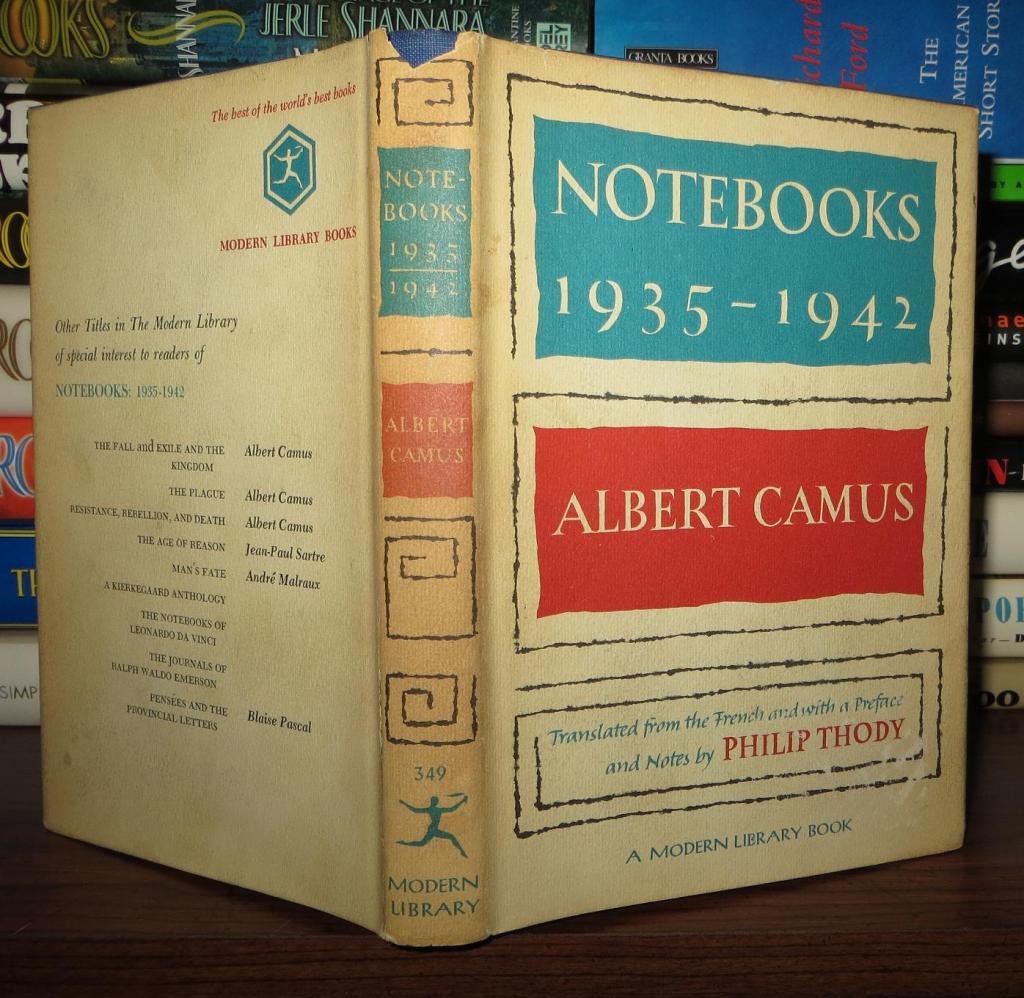
‘Notebooks: 1935-1942’ By Albert Camus (New Year’s Resolution, Book Forty-Two)


My father bought me this for my birthday. It’s a pretty, hardbound that’s only slightly larger than a paperback. And it’s Camus.

64659These are from his earliest published journals.

Many years ago, my stepmother gave me a cope of his journals from 1942-1951. It was a wonderful present and very thoughtful. Don’t mean to sound rude, but I was very surprised. She neither liked nor understood me at all (the feeling was more or less mutual and she was not a bad person, just not my type).

From May, 1938:

Nietzsche. Condemns the Reformation which saves Christianity from the principles of life and love that Cesarean Borgia was infusing into it. The Borgia Pope was finally justifying Christianity.

What an amazing statement! So forthrightly counterintuitive!

I don’t much that is true about the Borgia Pope (though I know a lot of scandalous fiction about him), but I remember that he was the first Pope to acknowledge his children. Previously, Popes with children tended to publicly identify them with the useful fiction of ‘nephews and nieces.’

Camus tried hard to eliminate personal history from these journals. They are intellectual documents, not autobiography. A reference here that hints at the quantity and quality of Camus’ envy-inducing sexual conquests. Some references to where Camus was standing when a thought occurred to him (in Greece, in Oran, in Paris, etc.). But little else personal.

Well, actually, a lot personal. The first two thirds take place while writing L’etranger and Le mythe de Sisyphe. The former appears in fragments, as Camus tests out passages and ideas, some of which would later make their way into that novel. The appearances of the latter take the form of numerous questions about suicide. Unlike that book of (admittedly, not very rigorous) philosophy, his journals suggest that committing suicide did cross mind. Not as an intellectual exercise, but an escape.

When the war appears, that becomes a constant, as you might imagine. But in a strange way. Camus the diarist seems shocked and surprised by the war. He makes some comments about Germany and German racism, but seems unable to really get his head around it. The failure that was the war, I felt, was, to Camus, a French failure. When he takes and fails to pass a physical (because of his tuberculosis), I was reminded that though he was unsuited for combat, he joined the resistance as the editor of Combat, an underground newspaper of the resistance.

Of course, when these journals end, France is occupied and Camus is living in Paris. From the journals, you would barely know the latter and the former not at all!

By the way, my father found this at Back in the Day Books in Dunedin, Florida. Haven’t been there personally, but seems like a quality place. Their facebook page always highlights good stuff in stock.

Monday Morning Staff Meeting


)1_WillPryce_Trinity_Hall

No news here. Just awesome pictures of college libraries. I’m a big fan of the early ones.

Philosophers in, at. and about the movies. Also, Zizek and Chomsky totally have  a kung fu fight. Chomsky and Zizek aren’t really philosophers, though, are they? They are the more general breed, the ‘public intellectual.’ Chomsky, who had done important work on linguistics earlier in his career, but now more of a leftist critic of society. And Zizek is a sort of professional ‘enfant terrible’ of the cultural scene. Not bad things to be, either of them, but not practitioners of philosophy, the way an Adorno was  a practitioner (thinking of someone also engaged in issues of mainstream culture).

Dear grad students, F–k you. Respectfully, your professor. 

Sometimes, the life of the man’s skull is more interesting than the life of the man. I don’t know. What was Swedenborg’s life like? Was it action packed and interesting?

Sunday Paper – Overdoing It


wine-boswell

If we are marked to die… well, this might not be the worst way. Repeated outbreaks of the ‘pox,’ excepted. Johnson’s biographer was a man of epic tastes, if not an epic man.

The debate between Edmund Burke and Thomas Paine. Notice how the piece ends by positing Burke (and Paine) as liberals. It is melancholy, isn’t, to read about a time when philosophies, not ideologies alone, could drive history and politics.

Writing and painting are very different things. Don’t get them confused, Cezanne suggests.

Here’s a great profile of the poetry press, Copper Canyon Press. They are not a terribly innovative press – well known (in their native countries) poets in translation and reliably well known poets in America (folks like W.S. Merwin) – but whatever. They publish a lot of poetry and have the clout to get written up in the NYT. What have you done for poetry lately? Huh? Probably less than Copper Canyon. And they did this cool thing where they solicited charitable contributions (they are a non-profit) that would go to help support paying advances to poets. Isn’t that a great idea? Money for poets! About time. Good job!

And speaking of poetry publishers in need of charitable contributions… well, here’s a story about a non-profit poetry organization that needs charitable contributions to keep publishing poetry. My dramatic segue wasn’t really followed up with much was it? But, seriously. It’s a good cause and needs publicity. It’s similar to that Coppy Canyon idea of soliciting money to pay advances to poets. Just helping poets make a living that includes, in some fashion, writing poetry.

Some Thoughts For Your Black Friday Shopping From Pope Francis


Taken from His Holiness’

APOSTOLIC EXHORTATION
EVANGELII GAUDIUM
OF THE HOLY FATHER

FRANCIS
TO THE BISHOPS, CLERGY,
CONSECRATED PERSONS
AND THE LAY FAITHFUL
ON THE PROCLAMATION OF THE GOSPEL
IN TODAY’S WORLD

(excerpts)

No to an economy of exclusion

53. Just as the commandment “Thou shalt not kill” sets a clear limit in order to safeguard the value of human life, today we also have to say “thou shalt not” to an economy of exclusion and inequality. Such an economy kills. How can it be that it is not a news item when an elderly homeless person dies of exposure, but it is news when the stock market loses two points? This is a case of exclusion. Can we continue to stand by when food is thrown away while people are starving? This is a case of inequality. Today everything comes under the laws of competition and the survival of the fittest, where the powerful feed upon the powerless. As a consequence, masses of people find themselves excluded and marginalized: without work, without possibilities, without any means of escape.

Human beings are themselves considered consumer goods to be used and then discarded. We have created a “disposable” culture which is now spreading. It is no longer simply about exploitation and oppression, but something new. Exclusion ultimately has to do with what it means to be a part of the society in which we live; those excluded are no longer society’s underside or its fringes or its disenfranchised – they are no longer even a part of it. The excluded are not the “exploited” but the outcast, the “leftovers”.

54. In this context, some people continue to defend trickle-down theories which assume that economic growth, encouraged by a free market, will inevitably succeed in bringing about greater justice and inclusiveness in the world. This opinion, which has never been confirmed by the facts, expresses a crude and naïve trust in the goodness of those wielding economic power and in the sacralized workings of the prevailing economic system. Meanwhile, the excluded are still waiting. To sustain a lifestyle which excludes others, or to sustain enthusiasm for that selfish ideal, a globalization of indifference has developed. Almost without being aware of it, we end up being incapable of feeling compassion at the outcry of the poor, weeping for other people’s pain, and feeling a need to help them, as though all this were someone else’s responsibility and not our own. The culture of prosperity deadens us; we are thrilled if the market offers us something new to purchase; and in the meantime all those lives stunted for lack of opportunity seem a mere spectacle; they fail to move us.

No to the new idolatry of money

55. One cause of this situation is found in our relationship with money, since we calmly accept its dominion over ourselves and our societies. The current financial crisis can make us overlook the fact that it originated in a profound human crisis: the denial of the primacy of the human person! We have created new idols. The worship of the ancient golden calf (cf. Ex 32:1-35) has returned in a new and ruthless guise in the idolatry of money and the dictatorship of an impersonal economy lacking a truly human purpose. The worldwide crisis affecting finance and the economy lays bare their imbalances and, above all, their lack of real concern for human beings; man is reduced to one of his needs alone: consumption.

56. While the earnings of a minority are growing exponentially, so too is the gap separating the majority from the prosperity enjoyed by those happy few. This imbalance is the result of ideologies which defend the absolute autonomy of the marketplace and financial speculation. Consequently, they reject the right of states, charged with vigilance for the common good, to exercise any form of control. A new tyranny is thus born, invisible and often virtual, which unilaterally and relentlessly imposes its own laws and rules. Debt and the accumulation of interest also make it difficult for countries to realize the potential of their own economies and keep citizens from enjoying their real purchasing power. To all this we can add widespread corruption and self-serving tax evasion, which have taken on worldwide dimensions. The thirst for power and possessions knows no limits. In this system, which tends to devour everything which stands in the way of increased profits, whatever is fragile, like the environment, is defenseless before the interests of a deified market, which become the only rule.

No to a financial system which rules rather than serves

57. Behind this attitude lurks a rejection of ethics and a rejection of God. Ethics has come to be viewed with a certain scornful derision. It is seen as counterproductive, too human, because it makes money and power relative. It is felt to be a threat, since it condemns the manipulation and debasement of the person. In effect, ethics leads to a God who calls for a committed response which is outside of the categories of the marketplace. When these latter are absolutized, God can only be seen as uncontrollable, unmanageable, even dangerous, since he calls human beings to their full realization and to freedom from all forms of enslavement. Ethics – a non-ideological ethics – would make it possible to bring about balance and a more humane social order. With this in mind, I encourage financial experts and political leaders to ponder the words of one of the sages of antiquity: “Not to share one’s wealth with the poor is to steal from them and to take away their livelihood. It is not our own goods which we hold, but theirs”.[55]

58. A financial reform open to such ethical considerations would require a vigorous change of approach on the part of political leaders. I urge them to face this challenge with determination and an eye to the future, while not ignoring, of course, the specifics of each case. Money must serve, not rule! The Pope loves everyone, rich and poor alike, but he is obliged in the name of Christ to remind all that the rich must help, respect and promote the poor. I exhort you to generous solidarity and a return of economics and finance to an ethical approach which favours human beings.

No to the inequality which spawns violence

59. Today in many places we hear a call for greater security. But until exclusion and inequality in society and between peoples is reversed, it will be impossible to eliminate violence. The poor and the poorer peoples are accused of violence, yet without equal opportunities the different forms of aggression and conflict will find a fertile terrain for growth and eventually explode. When a society – whether local, national or global – is willing to leave a part of itself on the fringes, no political programmes or resources spent on law enforcement or surveillance systems can indefinitely guarantee tranquility. This is not the case simply because inequality provokes a violent reaction from those excluded from the system, but because the socioeconomic system is unjust at its root. Just as goodness tends to spread, the toleration of evil, which is injustice, tends to expand its baneful influence and quietly to undermine any political and social system, no matter how solid it may appear. If every action has its consequences, an evil embedded in the structures of a society has a constant potential for disintegration and death. It is evil crystallized in unjust social structures, which cannot be the basis of hope for a better future. We are far from the so-called “end of history”, since the conditions for a sustainable and peaceful development have not yet been adequately articulated and realized.

60. Today’s economic mechanisms promote inordinate consumption, yet it is evident that unbridled consumerism combined with inequality proves doubly damaging to the social fabric. Inequality eventually engenders a violence which recourse to arms cannot and never will be able to resolve. This serves only to offer false hopes to those clamouring for heightened security, even though nowadays we know that weapons and violence, rather than providing solutions, create new and more serious conflicts. Some simply content themselves with blaming the poor and the poorer countries themselves for their troubles; indulging in unwarranted generalizations, they claim that the solution is an “education” that would tranquilize them, making them tame and harmless. All this becomes even more exasperating for the marginalized in the light of the widespread and deeply rooted corruption found in many countries – in their governments, businesses and institutions – whatever the political ideology of their leaders.

Midweek Staff Meeting – CPA


Prose-1 (1)Not ‘certified public accountant,’ ‘continuous partial attention,’ the internet affliction.

The god of writers. My totem would be an etching of the prophet Gad, one of the prophets who advised King David. He appears briefly in the Book of Samuel, but there is supposed to be a lost book called ‘The Book of Gad the Seer’ that is mentioned in the Chronicles, but which no one has seen since before… well, a long a freaking time. Gad stopped a plague once, apparently, but really doesn’t have much association with writing. Heck, we don’t even has his book.

We still don’t have a philosopher-king (or philosopher-prime minister, but that’s partly because we don’t have prime ministers in America, which, we possibly should, but that’s another discussion, the advantages and disadvantages of the parliamentary versus presidential systems; could one describe [depict?] Obama as a sort of philosopher-president; maybe, but, as much as he’s mocked as an egghead, he’s really more in the evangelical of the educated preacher, rather than the public intellectual; no, you’d have to go back to founding figures like Thomas Jefferson and James Madison to find our philosopoher-presidents, I think). But I do remember reading Michael Ignatieff’s editorials. I don’t remember being impressed. If I recall, he had kind of a Thomas Friedman thing going on, and, really, for pundits, is there any more grievous insult than being compared to Thomas Friedman. I mean, without getting deep into the downright idiotic chaff, like Ross ‘the neckbeard’ Douthat or ridiculously stupid and offensive figures like Cohen.

A cri de coeur for a return to polymathy. No. Seriously. Which is cool, because I’m probably closer to being a polymath than I am to being a specialist.

Happiness sucks. There. I’ve said it.

I’m just getting started!

The Sunday Paper – Subversives


Jean-Paul Sartre
Jean-Paul Sartre

The greatest threat to the American way of life? French philosophers, of course!

How does one write a proof of God?

The Elgar code.

For a while there, I was writing letters on my typewriter (a green, Smith-Corona portable form the sixties), but circumstances have made that physically difficult (it’s a long story; suffice to say that access to the machine is limited, at present). One of the first was a letter to Alvin Plantinga after reading the first book in his Warrant ‘trilogy’ and realizing that everything I had been taught about Plantinga’s concept of warrant was terribly, terribly wrong.

Monday Morning Staff Meeting – Translating Tradition


downloadStrategizing ways to export Korean writers.

Reading about the bad deeds of good poets never fails to titillate.

Fashioning the self.

Sunday Paper – The End Of Art


n-NEW-QUASAR-large570Has art become philosophy? And does that mean the end of art, in a certain sense (and the beginning of something else; the guy this article is about it all about Hegel, well not all about Hegel, but more about Hegel than most people are, which is a low bar, really, because how many people incorporate a lot of Hegel in their lives? Not even philosophers, leastwise, not philosophers in America, do that regularly. So… I don’t know. Take from this what you will. And by the way, Brillo Boxes is awesome. Thought you should know.)

So, this new black hole/quasar thingie they found is freaking astrophysicists out and stuff, what with gas moving weirdly or maybe just moving in a circle.

‘The tragedy of commonsense morality.’

Disconnecting


Parrhesia, truth and provocation.

Moralizing about disconnection (and, to be sure, I am among those who sympathize with the disconnection philosophy, even if I lack the strength of adopt it; have I been duped?)

Even among the doubters, warfare reigns supreme.