Because it’s what smart people do.
The end of brutalist worship in DC.
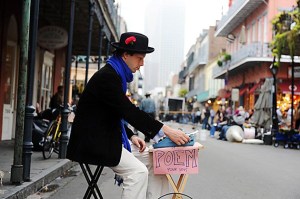
‘Type Rider II: The Tandem Poetry Tour’ – I know, cool, right?

 That title probably requires some explanation, but I also think it holds up on its own as an incident my family would not see as being all that unlikely. I’m not saying that one Easter, they wrote down their top ten “Things that will probably happen to Christoper before he dies or is put in solitary by Nurse Ratchet” and that this was on that list, but more they say, well, yeah, that makes sense.
I was contacted by a casting agent, who was looking for people some sort of faux reality tv thing, because he had been led to believe that I was building a time machine in my garage.
I know what you’re thinking: Christopher doesn’t have a garage! He depends on street parking!
You’re also thinking, like my family, that the time machine is not unlikely. Now, you don’t think I’m building a working time machine, you just think I finally cracked and am using plans given to me by Nikolas Tesla, which he secretly writes in invisible ink on paper napkins from the napkin dispensary on booth four of the Waffle House on US 19, near Countryside Mall. You think that’s why I won’t throw out the napkins on the floor of my car. And you’re not entirely wrong, however, I am not actually building a time machine.
When I was contacted, I rather suspected that a mistake had been made and that the casting agent believed he had found some crank.
This was confirmed when he gingerly asked, hey, before we speak, I understand that you’re building a time machine in your garage… um, how’s that going?
I felt that I had to admit at that point, that no, I am not.
But this also feels like a cool segue into quantum entanglement.
It’s been a banner year for quantum mechanics — a set of researchers just published a result that purports to show that quantum entanglement bridges both space-like AND time-like distances (e.g. the entangled pair can communicate across time.) They claim to have entangled one photon with a second photon which had been destroyed before the entanglement procedure began.
That was part of a lengthier conversation with a friend, and while the focus was on what the potential loss of the certainty entropy meant for what little certainty he felt like he had in life, it’s also kind of cool, because that’s a kind of time travel, isn’t it? Entanglement with something that only existed in the past?
The earlier conversation had been about how the universe, in certain contemporary models, appears perfectly static from the outside, but new models explains how that can be the case and still be in constant, roiling change. Basically, an outside observer would see a static, unchanging universe and anyone with the universe would see something quite dynamic. Sort simultaneously giving hope to both Parmenides and Heraclitus (his first thoughts were of Parmenides and mine of Heraclitus… any psychological insights from that, people?).
Because he’s more of science-y type and I’m more of a humanties-y type, we went in different directions. Mine was that this could provide an intellectual model for a better understanding of how a god could be omniscient in a universe where humanity has free will. But that’s a whole ‘nother conversation.
In the meantime, I will not be appearing on television, showing off my time machine.
And, in case you’re wondering… this the blog post that convinced them that I was building a time machine: https://coffeephilosopher.com/2012/07/05/im-building-my-time-machine-for-real-this-time/
 This is likely to be the end of my New Year’s Resolution posts. There is still time left in the year. A little less than a week, to be precise. But with family coming and what not, I don’t see myself completing anything. Forty-four is not fifty-two, but it’s not a bad number for reading, when juggling reading with full time work that rarely ends at forty hours. I might even have made my goal if there hadn’t been a bad stretch when stress from work and life kept me from focusing.
But here we are…
When Jesus Became God is a narrative history, beginning roughly with the reign of Emperor Constantine and progressing through to the western Roman emperor, Theodosius, and that latter emperor’s active and not infrequently brutal support of what would now be considered doctrinally correct Christology within the Catholic church.
The first half or so of the book is a gripping historical roller coaster about the battle for the theological soul of the still new church. On one side (eventually labelled the ‘Pro-Nicenes’) were priests and bishops who advocated for what became the Trinitarian view of Christ’s nature. On the other side were the Arians, who saw Christ as the son of God, but also as markedly different from the Father. Not necessarily consubstantial. Some even considered Christ to have, in a sense, been adopted by God. Jesus was not of one being with the Father, but more human and a symbol of human perfectibility.
For myself, I had no idea how desperate the struggle between the two sides was nor how closely fought it was. Early on, the author has a great grasp of the historical figures and the historical milieu. Figures like Constantine and the sometimes bishop of Alexandria, Athanasius, really ‘pop’ in the reading. Unfortunately, the same cannot be said of other the figures of milieu in the latter half of the book, which feels rushed and far less character driven.
I suspect that Rubinstein really buried himself in the primary and secondary sources relating to those early days of the struggle and felt a stronger connection than he did with the last half of the story, which is fine, but the reader suffers a bit for it. Honestly, the book is barely over two hundred pages and I don’t think it’s asking too much of a writer not to flag quite so much in the writing of it.




 the coffee philosopher