Happy Birthday, Lovecraft; Or, Screw You, Lovecraft, You Horrible Racist


A bust of H.P. Lovecraft at the Providence Athenaeum
Lovecraft has always been a little problematical, with his pulpy origins and outrageous racism, yet weirdly compelling stories.

A while back, I dived into a big collection of his work, re-reading At the Mountains of Madness and The Shadow Out of Time.

Mountains is great, exciting yarn or explorers going further and further into the ruins of pre-human (and, as it turns out, of non-earthly origin) civilization, but Shadow is one of Lovecraft’s best. Comparatively long, it feels like it drags, but not in a bad way. In a piling on sort of way, where the accumulation of slow building unease and paranoia becomes nearly unbearable.

But what are to think of him? I can’t say. Should I stop reading him because of his not just slight racism, like the doddering grandfather who makes uncomfortable remarks about the Japanese and World War II every time there’s a kung fu movie on TV (he really can’t tell the difference between Chinese and Japanese), but thought the Asian girl you brought home was adorable, but rather full on Mississippi Burning-style racism? Maybe, but I won’t. Does that make me a bad person? A hypocritical person? I don’t know.

The Arm Of The Starfish


No, I didn’t just read The Arm of the Starfish, by Madeleine L’Engle (of Wrinkle in Time fame).

But I did just read this essay from the Los Angeles Review of Books about L’Engle’s non-Wrinkle novels.

Not too long, I was trying to remember the name of this book I read as kid. I remembered that it had something to do with starfish research (and the ability of the starfish to regrow titular arms). Mostly, I (half) remembered this beautiful description of a somewhat villainous character, who was fat, with thin limbs and the effect was of a spider. I can’t remember the exact phrasing, but it stuck with me.

So then I read that essay and realized that the book was The Arm of the StarfishDon’t be surprised if I get it from the library and re-read it.

Apparently, in a weird way, it’s a sequel to the Wrinkle in Time trilogy, with two secondary, but important characters being the same as two vital characters in that trilogy. I don’t recall their spiritual/metaphysical adventures being referenced, so I’m guessing it was more of a reference point for the author than anything a reader really needs to know. Or maybe it is. If I re-read it, I’ll let you know.

‘Call Of The Herald’


I read a surprising amount of Brian Rathbone’s Call of the Herald on my Nook while I was in Thailand before realizing that it was better to stop wasting my time than finish it just for the sake of finishing it. I’d bought it on spec because it was cheap and I thought I remembered reading something good about somewhere.

Well, either I misremembered or else whoever said good thing about it was horribly mistaken.

First of all, I’m pretty sure this is actually YA fiction. Nothing else can justify to the thinly drawn, bland characterizations and lack of a well imagined setting.

So, evil invaders into a peaceful land, blah blah blah, local girl develops super awesome magical powers, blah blah, and I don’t know what next because I didn’t finish it and I don’t care.

‘Deadhouse Gates’


9780765348791

So, I borrowed the second book of Erikson’s Malazan Empire of the Fallen series from my local library. It’s good; it’s rather like Cook’s Black Company, in terms of being a magic heavy, grim sort of military fantasy.

However, even though there are something like eight more books to go, I think I’m done. I’m not sure I really care enough about the characters, which is as much to do with the fact that it’s been too long since I read the first book and my memory’s a little vague. Erikson packs these books with characters and I would have to read them at a pretty good pace to keep everything reasonably fresh in my mind and I’m just not prepared to take that step.

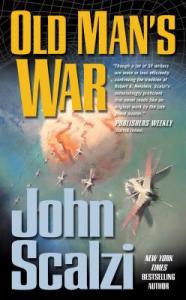
Old Man’s War


Old Man's War

Honestly, even though author John Scalzi has become kind of a big deal in science fiction, I hadn’t intended to read this – and wouldn’t have had it not been available for $1.99 or some such amount.

It’s a solid read, with an old school, pulp feel (only with better writing and a pleasing lack of obvious sexism/racism) and I enjoyed it. The action sequences were few, but decent. It’s very much like those dusty books from the 40a, 50s, and 60s that I love discovering in used bookstores. But, let’s be honest. I’d rather read one of those, which offer an esoteric thrill of discovery/archaeology, if nothing else.

The premise of Old Man’s War is interesting, though underdeveloped (people on Earth are kind of trapped there unless, at age 75, they join a military for the colonies; except for the whole joining the military, that aspect of it reminded me of a series of Asimov books where tall, beautiful, intelligent ‘spacers’ who colonized the stars look down on the poor folks on Earth who are not allowed to migrate because we’re so icky. Asimov, however, went into the sociology of all this. Scalzi, at least here, does not.

I’ll read the sequel if it is cheap or it is at my local library branch.

Midcult


I read the (relatively) recent novel, The Golem and the Djinni while I was in Thailand.

It’s got fantasy elements – I mean, c’mon, it’s got a golem and a djinni (and also an embittered, somewhat inept, yet also villainous, reincarnating wizard; but that’s neither here nor there) – but it’s not really intended to be a fantasy novel. Or it is, but like Atwood, it writes genre fiction that is, or is intended to be ‘literary’ fiction.

Ok, but that does that even mean (though I do love Atwood)?

I liked the book, but what did I take from it? Not much.

After thinking about it, I have a revelation. I suddenly understood Dwight MacDonald’s concept of ‘midcult.’ It’s not great fiction. It doesn’t come close. It’s intended to make us feel good for not reading trash and reading something that maybe we can pretend is great, but which is really just middlebrow ‘meh.’

Also, for a moment, I kept getting him confused with McLuhan and I remembered that scene from Annie Hall which has to be my favorite scene from a movie not involving Harrison Ford or Godzilla.

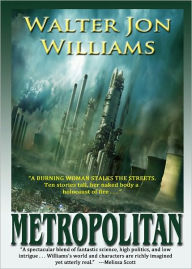
‘Metropolitan’ By Walter Jon Williams


2940014520690_p0_v1_s192x300

Metropolitan opens rather like a cyberpunk novel and maintains that veneer, but really, it’s a fantasy novel in disguise. ‘Magic’ is named ‘plasm’ and is generated by natural forces, but despite the science-y sounding name ‘plasm,’ and some of the science-y trappings about its use (copper grips and wires and batteries), it’s just another name for magic.

The main character, Aiah, is pretty well done. A somewhat desperate woman, whose risen as high as an ethnic minority (she is part of a darker skinned immigrant group) can in her ‘metropolis’ (the world is a single city, by the way, so place states are really city-states; also the earth is covered in a silvery shield and no one knows what is beyond, except that long ago, some ‘Ascended’ went up there and presumably locked the rest of folks in). She’s smart and reckless and you do fear for her in her desperation and recklessness. The titular Metropolitan, a sort of king in exile from another metropolis, Constantine, is decently done as a larger than life, charismatic figure. A good guy, but also willing to sacrifice a lot of lives to accomplish nebulous goals. Certainly, his appeal gets across. Also, he’s black, so credit to Williams for making the two main characters people of color and the lead a woman of color.

I enjoyed, but didn’t love it. And I probably won’t read the sequel. If you see it in a used bookstore, go for it, but that’s the most recommendation I’m giving.

On another note, I read this on my Nook app on my phone – mostly while stuck in Bangkok’s snarling, scrotum tightening traffic (I was not driving; there is a whole list of painful and possible fatal thing that I would do before driving in Bangkok, including taking career advice from a box of broken glass that has hated me since I was two and three quarters years old).

Still Not Posting, So Watch Some ‘Star Blazers’


Okay, So I’m Reading Comic Books Again


Planet Hulk #1

Technically, I’m reading Planet Hulk: Secret Wars. I don’t really know much about Secret Wars, except that everything has changed – Dr. Doom is god of the world, there is a country of Hulks (or should that be lowercase – ‘hulks’) with, apparently, a red skinned leader who looks as much like Hellboy as he does Red Hulk, as well a paramilitary police force of multi-ethnic, multi-gendered Thors (or thors).

I got it for one reason, and that is that hero is a gladiator version of Captain America who has Devil Dinosaur as his sidekick.

Yes, that’s right: I will read anything with Devil Dinosaur.

Devil is drawn respectfully. He is a fearsome predator; powerful, but always trying to be on the side of good.

Unfortunately, he’s also kind of denatured. He’s not a unique creature with his own history, but just an old, semi-forgotten comic book character brought back from the waning days of the silver age to be the sidekick. Which is sad. And you can see how important Jack Kirby’s kinetic style was to Devil’s action sequences, because those long, progressive panels are absent, leaving Devil just a big, pet monster, albeit as fierce one.

Also, Captain America with long, blonde hair and a battle axe to go with his shield, while a cool idea (Captain America as the world’s greatest gladiator, using his super soldier serum strength and reflexes and tactical nous [and twenty foot tall man-eating dinosaur] to defeat all comers!), in practice, it looks like Captain America doing some kind of He-Man cosplay.

‘The Thing’ By Dylan Trigg


9781782790778

This review will be necessarily vague and brief because, honestly, I don’t remember a lot of this book. A while back, I saw a list of the best books of critical theory published in 2014. The Thing not only seemed interesting, but it also referenced my second favorite Kurt Russell movie (after the awesome super classic, Big Trouble in Little China), as well having a lot of references to the equally enjoyable and problematic works of  H.P. Lovecraft.

So, while on a plane ride to Chicago, I started burrowing into the slim volume, which I had downloaded onto my nook.

Exhausting. Unfulfilling. Confused. Meandering. Lacking a coherent point.

Those were some of my initial opinions. Honestly, if it weren’t so short, I wouldn’t have kept reading it on the plane at all. But I didn’t finish it on the plane and I finally got around to finishing it a couple of months later, with too little memory of the first half of the book to attempt to understand it and too little patience with what I did remember to consider starting over.

But, here’s my summary: Husserl, mumble, mumble, Husserl, Merleau-Ponty, mumble, we are descended from aliens, Husserl, mumble, Levinas, Earth is kind of unfeeling so therefore Husserl, mumble, mumble, Merleau-Ponty, mumble, spider legs head.