From ‘Un Coup de Dés’ By Stephane Mallarme


202cbdd5b

Weekend Reading – A Physical Thing


detroit-manager-we-could-have-a-clean-balance-sheet-in-14-monthsHeidegger’s philosophical turn. Honestly, my reading of Heidegger mostly begins and ends with Being and Time. Yes, I read his books on Nietzsche, but it’s all about his first, great book. So I’m not so up on his philosophical turn. Certainly, it sounds disturbing. And there will always be over Heidegger the question of how should his personal actions color our judgement of his philosophical work? It’s not a simple question, really.

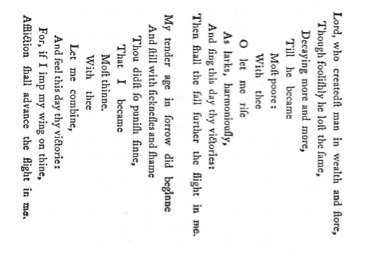
Poetry as objects.

Detroit needs writers! (And it’s taking concrete steps to recruit them!)

Some formerly online-only publications are doing what no one is supposed to be doing: going to paper. The Los Angeles Review of Books has been a must read website since it came online, but it’s now adding a print edition. So is the music website Pitchfork and other, formerly online-only entities. The nail is hit right on the head when Chris Frey of Random House’s Hazlitt website says that print is more ‘authoritative.’ And that’s not a bad thing. Cultural gatekeeping isn’t a bad thing. This is a good thing.

The demise of traditional publishing seems to have been overstated and the panic, thankfully, over.

‘Easter Wings’ By George Herbert (17th Century)


db62f46fe

Monday Morning Staff Meeting – The Trouble With Tribbles


Rick Scott GovernorW(h)ither the Catholic writer? The days of Evelyn Waugh, Allen Tate, Graham Greene, J.R.R. Tolkien, Kenneth Rexroth, Robert Lowell, and Thomas Merton are long gone, it appears. When you read about a Catholic writer these days, it is usually in the context of explicitly leaving the Church. Anyway, you should also read it because Dana Gioia is not just a very good poet, he’s also one of the better essayists of the poetry world and it worth reading. And I had no idea he was Catholic.

But where will they drink?

Another paean to Seamus Heaney. He was not my favorite poet, but he was probably the last great, English language poet who came as close as it is possible (in this anti-poetic age) to the stature of his Irish predecessor, W.B. Yeats or Robert Lowell (who has fallen out of favor lately, in favor of his confidante, Elizabeth Bishop, but was held in high esteem in the years after Life Studies) or Robert Frost as a sort of tribal elder figure, held able to comment and illuminate broad truths. Does English language culture have room for another anytime soon? Also, Seamus Heaney liked to text. Yup.

I would say that I was shocked to learn that this incident occurred in Florida, but, really, it’s just kind of inevitable that these incidents take place in Florida. Awesome job, Florida Republican Party! You have used your control of every lever of state power to… I don’t know, wreck my home state? Compete with Mississippi and Alabama for 50th place (56th if we include the District of Columbia, the U.S. Virgin Islands, the Northern Marianas Islands, Puerto Rico, American Samoa, and Guam; that’s right, I said it, Florida, and, by the way, Guam is way out of your league; you’re not competing with Guam, you’re competing with countries emerging out of multi-decade civil wars… and you’re losing). I don’t blame Rick Scott: we knew when we elected him that he was nothing more than a high finance con artist bilking taxpayer funded programs out of their cash who also just happened to look like a Star Trek villain.

Saturday Post – Hacks


Online predators (it’s not what you think) disguised as missionaries.

Independent bookstores turn a new page on brick-and-mortar retailing - The Washington Post-1Because pointing out that Thomas Friedman is vaguely racist (in a neo-colonial way) idiot whose grasp of current economic and socio-political realities is on par with a chimpanzee who has been locked in a room with a March 3, 1971 edition of Time Magazine.

Oracular revelations and the artist as mystic.

I’m not convinced by the author positing Norman Mailer as a great public intellectual (though, the author is very upfront about Mailer’s deep flaws), but it’s something I think about a lot. The idea of Jon Stewart and Stephen Colbert deliberately shrugging off the possibility of becoming ‘public intellectuals’ is interesting (and not something I would have thought of), but the point about Paul Krugman drills down to the real issue. Sort of. It’s not just that Krugman’s writing is typically specialized (I wish he would write more deeply about science fiction, apparently, one of his great affections). It’s that the ideal of the generalist is nearly impossible to attain. I read many years an essay where the author wrote that Goethe was the last Renaissance man (in the sense of being able to write and study and theorize as an expert in an incredibly wide range of human knowledge). He was not only a great poet, but one of the greatest novelists of all time. He was a scientist, who wrote innovative papers on meteorology. Too much is out there and available to humanity for someone to realistically be sufficiently well versed in a wide variety of intellectual fields (particularly the sciences) to contribute to a wide variety of fields.

Ooohhh… a new bookstore has opened up in Frederick, Maryland. Not so far away, or not so far away from my work. But otherwise, this is your standard (and, thankfully, accurate so far as I know) story about how indie bookstores are making a comeback.

Weekend Reading – Intentional Lives


Tintern Abbey
Tintern Abbey

In hard times, it is good to turn to Wordsworth, the most boring and most satisfying of the Romantic poets.

Is the monastic life the way past late capitalism?

Reading poetry naturally leads to introspection. I didn’t really need a brain scan to know that, but it’s nice to be shown right. After all, reading poetry is a slower, more thoughtful process. Maybe that’s the difference. A collection of poetry is rarely very long. Most of the contemporary collections I have are under one hundred and fifty pages, but you can’t breeze through them like a Mickey Spillane novel. You have to move at the speed of the poet’s pen (some poets compose faster than others, it is certain). But what happens when you read poetry is ineffably different than when you read prose. And no, being able to brain scan it doesn’t make it effable. Did you see what I did there? Effable. That makes for a kind of sex joke, too. Doing double duty.

Midweek Staff Meeting – Cranky Poets


warner_2-121913_jpg_600x777_q85

There be monsters still.

Nothing wrong with being a cranky old poet. It’s how I want to end my life.

We are not seen as the guardians of culture, but the greedy gatekeepers of knowledge. The majority of people do not know what publishers actually do.’ That was YS Chi, Chairman of Elsevier and President of the International Publishers Association. And I think it’s a valid point. I respect books published by actual publishers than those that are self published because some sort of gatekeeping process has taken place. Gatekeeping is not bad. And I’m not saying the publishing industry doesn’t often print absolute c–p (Dan Brown, cough, cough). But it’s something and it’s important.

This sounds less like a problem of French books and more of a problem of Anglophone readers…

For a country as surreal as America, we haven’t been very open to surrealism.

Midweek Staff Meeting – On The Street


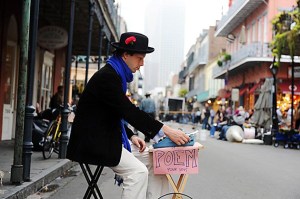
cover_story-1 Poets for hire on the streets of New Orleans. But, I will point out, while the article does mention a poetry event series focused on poets of color, the people in the article’s pictures are all white. This seems to be a case of missing much of what makes New Orleans unique – and it’s not the contributions of white people. On the positive side, it’s nice to hear that a few folks are making a viable living as ‘poets for hire’ or writing poetry on demand. I’m all for it. And it’s very true that American media has neglected its poetry lovers. Poets get a little attention. Poetry scholars get even less. But people who just like poetry? They might as well not exist.

Simone de Beauvoir on taking back desiring power from aging.

First, let me say that Eric Hobsbawn is a great historian. Period. And let me also say that I concur with him that replacement of ‘manifestos’ with ‘mission statements’ is appalling. The world needs more manifestos. Maybe I’ll write one. Probably not.

‘Algerian Chronicles’ By Albert Camus (New Year’s Resolution, Book Forty-Three)


Algerian Chronicles opens with a brilliant, early piece of longform journalism that Camus wrote as a newspaperman in Algeria in the thirties. Written about the Kabylia region of the then French colony of Algeria, it is insightful. It is specific. It talks about specific economic and social issues and makes points based on hard numbers and useful anecdotes. It reminds the reader that Camus achieved much of his fame as a periodical writer.

9780674072589Everything else, sadly, is a disappointment.

I should clarify that.

Everything else is thoughtful, impassioned, concise, and well written. As individual pieces, published in newspapers and magazines in the mid-fifties, I can only imagine that discerning readers eagerly searched for them in the newsstands.

But, my god, as a collection, read almost all at once, they are drearily repetitive.

No one is arguing against his point, or, at least, I am not. But it’s the same point, written in slightly different fashions with slightly different anecdotes and supporting statements. Ugh.

Don’t get me wrong. I am pleased as punch that this was finally translated into English and certainly, it is somewhat timely, given America’s own erratic efforts to extract herself from imperial entanglements. But I was quickly exhausted and bored by the later pieces.

The book improves, mainly by the inclusion of some pieces at the end which were not published in the original French edition of 1958. ‘Indigenous Culture: The New Mediterranean Culture’ is a strange but enjoyable piece. Oddly spiritual, too. It is almost a paean to medieval and late Roman Catholicism. Actually, the spiritual comes up more in this collection than in anything else I have ever read by Camus. The essay fits because it does create a link between continental French culture and history and Algerian culture and history, being connected, as it were, but a certain shared ‘Mediterranean-ness.’

‘Men Stricken from the Rolls of Humanity’ reads almost like one of Camus’ novels, but like the first reporting in this collection, has a welcome reportorial specificity that the more op-ed like pieces lack. It reminds one of his novels and other works because of how this piece, about a visit to a prison ship, talks about prisoners. Camus writes that it is not for us to judge nor pity them. He is merely noting their conditions and fate, but, of course, he is also reminding us of their humanity. You have to relate this question of what it means to be human and whether meaning can be assigned to human lives to his novels and more philosophical works.

There are then some letters to individuals and to periodical editors. These have the specificity that distinguishes the best works in this book: in this case, referring, usually, to particular incidents.

I keep on harping on specificity because that is what can separate so many related pieces from each other. The greater the specificity, the greater the feeling that a particular piece had value in being read instead of any other piece in the book.

Algerian Chronicles will remain an important part of my collection and certainly one can never go wrong by pulling down from the shelf a collection of Camus’ shorter writings and reading a piece for enlightenment, but I cannot imagine going back and reading the whole book again.

The Sunday Paper – I, Too, Value The Sweet, Dark Elixir Of Life


large_S_C3_B8ren_Kierkegaard‘At any rate, I prize coffee.’ ~from Soren Kierkegaard’s book Repetition, under the pseudonym Constantin Constantius,1843.

Do not, I repeat, do not bring sheep into the library. It is expressly forbidden.

And for heaven’s sake, stop cutting their budgets and do not, I repeat, do not close American libraries.

American style democracy does not leave much room for measured, moderate intellectuals.

An interview with the publisher of Tupelo Press, a quality poetry publisher. Good stuff.