‘The Hobbit: The Desolation Of Smaug’
The second part of The Hobbit movie trilogy is much more fast paced than the first. Unlike the Lord of the Rings, where the second movie was also the best, I felt this installment lacked a little something compared to the first. Characters got a little short shrift throughout; I felt we hardly heard from Bilbo, the titular Hobbit, at all!
And here is where the addition of new material, not in the book, really shows through. I don’t mind, but it also reminded me of what a perfect little gem the novel is. The movie, unlike the book, is burdened with the history of the later/earlier movies. It must match up with story told in the Lord of the Rings movies, whereas the novel, while taking place in Middle Earth, was content to be a fun adventure for children (and for adults to read to remind themselves of childhood). The ring could just be a magic ring that made the wearer invisible, but this movie cannot escape the knowledge of what the ring will in the future continuity of the story and, more importantly, already was in movies that were released a decade ago.
Benedict Cumberbatch as Smaug is too restrained by the technology that modifies his voice for him to really be the villain I know he is capable of being.
But it’s an exciting ride, nonetheless, and it’ll be a long wait until next Christmas to see the final installment. And I more eager than ever to re-read The Hobbit, which was first read to me by my mother when I was seven years old.
Weekend Reading – The Existential Despair Of The Political Hack

Amiri Baraka Died
He was seventy-nine.
For those who don’t know Amiri Baraka, née LeRoi Jones was proudly politically aggressive and militant, committed to justice for African-Americans. At his best, one of America’s best poets. At his worst, an enormous ass. But there you are. And I’m sad he’s gone, especially since there are none like him, least ways, none with his public profile, coming down the pipe.
Wrong Backlash
I wrote some briefly critical remarks about a New York Daily News profile of five woman poets.
Well, I was not the only to notice that some of pictures were a little sexy. Nothing wrong with that, but my feeling was that it did not respect their poetry. Not that it disrespect Poetry, capital ‘P.’ The poets themselves took advantage of an opportunity to get some publicity for their work, which was entirely appropriate. I was just disappointed because I felt the sexualization of some (only some) of the poets showed a lack of faith on the part of the publication in the poetry itself.
Ugh. Now I feel rather bad, that I was part of a piling on, as it were. And I have little doubt that many of the criticisms directed at the piece was little more than thinly veiled sexism directed at the poets themselves. I just hope that’s not what I did.
Reflecting On My Previous Resolution
On the plus side, I read a lot more than I have in several years and that’s a good thing. I might have missed my goal, but I cranked through forty-five books last year.
Forcing myself to really sit down and focus on reading was a good thing, but it had some downsides. Not enough ‘slow reading.’ Reading Alexander Pope was real lesson for me; I was trying, essentially, to meet a deadline, but reading someone like Pope requires time and patience that I didn’t feel able to give.
This year, I want to go back and re-read his Essay on Man and take it slow. I’m sure I didn’t appreciate it properly. And maybe I can get back to reading Pound’s Cantos again. And I never did finish the last book in the Wheel of Time ‘fourteenology.’ Gotta finish that, you know, just because. It’s time.
Things like Emerson’s essays or the letters of Charles Lamb – I don’t necessarily want to sit down and read the whole collection, but just one or two particular essays and some of the letters to Coleridge. Likewise, to feel free to pick up a favorite collection of poetry and just read a few.
But don’t want to give up what I gained, which is a renewed impetus to sit down and finish a damn book.
I don’t really have a resolution this year, except that I don’t want this year to suck quite so badly as the last three or four months of 2013. Good lord, those were awful. Just awful. My car was hit by a drunk driver. Ugh. I loved that car. It should have lasted for another 100,000 miles, damn it. Ugh, again.
I do need to visit more museums this year. I used to talk down to the Mall all the time and just pop into a museum or two, especially the National Gallery of Art, the Hirshhorn, or the Sackler/Freer Galleries.
Ok. I’m just rambling now. Need more sleep. That should be a resolution, too.
My New Year’s Resolution
‘The Lies Of Locke Lamora’ By Scott Lynch (New Year’s Resolution Book Forty-Five)
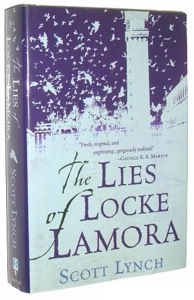 Well , what do you know? I finished one more book. This only happened because of a combination of getting sick and reading in bed and also of insisting that it is not rude to read in front of everyone if no one is speaking a language I can understand.
But onto the book!
This was a book I had read about somewhere as a good piece of fantasy and which I had filed away in my head, so I snatched it up when Barnes & Noble offered it cheap for my Nook.
The novel takes place in the well and interestingly sketched city-state of Camorr. Lynch makes the decision to do his world building by dropping names (Elderglass towers) and descriptions naturally in the text, as if the reader already knew about these things. The great William Gibson, at his best, does this well. Lynch isn’t bad and he’s helped by the fact that he cribs heavily from Fritz Leiber’s immortal city of Lankhmar and the undying (literarily speaking) duo of Fafhrd and the Gray Mouser. This isn’t a criticism, necessarily. After all, you can’t write wry, picaresque, roguish fantasy after Leiber and not reference the great man. And because any decent reader of fantasy worth her/his salt will have read those stories, it makes a useful short hand for the reader.
The meat of the plot takes a while to get going but the getting there is fun.
I was a little vexed that the titular Lamora decided to settle the final issue with the major villain via a sword fight, despite being notably mediocre in a fight. It seemed out of character for him not to have had a better plan and also took me out of the story when he acquitted himself decently well (though he won by a trick, of course).
It’s the first in a series but it doesn’t end on a cliffhanger, which I appreciate, though not for reasons that will make the author happy. You see, I loved powering through this book and enjoyed it immensely… but I’m not overwhelmed by a desire to return to his world.
Poetry From An Old Year

The end of the year is almost here. See. That rhymed. I’m a poet. And I didn’t know it.
I’ve always hated that joke. People who tell that joke are often the same people who pretend they’re about to say ‘I feel smarter’ but then actually say ‘I smell farter.’ Yeah. I’ve met people who say that. And that ‘poet’ ‘didn’t know it’ thing and they’re both reprehensible. Don’t every say either of those things. My genitals will burn for thousand years in a pit of unquenchable hellfire just for having written them above.
On to the good stuff now.
Surely a poetry ‘best of 2013’ list by Rae Armantrout has to be worth something, right?
The Guardian‘s critics have their anglo-centric favorites, too.
Evie Shockley has some strong feelings on the year’s best, as well.
And I don’t know any of these!
So, you’ve got something like thirty-six hours to read the books from their lists. Depending on your time zone. Ready, set, go!
 the coffee philosopher