‘Essay On Man’


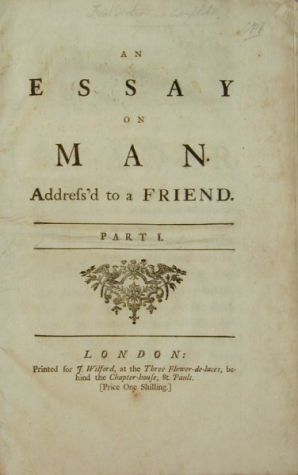
essay on man picI read a short collection by Alexander Pope last year – a collection that contained this poem – but I honestly rushed through it. While the collection may not have been long, reading essays in the form of three hundred year old heroic couplets is not a swift process, so I went back to leafed through it again.

The emphasis Pope seemed to put on the existence of angels felt to me like a product of Catholicism. Don’t get me wrong, angels are not a major part of this  poem, but when he talked about Man wanting to emulate the angels, the angels did not at all seem like a metaphor, but a reference to actually, heavenly beings. And, by the way, it was not considered as a compliment, because the whole poem is about accepting Man’s place in the world.

The whole thing was very Leibniz-ian, with a ‘best of all possible worlds’ aspect to it (though I don’t recall Voltaire ever publishing a satire against Pope; probably because, on the whole, he would have seen pope as a kindred, satirical spirit). Questioning how things are being put as being tantamount to questioning God.

I don’t know. Maybe more thoughts to come later. Or not.

Ezra Pound: Canto LXXIV


In case it was not already obvious, we are back to reading The Cantos. So, that’s what we’re doing this year. No New Year’s Resolution, though. I don’t know if I’ll finish them. I do have other things to do – including other things to read (we’re still not done with the final book in The Wheel of Time, so lots of catching up to do).

Apparently, this is actually the beginning of the Pisan Cantos. I don’t know what the other section was. Just that it was… short.

The themes remain (Chinese characters, finance, anti-communism, anti-semitism, Italian history), but the style has changed. Not radically, but noticeably.

There’s a reference to Hemingway, which may not seem like much, by this adds a bit of autobiography that I didn’t notice before, and that’s not a small thing. Also, I feel like Pound has moved into the thirties. Obviously, this was written after the Second World War, but the earlier bits were still well within what we might call high modernism. This is still that, but I feel like I can detect some surrealist influence. The lines feel more loose, more free flowing, more driven by the unconscious. Or maybe it’s just stream of consciousness. But I stand by what I said. It’s evolving into something influenced by surrealists.

A brief reference to Tangiers pulled me up short. Was Pound connected, did he follow, was he friendly to writers like Paul Bowles and William S. Burroughs? Also, was this Canto finished when Burroughs and the Beats were making pilgrimages to that North African port city?

A mention of Leviticus XIX and First Thessalonians 4, 11 (the differing nomenclature comes from Pound). The first, Leviticus, is when God instructing Moses in how the Israelites should behave. The second are instructions from Paul. God’s instructions are lengthy and precise, but Paul speaks more generally. And passage 4:11 goes as follows:

And that ye study to be quiet, and to do your own business, and to work with your own hands, as we commanded you;

Is that a reference to what Pound intends to do, post-War, post imprisonment?

Some disparaging, colloquial quotes about Italian generals and the Duke (Il Duce? A Mussolini reference?) indicate… what? Is he mourning the end of Fascist Italy? I think that the quotes, with their lower class tone, are more likely intended to be mocking the speaker than the speaker’s subject.

And a lot of references to modern art and writers. Hemingway, I already noted. But also ‘Mr Joyce’ (surely James Joyce) and Manet and Degas…

                         (made in Ragus)  and  :  what art do you handle?
” The best ” And the moderns? ” Oh, nothing modern
we couldn’t sell anything modern.”

This is a melancholy bit. The whole thing, actually. I can hear Pound adjusting to a new world, one that doesn’t respect… him? The world he loved, he helped created (I am not speaking here of those odious politics, but of how he made literary modernism possible: Eliot, Joyce, Hemingway – all benefitted enormously from his great artistic generosity; maybe be wasn’t the greatest writer of his era, but he made much of it possible).
Happy Birthday, Dungeons & Dragons


dnd_products_dndacc_45390000_pic3_enSo, today is being celebrated as the fortieth birthday of Dungeons & Dragons. It’s a bit of an approximation because the nature of the game is that its creation was a process. But, what the heck. Happy birthday.

In honor of this momentous day, I am going to subject anyone who bothers to read this to a lengthy description of the campaign I have been running. Suck it, reader. Or don’t. Click away. That’s what free will is all about.

A halfling thief named Finian, a human warrior named Regdar, and a human skald named Teague were serving in the military of a small, peaceful, multi-cultural kingdom that called itself the Sunward Empire. The king is a gnome and is the spiritual representation of the sun god. His consort is a human and is chief priestess of the wind goddess. Primarily supporting itself on a combination of trade between the eastern and western continents of Loe and Goa, respectively, as well as some mining and tropical agriculture.

The party is part of the small garrison of the Throughward Isle, which is the easternmost island and also has the largest iron mine in the Sunward Empire. After a quick introductory fight between the characters and some giant crabs in the shallows, there was an alarm sounded and the party ran to the main docks.

A group of well organized, well drilled human soldiers disembark in quick order. After a few minutes (’rounds’ in D&D parlance), it became clear that the small garrison would soon be overwhelmed and the garrison commander sent them to escort one of the island’s leading citizens and part of its ruling council to go to the fortified island/city of Hazakis to warn the emperor. They were lead to the entrance to the mines by a gnome named Peleg (who would remain with the party for a long time, before Finian cut off his scrotum and left him to bleed out on the street, but that’s another story).

In the mines, they are ambushed by some humanoid frogs called bullywugs and first see a symbol consisting of three vertical, wavy lines (which would reoccur throughout the campaign).

They emerged on the other side of the island and took a boat to the see the emperor.


20140121-175824.jpg

Weekend Reading – More Stuff About Things Declining Or Dying Out Or What Not


Coffee HP and pressmark

It’s not books this time, it’s readers. But usually, stuff about the death and/or decline of the book is really about the decline and/or metaphorical death of readers, aren’t they? But actually, this article says that’s not really happening, after all. So I’m going to blame the person who wrote the headline, because that’s usually different than the person who wrote the article.

A strange and somewhat confusing article about James Bond. Some weird psychoanalysis taking place here.

Never stop making manifestos!

So, hey! A little profile of Coffee House Press! I bought Anne Waldman’s Iovis Trilogy from them. That book get mentioned a couple of times in the piece so I should really get around to finishing it. Maybe after I finish The Cantos. Generally, they do a lot of great work with contemporary poets. I actually dropped into their offices one time, when I was living in Minnesota, just asked, hey, do you need entry level folks? They were polite in saying no, so… that’s about as far my anecdote goes, really.

Robert Creeley’s books and why he left Scribner.

The GOP is struggling to find new, young donors to replace their aging donors.

Ezra Pound: Canto LXXIII


WTF?

It’s in Italian. And no translation.

All I can tell you about this is that he’s using a lot enjambment, which also creates a lot of white space in the poetry… shall we say ‘column?’

Midweek Staff Meeting – Death Of A Poet


His political legacy is as important as his poetic legacy.

His funeral.

Soccer and tuberculosis and urban abandonment in DC.

Ezra Pound: Canto LXXII


I was little concerned when opened up to the new section and started in on LXXII because, well, it was in Italian.

Fortunately, Pound had the generosity to repeat the entire Canto in English.

This is a fairly self referential Canto, and not just because Pound writes:

But I will give you a place in a Canto
giving you voice. But if you want to go on fighting
go take some young chap, flaccid & a half-wit
to give him a bit of courage and some brains
to give Italy another hero among so many

It’s also not hard to see Pound, despite a bit of dismissal there, still remaining sympathetic to the WWII Italian (fascist?) cause. And he’s got to get in this little bit of anti-semitism:

Exuded the great usurer Geryon, prototype
of Churchill’s backers. And there came singing

I’m not sure how he reads Geryon as being relevant (I can’t help but think of Anne Carson’s great novel in verse about Geryon, though), but it’s easy to read ‘usurers’ and ‘Churchill’s backers.’

The tone of angry dismissal and disappointment runs throughout, but the sense of loss in Pound’s tone is also ever present.

Part way through, Marinetti enters the dialogue. Of monologue. Pound has a one sided conversation with an absent (and mourned for?) Marinetti, the great (and proto-fascist) futurist poet.

Weekend Reading – But It’s Hard To Read!


Orhan Pamuk’s melancholy observations of a melancholy poet (Constantin Cavafy, the muse of Alexandria).

‘Difficult’ does not mean ‘not pleasurable’ when it comes to literature.

Jim Crow in Florida.

Poetry, finance, and Marxism.

Ezra Pound: Canto LXXI


You can take the poet out of the modern financial system but you can’t… I don’t know where I’m going with this, but suffice to say Pound is still thinking about banking…

                                                  Funds and Banks I
never approved I abhorred ever our whole banking system
but an attempt to abolish all funding in the
present state of the world wd/ by as romantic
as any adventure in Oberon or Don Quixote.

It’s done in the form of a diary or rather as a sort of, shall we say, epistolary poem? Written as if a letter by a politically minded American who lived through the mid-eighteenth century through the first quarter or so of the nineteenth century.

As a poem in the style of eighteenth century prosody, with a touch of American spirit, it’s an amazing piece of work. Really amazing.

This is the end of a section. From what I’ve heard, it picks up after this, with the next section being what are popularly known as the Pisan Cantos.