
Nothing wrong with being a cranky old poet. It’s how I want to end my life.
This sounds less like a problem of French books and more of a problem of Anglophone readers…
For a country as surreal as America, we haven’t been very open to surrealism.
Algerian Chronicles opens with a brilliant, early piece of longform journalism that Camus wrote as a newspaperman in Algeria in the thirties. Written about the Kabylia region of the then French colony of Algeria, it is insightful. It is specific. It talks about specific economic and social issues and makes points based on hard numbers and useful anecdotes. It reminds the reader that Camus achieved much of his fame as a periodical writer.
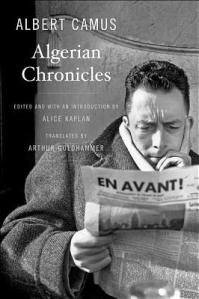 Everything else, sadly, is a disappointment.
I should clarify that.
Everything else is thoughtful, impassioned, concise, and well written. As individual pieces, published in newspapers and magazines in the mid-fifties, I can only imagine that discerning readers eagerly searched for them in the newsstands.
But, my god, as a collection, read almost all at once, they are drearily repetitive.
No one is arguing against his point, or, at least, I am not. But it’s the same point, written in slightly different fashions with slightly different anecdotes and supporting statements. Ugh.
Don’t get me wrong. I am pleased as punch that this was finally translated into English and certainly, it is somewhat timely, given America’s own erratic efforts to extract herself from imperial entanglements. But I was quickly exhausted and bored by the later pieces.
The book improves, mainly by the inclusion of some pieces at the end which were not published in the original French edition of 1958. ‘Indigenous Culture: The New Mediterranean Culture’ is a strange but enjoyable piece. Oddly spiritual, too. It is almost a paean to medieval and late Roman Catholicism. Actually, the spiritual comes up more in this collection than in anything else I have ever read by Camus. The essay fits because it does create a link between continental French culture and history and Algerian culture and history, being connected, as it were, but a certain shared ‘Mediterranean-ness.’
‘Men Stricken from the Rolls of Humanity’ reads almost like one of Camus’ novels, but like the first reporting in this collection, has a welcome reportorial specificity that the more op-ed like pieces lack. It reminds one of his novels and other works because of how this piece, about a visit to a prison ship, talks about prisoners. Camus writes that it is not for us to judge nor pity them. He is merely noting their conditions and fate, but, of course, he is also reminding us of their humanity. You have to relate this question of what it means to be human and whether meaning can be assigned to human lives to his novels and more philosophical works.
There are then some letters to individuals and to periodical editors. These have the specificity that distinguishes the best works in this book: in this case, referring, usually, to particular incidents.
I keep on harping on specificity because that is what can separate so many related pieces from each other. The greater the specificity, the greater the feeling that a particular piece had value in being read instead of any other piece in the book.
Algerian Chronicles will remain an important part of my collection and certainly one can never go wrong by pulling down from the shelf a collection of Camus’ shorter writings and reading a piece for enlightenment, but I cannot imagine going back and reading the whole book again.
 In the ‘cloud,’ corporations own everything you think own (and everything you used to own).
The next American winner of the Nobel Prize for Literature?
A very earthy sort of ‘vie boheme’ near Covent Gardens in the eighteenth century.


 Milton thought that books made better receptacles for human souls than bodies.
 the coffee philosopher