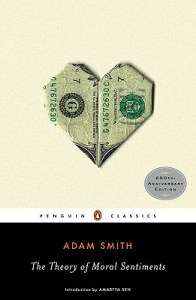
‘The Theory Of Moral Sentiments’ By Adam Smith


9780143105923I read this book slowly, over the course of more than a year, which is too bad now, because, as I’m writing about it, I can’t remember as many details as I might like.

I remember a couple of things, like a section that seemed to suggest that, in the (hypothetical) absence of God, it is the state that matters, but that being the only significant talk of capital-G God in a work that generally, though never explicitly, developed an anthropological explanation for morality that required no divine edicts.

I remember thinking that his explanation for the natural sentiments that exist in the majority of people, combined with social norms, allow us to put ourselves in the place of others (it sounds like empathy, and it is, but also more than that) in order to develop socially enforced moral codes.

I also remember thinking that this was just a hop, skip, and a jump to John Rawls’ theory of justice (as described in his… A Theory of Justice).

It’s definitely a philosophical document, but also definitely a product of time and place. When you think of the philosophical writings of Edmund Burke and David Hume, you see this approach that I referred to as anthropological.

And then… he suddenly spent the last thirty of forty pages discussion of the history of language, I got a little confused. At some points, he seemed to be making a point about language, for example the use of and us and Romans to help people put themselves in the place of others and themselves within society. But mostly, I have no idea. It might have been cool near the beginning, but at the end, it was a total distraction and letdown. When a nice summing up would normally be called for, he went off onto a strange tangent. Oh well. Welcome to the world of belles lettres, I guess.
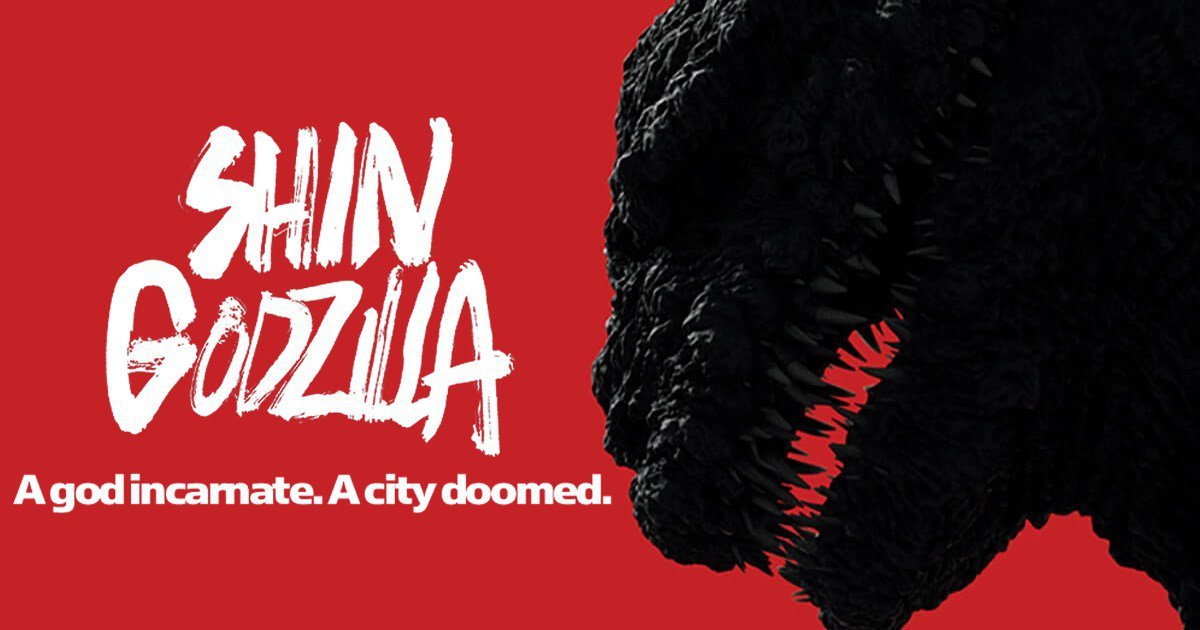
Shin Godzilla


godzilla-resurgence-trailer-ticketsThe latest Godzilla movie from Toho is showing only irregularly here in Washington, DC – one night here, another night there. I saw it Tuesday night at the E Street Cinema (still the best movie theater in DC).

You can’t compare it to the recent, American Godzilla. Though that was a good movie, it was also, primarily, a monster movie. So what you say? How are the Toho movies and all their kaiju movies they inspired not monster movies? Serious? Are you stupid? Are you a Trump voter? Are you that stupid?

Ok, ok. Calm down. I get you.

But the Toho productions have always been, even at their silliest, informed by political concerns in a way that the American movies have not.

Shin Godzilla takes that to a whole new level. Even more than usual, Godzilla himself plays a relatively small role and has limited screen time. What’s more, during much of his screen time, he is sleeping (he sleeps standing up, in case you were curious).

Most of the movie consists of high level meetings of government officials and their aides. And it’s exciting. I kid you not. Even though they’re just meetings, it is amazingly fast paced. There are plenty of moments of humor and of the director and screenwriter rolling their eyes at bureaucracy and some high level bumbling. The Prime Minister and later the acting Prime Minister come in for some gentle mockery, but never does the movie disrespect the ability of political actors to accomplish things.

In fact, the final message of the movie (delivered with little subtlety in the final scenes) is the need for vigorous politicians to chart an independent path for Japan in a part of the world being rapidly dominated by concerns about China and North Korea, as well as US responses to those concerns.

So, go see it.

Emmanuel Ax, Beethoven, Shakespeare


Last week, I cashed in one of my birthday presents – two tickets to see Emmanuel Ax play Beethoven’s First Piano Concerto at the Kennedy Center, followed by a Shakespearean themed program.

This was my second time hearing Ax play and, of course, he’s good; and he really seemed to enjoy playing such a youthful piece. I’m not a music expert and can’t even play the triangle, but it did seem to me that he had some rough moments during the first movement, but then really hit his stride, especially of the middle movement.

When they have stars like this, I wish they wouldn’t put them first, because, after hearing a great pianist play Beethoven, pretty much whatever follows is going to disappoint. I like Berlioz, but if one of his pieces immediately follows Bach’s Passion of Saint Matthew, well… it’s going to be a bit of a letdown, isn’t it?

The three pieces that followed were Erich Korngold’s Much Ado About Nothing Suite, Richard Strauss’ Macbeth, and Antonin Dvorak’s Othello Overture. I liked Dvorak the best, but the Korngold was fun. Also, I found out that Korngold wrote the scores to two of my favorite Errol Flynn swashbucklers: Captain Blood and The Adventures of Robin Hood!

One of the cool things they did was have two actors who feature a lot locally come out and perform bits from the relevant Shakespeare. I lost the paper that told me who they were, but the man was someone I had seen in many, many plays at the Folger Shakespeare Library (off the top of my head, I’ve seen him in District MerchantsTwevlth NightRosencrantz and Guildenstern Are Dead, and Mary Stuart. He got a great presence and a delicate comic touch that works even better, because he himself is such a big guy.

The Nickelback Theory Of Downballot GOP Candidates


Imagine you are the opening act for a popular band about to go on tour. Now, their most recent album hasn’t done very well, but they have been around for a while and one bad album won’t be keeping the fans away.

Unfortunately, they are touring at the same time as another popular band. But, you think, we are still going to get plenty of people coming to our shows. Also, even though we are only the opening act, we have our own fans who will come to see us, even if they aren’t very excited about the headliner.

And then it happens.

The headlining act announces that, for this tour, instead of playing their hits, they will play nothing but Nickelback covers.

So, sure, in some locales, where there is not much competition for entertainment dollars, you will still do okay, but basically, you are about to get your clock cleaned.

And you can tell yourself that you still have your fans, but your fans have just found out that you are touring with a Nickelback cover band and they’re going to think that you must a Nickelback fans, as well, and they ain’t coming to see you anymore.

The opening act, of course, is a symbolic of downballot GOP candidates and Trump is the Nickelback cover band.


What We Can Learn From Poets (According To Cicero)


The Baseball Stadium Theory Of Presidential Political Polling


Presidential horse race polls measure attendance at baseball games.

Let me explain. I was talking to a friend and sharing what I believe the polls are really showing. They are not, by and large, showing changes in allegiance (especially in this election; while Clinton probably has some room to grow among some small groups of traditionally Republican voters, Trump most likely has a pretty firm ceiling). Also, a quick google will let you know that most experts agree. So I’m not about blow things open with a new algorithm, I simply found what I think is a pretty cool metaphor.

At this stage, polls measure enthusiasm, which translates also into the likelihood of voting. When Trump dropped in the polls after the debate, it wasn’t because Trump voters switched sides in great numbers. It was because some Trump supporters, feeling down in the dumps, either said they were undecided, because Trump made it kind of embarrassing to be his supporter, or else, when asked, they downgraded their chances of voting, causing them to be caught by likely voter filters.

I compare this to a baseball fan base.

If you’re a Dodgers fan and the Dodgers are on a losing streak, you don’t suddenly become an Red Sox fan. No, you remain a Dodgers fan. But what does happen is that you don’t attend as many games, so the stadium in Chavez Ravine becomes more empty.

When the Dodgers start doing very well, you start attending games. If they start leading their division and ESPN tells us that they are World Series favorites, then people who rarely attend games or had stopped attending games start showing up again.

This is what polls are measuring. People aren’t switching between the Red Sox and the Dodgers (or Clinton and Trump). They are simply attending more or fewer games. Clinton is up, so her stadium is filled with fans. Trump is down, so attendance at his stadium is down.

So, does that mean that these polls aren’t measuring anything useful?

Absolutely not! Because enthusiasm and hope and involvement (read: stadium attendance) are key measures of likelihood to vote.

Just as you are less likely to attend your favorite team’s game if you believe they are going to lose, so are you less likely to vote if you see your candidate doing poorly (or making nonsensical word salads during a debate). Season ticket holders will always show up, but it’s the other, more occasional fans who are the difference between 47% and 51% of the vote.

The Eleventh Son: A Novel Of Martial Arts And Tangled Love


Eleventh Son is one of the few (that I have seen) twentieth century wuxia novels translated into English. You see, while my better half was out of town, taking care of family for almost six months, I was able to indulge all my dark Netflix desires: Family Guy, Voltron, and kung fu movies.

I knew that, for example, the great (and also sui generis) Crouching Tiger, Hidden Dragon was based on one of a series of novels. But I had also assumed it was from the nineteenth century or earlier, but it was actually from the mid-twentieth century. So I decided to search for a professionally translated version of a wuxia novel from that period and among the few I uncovered was… The Eleventh Son.

The style of writing (at least in translation) is so plain and chopped that it’s almost a short hand. It’s like someone wrote a novel in something between a caricature and loving embrace of the AP stylebook.

The story is of a famed bandit Xiao Shiyi Lang who finds himself rescuing and mutually falling for a (married and pregnant) Shen Bijun (whose husband is himself a world renowned martial artist). In between are fights and twists and all that and then it ends on a ridiculous cliffhanger. Actually, the whole plot doesn’t hang to together very well (an episode trapped in a dollhouse is just pointless) and the ‘big boss’ appears out of nowhere, narratively speaking.

I gather that a television series was made based on this and I suppose that might be better. Even though it was written and published as a novel, you can think of it as a screen treatment or libretto. If you read an opera libretto, you’ll find it to be various combinations of ridiculous, nonsensical, melodramatic, sappy, and downright stupid. But watch an opera live… well that’s something else.

Francis Fukuyama & ‘Children Of Men’


As part of series called Future Tense, I dragged my better half to see the movie Children of Men, followed by a brief lecture/Q&A featuring Francis Fukuyama (who actually introduced himself as ‘Frank’ Fukuyama; nothing intrinsically weird about that, but it did strike me, because I only know him as a sort of public intellectual and semi-repentant neo-conservative.

I loved the movie when it first came out, though I spent almost the entire movie on the verge of tears. This time, I was able to appreciate Clive Owen’s wry humor (and also accept that he would not have been a good James Bond; while Daniel Craig added a wonderful element of questioning Bond’s existence, a Clive Owen Bond would have been entirely too despairing).

Let me first admit that I have never read anymore longer than a magazine essay by Fukuyama. Yes, I am the guy in DC who does not own The End of History, in case you were wondering who that person was. Mostly because I know him as a neo-conservative/neo-liberal (hint: they’re the same thing), even though I also know he has backed off those tendencies over the last decade.

But that doesn’t mean I wasn’t interested in hearing what he had to say.

He was surprisingly religious and, as a moderator in a Q&A, he took care of the perennial issue of ‘let me ask a question that is actually a long statement intended to show how smart I am but which really shows that I once read an article from a two year old copy of The Economist while waiting to get a crown replaced.’ What he did was to give a brief lecture and then ask a question, so at least the people were supposed to speak and ramble.

While he asked several questions, they were ultimately about what the world might look like if there were no future. While I resisted the temptation to raise my hand and ask to be heard, I will admit that I had a rough idea of a comment in mind. I thought of de Sade’s Philosophy of the Bedroom. Specifically, I thought of that weird interlude when one of the characters suggests they pause their orgy and read an essay. You can google this. My point is that he talks about the death of God, which is the death of the king during the French Revolution. By executing the king, revolutionaries have killed the idea of order and limits coming from a higher power and they should accept that they have made it so that nothing is forbidden anymore. My insight from that is that the death of God can be something besides just a loss of faith (or an enormous, otherwise omnipotent being feeling dead from the sky), but also be something like, say, the loss of fertility. And then, in the words of Uncle Billy Burroughs, everything is permitted, nothing is forbidden.

Fukuyama also told me something I didn’t know: the title comes from the King James Bible’s translation of Psalm 90

Thou turnest man to destruction; and sayest, Return, ye children of men

It’s a prayer by Moses, by the way. And Fukuyama put in a nice plug for the King James version, telling folks how much they’re missing when they read those silly ‘modern’ language versions.

‘The Riddle-Master Of Hed’ By Patricia McKillip


9780441005963This is actually a trilogy, but when I was younger, I read the first book, but a good bit of it, I didn’t quite follow, though the opening stuck with me. Then, my mother sent me up a box of my books from her home and, among them, was an aging paperback copy of the first book, which I re-read while visiting a good friend in Chicago.

As it turns out, the only way to really read it now is to buy a reprint in an omnibus volume. Of course, I’m writing this because I’ve finally finished said volume.

McKillip is lovely, delicate writer, with a soft touch that is similar to Ursula K. LeGuin. I don’t think it would surprise any reader of Riddle-Master that it feels very similar in tone to the Earthsea novels (including being more than a little feminist, even though the hero of Riddle-Master is male – though so was the protagonist of two of three original Earthsea novels).

The story, which gets too complicated to really summarize here, struggles after the first book. Things don’t feel properly explained and everything rushes towards to a conclusion that, while not exactly deus ex machina, does not feel properly earned.

The coolest idea, undoubtedly, are the importance of riddles to the culture of the world. When the story begins, magic is gone – or, at least, wizards are gone. But a connection to that former world is maintained through the study of ancient lore. These ‘riddles’ are almost never actually riddles, but more like trivia from antiquity. The theme of these riddles as being vital secrets for understanding one’s self, one’s world, and one’s predicament is consistent throughout and I never ceased to find the concept rewarding.

What I most took away is a desire to re-read another one of her books, The Forgotten Beasts of Eld. I think I was living in Florida when I read it. I remember being in my mother’s car and reading it after she had bought it for me at a used bookstore.

Wordsworth


Wordsworth is one of my ‘go to’ writers. If you’re going on a trip and you’re not sure what to bring, you can always bring a selected poems by Willy, because you can read him again and again and he’ll never let you down (Wuthering Heights is another one that I can read and, as soon as I’ve finished it, immediately start reading again; I once read it twice in one day).

But, I’m really only a fan of his longer poems. Sure, Intimations with its ‘Splendor in the grass’ gets me going, but overall, it’s the long poems: The PreludeThe ExcursionThe Recluse. And you’ll notice that those are all, for lack of a better descriptor, semi-autobiographical pastoral poems. His long historical poems feel like rather dull epics to me and most of the shorter ones don’t have that slow burning, hypnotic pull. The Prelude is a darn long poem. It’s not Proust long, but it does have that same sort of gentle pacing that pulls you in over the course of time until you’ve entered a sort of literary ‘fugue’ state.