Simone de Beauvoir on taking back desiring power from aging.

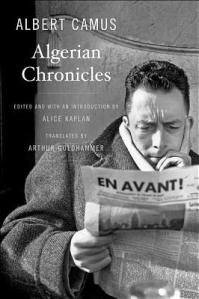
‘Algerian Chronicles’ By Albert Camus (New Year’s Resolution, Book Forty-Three)
Algerian Chronicles opens with a brilliant, early piece of longform journalism that Camus wrote as a newspaperman in Algeria in the thirties. Written about the Kabylia region of the then French colony of Algeria, it is insightful. It is specific. It talks about specific economic and social issues and makes points based on hard numbers and useful anecdotes. It reminds the reader that Camus achieved much of his fame as a periodical writer.
 Everything else, sadly, is a disappointment.
I should clarify that.
Everything else is thoughtful, impassioned, concise, and well written. As individual pieces, published in newspapers and magazines in the mid-fifties, I can only imagine that discerning readers eagerly searched for them in the newsstands.
But, my god, as a collection, read almost all at once, they are drearily repetitive.
No one is arguing against his point, or, at least, I am not. But it’s the same point, written in slightly different fashions with slightly different anecdotes and supporting statements. Ugh.
Don’t get me wrong. I am pleased as punch that this was finally translated into English and certainly, it is somewhat timely, given America’s own erratic efforts to extract herself from imperial entanglements. But I was quickly exhausted and bored by the later pieces.
The book improves, mainly by the inclusion of some pieces at the end which were not published in the original French edition of 1958. ‘Indigenous Culture: The New Mediterranean Culture’ is a strange but enjoyable piece. Oddly spiritual, too. It is almost a paean to medieval and late Roman Catholicism. Actually, the spiritual comes up more in this collection than in anything else I have ever read by Camus. The essay fits because it does create a link between continental French culture and history and Algerian culture and history, being connected, as it were, but a certain shared ‘Mediterranean-ness.’
‘Men Stricken from the Rolls of Humanity’ reads almost like one of Camus’ novels, but like the first reporting in this collection, has a welcome reportorial specificity that the more op-ed like pieces lack. It reminds one of his novels and other works because of how this piece, about a visit to a prison ship, talks about prisoners. Camus writes that it is not for us to judge nor pity them. He is merely noting their conditions and fate, but, of course, he is also reminding us of their humanity. You have to relate this question of what it means to be human and whether meaning can be assigned to human lives to his novels and more philosophical works.
There are then some letters to individuals and to periodical editors. These have the specificity that distinguishes the best works in this book: in this case, referring, usually, to particular incidents.
I keep on harping on specificity because that is what can separate so many related pieces from each other. The greater the specificity, the greater the feeling that a particular piece had value in being read instead of any other piece in the book.
Algerian Chronicles will remain an important part of my collection and certainly one can never go wrong by pulling down from the shelf a collection of Camus’ shorter writings and reading a piece for enlightenment, but I cannot imagine going back and reading the whole book again.
The Sunday Paper – I, Too, Value The Sweet, Dark Elixir Of Life
 ‘At any rate, I prize coffee.’ ~from Soren Kierkegaard’s book Repetition, under the pseudonym Constantin Constantius,1843.
Do not, I repeat, do not bring sheep into the library. It is expressly forbidden.
American style democracy does not leave much room for measured, moderate intellectuals.
An interview with the publisher of Tupelo Press, a quality poetry publisher. Good stuff.
Saturday Post – Where Are All The Jobs?
Weekend Reading – Oddly Inadequate
‘Notebooks: 1935-1942’ By Albert Camus (New Year’s Resolution, Book Forty-Two)
My father bought me this for my birthday. It’s a pretty, hardbound that’s only slightly larger than a paperback. And it’s Camus.
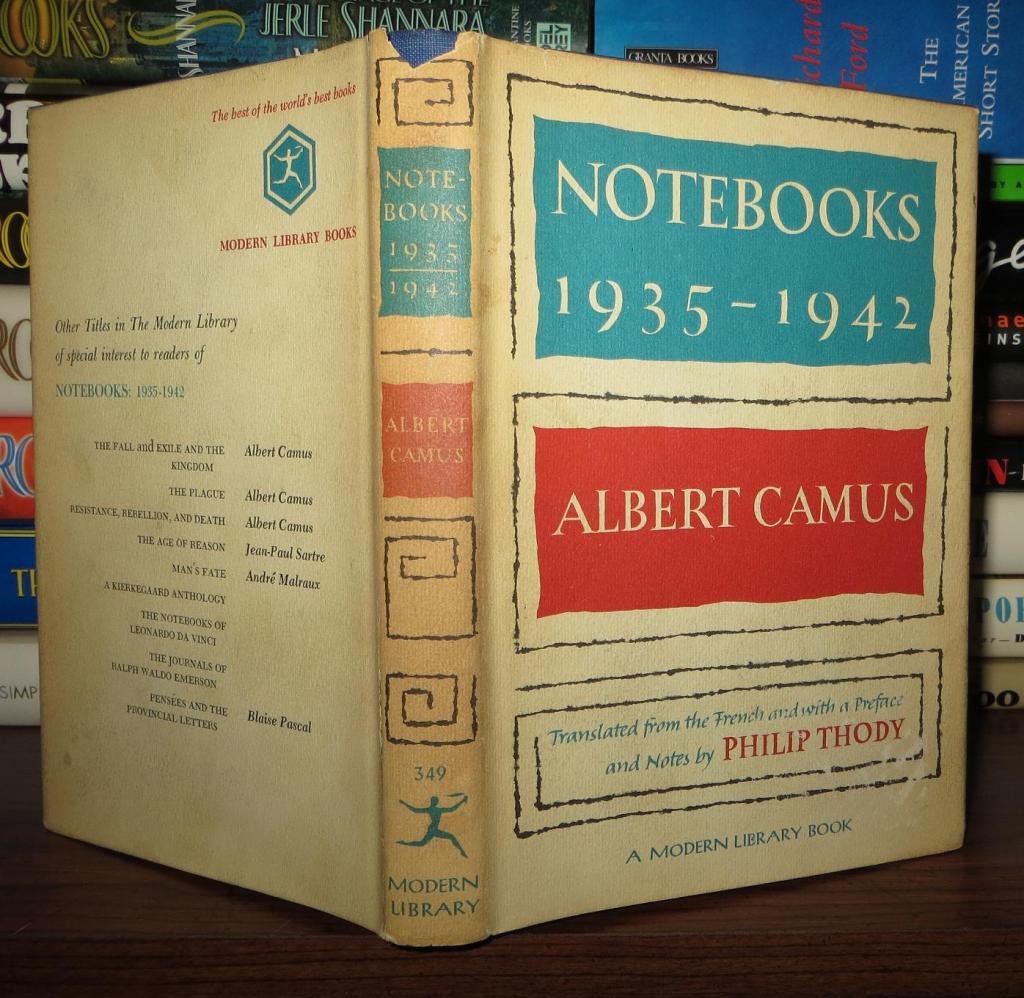 These are from his earliest published journals.
Many years ago, my stepmother gave me a cope of his journals from 1942-1951. It was a wonderful present and very thoughtful. Don’t mean to sound rude, but I was very surprised. She neither liked nor understood me at all (the feeling was more or less mutual and she was not a bad person, just not my type).
From May, 1938:
Nietzsche. Condemns the Reformation which saves Christianity from the principles of life and love that Cesarean Borgia was infusing into it. The Borgia Pope was finally justifying Christianity.
What an amazing statement! So forthrightly counterintuitive!
I don’t much that is true about the Borgia Pope (though I know a lot of scandalous fiction about him), but I remember that he was the first Pope to acknowledge his children. Previously, Popes with children tended to publicly identify them with the useful fiction of ‘nephews and nieces.’
Camus tried hard to eliminate personal history from these journals. They are intellectual documents, not autobiography. A reference here that hints at the quantity and quality of Camus’ envy-inducing sexual conquests. Some references to where Camus was standing when a thought occurred to him (in Greece, in Oran, in Paris, etc.). But little else personal.
Well, actually, a lot personal. The first two thirds take place while writing L’etranger and Le mythe de Sisyphe. The former appears in fragments, as Camus tests out passages and ideas, some of which would later make their way into that novel. The appearances of the latter take the form of numerous questions about suicide. Unlike that book of (admittedly, not very rigorous) philosophy, his journals suggest that committing suicide did cross mind. Not as an intellectual exercise, but an escape.
When the war appears, that becomes a constant, as you might imagine. But in a strange way. Camus the diarist seems shocked and surprised by the war. He makes some comments about Germany and German racism, but seems unable to really get his head around it. The failure that was the war, I felt, was, to Camus, a French failure. When he takes and fails to pass a physical (because of his tuberculosis), I was reminded that though he was unsuited for combat, he joined the resistance as the editor of Combat, an underground newspaper of the resistance.
Of course, when these journals end, France is occupied and Camus is living in Paris. From the journals, you would barely know the latter and the former not at all!
By the way, my father found this at Back in the Day Books in Dunedin, Florida. Haven’t been there personally, but seems like a quality place. Their facebook page always highlights good stuff in stock.



 the coffee philosopher