Nature’s God: The Heretical Origins Of The American Republic


This wonderful, if sometimes clunkily written, book is a series of long digressions on figures of deep influence to the intellectual leadership of the American Revolution and America’s founding. He begins with a discussion of two lesser known Revolutionary figures, Ethan Allen and Thomas Young, who wrote stridently ‘Deist’ (really, atheist) works. Theoretically, it is about the influence of Deism on the founders, but really, it’s about making sometimes tendentious, but always interesting arguments for another layer of philosophical forebears beneath accepted intellectual forefathers like John Locke.

So how does that work in practice? A long discussion of Epicurean cosmology and how it (supposedly) informed the intellectual climate that directly influenced Revolution figures (mostly Jefferson and Franklin; though this also undercuts the idea that these were foundational, since in their learning and interests, they were sui generis). Spinoza is brought up early and often and is taken to be a key figure whose ideas were behind all the most influential ideas of those most directly connected to the ideas of the Revolution.

I’m not sure that Stewart was all that deeply interested in writing a book about the intellectual history of the American Revolution, but rather that it made an easier sell on his actual book, a fascinating look at two marginal figures of the American Revolution combined with an expansive view of the influence of Epicurean physics and places Spinoza at the center of the Enlightenment (yes, he makes a point towards the end that Spinoza is an ‘early modern,’ but in context of the whole book, he is clearly shifting the Enlightenment backwards a good bit, moving it’s beginning to Spinoza and Hobbes).

Stewart is himself a materialist of the Spinozan variety (he wrote an earlier book about the Dutch-Iberian philosopher), I would hazard by his good natured glee when writing about it. I don’t mind a position, in that respect, especially when it is joyful in its advocacy, rather than disrespectful in it.

I enjoy listening to (and usually disagreeing with) some of the podcasts and YouTube videos put out by the gloriously titled “James Wilson Institute on Natural Rights and the American Founding.” I will give them credit for introducing me to the philosopher Daniel N. Robinson and also for aiming to influence the legal community in a specific conservative direction. Unlike the Federalist Society, which is really just a political organization dressed up in judicial clothes, the James Wilson Institute has a very specific legal philosophy around natural rights, which also puts it in opposition to the current trend of pretending to be originalist (natural right theory is not orginalism).

I bring this up because Steward waits until the book is nearly done to bring James Wilson (a Founding Father who is not obscure, but, let’s just say, sits in the second tier) up and goes on to describe him as: avaricious, socially ambitious, lavishly educated

Ha.

Inventing America


I loved this book, but mostly because it made me want to read other books. I’ve started reading Carl Becker, because Wills mentions him. I definitely need to read more Scottish Enlightenment (Hume, Home, Hutcheson, etc).

However, the argument itself seems… unnecessary today. That the Scottish Enlightenment was the critical intellectual yeast of the Founding documents does not seem controversial today, nor does relegating Locke slightly (though not so much as Wills does; he tries to dispel any idea of Locke’s political writings being an influence on Jefferson’s Declaration, which smacks of a lady protesting overly vigorously). He also leans heavily on finding references to Francis Hutcheson (followed by Kames, Hume, Smith, and only rarely Reid).

Wills writes that Lord Kames was Jefferson’s intellectual hero. Of course, Kames, Christian name, Henry Home, was David Hume’s uncle (Hume changed his name so that the spelling matched the phonetics) and Jefferson notably raged against Hume.

He spends as much time emphasizing the Declaration was not seen as a momentous documents at the time it was signed, only later becoming so (in part, through Jefferson’s own efforts to elevate it), as he does on the specific influences that this book is supposed to address. C’est malls vie, I guess.

I did learn things, though, or at least gain new perspectives. He provides new lenses through which to view Jefferson’s famed Head and Heart letter, provided by Scottish sentimental (which doesn’t mean what you think it means) moralism and Laurence Sterne. Incidentally, though I mostly fall into the camp of those who feel that the recipient of that letter and Jefferson did have a sexual relationship, though the letter suggests to me that our third president was an awkward lover.

Agony and Eloquence: John Adams, Thomas Jefferson, And A World Of Revolution


Another book about the relationship between Jefferson and Adams; less formally innovative than the other, but a nice, brisk read, nonetheless. Some odd choices though. It focused less on than the bitter divide that kept them apart for over a decade and more on the things that connected them. For about half the book, it seemed to be using their differing views of the French Revolution as the lens through which to view these two men, but then it seemed to forget about it. Which was weird, because it spent at least fifty pages discussing important figures within the French Revolution. Was that just padding?

Also, kind of amazed how historians (mostly white, male historians) are still tip toeing around Sally Hemings. It was a terrible, terrible thing he did, because her age and lack of freedom meant she could not consent and wildly hypocritical. But he did good, too, and it need not be interred with his bones, and Antony might say, it we acknowledge his deep sins.

Betrayal: The Final Act Of The Trump Show


At this point, there’s not much new compared to the coverage of the book and other reporting… but, good heavens, what a lot of crazy people. Vice President Pence comes across as… sort of good? Even if he waited until the very last moment to say, enough is enough, can we please stop destroying the Constitution and American democracy?

The role of John McEntee, a Trumpy, horndog who was put in charge of Stalinist purges, was interesting. I’d heard of him, but the salacious tidbits, like hiring attractive, twenty year old female Instagram ‘influencers’ alongside hardworking, loyal young men who also weren’t competition for any sexual conquests McEntee felt like embarking on.

Read more

War For Eternity: Inside Bannon’s Far-Right Circle Of Global Power Brokers


So, there’s this insane right wing, slightly racist philosophy called Traditionalism. When capitalized, it means something very specific, more than a little occult, and deeply weird.

It’s non-fiction, but most resembles Umberto Eco’s great novel of occult paranoia, Foucault’s Pendulum. Listening to Teitelbaum’s breathless accounts of conversations with right wing esotericians, I keep thinking of Eco’s narrator and his encounters with important seeming occult thinkers.

This is also because, even though Teitelbaum repeatedly presents himself as a scholar (specializing, apparently, in right wing ethnomusicology, which doesn’t sound like a real thing), he doesn’t write as on. One review said he seemed a bit star struck by Bannon, but beyond that, the book is more of a mostly chronological account of his descent into crazy town, with Bannon as his Gandalf (a wise man who tends to disappear and then reappear, offering wise words). I also pick up hints of Bernard Henri-Levy, in it. The globetrotting name dropping and the self-importance of it all.

He acknowledges the book was rushed and it has a breathless quality, like he’s embarked on a mystery he must solve : Tinker, Tailor, Soldier, Traditionalist. He uncovers clues, only to find that it wasn’t clue, only the self-important ramblings of a minor figure that no one cared about. It also has a chronological quality; it is more or less directed by the timeline of his interviews with Steve Bannon.

I learned that the godfather of traditionalism is the French philosopher, René Guénon. I have somewhere his book, The Multiple States of Being, which I haven’t read. It was given to me by an acquaintance; later, I figured out that giving me that book was his way of expressing his romantic feelings for me. Having learned from this book that Guénon helped found a neo-fascist movement makes that seem an odd choice, but I’ll give that acquaintance the benefit of the doubt.

However, my main takeaway from this book is this: Bannon and I used to frequent the same metaphysical bookstore in Los Angeles: The Bodhi Tree. Did I ever see him? Maybe. Would I have recognized another shaggy, middle-aged white dude as the future political strategist for the apocalypse? Meh.

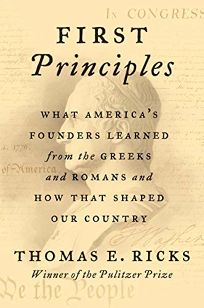
First Principles: What America’s Founders Learned From The Greeks And Romans And How That Shaped Our Country


I loved this book, because it’s all about the stuff that fascinates me about the Founders, particularly Jefferson. Does not necessarily make it for everyone. But if you wish you read Latin (or if you do and wish that everyone else did, too).

One of the central claims is that the early period examined – sort of late late colonial to the early 1800s – was heavily influenced by Roman and Latin history and philosophy. Later, as ideas of classical virtue declined, Greek to precedence.

He closes with an epilogue that addresses contemporary issues, including Trump, and how classical learning, especially Latin, can help.

While I don’t disagree, he never properly made that case in the previous two hundred odd pages. Too bad.

Confounding Father: Thomas Jefferson’s Image In His Own Time


I am not sure the McDonald’s book is quite so different from other biographies and studies of Jefferson as he thinks, was one thought that occurred to me as I read Confounding Father. Really, in trying to show how Jefferson is seen in his own lifetime, he is going over things I have read previously and I do not really see a very different shine on any of it.

Which is not to say that it isn’t a good book on the great man with interesting things to say.

He credits Jefferson’s rise to fame in part, at least, to Hamilton’s constant, public attacks on him, which served to elevate him as the leader of a certain democratic ideology, which I have read before, but which he describes in greater detail that I have read before.

The image of him as the philosopher on the mountain began, by this account, in the late 1780s (and has persisted to this day), but one of the things that comes up repeatedly is how little known he was for his (disputed) authorship of the Declaration until probably the 1790s and how much that was actively promoted by Jefferson himself, albeit in a slightly roundabout fashion (by contacting what we would now call thought leaders and gently letting them know about his key role and helping elevate the document to a place which it had not held before).

The best section by far is on the elections of 1796 and 1800. Specifically, on how electioneering took place. The descriptions of letters going back and forth and the wars taking place via partisan newspapers… it’s all the sort of thing that I love (he writes that in 1800, printers circulated 250,000 newspapers, pamphlets, and books each week in America, truly astounding number, greater even, I wager, than the amount of Harry Potter fan fiction produced last year). How the (now known to be true) tales of his sexual relationship with Sally Hemings circulated in the media even gets its own chapter.

So, in the end, it was a decent, if not terribly deep, biography.

The Four Horsemen: The Discussion That Sparked An Atheist Revolution


The title is writing checks that this transcript can’t cash. Or maybe it did. Maybe this banal festival of self-satisfaction did spark a revolution of people who think that reading Sam Harris makes you smart.

The thing is, I find half of the participants to be smug, shallow t—ts. Dennett is a legitimately fine philosopher and Hitchens one of the great raconteurs of the last fifty years.

But Dawkins cashed in his well earned fame from his early work as an evolutionary biologist into a second career as a low rent Jordan Peterson and Harris has been a first class a— for many years.

The format lets no one get a real head of steam going and if you’ve ever watched the video, you can see a progressively drunker Hitchens get frustrated at how boring his compatriots are.

I hadn’t any desire to read this, but my child and I were at the library and I wanted something to read while she did her thing, so looked to see if this branch had any Hitchens and they did… sort of. Best thing I can say about this: it’s short and fast to read.

BadFaith: Race And The Rise Of The Religious Right


This book does not tell a new story. It is commonly understood that the evangelical political movement did not organically organize around opposition to abortion, but was woken from its Benedictine slumber by rulings that eliminated tax exempt status for whites-only schools, better known as segregation academies. Abortion was picked as the issue to speak about more publicly because the real inspiration was rather icky.

What is interesting is that Balmer grew up within the movement and has personally spoken with key figures like Paul Weyrich and was present for someone of Reagan’s less subtle dog whistles. It’s a short book, but while not an exemplar of style, does provide a pretty interesting and often insider’s view of the meetings and events that led to the evangelical movement becoming a right wing political movement, leaving behind, along the way, the social justice teaching of Christ.

Radical Hamilton


This… was a disappointment. I know Hamilton is having a moment, but this book didn’t quite seize on it.

The unique insight, supposedly, is that Hamilton’s insufficient to recognized Report on Manufactures is the key economic document for understanding the man’s rare genius. Yet despite saying constantly how important that work is, it is not properly discussed until something like 2/3 of the way into the book.

The book feels just sort of… thin. Yes, a connection was made between his biography (especially his service in the Revolutionary War), but I don’t know. I wanted more. I expected more. Hamilton was a prophet of government involvement in the economy and of industrial strategy (if there was an interesting insight, it was the connection between Hamilton’s ideas and the industrial policies of Japan during the Meji era).

Finally, he keeps using the word ‘dirigiste’ to describe Hamilton’s position on virtually everything. I mean, a lot. He uses it all the time. The constant use is like someone who has just discovered a word and decides to keep using it, rather like when my child learned to spell and use the word ‘anxious’ and it was her go to adjective in virtually any context.