Francis Fukuyama & ‘Children Of Men’


As part of series called Future Tense, I dragged my better half to see the movie Children of Men, followed by a brief lecture/Q&A featuring Francis Fukuyama (who actually introduced himself as ‘Frank’ Fukuyama; nothing intrinsically weird about that, but it did strike me, because I only know him as a sort of public intellectual and semi-repentant neo-conservative.

I loved the movie when it first came out, though I spent almost the entire movie on the verge of tears. This time, I was able to appreciate Clive Owen’s wry humor (and also accept that he would not have been a good James Bond; while Daniel Craig added a wonderful element of questioning Bond’s existence, a Clive Owen Bond would have been entirely too despairing).

Let me first admit that I have never read anymore longer than a magazine essay by Fukuyama. Yes, I am the guy in DC who does not own The End of History, in case you were wondering who that person was. Mostly because I know him as a neo-conservative/neo-liberal (hint: they’re the same thing), even though I also know he has backed off those tendencies over the last decade.

But that doesn’t mean I wasn’t interested in hearing what he had to say.

He was surprisingly religious and, as a moderator in a Q&A, he took care of the perennial issue of ‘let me ask a question that is actually a long statement intended to show how smart I am but which really shows that I once read an article from a two year old copy of The Economist while waiting to get a crown replaced.’ What he did was to give a brief lecture and then ask a question, so at least the people were supposed to speak and ramble.

While he asked several questions, they were ultimately about what the world might look like if there were no future. While I resisted the temptation to raise my hand and ask to be heard, I will admit that I had a rough idea of a comment in mind. I thought of de Sade’s Philosophy of the Bedroom. Specifically, I thought of that weird interlude when one of the characters suggests they pause their orgy and read an essay. You can google this. My point is that he talks about the death of God, which is the death of the king during the French Revolution. By executing the king, revolutionaries have killed the idea of order and limits coming from a higher power and they should accept that they have made it so that nothing is forbidden anymore. My insight from that is that the death of God can be something besides just a loss of faith (or an enormous, otherwise omnipotent being feeling dead from the sky), but also be something like, say, the loss of fertility. And then, in the words of Uncle Billy Burroughs, everything is permitted, nothing is forbidden.

Fukuyama also told me something I didn’t know: the title comes from the King James Bible’s translation of Psalm 90

Thou turnest man to destruction; and sayest, Return, ye children of men

It’s a prayer by Moses, by the way. And Fukuyama put in a nice plug for the King James version, telling folks how much they’re missing when they read those silly ‘modern’ language versions.

Church


About a month ago, my better, my parents, and I visited the ancestral homeland in rural Arkansas. A bit of a culture shock for my better half, as a POC and an immigrant, to make her way there, to say the least.

On Sunday, three of us (father, wisely perhaps, stayed in) went to a pentecostal style church with other members of the extended family.

I was kindly warned by other family members (ok, by my mother) and passed on some of those warnings to my better half.

But I didn’t think much of the warnings. I had, after all, been the pentecostal and evangelical churches before. Many times, in fact. Those were all African-American churches, and I didn’t realize how big a difference that would make.

The service itself (a little odd, for someone raised in the Episcopal tradition and presently an imperfect Catholic churchgoer) lacked ritual, but was, instead, twenty minutes of music and nearly two continuous hours of preaching.

Ahh… the preaching.

I give credit to any person who can pontificate (pun intended) for so long, but the content was absolutely horrifying to my own spiritual/religious/faith sensibilities.

The black prophetic tradition that I have encountered, even when talking about things that are wrong in the world, is ultimately, a positive one. Dr. King noted that he might not make it to the mountain, but the focus was not on that, but on the fact that the mountain was there and within reach of humanity.

For this (white) preacher, the focus was on despair and the negative. Yes, the positive (salvation is attainable) was mentioned, but the focus was on the negative. Same content, if you will, but emphasis matters. Oh, does it matter.

For most my time as a Catholic, I’ve had the fortune to have a wonderful sermonizer at the pulpit, in the form of a jovial priest named Father Byrne. Like most priests I have met, he’s a happy guy (based on my small sampling, job satisfaction seems through the roof for people who have taken orders). His sermons often opened with a challenge, but quickly moved to a loud and happily declaimed declaration along the lines of, “But I’ve got good news for you!”

The contrast was stark and, ultimately, horrifying to behold.

My better half luckily skipped the bible study before the service. Luckily, because there probably would have been altercation had the same comments been made while she was there as were made while she wasn’t (and I have to suspect that the person who made the most reprehensible remark lacks the self awareness to have picked up on the fact that saying what she said around a POC would be no less inappropriate, but wildly more personal offensive).

You’re probably wondering what she said, right?

Somehow, racism came up (along with the impending collapse of civilization, which one can’t help but feel they interpreted as ‘white civilization’) and a woman told the group about how her apparently perceptive/prophetic grandfather had, in the 1950s, predicted an eventual race war between white and black.

Now, a little reflection on that story might lead one to ask, what might have been happening in the 1950s to lead a white man in the South to say this?

Could it be a nascent civil rights movement? Could it have been early moves towards integration, like Truman’s integration of the military or the 1954 decision, Brown v Board?

But every seemed quietly acknowledge the woman as having made a valid point of some kind. Or maybe, like me, the rest of the attendees were cowards who said nothing.

I read this conversation between the poet Jenny Zhang and Nate Brown wherein a story is told about teaching a workshop where someone presents a story about several white college students in a mostly white town who encounter a black man who is, in the story, referred to/named as ‘Black.’

The teacher tries to drive the conversation towards some kind of dialogue about that, but no one seemed to get that referring to the only POC in the story by their color as being at all problematic.

That struck me, because I couldn’t help but think back to that moment at bible study… did the woman never stop to think that there might be more to this sixty year old prediction of a race war than mere insight?

And, once again, I call upon the wisdom of this line:

When you’re accustomed to privilege, equality feels like oppression.

And Yet…


9781476772066The most recent (though probably not last) of the posthumously published collections of Christopher Hitchen’s essays lends itself to a sort of narrative arc, as the pieces inch closer to his terminal diagnosis with esophageal cancer and the reader’s mind naturally tends to see relationships (prophecy?) between his death and the chronologically later essays.

As someone who spent the first five years of the new millennium as a professional political campaign professional, the political essays around the 2004 election and shenanigans in Ohio were a painful reminder of a time that, until my memory was sparked, felt very long ago. Pleasingly, those and other discussions of then current events from the middle of that decade did not feel as dated as they could have.

His book reviews – at their best, excuses for lengthy rambles that show off, but provide the best platform for Hitchens ‘holding court’ – are the highlights, especially the long ones on biographies of Che Guevera and V.S. Naipul (Hitchens shows off his Britishness by referring to him as Sir Vidia).

It’s no secret that Orwell was a touchstone for Hitchens. As an essayist, he is often compared to Orwell; and I have often heard Orwell described as the great English essayist of the twentieth century.

But what have you read by Orwell? I’ll wager, gentle reader, that it doesn’t extend beyond his best known novels, 1984 and Animal Farm. And if you have read an essay, it was probably that short one he penned on the proper way to make tea. While an admirable tidbit, hardly what reviewers are referring to when they praise Orwell the essayist.

My point is related to a question that came to me when Hitchens died: how long will be remembered?

Having not written a pair of timeless novels, who will read his essays, beyond a handful of academic scholars, in twenty years? His reach will be less than that Edmund Wilson wields today (which, let’s not kid ourselves, isn’t much). His book length works are too timely, methinks. Maybe Letters to a Young Contrarian will be read, but it feels to self congratulatory to me to be the source of long lasting, posthumous relevance.

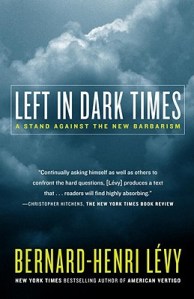
‘The Left In Dark Times’ By Bernard-Henri Lévy


9780812974720I bought The Left in Dark Times because I wanted to read something by Bernard-Henri Lévy and I thought that this book, rather than his reportage/current events style books, would be a good introduction to his actual thinking. While sometimes called a philosopher, I’m not really sure it applies, but I wanted something vaguely rigorous by him (which, as it turns, this isn’t, exactly).

You may know Bernard-Henri Lévy (sometimes known as BHL; he’s that famous in France) as that rick looking French guy on TV with the leonine mane of grey/white hair, dark suit, a white shirt that is always unbuttoned two buttons below what is appropriate to the situation, yet always staying above the critical belly button line.

The Left in Dark Times feels terribly dated. It is something from a time that feels very long ago; before the ‘Great Recession,’ before the more recent global economic contractions (Greece, China, etc). Before we were expelled from an economic eden where risky trade and capital entrepreneurship would lift all boats, if we just let it. In this book, economics aren’t a ‘thing’ at all.

The left is in dark times because, he writes, economic democratic-socialism has been, somehow, disproven, by the good times of the early and mid noughties. For him, the true Left (capital L) is in international humanitarian interventionism. Which is not, in itself, bad, but now, things feel so tied to the economy as causing so many humanitarian problems through indirect means. He scoffs at the idea of a malignant economic imperialism and colonialism, but these days, their ill effects feel all too true.

Let’s just say it: his Left feels more like neo-liberalism. The vapours hanging over his exhortations are pre-lapsarian, before Tony Blair and New Labor fell from grace. We can no long say, can we, that humanitarian crises are unrelated to the failures of unregulated, neo-liberal, rentier capitalism.

He writes a lot about the anti-semitism and the ‘Palestinian question.’ I agree with him on a two state solution, but I don’t agree with his positioning on things like BDS and attitudes towards Israel, but as a Jew (BHL, not me), I give him some leeway here, especially since I am not so blind as to understand that anti-semitism is a much more pervasive problem in France and in Europe, in general, than it is in America (or is worse in America than I know? with Trump’s appropriation of anti-semitic imagery, is it an underappreciated issue here, too?).

He ends (not really; there’s a meandering and surprisingly long epilogue) with a passionate defense of the Universal, by which he means universal human values. He does defend Europe, but is careful not to mean merely an extension of an idea of western values to the world. His Universals are, though, the justification for interventionism. Reading just made me sad, coming on the heels of the Brexit and dissolution of trust between northern and southern Europe (really, between southern Europe and Germany). He becomes oddly religious. Or almost religious. He defends (sort of, and then backs away) Jewish concepts of prophecy and the prophetic tradition as linked to the Universal. I like one phrase, near the end: “The Universal works more by influence than incorporation.” I can get behind such a Universal. It feels kindred to King’s moral arc.

Ultimately, he is a Hitchens like figure. Tied to a time and a place and an ideology that makes him more than normally timely and less than normally timeless. And, while it might be the translation, he lacks Hitchens’ genius for scintillating polemics that make him, still, a worthwhile read for students of essayistic style.

‘Writers that only add their own verbiage to existing knowledge’


I was talking with a friend, about a mutual acquaintance who the friend of our good friend (did you understand that sentence?).

I don’t like this acquaintance. Never have. Just something about him.

He writes for blogs in a recognizable style of pseudo-ironic mockery. His writing, like much in the genre, can be funny.

But I was trying to articulate why that wasn’t enough. It’s not enough to mock the silliest and most mock-able aspects of modern life (usually politics) when it’s not combined with research and and investigative reporting of some kind.

Then my friend summed it up:

It’s writing that only adds its own verbiage to existing knowledge.

Quite possibly I have been guilty of that. Actually, I can say for certain that I have been. But it’s also becoming a problem, I think. I’m not talking about a Facebook post or meme, but writing that theoretically purports to be more – to be an essay, a polemic, an article.

Anyway. That’s my rant for today.

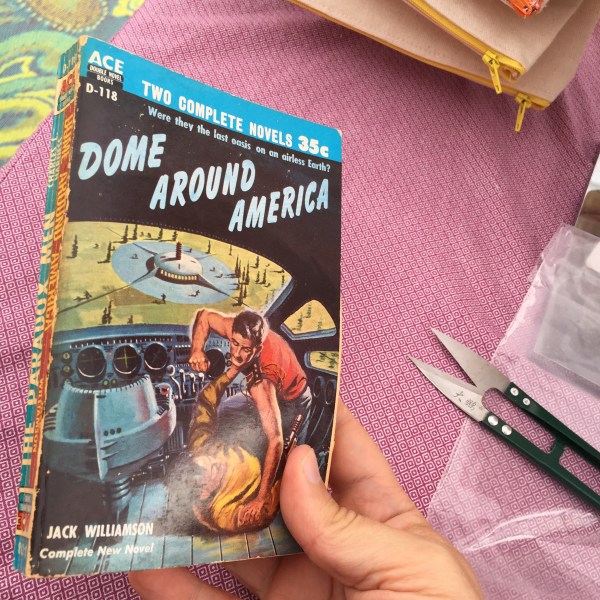
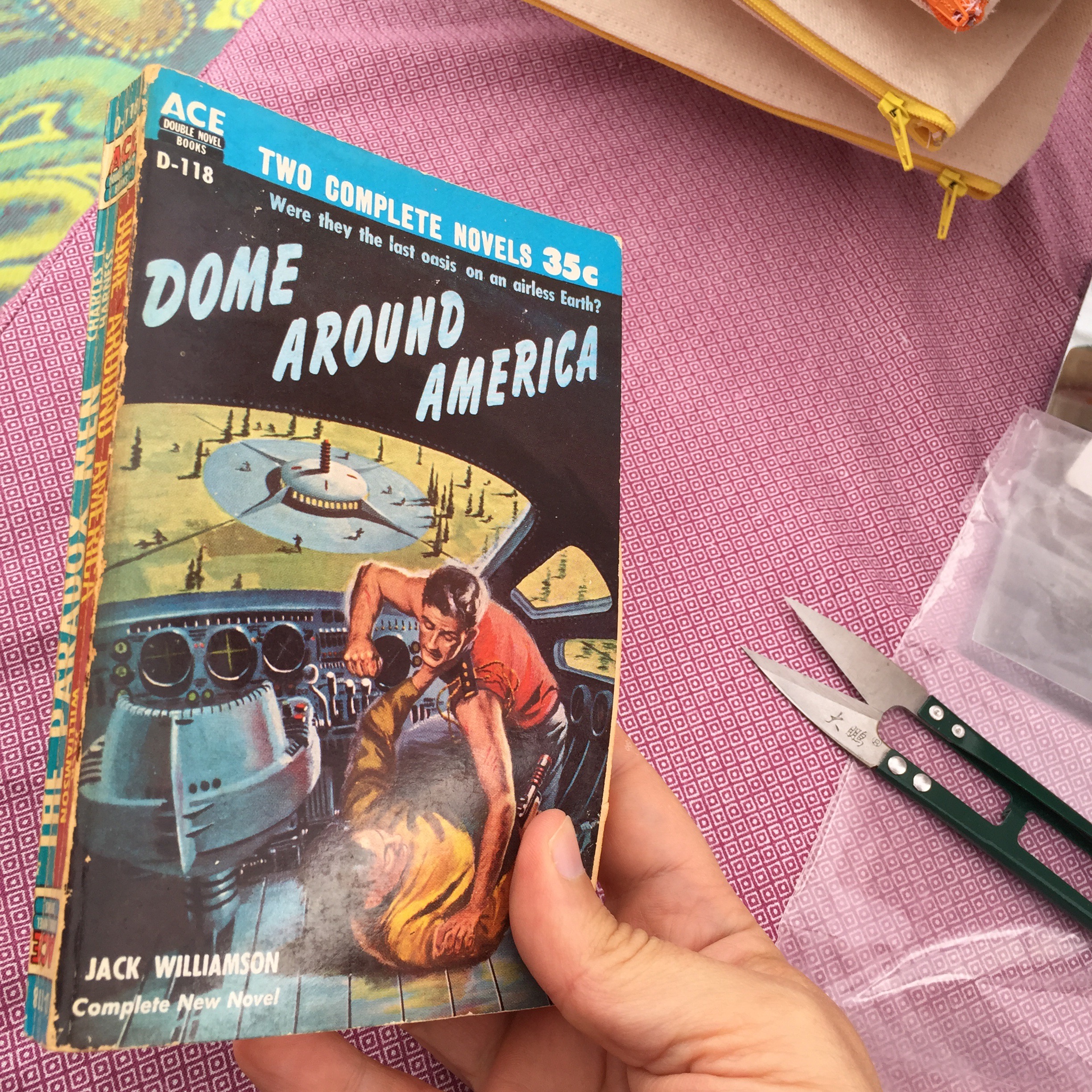
‘Dome Around America’ By Jack Williamson


The best part of Ace Doubles are a return to a time when a science fiction novel didn’t have to be heavy enough to crush a man’s skull. One hundred to one hundred and fifty pages of fast moving plot.
I’ve noticed that a lot of these novels seem to have radical changes in plot in the final third – an unexpected crisis/event that acts as a kind of reverse deus ex machina. Saw the same sort of thing in Agent of Chaos and Master of Life and Death.

Anti-communism was a theme. At first, it seemed like it was all prepped to be a criticism of American style capitalism, but then… it wasn’t.

I’ve already started the other side, The Paradox Men, and it seems much more imaginative.

Christians In America Are Not Being Persecuted; Or, The Only Christians Being Persecuted By Wal-Mart Using ‘Happy Holidays’ Signs Are Exploited Wal-Mart Employees Who Happen To Be Christian


I am a Christian and we are so ridiculously far from being persecuted in this country, that it’s… ridiculous.

The major holy days of my religion are national, federally recognized holidays. Spring break is entirely designed to make sure people have time off during Easter!

Yom Kippur and Songkram are not holidays. Americans do not suddenly feel compelled to say “happy holidays” to each other during Ramadan, nor are we deluged with signs and holiday sales during it.

And about that whole “Merry Christmas” versus “Happy Holidays” b——t… the entirety of non-Christian America is basically forced to recognize Christmas for an entire month, at least, so “Happy Holidays” does not represent an attack on the Christian faith, but rather a recognition that maybe we could make the state sponsorship of a Christian holiday maybe, slightly, but not really less exclusive of non-Christians. And, frankly, if the Wal-Mart stops using the name of a holiday celebrating the birth of my faith’s messiah to promote the sale of lawnmowers and to celebrate an exploitative system, well that’s okay with me.

The entirety of supposed ‘persecution’ of Christians in America is a response to a half-hearted effort to make our culture less overwhelmingly biased towards one religion.

‘When you’re accustomed to privilege, equality feels like oppression.’


I just heard that line for the first time the other day, but, good Lord, does it pithily explain so much resentment and misunderstanding.

It explains, in part, the rage of so many white (and, yes, racist) Trump supporters who see centuries of white privilege being eroded by a growing non-white population and a culture less overwhelmingly (though still very overwhelmingly dominated, in many very important ways) by the white population.

It also explains why so many white folks feel that ‘reverse racism’ is a problem (because, it’s really not; not even remotely).

Wish I’d thought of this phrase myself.


It Is Not True That The Democratic Party Has Moved To The Right


I keep on hearing people complaining about how far to the right the Democratic party is, when the Democratic party has moved steadily to the left over the last several years.

Go back in time (and you don’t have to go back very far) and the Democratic Party had no voice (nor even really acknowledged) when it came economic inequality or police violence against communities of color. Democrats didn’t support gay marriage or transgender rights; they didn’t stand up for millions of hard working, undocumented immigrants. Democrats passed national healthcare reform that very nearly would have, had not the Supreme Court and a group of Republican governors and legislators (who clearly don’t care about the health of their neighbors) c—–d in the punch bowl, covered nearly every America.

You want Democratic electeds to move further to the left? That’s fine and I totally agree with you! I have family living in the rural South who are only able to get live saving medical care because of Obamacare, but you can bet I want Medicare for all extended to them. We raised taxes on the wealthiest household in America, but I still want higher taxes on capital gains.

But let’s confuse wanting more with having gotten nothing.

‘I Vote The Person, Not The Party’


If you hear someone use that phrase, you know that they overwhelmingly vote for candidates of a single party. This is just something people say and it goes to why the idea that independent voters are important is a myth.

Personally, I hear that phrase most often from people in my extended family who know that I’m a yellow dog Democrat and a former political operative for Democratic candidates and don’t want to say, flat out, they are hard core Republicans or, maybe, and this will be important, don’t want to believe they are party line voters. But when I ask, after hearing that phrase, for the name of the last Democrat they voted for or for the names of the last six presidential candidates they voted for… well, you get the picture.

The overwhelming majority of people who declare themselves independent actually vote almost exclusively for candidates of a single party at the same rate as people who actually declare a party. The majority of people declare themselves independent for a couple of reasons, both related to pride. Being politically independent fits in with an image from American mythology. It is also a way to distance yourself from a political party whose name is in the mud.

Mitt Romney won ‘independent’ voters because the GOP brand was not great, so a lot of folks who might previously have declared themselves Republican, claimed to be independent. But they still voted Republican.

Here’s another prediction. The ‘independent’ vote will be close in November. Trump will either win or come very, very close in the independent share of the vote because a lot of… shall we call them yellow dog Republicans? …will still vote straight ticket GOP, but will be embarrassed of their true party affiliation because, well, Trump is freaking embarrassing.