I’m Watching ‘Outlaw Star’ While The Missus Is Away


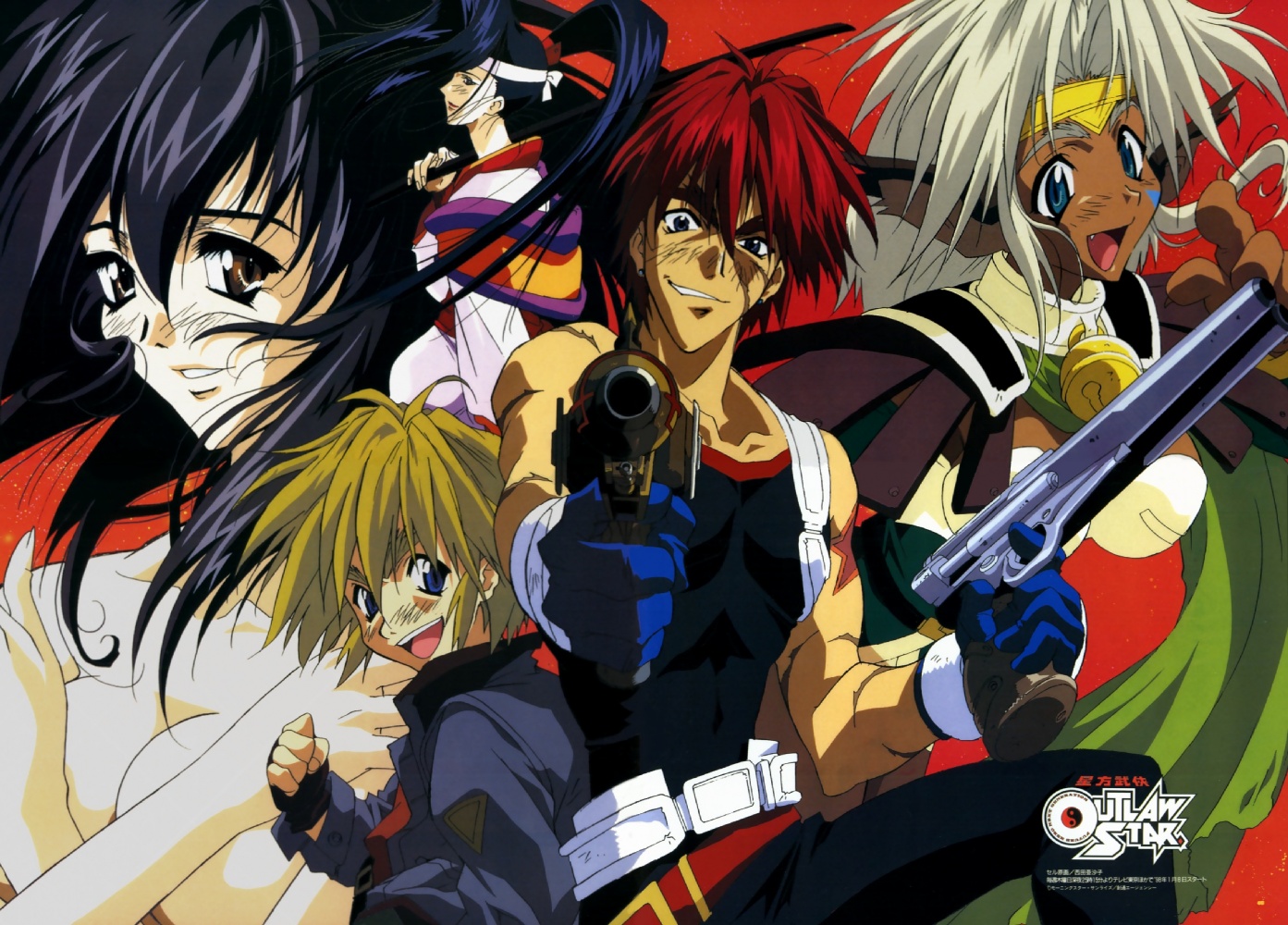
Outlaw StarI’ve been taking advantage of some time as a single man to watch DVDs of my favorite bit o’ japanimation: Outlaw Star.

If you’ve never heard of it, don’t worry. I gather it’s not widely known.

So, while walking back from the Kennedy Center (I’d just seen Anna-Sophie Mutter perform), I got myself in the mood to watch an episode or two (out of a total of twenty-six) and thought about the gender roles. Or rather, depictions of women.

The primary female protagonist (Melfina) is typically young, school girlish, and large eyed. Most of the time, she’s little more than that. An innocent, virginal object who desires (and is eventually, but only eventually, desired by) the primary male protagonist (Jean Starwind), in the seventh episode, while she’s still dealing with being a  ‘bio-android’ (I gather, essentially human, but with some subtle differences and also grown artificially, rather than born) and not having the memories to go along with her mental age, she falls asleep on Jean’s shoulder. His young friend, Jim Hawking, hits him on the head with a frying pan in looney tunes fashion, when Jean gets a little, shall we say… fresh with the sleeping Melfina. Jim then cuddles up with her and says, ‘She’s like my mom.’

Never before or again are his parents or how a ten year old (roughly)  boy came to be living with a shiftless twenty-something bounty hunter, but that one little moment sets up a rare and totally contrary way to view Melfina (who is otherwise a generally sisterly figure – until she becomes a lover figure, but even that is portrayed in a somewhat platonic fashion: she and Jean are friends first) and is one of the few times when Jim’s needs as a child are acknowledged.

There is a beautiful assassin named Twilight Suzuka. Actually, that should really just be Suzuka, shouldn’t it? She is beautiful, but towards the very end, she meets the man she most wants to kill… and he is wearing her face. He wears baggy, shapeless, sexless clothes, but without those other signifiers and a masculine voice, her face is perfectly adequate as  a beautiful young man. She also very noticeably avoids the question of whether she loves Jean. She promises an answer later, but never gives it. But why does she stick around?

Well, there we are. I’ve just made a big deal of a sixteen year old cartoon. Whatever. I like it.

Midweek Staff Meeting – Stop Screwing This Up!


dnd_products_dndacc_1eD3_pic3_en

Darn hippies aren’t doing it right!

It means that we’re going to hell in a hand basket!

Please be wrong.

No. And (if yes), the American reader.

Book of a lost village.

Ice-T is not a fan of Dungeons & Dragons.

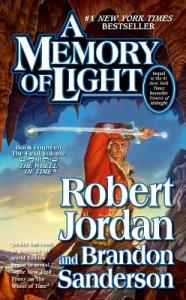
‘A Memory Of Light’ By Robert Jordan/Brandon Sanderson


9780765364883It’s finally over. I’m kinda sad. Part of the sadness comes from the knowledge that I’ve never read these books again. Basically, I will probably never have the time. Fourteen books, averaging over 800 pages each… not gonna happen. I have yet to read the complete works of Dostoyevsky and that has to be a priority over re-reading the Wheel of Time series. Still. A bit sad.

This one is also only a bit over nine hundred pages, which, I guess is an improvement.

I want to go back to something that’s actual from the previous book, involving how the Children of Light (a kind of radical/reactionary military society that’s very unyielding) somehow agreed to work with a person totally antithetical to their beliefs. I know that the person (Perrin, if you must know) is ta’veren, which means that things just kind of happen around him (the Pattern bends around him, to use Wheel of Time speak) and there was good faith authorial effort to show some development in the Children of Light, but it was just too damn fast. I don’t buy. I didn’t buy it then. And this book is reminding me how I didn’t buy it.

But, the book does one thing very, very right. It picks up speed very, very fast. Very. Fast.

Less than halfway through, it turns into an enormous set piece, with three major, multi-day battles – not including the  more individualistic, ultimate showdown between the mythic hero and ultimate evil. Sanderson shows a good touch for this sort of thing (his battle scenes in the Mistborn Trilogy were pretty good, so it’s not unexpected, but it is appreciated). The action is non-stop, exciting, and propulsive. The battle scenes, at least.

Rand al’Thor, the great hero of the book, has his final confrontation with the nebulous evil that is the ‘Dark One.’ And it’s a little disappointing. Parts of it seem, I kid you not, ripped off from The Last Temptation of Christ. While one can figure out what happened (Rand won, but how is the question) and what was done and the reasoning, it was not clear. Not in a ‘making the reader think’ way but in a ‘sloppily rushed to a not very well described conclusion’ way. There is some irritating deus ex machina regarding some of the main characters and the way in which they survived. And the very end, with Rand sneaking off while (most) everyone thinks he has died and is being burned on a pyre… well, what is the body being burned? And what is he doing to do about his two unborn children? It’s… I don’t know. Some big enemies were brought into the fight without a real explanation of why they were there and what they were and what exactly was motivating them.

But, hey. I finished. Fourteen freaking books. I took the last of them to the used bookstore the other day (not the final book, which I bought in hardback; not used bookstore wants hardback genre fiction, so I will likely donate it to the library). A part of my life that began in 2009 is over and that’s good and bad, but certainly not something I regret.

Monday Morning Staff Meeting – Yes, But Was He Any Good?


This article goes into the big question when it comes to J.R.R. Tolkien: was he any good as a writer? The article says… maybe. It’s all a bit wishy washy. And I object strenuously to the negative criticism of his poetry, which I loved when my mother sang to me while reading The Hobbit out loud to a seven year old me. I think that there is also an argument to be made for a little pomo gamesmanship in his writing, if you look at it as having been written in an imaginary language (based on Anglo-Saxon and pre-English languages from the British Isles) and then translated into English. Rather as if someone wrote an epic novel in Klingon and then translated it into English. And, in case you hadn’t figured it out yet – I’m a fan of Tolkien.

Neo-liberalism and negative solidarity.

UC Davis has sold out to Amazon.

Emile Zola: novelist, polemicist, pamphleteer… influential art critic?

There are Crystals in Stone and Pressure in Snow So Are Snow and Stone the Same

Allen Ginsberg was many different from the others.

I’m glad that some newspapers are still covering poetry. Even if it is on the other side of the country (Dear WaPo, would it kill you to write more about literature and poetry ’round here? ‘Cause there’s a lot of it, most of it having nothing to do with poorly researched, pseudo-timely musings on the politics of six months ago).

628x471

Dungeons & Dragons: Part II


dnd_products_dndacc_1eElementalEvil_pic3_enI’m just going to keep on recording the events of my Dungeons & Dragons campaign. You will probably keep on not reading it, but… I don’t know. Maybe someone will. Or no one will. Or just me.

The party took a boat, along with a helpful gnome named Peleg and an obnoxious, arrogant elf named Aelat, to the capital city of Hazakis. Inside the city, Teague, the cowardly, but also passionate, venal, cruel, and impulsive bard, managed to insult the emperor by suggesting that the Sunward army was doomed. Fortunately, after the party was summarily thrown into prison, some wiser heads prevailed and smuggled the party out and sent them to mainland to determine what was behind the invasion. The invaders had already been determined to be the Hoshen, a warlike nation of humans not normally known to be seafaring; as well, a strange symbol had been found on an amulet worn by some leaders: three parallel, vertical, wavy lines.

Teague, Regdar, and Finian set off for the prosperous and tricky city of Amran, the Sunward Empire’s main trading partner, hoping to meet up with an agent of the Sunward Empire who had been stationed in Amran for many years…


20140125-103720.jpg

Midweek Staff Meeting – You Are Doomed To Failure


The soul crushing poverty of the humanities’ major has been overstated. Slightly. It’s not so bad, really.

But since you don’t read anyway… meh.

Can I just say that this a great little list of why D&D is awesome? You’re welcome.

So, yeah. The Gulf is still screwed. Good times.

deepwater_horizon.jpg__800x600_q85_crop

Happy Birthday, Dungeons & Dragons


dnd_products_dndacc_45390000_pic3_enSo, today is being celebrated as the fortieth birthday of Dungeons & Dragons. It’s a bit of an approximation because the nature of the game is that its creation was a process. But, what the heck. Happy birthday.

In honor of this momentous day, I am going to subject anyone who bothers to read this to a lengthy description of the campaign I have been running. Suck it, reader. Or don’t. Click away. That’s what free will is all about.

A halfling thief named Finian, a human warrior named Regdar, and a human skald named Teague were serving in the military of a small, peaceful, multi-cultural kingdom that called itself the Sunward Empire. The king is a gnome and is the spiritual representation of the sun god. His consort is a human and is chief priestess of the wind goddess. Primarily supporting itself on a combination of trade between the eastern and western continents of Loe and Goa, respectively, as well as some mining and tropical agriculture.

The party is part of the small garrison of the Throughward Isle, which is the easternmost island and also has the largest iron mine in the Sunward Empire. After a quick introductory fight between the characters and some giant crabs in the shallows, there was an alarm sounded and the party ran to the main docks.

A group of well organized, well drilled human soldiers disembark in quick order. After a few minutes (’rounds’ in D&D parlance), it became clear that the small garrison would soon be overwhelmed and the garrison commander sent them to escort one of the island’s leading citizens and part of its ruling council to go to the fortified island/city of Hazakis to warn the emperor. They were lead to the entrance to the mines by a gnome named Peleg (who would remain with the party for a long time, before Finian cut off his scrotum and left him to bleed out on the street, but that’s another story).

In the mines, they are ambushed by some humanoid frogs called bullywugs and first see a symbol consisting of three vertical, wavy lines (which would reoccur throughout the campaign).

They emerged on the other side of the island and took a boat to the see the emperor.

‘The Hobbit: The Desolation Of Smaug’


The second part of The Hobbit movie trilogy is much more fast paced than the first. Unlike the Lord of the Rings, where the second movie was also the best, I felt this installment lacked a little something compared to the first. Characters got a little short shrift throughout; I felt we hardly heard from Bilbo, the titular Hobbit, at all!

And here is where the addition of new material, not in the book, really shows through. I don’t mind, but it also reminded me of what a perfect little gem the novel is. The movie, unlike the book, is burdened with the history of the later/earlier movies. It must match up with story told in the Lord of the Rings movies, whereas the novel, while taking place in Middle Earth, was content to be a fun adventure for children (and for adults to read to remind themselves of childhood). The ring could just be a magic ring that made the wearer invisible, but this movie cannot escape the knowledge of what the ring will in the future continuity of the story and, more importantly, already was in movies that were released a decade ago.

Benedict Cumberbatch as Smaug is too restrained by the technology that modifies his voice for him to really be the villain I know he is capable of being.

But it’s an exciting ride, nonetheless, and it’ll be a long wait until next Christmas to see the final installment. And I more eager than ever to re-read The Hobbit, which was first read to me by my mother when I was seven years old.

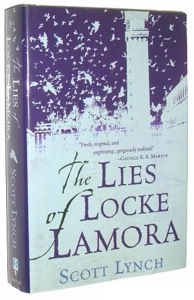
‘The Lies Of Locke Lamora’ By Scott Lynch (New Year’s Resolution Book Forty-Five)


20131230-144059.jpgWell , what do you know? I finished one more book. This only happened because of a combination of getting sick and reading in bed and also of insisting that it is not rude to read in front of everyone if no one is speaking a language I can understand.

But onto the book!

This was a book I had read about somewhere as a good piece of fantasy and which I had filed away in my head, so I snatched it up when Barnes & Noble offered it cheap for my Nook.

The novel takes place in the well and interestingly sketched city-state of Camorr. Lynch makes the decision to do his world building by dropping names (Elderglass towers) and descriptions naturally in the text, as if the reader already knew about these things. The great William Gibson, at his best, does this well. Lynch isn’t bad and he’s helped by the fact that he cribs heavily from Fritz Leiber’s immortal city of Lankhmar and the undying (literarily speaking) duo of Fafhrd and the Gray Mouser. This isn’t a criticism, necessarily. After all, you can’t write wry, picaresque, roguish fantasy after Leiber and not reference the great man. And because any decent reader of fantasy worth her/his salt will have read those stories, it makes a useful short hand for the reader.

The meat of the plot takes a while to get going but the getting there is fun.

I was a little vexed that the titular Lamora decided to settle the final issue with the major villain via a sword fight, despite being notably mediocre in a fight. It seemed out of character for him not to have had a better plan and also took me out of the story when he acquitted himself decently well (though he won by a trick, of course).

It’s the first in a series but it doesn’t end on a cliffhanger, which I appreciate, though not for reasons that will make the author happy. You see, I loved powering through this book and enjoyed it immensely… but I’m not overwhelmed by a desire to return to his world.