Growing Up On Anime


As a teenager, we spoke a lot about anime (which, in those ancient days, we sometimes also called ‘japanimation’) and also (though less) about it’s printed sibling, manga (though we usually just called them graphic novels; at that time, we usually just used the term ‘manga’ to refer to either the anime or graphic novels with nudity). I can’t speak for my friends, but I’m pretty sure that, I, at least, pretended to know and have read and seen more than I actually had. But that’s normal for a teenager, I think.

But certainly, seeing Akira on the big screen at the Tampa Theatre was an awe inspiring couple of hours for me and was probably most responsible for my love (though the foundation had been laid by badly edited and dubbed shows on Saturday morning, cobbled together from various animes, given English language names like Star Blazers and G-Force).

I’m forty now and I still watch this stuff. And I get excited when my favorite ones get name checked (this one here points out some similarities between my favorite anime, Outlaw Star, and the glory that is Firefly).

While my better half was gone for several weeks, I watched a particularly embarrassing series aimed at teenagers (though I still maintain the right to make fun of grown ups who read Twilight and/or watch the movies because there is no good god viable excuse for that if you are over 18). I also read the manga (which came first) on my Nook and now it’s done and there probably won’t be anymore (thought there are whole internet sites devoted to desperately praying that there will be a third series of either the manga or the anime) and I’m unaccountably sad.

When you finish a series that has touched for some reason and you know that there won’t be anymore and, possibly even worse, you can’t go back and read it again for the first time, it’s like having your heartbroken in early adolescence because your pain is almost worse for being insensate, because you lack the age and experience to arrange in your brain into something meaningful and more fully comprehensible. I tried to go back to the beginning and even read the first volume again, but Tom Wolfe was right, wasn’t he, because I couldn’t really do it. My mind was too full of the sadness of the fact of the ending (the ending itself was sad, but not unbearably so; it was more sadness that it had ended at all) to be able begin again.

Not Dead Yet – Weekend Reading


A reading of Molière, Jean François de Troy, about 1728

Yes, that was a Monty Python reference, but I’m referring to old fashioned bookstores. Unbelievably, there is a book store in DC that I haven’t yet visited. It’s in Petworth and is called Upshur Street Books.

What? No Shakespeare! Inconceivable! And yes, that’s another movie reference.

This just sounds awesome. How can I get myself invited to one of these ‘Little Salons?’

The ‘mind’ of poetry. But, seriously – you used the Laffer Curve to prove your point? I mean, you do know that the Laffer Curve is almost completely bogus?

This is just kind of cool – a collection of short reviews of both books in Ace’s ‘Doubles’ series. I just read one with The Caves of Mars on one side and The Space Mercenaries on the other. However, there is no review of that book(s) on this site. But that’s okay. You are quite literally visiting a site – right now – that reviews both those books. There’s a search feature. Feel free to use it.

I have heard that the Philly poetry scene is pretty cool and happening. It even got mentioned on Gilmore Girls once.

Nothing short of genius will do. Genius… and no sex. Wait… what?

Typewriters I have known.

The Caves Of Mars


  The Caves of Mars is the flip side of my doublesided ‘Ace Double,’ which also includes The Space Mercenaries. Look, I’m just going put it out there: The Space Mercenaries is better. The Caves of Mars moves slowly, but interestingly through some world building and character/relationship background and building, but then speeds towards… I don’t know. An irritating and unconvincing deus ex machina style ending.

It begins with a trip to Mars that goes awry, with the hero, Ric, a space pilot and man of action, losing his arm checking out something in an ice cave for his friend, the nervous nelly scientist, Alan. They both used to be in a sort of love triangle with the improbably named scientist, Candi.

But they had happened upon some super awesome fungi that cure all your ills. But it is the clearly nefarious Doctor Krill who takes the lead on this stuff. Marketed as something called Martian Panacea or ‘M-P,’ the Law (capitalized) outlaws it out. As they say, when M-P is outlawed, only outlaws will have M-P. So there’s this plot where the disconsolate and suicidal Ric gets a secret message from Alan and sneaks into a secret M-P hideout in Mexico. Around this time, he figures out it’s a sort of cult and…

Well, let’s skip past all the bits where Doctor Krill, despite catching Ric and Candi en flagrante declicto – and I don’t mean the sexy kind, but the obviously seditious kind. But Krill basically says, ‘I’ve got my eye on you!’ and lets them go. Kind of.

Anyway, there is an alien intelligence left by a long forgotten race and Ric cunningly stops Krill’s plot to clone a race of martians to serve him by – and here’s where I’m not totally sure what actually happened – implanting his own DNA into the test tubes so that the reborn martians will now worship Ric as a god, which is, don’t get me wrong, better than Doctor Krill being worshipped as a god, but I’m not convinced this in an unalloyed good.

It had the hope of being a decent, second-rate space opera, but devolved into a not so decent, third rate space opera.

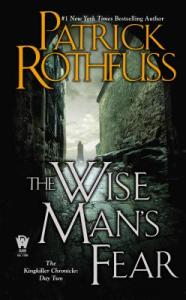
‘The Wise Man’s Fear’


9780756407919I read The Name of the Wind, I enjoyed it, so I went to the library to check out the sequel, which, except for being ridiculously long (look, people, not even Tolkien needed so many pages; you don’t need to write  door stop every freaking time), was generally better than the first book.

The main character, Kvothe, when we first hear about, is a legend who has done legendarily awesome things. Unfortunately, most of the first book was about him in school, which… I mean, that’s okay, and everything, but I really wanted to read about mythic adventures of this other, older Kvothe.

This book is still mostly about that younger Kvothe, but at least we get some hints of the future Kvothe, the super awesome magician.

But I have to go back to a point I’ve been harping on lately. All you fans of these books and of Harry Potter, did you know that someone who is a much better writer than either Rothfuss or Rowling wrote a book about the schooling and rise to greatness of a young magician, from childhood all the way to early manhood that is not only much better, but is also just a couple of hundred pages long? That’s right! You could have gotten an improved experience in only a fraction of the time and at a fraction of the cost! It’s called A Wizard of Earthsea and even if you read all the sequels (I think there are three), the total number of pages would be less than a single one of those Harry Potter free weights. And, not to belabor the point, but you would be reading books that are much, much better.

Okay, I’ll get off my high horse now.

Devil Dinosaur


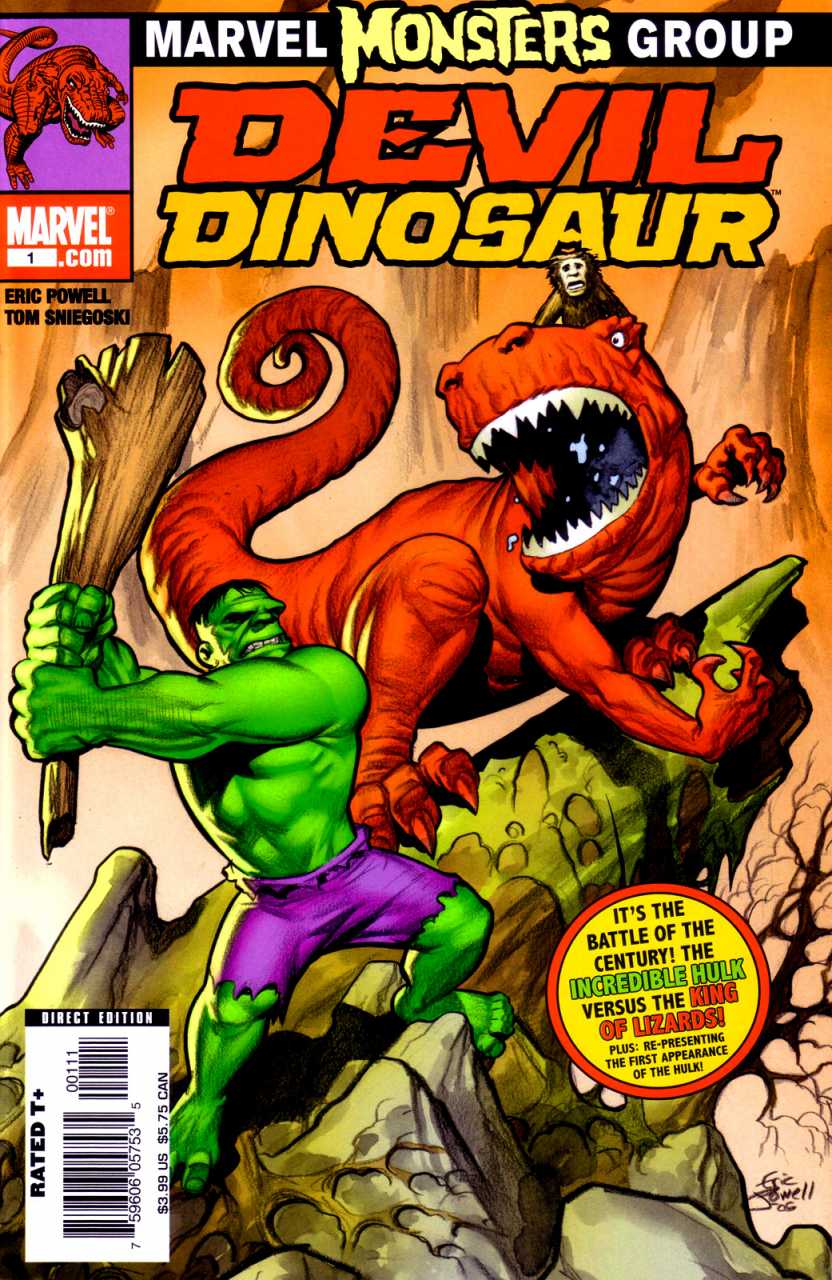
1790937-marvel_monsters___devil_dinosaur___00___fcYes, I’ve quit my regular buying of comic books, but I still make a few exceptions. In Toronto, there was a cool little comic book store/coffeehouse called the Black Canary (named after a DC Comics heroine; no superpowers, but just a tough woman).

I thought it might be a good time to look for some heretofore unpossessed (by me) Devil Dinosaur comics. I look first among the Godzilla comics (I know there was a crossover arc) and then the Devil Dinosaur box. Lo and behold, I found (for six Canadian dollars), a comic I had never read before. Super powerful aliens watch a scene from the original comics (when Devil defends Moon Boy’s people from some aggressive proto-humans) and, feeling sorry for the bad guys, give them an edge by beaming the Hulk into their midst. Hulk smashes Devil, but they think maybe they’ve made a mistake, so they give Devil extra strength and things go wrong from their, with two powerful monsters destroying the aliens’ stuff.

In the end, all goes back to the way it was.

Unlike a Devil/Spiderman crossover a few years back, this one didn’t treat Devil very respectfully. It made you realize how awesome Jack Kirby was – how in his original run, he used his artistic style to create very dynamic panels, where the action leaned forwards, towards the next page or panel, propelling things forward.

Weekend Reading – Plausible Deniability


Merritt_jpg_250x300_q85An appreciation of A. Merritt’s commitment to incorporating scientific sounding explanations in his imaginative worlds (I read a novel by Merritt called The Metal Monster; don’t regret it and will probably read some more of him, but my appreciation is more or less specific product of my particular tastes, so I wouldn’t necessarily recommend him).

“Writing about moral philosophy should be a hazardous business,” said the late Bernard Williams.

Chinese poetry is happen’, man.

It’s still Poetry Month. Read some poetry, people. Buy a book. Support a poet.

  William Shatner!!!!


in Toronto, they have stars, just like in Hollywood (and also Palm Springs). Now, if we’re honest, the Hollywood sidewalk stars are much, much cooler… but Shatner, baby!!!!!

I Had This Toy! It Was Awesome!


‘Name Of The Wind’


It’s good. But it’s not that good.

I’d heard raves about it and reviews mentioning Arabian Nights style tales within tales. So a third person limited narrative and then a narrative by a chronicler (called ‘the Chronicler’) writing down the story of Kvothe the Kingkiller. It’s not as complicated as it sounds. It is like Heart of Darkness. You can make a lot of the fact that the narrator is actually a guy on the Thames listening to someone else’s story, but there’s really no need. Heart of Darkness is brilliant and you don’t need to make a lot of that minor narrative trick to realize that it’s great. More importantly, that narrative trick has only the tiniest amount to do with its greatness.

So Kvothe is an epic figure with an down to earth nature and it starts out very much the archetypal tale of the hero’s beginning: the tragedy and then growing up an orphan with vengeance, like a hard bead of acid, gnawing at his heart.

But then he goes to the University and… well, let’s just call it Harry Potter-esque. Granted, Kvothe is a more interesting character than Harry Potter, but then so are the flushings that follow a meal of authentic Gujarati cuisine, washed down with prune juice and Guiness and then followed with a dessert of candied tamarind. I can’t say this often enough, so I’ll say it again: if you want to read about a wizard school, you will never do better than to read LeGuin’s A Wizard of Earthsea. What LeGuin does that Rothfuss does not it maintain the same tone and style for the epic bits and the schoolyard bits. Rothfuss seems to switch between classic Tolkien and some kind of mid-century tale of bright young English schoolboys and their antics, only with a little magic.

But let’s not get carried away. This is a good book. If you like fantasy, this is better than 90% of what you’ve been reading. A lot better. But don’t get fooled into thinking it’s in the very top echelon.