Ezra Pound: Canto LXXVII


Obviously, this is my first Canto for some time. Not really the best one, if you’re going to dive back in.

It starts out with some of Pound’s Gertrude Stein-like efforts to mimic American colloquial speech, like:

” I’ll tell you wot izza comin’
Sochy-lism is a-comon’

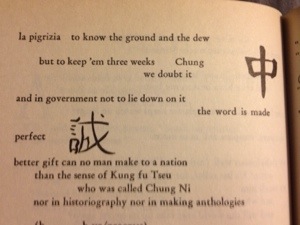
But the rest is interspersed with Chinese script and, oddly, one bit of Persian, which I believe comes with a reference to the Persian epic, The Shahnameh. There is even a little glossary of the Chinese characters, not that I entirely trust it (you can see why in the picture – ‘bi gosh’).

Most of the rest is a series of name droppings: Cocteau, Daudet, Voltair, Goncourt, etc.


20140729-190327-68607405.jpg

20140729-190329-68609018.jpg

20140729-190330-68610848.jpg

Ezra Pound: Canto LXXVI


This Canto bounces around a bit, linguistically. Splashes of Latin, Greek, French, and lots of Italian (and English, of course). Some Chinese characters whose inclusion doesn’t make sense to me. Obviously, I never understand what they mean, but it just seems that, stylistically, they don’t make sense. This is an otherwise pretty European Canto (we are in the Pisan Cantos, now, aren’t we, after all?).

Some great stuff. It doesn’t roll off the tongue, but the sounds are great. Pound’s been taking lessons from some of colleagues, I guess. Never really saw him as an aural poet before.

”  both eyes,  (the loss of)  and to find someone
who talked his own dialect.  We
talked of every boy and girl in the valley
but when he came back from leave
he was sad because he had been able to feel
all the ribs of his cow…”
this wind out of Carrara
is soft as un terzo cielo

Later:

                                     no overstrokes
no dolphin faster in moving
nor the flying azure of the wing’d fish under Zoagli
when he comes out into the air, living arrow.
and the clouds over the Pisan meadows

20140306-225716.jpg

Ezra Pound: Canto LXXV


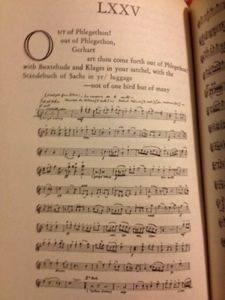
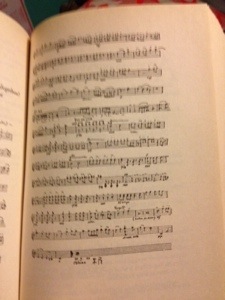
Okay. It’s mostly sheets of music. I can’t read music. Can’t even play an instrument. Not even the triangle. I’m really bad.

If you’re musically inclined, make what you will of what’s below. It’s probably something famous.

So… apparently, ‘Gerhart’ was pianist friend of Pound and he transcribed the music below, which was originally composed by Clement Jannequin for four voices. Phlegethon is one of the rivers of the ancient Greek underworld.

20140126-184956.jpg

20140126-185041.jpg

Ezra Pound: Canto LXXIV


In case it was not already obvious, we are back to reading The Cantos. So, that’s what we’re doing this year. No New Year’s Resolution, though. I don’t know if I’ll finish them. I do have other things to do – including other things to read (we’re still not done with the final book in The Wheel of Time, so lots of catching up to do).

Apparently, this is actually the beginning of the Pisan Cantos. I don’t know what the other section was. Just that it was… short.

The themes remain (Chinese characters, finance, anti-communism, anti-semitism, Italian history), but the style has changed. Not radically, but noticeably.

There’s a reference to Hemingway, which may not seem like much, by this adds a bit of autobiography that I didn’t notice before, and that’s not a small thing. Also, I feel like Pound has moved into the thirties. Obviously, this was written after the Second World War, but the earlier bits were still well within what we might call high modernism. This is still that, but I feel like I can detect some surrealist influence. The lines feel more loose, more free flowing, more driven by the unconscious. Or maybe it’s just stream of consciousness. But I stand by what I said. It’s evolving into something influenced by surrealists.

A brief reference to Tangiers pulled me up short. Was Pound connected, did he follow, was he friendly to writers like Paul Bowles and William S. Burroughs? Also, was this Canto finished when Burroughs and the Beats were making pilgrimages to that North African port city?

A mention of Leviticus XIX and First Thessalonians 4, 11 (the differing nomenclature comes from Pound). The first, Leviticus, is when God instructing Moses in how the Israelites should behave. The second are instructions from Paul. God’s instructions are lengthy and precise, but Paul speaks more generally. And passage 4:11 goes as follows:

And that ye study to be quiet, and to do your own business, and to work with your own hands, as we commanded you;

Is that a reference to what Pound intends to do, post-War, post imprisonment?

Some disparaging, colloquial quotes about Italian generals and the Duke (Il Duce? A Mussolini reference?) indicate… what? Is he mourning the end of Fascist Italy? I think that the quotes, with their lower class tone, are more likely intended to be mocking the speaker than the speaker’s subject.

And a lot of references to modern art and writers. Hemingway, I already noted. But also ‘Mr Joyce’ (surely James Joyce) and Manet and Degas…

                         (made in Ragus)  and  :  what art do you handle?
” The best ” And the moderns? ” Oh, nothing modern
we couldn’t sell anything modern.”

This is a melancholy bit. The whole thing, actually. I can hear Pound adjusting to a new world, one that doesn’t respect… him? The world he loved, he helped created (I am not speaking here of those odious politics, but of how he made literary modernism possible: Eliot, Joyce, Hemingway – all benefitted enormously from his great artistic generosity; maybe be wasn’t the greatest writer of his era, but he made much of it possible).

Ezra Pound: Canto LXXIII


WTF?

It’s in Italian. And no translation.

All I can tell you about this is that he’s using a lot enjambment, which also creates a lot of white space in the poetry… shall we say ‘column?’

Ezra Pound: Canto LXXII


I was little concerned when opened up to the new section and started in on LXXII because, well, it was in Italian.

Fortunately, Pound had the generosity to repeat the entire Canto in English.

This is a fairly self referential Canto, and not just because Pound writes:

But I will give you a place in a Canto
giving you voice. But if you want to go on fighting
go take some young chap, flaccid & a half-wit
to give him a bit of courage and some brains
to give Italy another hero among so many

It’s also not hard to see Pound, despite a bit of dismissal there, still remaining sympathetic to the WWII Italian (fascist?) cause. And he’s got to get in this little bit of anti-semitism:

Exuded the great usurer Geryon, prototype
of Churchill’s backers. And there came singing

I’m not sure how he reads Geryon as being relevant (I can’t help but think of Anne Carson’s great novel in verse about Geryon, though), but it’s easy to read ‘usurers’ and ‘Churchill’s backers.’

The tone of angry dismissal and disappointment runs throughout, but the sense of loss in Pound’s tone is also ever present.

Part way through, Marinetti enters the dialogue. Of monologue. Pound has a one sided conversation with an absent (and mourned for?) Marinetti, the great (and proto-fascist) futurist poet.

Ezra Pound: Canto LXXI


You can take the poet out of the modern financial system but you can’t… I don’t know where I’m going with this, but suffice to say Pound is still thinking about banking…

                                                  Funds and Banks I
never approved I abhorred ever our whole banking system
but an attempt to abolish all funding in the
present state of the world wd/ by as romantic
as any adventure in Oberon or Don Quixote.

It’s done in the form of a diary or rather as a sort of, shall we say, epistolary poem? Written as if a letter by a politically minded American who lived through the mid-eighteenth century through the first quarter or so of the nineteenth century.

As a poem in the style of eighteenth century prosody, with a touch of American spirit, it’s an amazing piece of work. Really amazing.

This is the end of a section. From what I’ve heard, it picks up after this, with the next section being what are popularly known as the Pisan Cantos.

Pound Is Dead


I can’t believe I forgot. This day in 1972, Ezra Pound died. God rest his soul.

Intellectuals & Artists In Politics


The role of artists and intellectuals in political resistance is a well documented and generally well respected modern and contemporary feature, but their role in actual governance has been littered with failure and ignorance.

Up until fairly recently, art and intellectuals were primary supported by (or actually part of, by way of birth) the governing class, which placed them in a different role vis a vis politics.

But at least since the Romantic period, certainly artists and also, to a great extent, I think, intellectuals have been put into a role as outsiders.

This is all about Ezra Pound and what to do with him. Because that question never goes away, does it?

I was reading this article about Pound’s relationship with Mussolini and the impression is that Pound was roundly duped by Il Duce.

Listen to this comment by Mussolini’s aide:

This is an eccentric proposal thought by a foggy mind lacking any inkling of reality. Keeping in mind the affection Pound has for Italy and the enthusiasm that motivates him, it is sufficient to let him know that his interesting proposal is being studied…

Pound as a stupid little man, tossed meaningless sops to keep him happy with being effectively ignored so he could be blithely trotted out as a meagre tool of propaganda when time permitted.

The great genius… reduced to so little.

Massimo Bacigalupo On Pound’s Cantos


America in Ezra Pound’s Posthumous Cantos