
Saturday Post – Hacks

Weekend Reading – Intentional Lives

Midweek Staff Meeting – Cranky Poets

Midweek Staff Meeting – On The Street
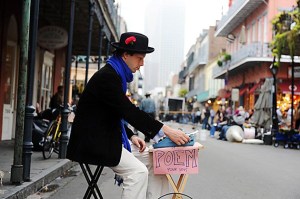
The Sunday Paper – I, Too, Value The Sweet, Dark Elixir Of Life
 ‘At any rate, I prize coffee.’ ~from Soren Kierkegaard’s book Repetition, under the pseudonym Constantin Constantius,1843.
Do not, I repeat, do not bring sheep into the library. It is expressly forbidden.
American style democracy does not leave much room for measured, moderate intellectuals.
An interview with the publisher of Tupelo Press, a quality poetry publisher. Good stuff.
Weekend Reading – Oddly Inadequate
Gift Ideas

As you might expect, I’ve done a good deal of poetry gift giving, though maybe not this year (for reasons unrelated to poetry).
But let me give a couple of ideas for folks looking for something poesy-like that might make a good gift.
Brian Turner has two books of poetry, Here, Bullet and Phantom Limb. He is a veteran and writes a great deal about war and veterans and homecoming and PTSD and the like. Political without being partisan. Got that relevant-y thing going on. Good poet.
Charles Simic is fun and amusing, while also being a little dark and is far more formally interesting than Billy Collins. A better poet, too. Something for the person you know who, among all the poets s/he might have encountered in the x years since being forced to read poetry in school, has only read Collins and needs to be carefully introduced to something better. Sort of like introducing a fish in a bag of water in its new aquarium. The World Doesn’t End is might favorite, but a book of just prose poems might be a bridge too far. Virtually anything else he’s published would work.
Charles Baudelaire. For the angry, sexually frustrated person in your life. Get a copy of Fleurs de mal that includes the poems that were not published in the original version because they were too crazy for the time. One of those poems is a not-nearly-as-metaphorical-as-you-would-think piece about having syphilis and then cutting his lover with a knife and having sex in the wound he just made so that he can inject syphilis in the wound when he ejaculates. Yeah. He goes there. He’s French, what can I say?
Wordsworth. He’s just relaxing. People who think they don’t like contemporary because it lacks the magic of the great masters, like Byron and Shelley, probably haven’t actually read Byron and Shelley and would be very disappointed and confused if they did. Those people would be better off reading Wordsworth. His poetry is amazing, I love it, but it can also be like a warm, comforting bath that takes you away to Lake Country, only with central heating. And no syphilis sex with fresh, bleeding wounds. At least, none in my interpretation of his poems.
You want edgy? You want queer? But you also want someone with real poetic skill, someone who learning and experience who knows how to write and also knows classic and contemporary canons? You want Eileen Myles. A real throwback to a mythological ‘New York in the Seventies.’ She writes poetry and also prose that is really poetry (Lyn Hejinian would be an apt comparison). Trust me on this one. Just trust me.
For someone who hates to read, you can go to the Pacifica Radio Archives and for just $17.95, plus shipping, they will make a CD of a 1956 recording of Allen Ginsberg reading his poetry on the radio, including Howl. What a present, huh?
‘Guinevere In Baltimore’ By Shelley Puhak (New Year’s Resolution, Book Forty)
 Finally hit number forty. I don’t see myself making it all the way to number fifty-two, though. Nope. Don’t see it. Which is more than a little disappointing. Certainly, there’s no one to blame but myself. I can make some excuses about work and stress, but, really, it just illustrates the point of how we have let ourselves get away from the critical business of expanding our mind and world and improving ourselves and making a better place by reading.
Anyway…
Puhak won the Anthony Hecht Award, which was judged this year by my beloved Charles Simic. Both poets read at the Folger earlier this month and it was very good. Simic is always great and I very much liked Guinevere in Baltimore – though I liked it better in print than I did in her readings from it. Her readings sounded more repetitive than they come across on the page; this is a book that is meant to be read, rather than listened to.
The conceit is re-imagining the story of Lancelot’s affair with Guinevere, queen of the Britons and wife of his best friend, King Arthur, as something modern, with Arthur as a bumbling CEO, Lancelot as an aging playboy, and Guinevere as a woman of forty – old enough to be very conscious of age and loss and the terrible, silly sadness of her love affair.
As the title suggests, this is Guinevere’s story, with Lancelot a close second and Arthur barely appearing, at least as a speaker.
I’m writing this without the book by my side, so I can’t properly do any excerpts for you, but I do want to credit Puhak for her amazing use of enjambment.
The whole mixing the mythic and mundane is pretty, well, mundane these days. It’s been done. Been there, done that. So making it new (tip of the hat to Pound) isn’t easy, but is critical.
She does a great job of creating these mid sentence enjambments, where the line above resonates with the old mythology and language of myth and ancient times, but then when it continues in the next line, after the enjambment, the sentence suddenly becomes something quite contemporary and sadly sordid. You’ll have to trust me. It’s really good.
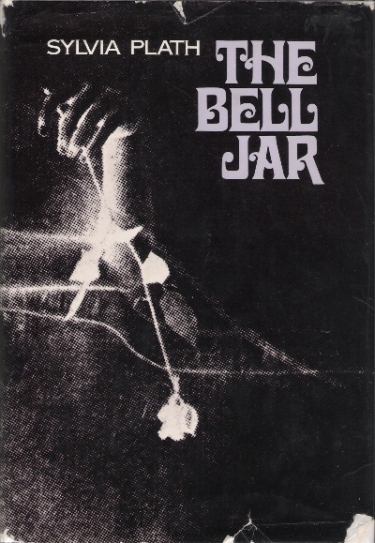
‘The Bell Jar’ By Sylvia Plath (New Year’s Resolution, Book Thirty-Nine)
I almost bought this book a month or so ago. I had read a review of a new book about Plath’s time in New York City as a fellow/intern/whatever at Mademoiselle. Unfortunately, when I browsed, all I could find was a copy with a pink cover. I wasn’t ready to go that far.
Fortunately, my mother had a copy at home and mailed it to me. ‘W Honey’ was written in blue ink from a ballpoint pen on the inside cover.
The style initially appears as being Heminway-esqeu; clipped, staccato, declarative.
But rather than being used to express masculinity, Plath uses it to express the first person narrator’s negative emotional affect (and also help establish her as a somewhat unreliable narrator).
 When I was younger, guys would talk about this novel in horror. It was boring. A slog. And I’m pretty sure none of us had actually read it.
The famed crack up, when it happens, feels very sudden. Or, at least, it did to me. Is that how such things really happen? That’s an actual question. I don’t know the answer.
Sex is pretty big in this big. Not much of it actually happens, but Esther (the narrator) is constantly thinking about it. Which, I guess, is pretty normal for a nineteen year old.
This is something I have noted in books from and about this period (and also implied in movies), which is an oddly more permissive attitude towards casual sex. A one time, casual encounter seems preferable in the literature. Sex being something to get gotten out of the way and separate from ‘marriageable’ relationships.
Of course, when Esther finally does have sex, it goes tragically and medically wrong (some hemorrhaging due to an unlikely bit of bad luck that requires some emergency treatment). Unlike Hemingway, though, this is emphatically not portrayed a punishment. Rather, it is the culmination of the somewhat bad luck Esther has had trying to get laid for the first time. A couple of failed efforts, ending with some spectacularly bad sex and bad luck.
 the coffee philosopher