William Carlos Williams Disappointed Me


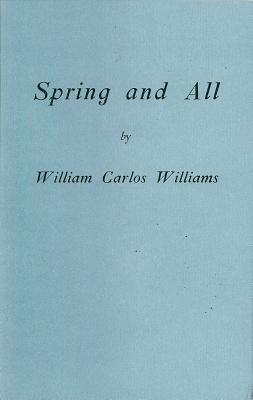
9780811218917I’ve had this copy of Spring and  All for some time. Well over a year. I bought it at the Strand Bookstore in NYC in January of 2013. I think. Whenever it was that I was NYC in the month of January. And I just got around to reading it on my recent trip to Thailand.

It’s a lovely edition, with a lovely tactile cover that you just love to touch, but the test of a book of poetry is not whether the book feels cool and relaxing on the cheek, but whether the poetry reads well.

Look, I know that WCW can write a poem. I’m not saying he can’t, but he’s just out of his depth here.

He’s trying to respond to continental style high modernism and he tries to use some of their tools in the prose poems that make up most of the book and which operate as a kind of manifesto, but he’s just not cut out of it. He tries to beat them at their own game and comes up short.

On the plus side, while trying to talk a young relative about poetry, I was able to open this book up to that ‘red wheelbarrow’ poem that you were probably forced to read in high school and use it as an example of how poetry doesn’t have to be hard and that it can be easy to read while still saying a great deal.

Monday Morning Staff Meeting – Dark Books


Do you suppose Heidegger wishes that he would have just burned them instead?

Honestly, these don’t sound all that different from what we’ve come to expect from her, but that’s okay, because she’s pretty awesome.

The Instagram poet strikes!

Anytime someone wants to write about Adrienne Rich, well, that’s just fine with me.

Ezra Pound: Canto LXXVI


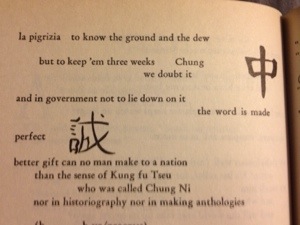
This Canto bounces around a bit, linguistically. Splashes of Latin, Greek, French, and lots of Italian (and English, of course). Some Chinese characters whose inclusion doesn’t make sense to me. Obviously, I never understand what they mean, but it just seems that, stylistically, they don’t make sense. This is an otherwise pretty European Canto (we are in the Pisan Cantos, now, aren’t we, after all?).

Some great stuff. It doesn’t roll off the tongue, but the sounds are great. Pound’s been taking lessons from some of colleagues, I guess. Never really saw him as an aural poet before.

”  both eyes,  (the loss of)  and to find someone
who talked his own dialect.  We
talked of every boy and girl in the valley
but when he came back from leave
he was sad because he had been able to feel
all the ribs of his cow…”
this wind out of Carrara
is soft as un terzo cielo

Later:

                                     no overstrokes
no dolphin faster in moving
nor the flying azure of the wing’d fish under Zoagli
when he comes out into the air, living arrow.
and the clouds over the Pisan meadows

20140306-225716.jpg

Protest Poetry And Dissident Poetry


For some reason, I decided to re-read bits of a speech that the late great Adrienne Rich had given upon the occasion of being given an award (her remarks were published by Norton as a sort of chapbook under the title  Poetry and Commitment).

She references the American poet James Scully, who (according to Rich)  calls ‘protest poetry’ conceptually shallow, reactive, predictable, and typically featuring hand wringing from the sidelines. She then includes brief quote from Scully:

Dissident poetry, however, does not respect boundaries between private and public, self and other. In breaking boundaries it breaks silences, speaking for, or at best, with the silenced; opening poetry up, putting it into the middle of life… It is a poetry that talks back, that would act as part of the world, not simply as a mirror of it.

This struck me because it came after some conversations with my father about political poetry, or, rather, its relative absence, at least in American poetry. And, of course, the recent passing of Amiri Baraka, the poet formerly known as LeRoi Jones.

Maybe Baraka exemplified best what Rich talks about, being committed.

She defends Shelley’s much maligned line about poets being unacknowledged legislators because Shelley did not know how nor conceived that he could separate his deeply held, liberal political views with his poetry nor that any other poet could. They were all from the same wellspring.

This just all sort of falls when I’m reading a lot of politically minded poetry. I picked some bell hooks the other night and am also reading Diane Di Prima’s Revolutionary Letters and even (though it’s not poetry) Solanas’ SCUM Manifesto (with an obnoxiously long foreword, I might add).

In honor of all this, here’s my terrible, awful attempt at what Scully would rightfully sneer at as protest poetry. He would probably also note that rhyming is not really my strong suit. Well, at least it’s political. I guess. I’ll almost certainly live to wish that I’d burned it, instead.


Rick Scott: An Ode

At last, I come arrayed
In the fanfare of the common cracker man
Humble, tacky but no frayed –
Dispatching notes of great jay
And for your acknowledgement and unhesitating belief, I have prayed.
 
The winnings you have won,
The challenges you have overcome –
Nothing to the great evil I have undone!
 
Tidings of unvarnished truth I bring!
My great employment, great employments wrought.
Corporate friends with good goods come to kiss the sun kissed ring,
Promises kept to a tee – seven hundred thousand on the nose!
My regal and trustworthy success a contrast to the old, faded king.
 
My jealous enemies name me Skeletor™
And cry that my greatest victories I falsely forge
But their spiteful, jealous facts I will ignore!
 
Your tax dollars I have given
To my honest, grafting friends
And for you, eight dollar an hour jobs, promised then forgiven.
No vow was ever truer kept:
Every poor man’s dollar, every corporation’s promise, only slightly riven.
 
And to those shallow, faithless, disbelieving fools who say
I promised you more jobs than just those created by Obama’s daring play,
Do not throw those lying tapes, videos and quotes in my face – nay, I say, nay!

Midweek Staff Meeting – My Blood Is Superior


Lotl_-_The_Sleestak_God_002

Just give it up already. You’ll be healthier.

I could write on a train. In fact, I’m pretty sure I already have. So. You know. Call me.

Is poetry not literature, but something else? Was it, but is no longer?

The honest answer is: maybe?

I don’t know. All of them?

What we can learn from Schiller about the beautiful. It’s not mentioned, but Elaine Scarry wrote a great book on beauty, called On Beauty and Being Just and I recommend that. I honestly haven’t read the Schiller book in question. I don’t actually think I’ve read any Schiller, unless you count the chorus to Beethoven’s Ninth. My local public radio station has taken to playing just the second movement of the Ninth. That’s like half a handjob. I mean, yeah, it feels good, but without the finale, I’d really rather you didn’t even start it.

Muriel Rukeyser’s ‘Elegies’


9780811221061She’s a poet I’d read about a lot. For some reason, I thought she was more recent than she is – that she had begun writing more in the fifties and sixties, but the poems that make up Elegies were written in the late thirties and the forties. They are not, strictly speaking, war poems (but, really, how can anything in poetry be definitely said to be anything, strictly speaking; even forms like the sonnet and haiku have been reimagined so that I question whether anything in poetry should be defined strictly), but are inspired (depressed?) by the Spanish Civil War and the Second World War.

I guess that to her contemporaries, she was considered a ‘difficult’ poet, but to the modern ear, it’s hard to hear. She seems quite direct by comparison to much contemporary poetry (which is not a criticism of contemporary poetry; I find J.H. Prynne nearly impossible to suss out, but find his poetry amazing, nonetheless).

There is a strong current of melancholy running through it, which you might expect from an elegy, but they’re not really elegies. They’re dedicated to her lover, who she only knew briefly, before the Spanish Civil War separated them. He died in 1938, but she didn’t know until 1943.

And it’s not a melancholy towards the ravages of war. Or, at least, not exactly (not ‘strictly speaking’).

The first elegy, Rotten Lake. It reminds me of Tolkien. Specifically, the mood behind the end of Return of the King. Not the one you saw in the movie, but the one in the book, where the hobbits return to the Shire and find that Saruman and Wormtongue have turned the beautiful fields and hills of the Shire into an industrial wasteland. A not subtle statement about how Tolkien perceived returning to English country life after the First World War. Rukeyser isn’t mourning pastoralism, but she is saddened by the coarsening, by the decline of a place where memories are strong.

I wanted to quote this bit from the fourth elegy, Refugees:

We bear their smile, we smile under the guilt,
in an access of sickness, “Let me alone, I’m healthy!”
cry. And in danger, the sexually witty
speak in short sentences, the unfulfilled.
While definition levels others out.

What a great phrase, ‘the sexually witty.’ Can’t you visualize it? Powerful, virile, venal, sad.

The sixth, River Elegy, may be my favorite. And not just because it’s the shortest. There is a theme of water (and water being symbolic of sex), but the river comes across in this great propulsivity of language. No formalism here, just thick stanzas of desperate desire, movement, and fear of loss. I would be curious to know when it was written, what was happening in the wars? The elegies that follow are more melancholy, looking over the loss of wars, but this one seems to be still holding out hope. Was it written before she knew for certain her lover had died? After, but digging deep to pull out some hope, or not hope, but desperation. Like a shark, keep moving or the hope dies, but secretly just moving out of fear of stopping. Because the later elegies are more… stopped. In the eight elegy, she writes: I see it pass before me in parade

She is still and the world is moving.
The Sunday Newspaper – Dead Poet C–p


Dead Poets Society sucks. That’s not what studying literature is about. But on another note, have you seen that freaking iPad commercial where Robin Williams’ voice from that movie wafts about, reciting and lecturing on Walt Whitman as a means to emphasize the importance of poetry and how poetry makes us human, makes life worth living! I do agree with that sentiment, wholeheartedly, 110%, unabashedly. You name it. But no one in the commercial is doing anything remotely to do with poetry. And they’re all holding iPads, devices which are mainly for consumption of video content. I have an iPad and I actually have some poetry apps on it, but, c’mon. The iPad is about kitten videos, Angry Birds, and mobile pornography. It is emphatically not about poetry. And, despite including that Whitman-esque voiceover, the advertisement does not even remotely try to pretend that the iPad in use has anything to do with poetry! Ack! This is just pissing me off to no end!

Weekend Reading – It Turns Out Entrepreneurs Less Concerned About Tax Rates, More Concerned About Not Living In A Nightmarish, Ayn Rand Fantasy World


This will blow your mind, but entrepreneurs are actually drawn to cities with a high quality of life (read: investments in infrastructure, environment, arts, etc) and a pool of skilled employees (read: investments in education, k-12 and beyond). Not, apparently, the low wage wastelands with low taxes and minimal regulations (read: gutted protections for clean air and water and for labor).

Could. Not. Agree. More.

This is the sort of thing that makes me nostalgic. Bars have gotten louder and cafés have gotten quieter… and each change affects the promise of political change. I can remember when you could have a conversation and even read in a bar. I used to read in bars all the time. Not so much anymore. And how long has it been since a coffeehouse was the site of active discussion? A long time, I bet. I can remember when coffeehouses were far more boisterous, with strangers engaging in conversation. The coffee wasn’t so good, but I was actually okay with that trade off. And it probably promoted entrepreneurship. I just sayin’.

coffeehouseorator_2171774c

Midweek Staff Meeting – Stop Screwing This Up!


dnd_products_dndacc_1eD3_pic3_en

Darn hippies aren’t doing it right!

It means that we’re going to hell in a hand basket!

Please be wrong.

No. And (if yes), the American reader.

Book of a lost village.

Ice-T is not a fan of Dungeons & Dragons.

Monday Morning Staff Meeting – Yes, But Was He Any Good?


This article goes into the big question when it comes to J.R.R. Tolkien: was he any good as a writer? The article says… maybe. It’s all a bit wishy washy. And I object strenuously to the negative criticism of his poetry, which I loved when my mother sang to me while reading The Hobbit out loud to a seven year old me. I think that there is also an argument to be made for a little pomo gamesmanship in his writing, if you look at it as having been written in an imaginary language (based on Anglo-Saxon and pre-English languages from the British Isles) and then translated into English. Rather as if someone wrote an epic novel in Klingon and then translated it into English. And, in case you hadn’t figured it out yet – I’m a fan of Tolkien.

Neo-liberalism and negative solidarity.

UC Davis has sold out to Amazon.

Emile Zola: novelist, polemicist, pamphleteer… influential art critic?

There are Crystals in Stone and Pressure in Snow So Are Snow and Stone the Same

Allen Ginsberg was many different from the others.

I’m glad that some newspapers are still covering poetry. Even if it is on the other side of the country (Dear WaPo, would it kill you to write more about literature and poetry ’round here? ‘Cause there’s a lot of it, most of it having nothing to do with poorly researched, pseudo-timely musings on the politics of six months ago).

628x471