Poetry Is A Necessity When You Travel


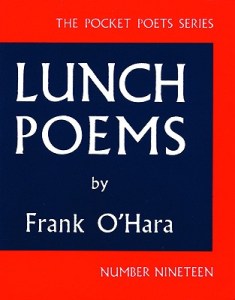
Reading Frank O’Hara’s Lunch Poems was a lucky coincidence. The book was a gift. I had been looking for a proper book of poetry to bring with me. Poetry is a necessity when you travel. You can pick it up, open it a random point, at the beginning, at a point, not random, but chosen because it has relevant meaning to what you have encountered.

My original thought had been to bring Whitman, but most editions are too big to be easily carried about.

But there was something of Whitman in Leaves of Grass. The pleasure in humanity as a mass. The aspects of the flaneur. Yes, the homoeroticism. Nothing in Lunch Poems resembles Whitman’s aching Civil War songs and laments, but, then again, what does? A reminder of Whitman’s power and influence over even the best poetry that followed. Or, perhaps, especially over the best poetry that followed.

Frank O'Hara: 'Lunch Poems'

Midweek Staff Meeting – I Saw That!


6-F1903.309-768x411So, I finally got around to seeing this amazing Sotatsu exhibit at the Sackler. It’s around until Sunday, so go see it!

This is super awesome: century old audio recordings of Guillaume Appolinaire!

Whatever he chooses to write about, David Brooks is always hilariously wrong.


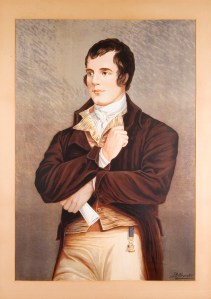
Happy Burns Night!


Burns

If Nothing Else


  If nothing else, have finished a lot of reading. Eight books to be precise with a good chance of finishing my re-read of Persuasion and of finishing the Elective Affinities. And of course, there has been much else, rather than nothing else.

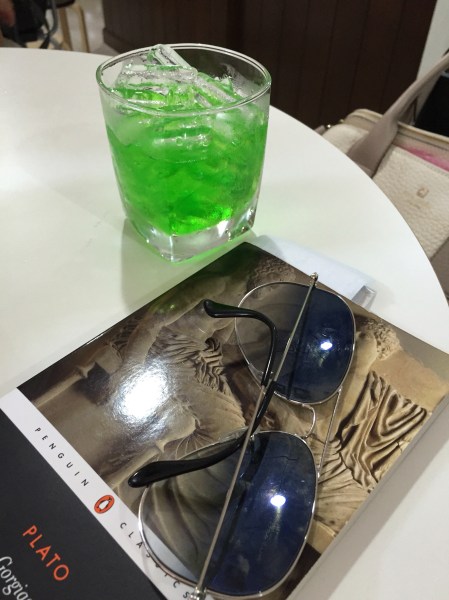
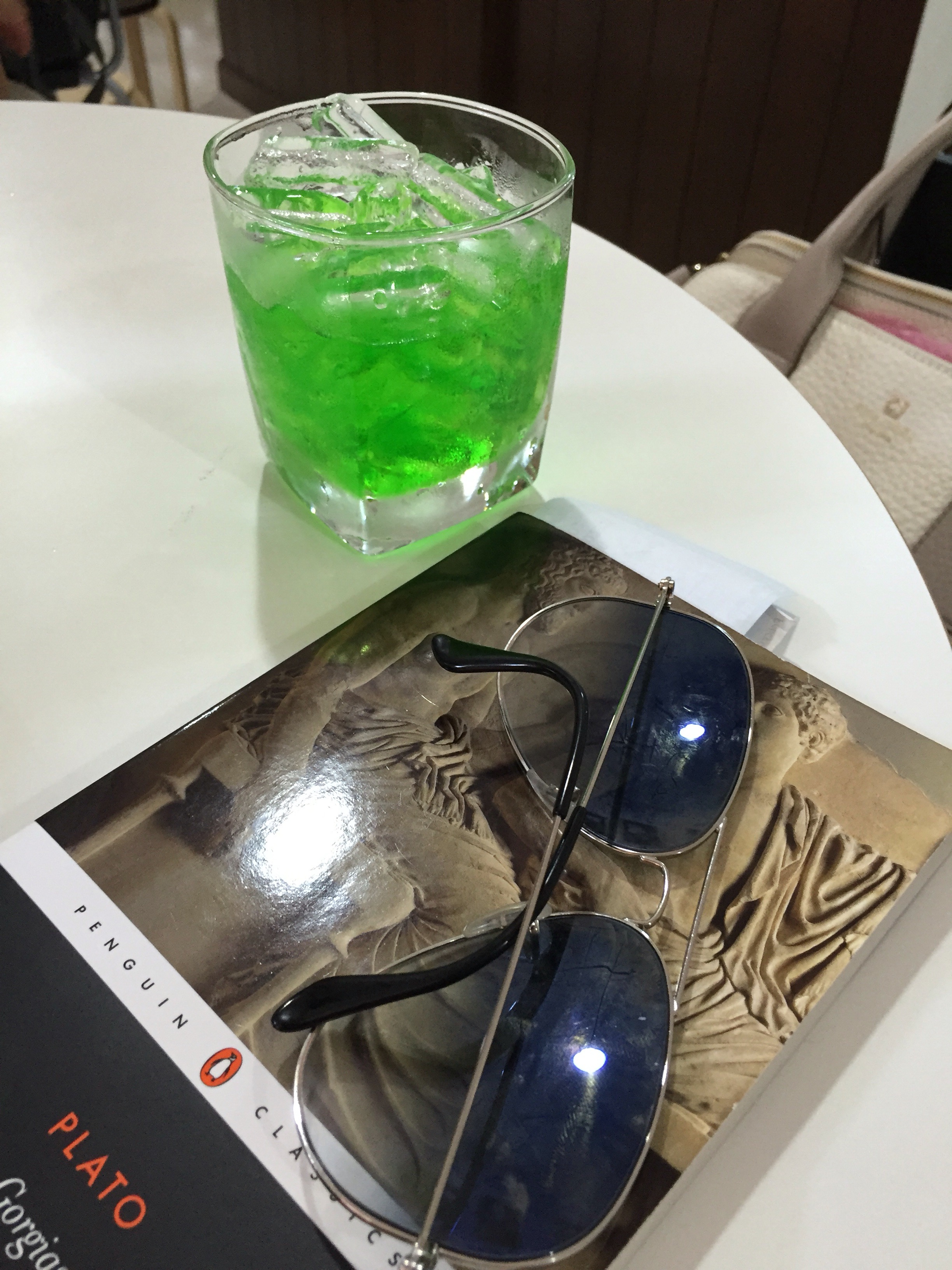
The total stands at four fantasy novels (The Blade Itself, The City of Wonders, The Charnel Prince, The Throne of the Crescent Moon), one British ‘cozy’ style mystery (Sydney Chambers and the Shadow of Death), two philosophy (Gorgias, A Short Introduction to Art Theory), and one poetry (Lunch Poems).

Obviously not the final judge of a good vacation, but being as susceptible to the temptations of technological distraction as anyone, it is good to be in a position to be able to get some solid reading done. I’ll be on my own when I get back (my better half is staying in Thailand for a few months) and can hope to do some more reading when I return, but there is a certain feeling of accomplishment in plowing through a solid number of books.

My Top Ten Of 2015


In no particular order and merely to get in on the game, here is a list of my top ten reads from 2015 (not the the top ten published in 2015, because I’m still catching up on the nineteenth century [I think I already made that joke earlier]).

Machi Tawara’s Salad Anniversary was just so darn enjoyable to read that it’s got to be on this list.

The Golden Lotus… it took me a while to finish it, but in addition to being an enjoyable read (somehow, the seemingly repetitive venalities of Ximen Qing never got old), I also felt that I learned a lot by immersing myself in the pages of a book about a very, very different milieu than my own. Even little stuff, like figuring out what they were actually drinking when it mentioned ‘wine’ (most likely a malted beverage, similar to sake) and, yes, reading about medieval Chinese sex toys.

Shen Congwen’s Border Town did not stay with me long, but good Lord, was it heartbreaking. I suspect that my mind is trying not to remember it, because it was so darn sad.

Jenny Zhang’s Dear Jenny, We Are All Find was not only a good read, but I felt downright prescient when, while reading it, she became minorly famous for her response to… let’s call it ‘Poetry-gate.’

You know there’s going to be some fantasy on this list, right? Nothing new, but I re-read the gentle, melancholy Riddle- Master of Hed this year, for the first time in decades.

While re-reading Proust, it was in the third book, Guermantes Way, that my efforts bore fruit and I was understanding him in a way that I had not before.

I finished Powell’s magisterial-comic epic, Dance to the Music of Time. Unfortunately, the volumes I read in 2014 were the best, but Books Do Furnish a Room was very good and I finished it in January of 2015, so it counts.

The Red Lily… a sexy, nineteenth century bit of a novel about artists, aristocrats, love affairs and what not… what’s not to like?

Seeing Antogonick performed on the stage in Chicago singlehandedly got me back into Anne Carson, who I had fallen out of love with. I picked up an inexpensive copy and read it after seeing the play and, yeah, it’s still damn good.

Epinician Odes and Dithyrambs of Bacchylides was a freaking wonderful find! Who knew occasional poetry could be so awesome!
 

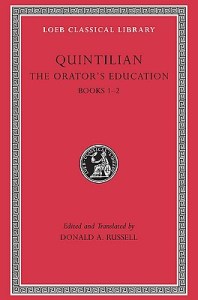
‘The Orator’s Education, Books 1-2’ By Quintilian


Orator's EducationI have mostly loved The Orator’s Education, as much for its insights into the Roman culture of its time as anything else – off handed remarks about gladiatorial styles, discussions that introduced me to how much constant interchange there was between Latin and Greek (with Latin even stealing letters from the Greek – I had had no idea what a state of perpetual transition Latin was in; such a difference from its current status as a ‘dead language’), remarks that showed how little formalized spelling and grammar could be, and more.

When Quintilian talks of ‘orators,’ he is, in the greater part, speaking of what we would call lawyers. Apparently, the pleading of cases was less a legalistic endeavor than it was a dramatic and rhetorical one. While legal procedurals on television make it seem like that’s still the case, believe me when I tell you that modern trials are almost always boring to watch and the average lawyer is not particularly eloquent.

At one point, Quintilian defends oratory against the claim that it cannot be an art because no art seeks to demolish itself (presumably, referring to how opposing orators will seek to demolish each other’s arguments). Leaving aside his actual refutation, what a different view of art! Now, we accept fairly readily the idea that an art is usually something in a state of constant oedipal rebellion.

He talks about three kinds of art: theoretical, practical, and poetic.

Theoretical arts include ancient astronomy, according to the author, and are what we might think of as scientific research, where the end is not a ‘thing,’ but understanding of the of the subject of study.

Practical arts are not things like carpentry, but rather actions. The example he gives is dance, where the end result is not a thing, but a properly completed action (oratory is this kind of art, he says)

Poetical arts are those which end with a work that can be seen, like a painting. I think this is awesome, because he uses the word ‘poetical’ to describe the most practical (in modern terms) of arts – that which ends in something. Gave me a smile.

Found The Perfect Book For My Trip


So I’ve been trying to figure out what reading material to bring with me to Thailand, besides the voluminous pulps downloaded to my nook.

I had been thinking about this Dover edition of Thus Spake Zarathustra that I bought in 2001 at Bridgestreet Books. And lo and behold, while unpacking, I found it!

Also while unpacking, I found this lovely hardback edition of Emerson. Positively perfect, except it is just too darn heavy. Nietzsche it is! Cicero is an outside contender, but Nietzsche holds most of the cards.

But now I need some poetry. In the past, I brought Wordsworth and he’s still my go to poet for this, but I’m hoping someone else inspires me. Tennyson would be great but I don’t actually own any Tennyson and I’ll be gone too long to use the library.

Can’t Wait


Going back to Thailand I cannot wait. Absolutely ready. One hundred percent. Too much going on: buying a house, jam packed holiday season for my better half (she objects when I say that I ‘work’ for her; she prefers something like ‘help’ or ‘volunteer,’ but let’s be realistic, I’m an unpaid employee [so maybe the correct term of art should be that I ‘intern’ with her]), work stuff, work stuff, work stuff, family stuff.

Ready for a vacation. Ready to get away. Especially, knowing that it will probably be a while before I get away again. Logistics, and all.

Perhaps this is what adulthood is like, the constant, ceaseless nervous tension (I stole that turn of phrase about tension; I think from William Gibson; google it, I’m not your babysitter). Or perhaps it’s middle age. Did I skip adulthood and go directly to midlife?

Part of it is struggling, as always, with depression, which feels like a perpetual weight on your internal organs. Something is constantly pressing down on your heart and lungs and so they don’t work properly and you can always feel them about to fail and that knowledge of their being on that precipice takes your mind away from everything else and keeps you psychically crippled, after a fashion.

Let’s hope it’s the break I want it to be. I’ve downloaded several books to my Nook and are keeping them unread for the journey (mostly fantasy novels) and I’ll take some pleasure soon in picking out one or two physical books for the journey. At least one book of poetry, something worth re-reading. In the past, I’ve taken Wordsworth, for example. Perhaps this time I’ll bring Eliot or Shelley or Clare. And something else, something in prose. Could be a novel, but I’m inclined towards something non-fictional. While unpacking, I saw my cope of Elaine Scarry’s On Beauty and maybe I’ll bring that. It’s a little bulky, but perhaps if I put it away and don’t read anymore of it, Quintillian’s writings on the education of an orator. But probably not. Cicero might be better. Plato would be perfect, but I don’t have a compact copy of any of his books.

We shall see. Here’s a picture from Thailand, in the meantime.

Monday Morning Staff Meeting – Somebody’s Got A Crush


Art loves poetry. Or manipulates the idea of poetry. Or appropriates. Poets still get no respect.

Better business through literature.

Mean writers.

Weekend Reading – Potluck


The only reason for putting ‘potluck’ in the title is that today is the annual office holiday potluck party. You’re not invited. Probably. Unless you work with me. Which you probably don’t. Statistically, it’s very unlikely.

The pro-capitalist, anti-communist origins of MFA programs in creative writing.

It’s time for those end of year, ‘best of’ lists. And some of them are about poetry! Not lists by me, though. Not that I haven’t read a lot of poetry this year, because I have, at least compared to the average person, who probably reads none in a year, but more that I’m still catching up on the greatest hits of the nineteenth century (it might have been last year that I read him, but you should totally check out the mostly crazy, but sweet English pastoral poet, John Clare). Fortunately, The Guardian, over in merry old England, actually pays attention to poetry. So they did a top ten list that is probably worth looking over.

The poet on art.