It’s A #Poetrymonth Listicle!


Why not? I mean, that’s all people read anymore, right? Listicles? Thank you Buzzfeed for helping destroy western civilization. Probably other civilizations, too. Does China censor out Buzzfeed? Maybe they want to protect their civilization from what I’m about to do (which, perhaps ironically, includes translations of Chinese poetry).

Anyway, these are collections that I have read since the last year’s National Poetry Month.

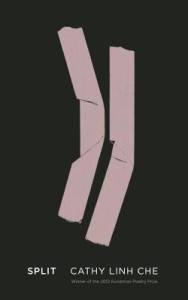
Split by Cathy Linh Che. I read it earlier this year and it’s still my favorite poetry collection in recent memory.

Salad Anniversary by Machi Tawara. Or maybe this one was my favorite. This book makes you happy.

Selected Poems of Li Po by [should be self evident, but if you’re curious, David Hinton translated it]. This is the Chinese one I was talking about. Contains more poems about being drunk than any other collection I have ever read.

Ooga-Booga by Frederick Seidel. You wish he wasn’t so good.

Dear Jenny, We Are All Find by Jenny Zhang. Also wrote a cool and devastating essay on… are we still calling it Poetry-gate? Anyway, should be better known for this collection.

Once in the West by Christian Wiman. Debated including this one, but still, a fine collection by an interesting, very talented and frequently delightful poet.

Antigonick by Anne Carson and also sort of by Socratis, but also not really or only inspired by Socrates. Is this poetry? It’s a play, certainly, but ancient Greek poetry was also performed and Greek drama evolved by the addition of additional voices to the performance of poetry. Whatever. Probably not, but I’m including it. Why am I including it? Because, awesome, that’s why.


Happy National Poetry Month!


So go read some poetry this month.

Seriously. They have some at the library. You can even read Shel Silverstein. Remember him? He counts. And he’s good, though, if you’re an adult, you should consider supplementing him with maybe some Whitman or Frost. And consider maybe challenging yourself a little? Some non-dead white males? Claudia Rankine’s last collection sui generis, Citizen is alive, not white, and not male, so you could read her and consider yourself to have done the bare minimum to fake being a cultured person in April.

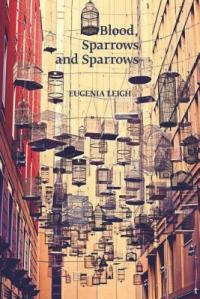
Blood, Sparrows And Sparrows


9781935536499Another book by another poet I’d read about and seen recommended. I was in Politics & Prose, dropping off an order (they stock Lil’ Fishy onesies, if you’re looking for a cool present or outfit for an infant) and couldn’t help going to the poetry section and there, as if by some random magic, it was. Honestly, the odds of any particular book poetry, much less one you are looking for that is not by someone dead or someone named ‘Collins’ or ‘Merwin,’ are not that great, so this probably counts as a minor miracle. I saw minor, because I doubt the particular influence of the hand of God in this. So maybe not so much a miracle, at all, as a cool coincidence.

Even though I’m writing this later, I actually bought this not more than a few days after reading Cathy Linh Che’s Split. When I first leafed through some poems, I was actually a little disappointed and thought that I’d made a bit of a mistake. So I set it down and picked it up something like a week later.

During that week, it improved considerably. No, it didn’t hit me the way Split did, but neither of them hit me the way William Wordsworth’s Prelude did, so maybe that kind of apples to oranges comparison is not useful (though recurring themes of abuse make the two more recent collections more similar than, say, anything Wordsworth wrote).

Visceral and formally varied, stanzas and line indentations give some nice visual shape to the poems, though never at the expense of the words. She’s got a nice sense of humor and sneaking spirituality (rather like someone who has left a church as an adult, but was taken every Sunday as a child, so has the liturgies stamped on her brain).

‘Iraqi Nights’ & Al-Mutanabbi Street Starts Here


On a Wednesday, I saw Dunya Mikhail at the Hill Center, where she was interviewed/conversed with the Post‘s Ron Charles. Sadly, it was the most disappointing of these events that I’ve attended. Whether it was the language barrier (Arabic being her first language and the one she writes in) or something else, the conversation never quite took off. Ron couldn’t seem to get an extended reaction nor dialogue out of her. It didn’t help that she wasn’t very familiar with the English language translations of her poetry that Ron was reading from.

I read her collection, Iraqi Nights and enjoyed it, but didn’t love it. The idea that this was a poetic take Iraq’s travails through the lens of The Arabian Nights never quite came through and some of the poems bordered on being just pithy lines.

On the following Saturday, I dragged a semi-reluctant friend for an event honoring the ninth anniversary of the bombing of Al-Mutanabbi Street, Baghdad’s ‘Street of Booksellers.’ Poets and musicians, including Dunya Mikhail, were there.

Unfortunately, there was a solid forty-five minutes of self-congratulatory back slapping by some white people that was just… too much.

This is Washington, DC and the year 2016 and we don’t need to be told that Bush’s invasions were colossally incompetent, misguided, and deceitful farces not worth the tiniest amount of the blood and treasure they cost. If you really want to drive this idea home, though, the best way would be to get out of the way and let the Iraqi artists speak through their works.

The last part of the event was a musical performance that sounded almost liturgical in chant-like signing accompanied by an oud and a piano (and wind chimes), but I left early, not because the music wasn’t wonderful (it was), but because those ridiculous opening ceremonies/lectures/chidings/backslappings had left a wound that festered and drove me out.

Fortunately, I did get to see a short video while I was still there – a video the showed the pointlessness of the opening lectures by older white people. It was a simple video. Some footage of the street, including archival footage from before the bombing, but mostly it was just focused on a man who owned a cafe on the street and had lost four of his five sons and one grandson in the bombing. Absolutely heartbreaking, especially once you realized that when he was talking about his son missing a leg, he wasn’t saying that his son was now crippled. He was saying that they couldn’t find all of his son’s body parts. When a man is telling you that story, you don’t need an anti-war lecture.

‘Split’ By Cathy Linh Che


SplitSomewhere I had read about this book and added it to my online wishlist on the Barnes and Noble website (which I use as a way to store books I want to read or feel I should read; sometimes I buy them from Barnes and Noble, sometimes from other bookstores, and sometimes I check them out from the library; this one, as I will specify in more detail momentarily, I bought at a Barnes and Noble). Traffic was bad the other day, due to horrible rain and the inability of many local drivers to drive in… weather.

Barnes and Noble seemed like a good place to kill an hour and wait for things to ease up. I looked at some lit mags, some sci fi, and, of course, the poetry section. And there I saw Che’s book. Honestly, I had never expected to randomly see it in a chain bookstore. Bridgestreet Books, maybe, but that’s it. But there it was.

Naturally, I bought it.

And I took it to the little cafe and ordered a snack and some herbal tea (I’m getting old, because I think that it’s not a good idea to drink caffeine in the evening; I miss the younger me, who drank coffee all night with his friends, talking politics, poetry, and philosophy).

Split blew me away. Heartbreaking (sexual abuse by a family member is a repeated subject, as well as other kinds of loss of innocence, including those from her parents’ status and immigrants and refugees; also, oddly, cameras – the mechanical nature of a physical camera – makes more than a few appearances) in it’s narratives and marvelously crafted. Tending towards short couplets and three line stanzas (triplets?) with some indentations to keep the reader on his/her toes, but also with prose and prose-like poems and other forms.

Here’s a little bit from Pomegranate:

In the Underworld
I starve a season
while the world wilts

into the ghost
of a summer backyard.
My hunger open and raw.

I had a little trouble picking something, because her poems are just a little too long to quote in their entirety and don’t lend themselves to excerptation.

Parades & Upshur Street Books


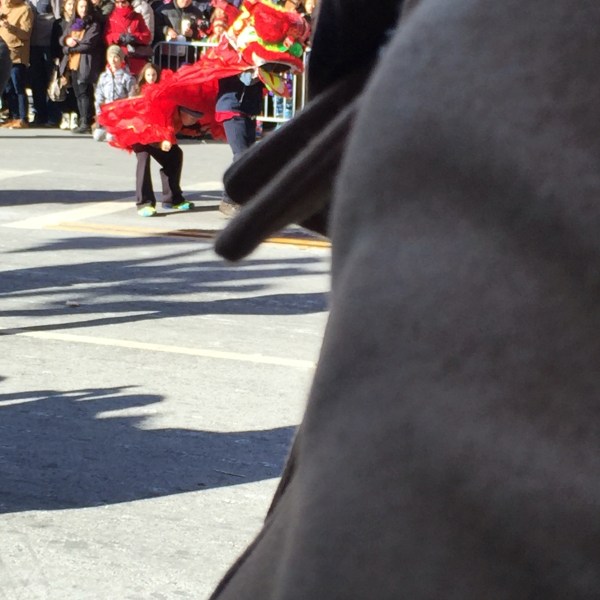
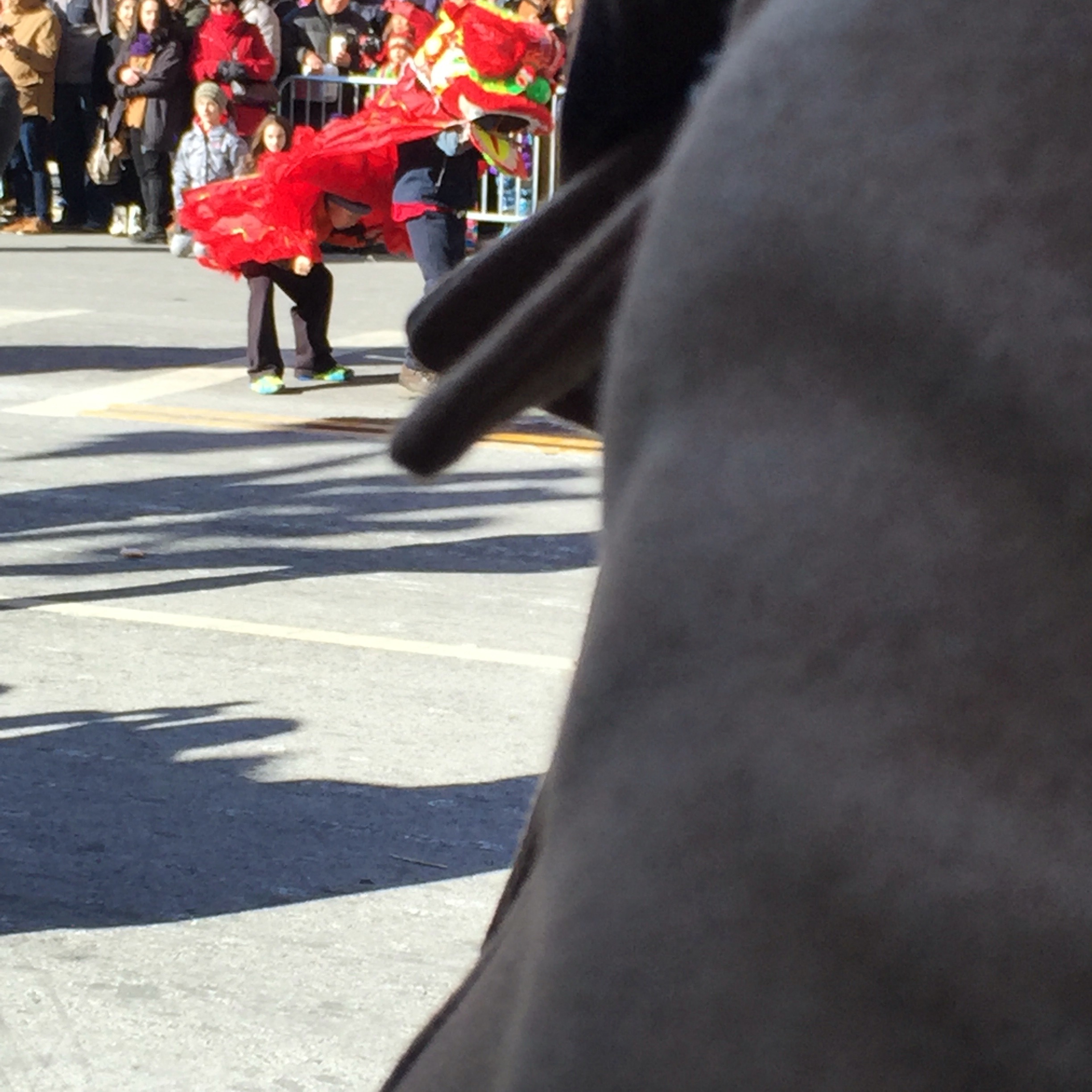
 Much of Valentine’s Day was spent in some solitary wanderings on crowded streets. My better half was away (the third year in a row we have spent February 14th apart, which, in a way, is not so bad, because, like New Year’s Eve, Valentine’s Day tends to pile on such overwhelming expectations of joy, romanticism, and impossibly good sex that it tends to crush the possibility of all three; that said, I’d rather she were with me, if I had my druthers), so I took a bus to Chinatown and carelessly browsed the Smithsonian Museum of American Art until it seemed a good time to find a spot on the street to watch the Chinese New Year (or Lunar New Year) Parade. Last year, I was on my own, I walked randomly about town and found my way to Chinatown and, unexpectedly, the parade. So I thought maybe I’d start to make it a tradition. Or not.

The parade itself contains a surprising number of white people and while I’m never exactly sure when these things cross the line from solidarity to appropriation, I suspect that that said line was, indeed, crossed. Whatever. I just watch it to see the little kids trying to manipulate dancing dragon costumes and props.

When the parade was over the subsequent parade of pols marching to the podium to speak was too much, even for me (in case you’re interested, Jack Evans was the straw that broke this camel’s back), I took a metro up to Petworth to make my first visit to Upshur Street Books.

It’s a nice little bookstore, but the selection is not very large, particularly the poetry shelves, which were few. Unusually for me, I did not buy anything. Something will, no doubt, bring me back, but it’s not going to be a regular thing.

I walked back (taking about an hour) and met a friend for a movie and then another friend and his wife for noodles.

Pound In Translation


That’s a bit misleading. I’ve noted a couple of times recently, when writing about translations of classical Chinese poetry, that the greatest influence on those translators might be Ezra Pound’s translations.

Well, in this trashing of Pound (not undeserved), is a quote from Simon Leys:

Pound had a mistaken idea of the Chinese language, but his mistake was remarkably stimulating and fecund as it was based on one important and accurate intuition. Pound correctly observed that a Chinese poem is not articulated upon a continuous, discursive thread, but that it flashes discontinuous series of images (not unlike the successive frames of a film).

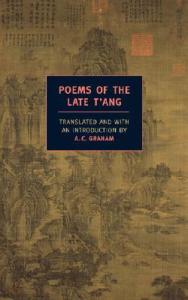
Poems Of The Late T’ang


9781590172575

I probably should not have read this so soon after (re)reading a collection of Li Po, because (except for a few poems, including by Li Po) the vast majority of the poems in here are simply not as good and of less interest to the non-specialized, general poetry reader (of course, these days, a reader of poetry is not a generalist, but a specialist, because poetry is tragically underread). Many, frankly, appear as filler. Rather, they are there to fill in gaps, so provide a historical purpose, perhaps, but less so an aesthetic one.

As a side note, the edition I read was not the one pictured, but an older (I bought it used), Penguin edition. Even if I wasn’t a huge fan, for reasons partly unrelated to the work, I’m glad the NYRB imprint has republished this work.

Platonism In Boethius


Actually, it’s more Plato, than Platonism, which is arguably something different than the the ideas of Plato. Arguably.

I have a strange attachment to Boethius’ Consolations of Philosophy. Over a decade ago, my Aunt Petey was in a coma and she was taken off, to use the sterile, clinical phrasing, nutrition and hydration and then brought to her eldest son’s home, where the family gathered and waited.

At one point, I stood beside her bed and started reading aloud from Consolations. Maybe because I was reading it anyway or maybe because it was written by a man waiting to die. Maybe I just thought my family would think me extra super smart if I did it. Maybe I was just killing time, even as my aunt was killing time in a far more literal sense. I honestly don’t remember why.

But whatever my motivations, certainly, something like that burns a particular work onto the brain.

When I read Gorgias, I was unexpectedly hit by some parallels. There are some obvious between the Beothius of Consolations (the only Boethius that I know) and the Plato I know from his broader corpus (though I haven’t read all of Plato): their lack of respect for poetry (which, granted, was more like theater or even pagan ritual at the time) and the fact that the Socrates of Plato’s dialogues, including Gorgias, is always in a state of waiting to be taken away to die, much as my Boethius is in a cell, waiting for eventual punishment (which turned out to be execution, as he suspected).

Gorgias had an unexpected metaphysical aspect, as Socrates argued for the scales of justice righting themselves in the world hereafter as a way for the correct path – the best life, as it were – to be finally rewarded, even if lots of bad things happened to good people in this one, along with some pretty awful people seemingly to live pretty fun loving and enjoyable existences. In the Consolations, the figure of Philosophy (a woman, by the way) seems to take Socrates’ role and lead Boethius to the realization that his unjust accusers are, for this metaphysical reason, ultimately less happy than a just and good man, even if he is about to be tortured and killed.

Selected Poems Of Li Po


One of the advantages (and distractions of moving) is unpacking your books and seeing tomes you had forgotten about, reappear, as if by magic.

9780811213233I remember very clearly buying this book. I also remember that I didn’t really like it at the time. But, it came with me on a walk recently. It was the proper size and I had just unpacked it, so it went into my satchel and onto the road with me (or, rather, onto the sidewalk with me; actually, roads, too, because the recent Snowzilla had left many of the sidewalks unwalkable, so us pedestrians took to the streets, drivers be damned!).

Now, I’m wondering why I didn’t realize before how awesome it is.

And credit must go to the translator. While I don’t read classical Chinese, from what I know, a direct translation would be almost meaningless and certainly poetry-less. Of course, let’s be totally honest and acknowledge that classical Chinese poetry (and even contemporary Chinese poetry) translations are, in their style, vastly influenced by Ezra Pound’s translations and his interpretation of baroque spareness.

Avoiding Farewell in a Chin-Ling Wineshop

Breezes filling the inn with willow-blossom scents,
elegant girls serve wine, enticing us to try it.

Chin-ling friends come to see me off, I try to leave
but cannot, so we linger out another cup together.

I can’t tell anymore. Which is long and which short,
the river flowing east or thoughts farewell brings on?