The Last Day Of #PoetryMonth


So, National Poetry Month, also known as ‘April,’ ends today. So read a poem. April was chosen because of Eliot’s The Wasteland. So you could read that. Or read some Robert Frost (but read him carefully; to paraphrase Inigo Montoya, he doesn’t mean what you think he means). Or Whitman. C’mon. Whitman is, like, totally All-American, you know? There’s even some Whitman written over the escalator at the Q Street entrance to the Dupont Circle Metro Station. Or, you know… the internet. It’s everywhere. So check some out, but take your time reading it. Read it slowly and try to actually see something in it.

And, by the way, you could even read some tomorrow, as well as reading some today. Even though May is not Poetry Month, I check with an attorney and it’s totally okay to read poetry in May. Or June. Do you see where I’m going with this?

That is all.

‘The Wise Man’s Fear’


9780756407919I read The Name of the Wind, I enjoyed it, so I went to the library to check out the sequel, which, except for being ridiculously long (look, people, not even Tolkien needed so many pages; you don’t need to write  door stop every freaking time), was generally better than the first book.

The main character, Kvothe, when we first hear about, is a legend who has done legendarily awesome things. Unfortunately, most of the first book was about him in school, which… I mean, that’s okay, and everything, but I really wanted to read about mythic adventures of this other, older Kvothe.

This book is still mostly about that younger Kvothe, but at least we get some hints of the future Kvothe, the super awesome magician.

But I have to go back to a point I’ve been harping on lately. All you fans of these books and of Harry Potter, did you know that someone who is a much better writer than either Rothfuss or Rowling wrote a book about the schooling and rise to greatness of a young magician, from childhood all the way to early manhood that is not only much better, but is also just a couple of hundred pages long? That’s right! You could have gotten an improved experience in only a fraction of the time and at a fraction of the cost! It’s called A Wizard of Earthsea and even if you read all the sequels (I think there are three), the total number of pages would be less than a single one of those Harry Potter free weights. And, not to belabor the point, but you would be reading books that are much, much better.

Okay, I’ll get off my high horse now.

‘The Rise And Fall Of The Man Of Letters: English Literary Life Since 1800’ By John Gross


9781566630009Firstly, so glad that I read this book. Incredibly interesting and shines a light on a fascinating aspect of literary history. This book is not about the Charles Dickens of the world. It is about the editors and publishers who published Dickens’ novels in serial form in Victorian magazines and papers. It is about the critics who shaped the tastes of the reading public. In a book like this, the towering figures are men like Matthew Arnold, not Tennyson.

But… the early stages are a lot more interesting. Matthew Arnold, Thomas Carlyle, and Charles Lamb. The milieu of Gissing’s New Grub Street. I was reminded of the frenetic literary world that I read about in Balzac’s  Lost Illusions. But as it got more contemporary, it got less appealing to me. And, unfortunately, I took a long time to read this book. Not for lack of interest, but because, for some reason, it became a fall back book. I would take it with me and read bits of it on the metro or while waiting for a doctor or, yes, in the bathroom. I didn’t sit down and plow through it in a brief period. Which means, that my memory of the best bits is fuzzier than my memory of the other bits.

But don’t let me turn you off from this – I can guarantee that you’ve never read this side of English literary history.

Shakespeare’s Birthday Bash At The Folger


Sunday was one of my favorite days of the year: the day when the Folger Shakespeare Library opens up its backrooms to the public and serves up cake and swordfighting in honor of Shakespeare’s birthday.

We brought two boys with us – our friends’ children, age 7 and 10 (perfect ages to appreciate the offerings).

I love sitting in the library, listening to classical quartet (this time, it was two violins, cello, and flute) and then going and looking at some of the paintings. The Folger has a wonderful collection of art about Shakespeare, like paintings of scenes from his plays or portraits of Shakespearean actors, as well as portraits of Shakespeare himself (mostly posthumously painted). Their crowning glory is a portrait of Queen Elizabeth (the ‘Seive’) and one of her one-time favorite, Robert Dudley (which was, sadly, not on display).

The fight director for the Folger gave a couple of presentations on historical fighting techniques, with references to Shakespeare. Of course, the boys were rapt.

A couple of notable things stuck out with me. Firstly, that swashbuckling used to be a sort of insult. A swashbuckler didn’t know how to fight. A ‘swashing’ blow was a reflexive swing which, if it landed on a buckler, made a lot sound and fury, signifying nothing (do you see what I did there?).

Secondly, in Romeo and Juliet, they keep asking Mercutio if he’s hurt, because they cannot tell. Mercutio was stabbed with a continental rapier, which creates a small wound – what would now be called a sucking chest wound. While terrible internal injuries have been suffered, it won’t actually bleed. Romeo literally cannot see a wound, so doesn’t know that Mercutio has been dealt a fatal blow.

Thirdly, he noted a scene in Julius Caesar where Caesar exits the stage to take care of some bureaucratic matter and then the conspirators enter the stage and engage in some silly dialogue about whether some person giving them the eye means that they’ve been uncovered. He said that was not something to build tension – there’s already plenty of tension and, arguably, the scene actually deflates some of the tension. No, it is entirely intended to give the actor playing Caeasar time to attach some Elizabeth special effects – namely a bladder filled with blood – around his chest. And when, having done the deed, the conspirators decide to get their hands bloody and walk the streets to show they are not ashamed or hiding their action, it was actually a stagecrafty way to help mop up the blood on the stage.

Finally, there was a roundabout argument for gun control. Shakespeare lived in the first age when the growing middle class would walk to streets with swords – that they often weren’t trained to use. Fights were more deadly, as a consequence. He argued that Shakespeare was constantly commenting on the culture of weapons and violence. At the end of Romeo and Juliet, an entire younger generation of two families have been killed as a consequence of escalations resulting from a culture of weapons and violence. Literally, it snowballs from anger at Romeo crashing a party held by a rival family and ends with a trail of corpses.


08d7a562fb13d208053257c5a11873e4

Weekend Reading – Reviews


When the poems are better than the book (this is a review of a book by Terrance Hayes, but I once read about Sharon Olds something to the effect of: there is no poet whose poems I like so much and whose books of poetry I dislike so much; but that was more about too much Olds being way too much of a good thing, especially when themes and ideas overrepeat)

The faultlines of reference.

Apparently, there is a brontosaurus. Or there might be.

I am confused now. Let’s talk about poetry instead. Here’s an interview with Marilyn Chin.

Midweek Staff Meeting – Who’s In Charge Here?


I volunteer to take charge of the Library of Congress, so feel free to contact me anytime. One hundred percent available for the job.

I actually have read Raymond Williams, a Verso Books publication of The Politics of Modernism, a nice little volume of aesthetics. I would recommend him, too, so, by all means, rediscover him.

Bronze age beer. Word.

A person, a democracy, a nation – all are nothing with the liberal arts.

Devil Dinosaur


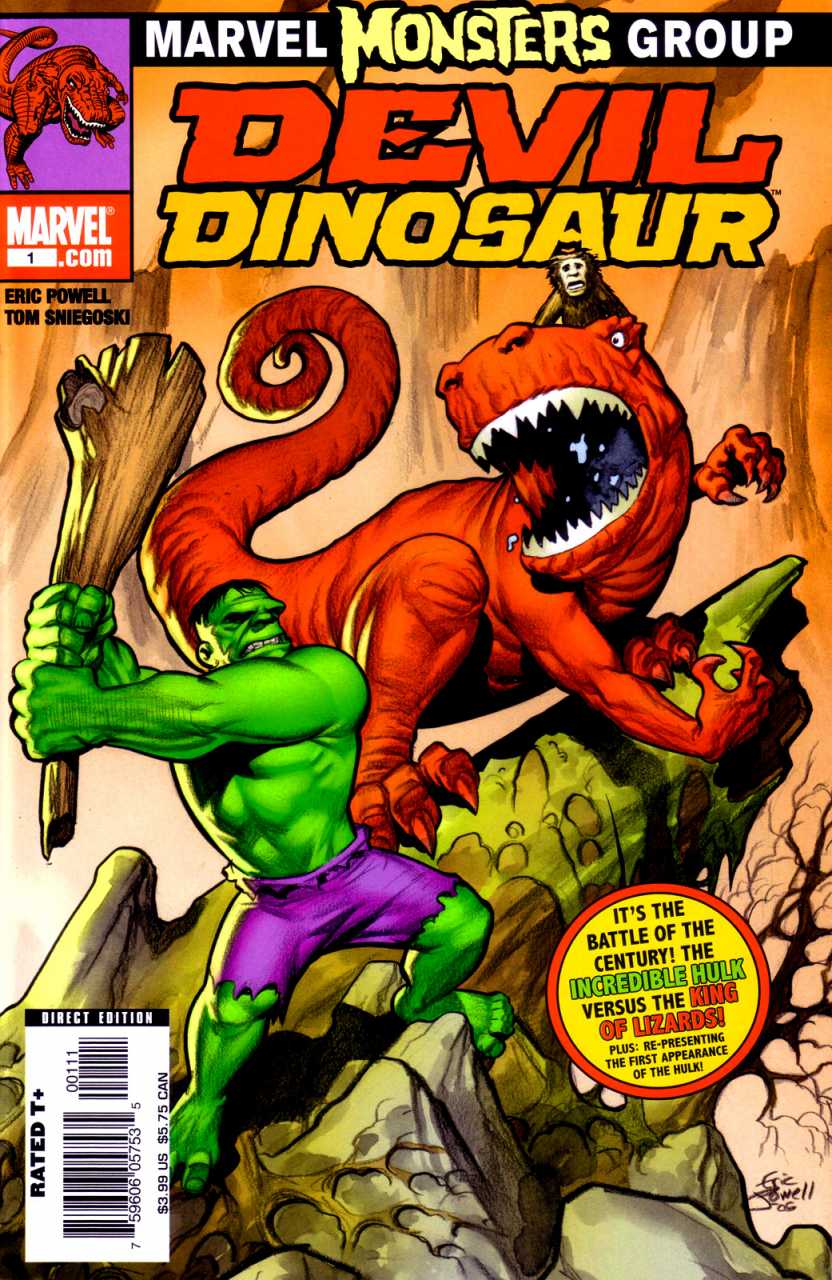
1790937-marvel_monsters___devil_dinosaur___00___fcYes, I’ve quit my regular buying of comic books, but I still make a few exceptions. In Toronto, there was a cool little comic book store/coffeehouse called the Black Canary (named after a DC Comics heroine; no superpowers, but just a tough woman).

I thought it might be a good time to look for some heretofore unpossessed (by me) Devil Dinosaur comics. I look first among the Godzilla comics (I know there was a crossover arc) and then the Devil Dinosaur box. Lo and behold, I found (for six Canadian dollars), a comic I had never read before. Super powerful aliens watch a scene from the original comics (when Devil defends Moon Boy’s people from some aggressive proto-humans) and, feeling sorry for the bad guys, give them an edge by beaming the Hulk into their midst. Hulk smashes Devil, but they think maybe they’ve made a mistake, so they give Devil extra strength and things go wrong from their, with two powerful monsters destroying the aliens’ stuff.

In the end, all goes back to the way it was.

Unlike a Devil/Spiderman crossover a few years back, this one didn’t treat Devil very respectfully. It made you realize how awesome Jack Kirby was – how in his original run, he used his artistic style to create very dynamic panels, where the action leaned forwards, towards the next page or panel, propelling things forward.

Flashman


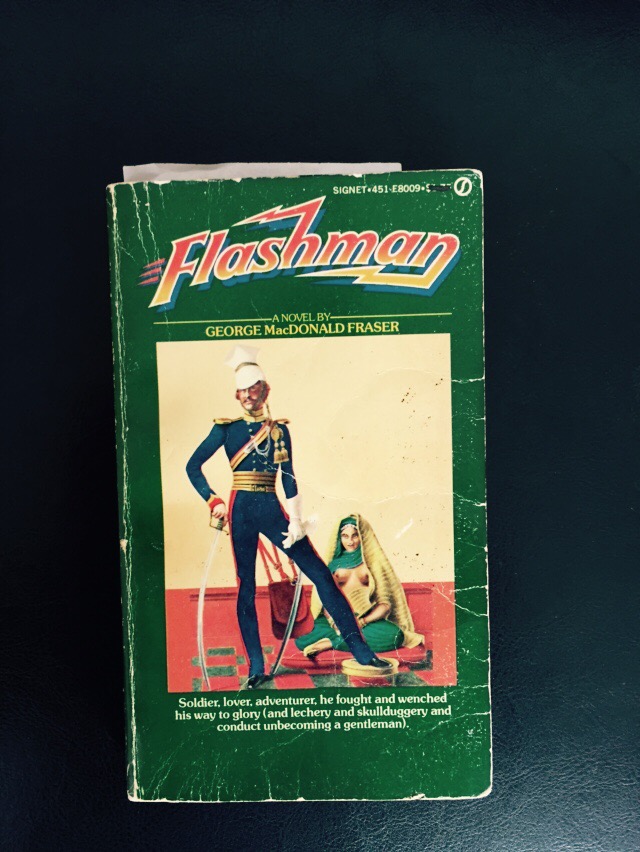
  I had heard about the Flashman novels – a sort of send-up of nineteenth and early twentieth century adventure novels. I’d seen the books in my local used bookstore and had been intending for some time to buy one and send it my father (who, like his older brother, has something of thing for Victoriana adventures; Kipling sort of stuff). But, naturally, I had to read it for myself first.

Flashman is more straightforward than I would have thought and the hero not so bad as I’d been lead to believe and less over the top. I wasn’t totally thrilled by his voice and it found it less than unique, but a rather straightforward pulp-style voice, only with a less admirable character.

There were some fun moments, mostly around Henry Flashman’s sexual failures. Firstly, when he tries to seduce a fellow officer’s wife, but she fights him off, not realizing that having one’s breasts fondled by a man isn’t a sign of ordinary affection, like shaking hands, but a sexual signal. Her shock and horror that he would have misinterpreted her accepting giggle of his boob fondling to be an implication that she wants a roll in the hay was lovely. Also, it was nice to see Flashman have to come to grips with (and accept) his wife’s apparent infidelity whilst he was in India and Afghanistan.

Also, I suspect that his account of the utter disaster of the British retreat from Kabul in 1842 (and also the events leading up to it) is not that bad.

By the way, Henry Flashman was a character in Tom Brown’s School Days and this Flashman is intended to be him – in fact, it begins with the expulsion of Flashman, related in that book.

Weekend Reading – Plausible Deniability


Merritt_jpg_250x300_q85An appreciation of A. Merritt’s commitment to incorporating scientific sounding explanations in his imaginative worlds (I read a novel by Merritt called The Metal Monster; don’t regret it and will probably read some more of him, but my appreciation is more or less specific product of my particular tastes, so I wouldn’t necessarily recommend him).

“Writing about moral philosophy should be a hazardous business,” said the late Bernard Williams.

Chinese poetry is happen’, man.

It’s still Poetry Month. Read some poetry, people. Buy a book. Support a poet.