It’s A Mystery!


…was the corny name of a fun little event put on by WETA, one of our local public radio and television stations. Professor Rebecca Boylan from Georgetown spoke about (primarily) British mysteries and the distinction between truth and justice, insider and outsider, etc.

It wasn’t as academic as I would have liked, but she did talk about three philosophical ‘truth theories’ and how various detectives use them to reach the ‘truth.’

First was the correspondence theory, which is building relationships or correspondences between facts to arrive at the truth. She mentioned Wallander of the detective show (and books) of the same name, though the classic Sherlock Holmes would have been a more obvious one, I think.

Secondly was the coherence model, which is less observational and more introspective; more about building a internally consistent model for the truth, for which the models were Luther (love Luther!) and Poirot.

Finally, was the pragmatic model, which was less about absolute ‘truth,’ than what worked.

Also, a neat and counter intuitive comparison of Luther and Morse, with Luther posited as the urban Morse and both being primarily representatives of the detective as outsider.

And they gave me this cool mug!

‘Except That I Have Bad Dreams’


HAMLET
Why, then, ’tis none to you; for there is nothing
either good or bad, but thinking makes it so: to me
it is a prison.

ROSENCRANTZ
Why then, your ambition makes it one; ’tis too
narrow for your mind.

HAMLET
O God, I could be bounded in a nut shell and count
myself a king of infinite space, were it not that I
have bad dreams.

The line, ‘there is nothing either good or bad, but thinking makes it so,’ came up in conversation recently.

I remembered the bit about the nut shell, but the last line of exchange escaped until, while later, I was driving, and it hit. And when it did, I realized how much it changes to whole color of the dialogue (though putting squarely with the rest of Hamlet which is, surely, at least partly about the existence/nonexistence of free will, maybe not in a metaphysical sense, but in the sense of being trapped by external events).

Taken of itself, that line, ‘there is nothing either good or bad, but thinking makes it so,’ is a wonderful example to (horrible) parents (usually fathers) who want their children to stop being upset about something that has, quite naturally, upset them. Because, really, it’s their fault they are upset, because it’s only their thinking that has made it ‘bad.’

But ‘were it not that I have bad dreams’ changes everything, doesn’t it? Even though dreams are an internal thing, they are also (at least partly) external reflections. You can’t make the world good or bad just by thinking, because the world will always intrude. Yes, it may all ‘be in your head,’ but the world is also in your head and the world has its own ideas.

‘The Silent Army,’ By James A. Moore


TheSilentArmySo, for the second time in recent memory, I have finished a four volume fantasy series only to see all the author’s hard work undone by some confusing, poorly explained deus ex machina(s).

These books were generally fun, with rival gods, an army of incredibly skilled and physically powerful soldiers, some interesting characters and decently drawn, if not incredibly well described, milieu.

Not only was the character we’d most come to identify with and see as the hero (Merros Dulver, if you care) largely marginalized, but the… solution, I’d guess you call it, was accomplished by a brain damaged minor character who did so by means of having (along with two other people) acquired more or less god-like powers by means… well, I really don’t know. Something was described, but not very well, so I really can’t say.

There seemed to be a hint that Moore would be writing more books in a related series in this fantasy world he’s created, but, honestly, he lost me. Won’t be reading them.

Collected Poems Of Chika Sagawa


SagawaCoverSPDI took my time reading this book because, more than most poetry, each poem needed to be read slowly and read at least twice. She died at age twenty-four, which is not only sad because of how much potential literature was lost, but also a reminder of how little I’d accomplished at twenty-four. Ugh.

As for the poetry itself, you have probably guessed that I found it amazing. We could go into a discussion here about translation and what not, but I’m really not in the mood. It’s free verse and, according to the intro, this was a wildly revelatory new movement in the Japan of the twenties and thirties. Supposedly, there wasn’t even a word for ‘poetry,’ merely ‘haiku’ and ‘tanka.’ Which is something like if, in English, there were no word for poetry, but only sonnet and villanelle. Besides the long nightmare of too many villanelles, imagine the astonishment of T.S. Eliot’s strange poetry suddenly appearing?

In English, we don’t get an appreciation for how formally groundbreaking her poetry was (not that she was the only, or even the first, Japanese writer to experiment with this), but we can appreciate it’s strange beauty. Heavily influenced by French poetry, it also (in my crude, sad, poor understanding of Japanese culture, which is probably just a horrible mash up of ridiculous stereotypes) feels distinctly Japanese.

Nature and the natural movement towards death (and decay? or do I mean ephemerality?) is frequent. I was constantly struck by how often ‘green’ appeared, but not in a natural sense. Or perhaps underlying that everything is part of nature (and inevitably dies? or is inevitably resurrected?). Snow is the second most common… motif? No, not motif. Maybe just a recurring word. And not so recurring as green.

Here is a short one, maybe not the best, but one whose first line repeatedly struck me:

GATE OF SNOW

People’s outdated beliefs are piled up around that house.
— Already pale, like gravestones.
Cool in summer, warm in winter.
For a moment I thought flowers had bloomed
But it was just a flock of aging snow.


East City Bookshop


While I missed its opening, fortuitously scheduled for April 30, also know as Indie Bookstore Day, because I was in Chicago or somewhere like that, I did eventually make my way over to East City Bookshop last Sunday.

It’s a little funky to get to, though it’s very near Eastern Market, and my first impression was a little off putting, it bears further exploration.

I was off put (or put off) because the first floor is small, with not many books. There were many shelves of books placed cover out, instead of spine out, which screams (to me), we have a small and poor selection!

Luckily, there were some stairs to a much larger downstairs which had a very nice and large children’s section and a well curated fiction and poetry section. The poetry section was not large, but I found Ocean Vuong’s much talked about debut (which I eventually bought), and Last Words from Montmartre by the late Taiwanese writer Qiu Miaojin (published by the awesomely reliable folks at NYRB; they had a number of books from that imprint and it’s a sure sign of quality).

While I didn’t partake, there was a big comfy couch and what looked like a play area for artsy activities for kids, though there also seemed to be a lot of wasted space.

In the end, it’s super close to an area where I spend a lot of time and someone clearly spent some time and attention to selection, even if there are some (to my mind) missteps in organization.

Midweek Staff Meeting – Irreplaceable


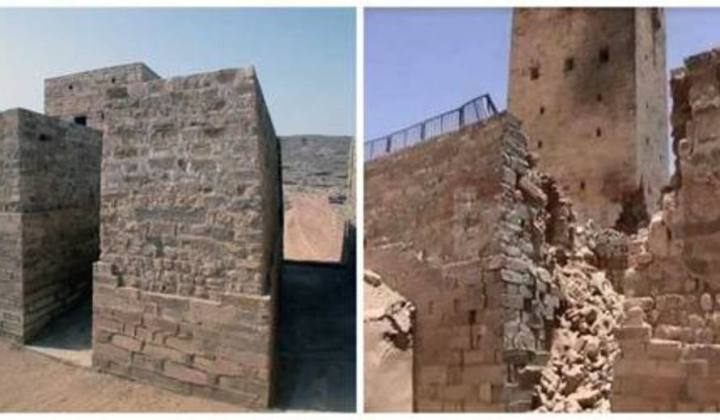
Saudi bombs are destroying the records of humanity’s earliest civilizations, one of the most important routes out of Africa for early human, evidence of neolithic trading empires and more. And we will never, ever get it back.

The correspondence between Mary McCarthy, the novelist that not many people seem to read anymore (Remember The Group?) and Hannah Arendt, the philosopher people can’t seem to stop talking about these days.

How chili peppers migrated from South and Central America to China’s Sichuan province in the seventeenth century and whether the fact that I love spicy food makes me a revolutionary, or, rather, more like to be one.

The oddly important place of philosophy in Wikipedia (but please note: do not actually use Wikipedia to learn about philosophy).

news_1291-890-520-20150611112036

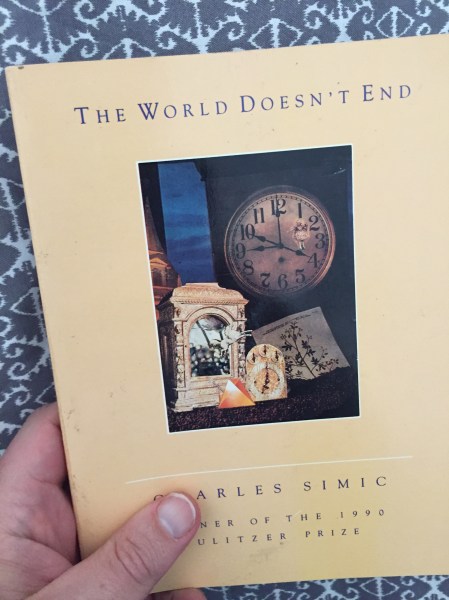
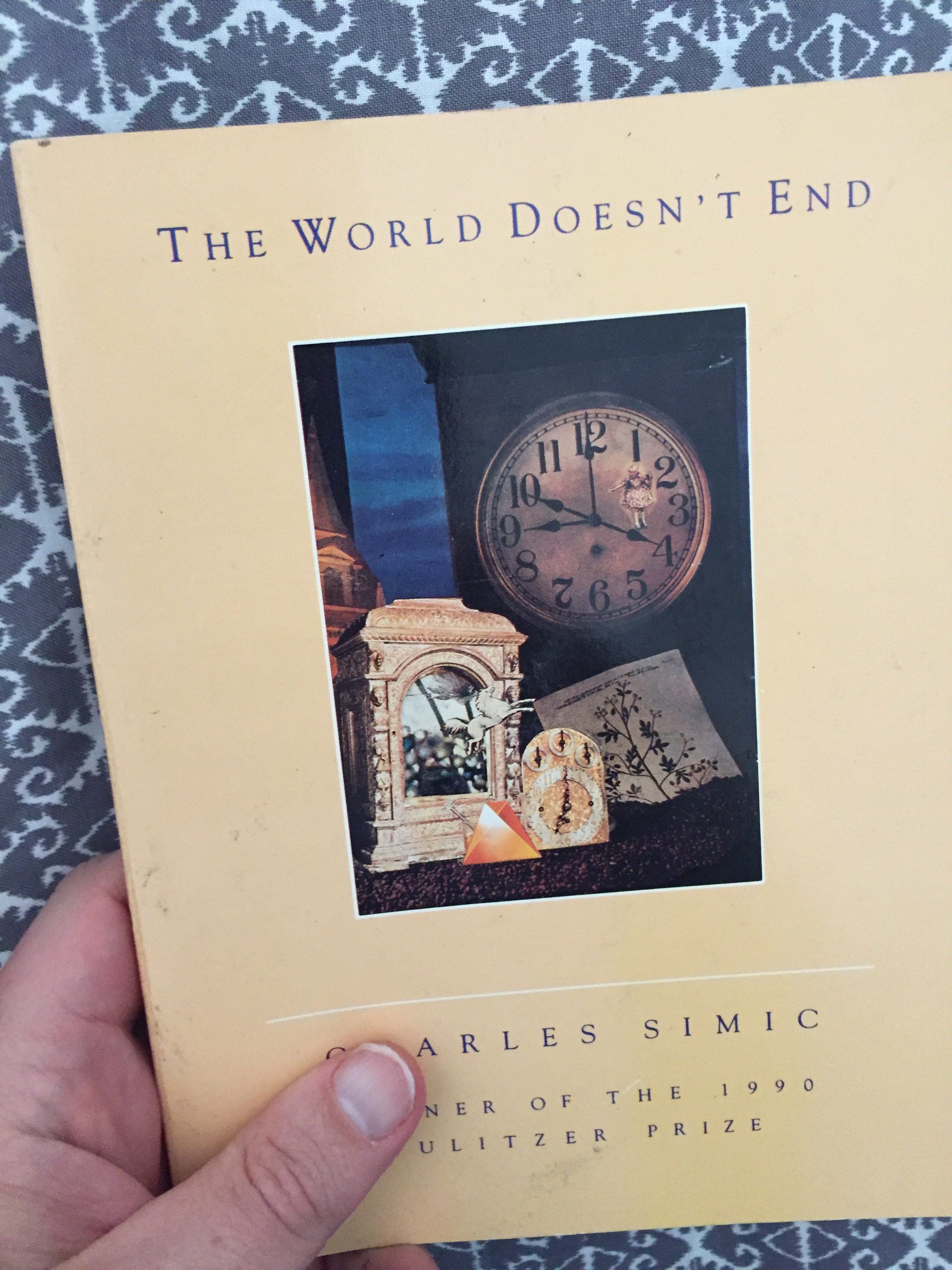
Re-Reading Charles Simic’s ‘The World Doesn’t End’


It’s hard to overstate how much this book affected me, because it opened my eyes to the infinite possibilities of contemporary poetry and poets. Upon re-reading, I found it as good or perhaps better than I remembered. The poems were more melancholy than in memory, as well. The world may not end, but that is also as much to say that suffering does not end, as well.

Happy Independent Bookstore Day!


Washington, DC is unique right now, in having a lively literary scene with plenty of bookstores, but exactly zero chain bookstores.

My own neighborhood has two longstanding used bookstores and, supposedly, today is the first day of a third bookstore on Capitol Hill – East City Bookshop.

I am out of town right now, but am looking forward to checking it out.

Thundarr The Barbarian The Movie!


Earth in the age of Thundarr the Barbarian

They’re doing a whole series of Hannah-Barbera movies! Unfortunately, they’re starting out with another Scooby Doo, which I can entirely do without, but I am already psyched about the presumably upcoming movies: “Thundarr the Barbarian,” “Space Ghost” and “The Herculoids.” They should probably do the last one first, because nothing guarantees a hug opening weekend like an armadillo triceratops that shoots exploding meteors from its horns. And to those of you who think I’m being sarcastic, ask someone who has known me longer and they will tell you that I am being one hundred percent serious because Thundarr is a post-apocalyptic barbarian with a mutant horse and light saber and the Herculoids have, in addition to the meteor shooting triceratops, also have a flying dinosaur that shoots lasers from its eyes. They also have glow in the dark play-doh, but that never the biggest selling point for me.

It’s A #Poetrymonth Listicle!


Why not? I mean, that’s all people read anymore, right? Listicles? Thank you Buzzfeed for helping destroy western civilization. Probably other civilizations, too. Does China censor out Buzzfeed? Maybe they want to protect their civilization from what I’m about to do (which, perhaps ironically, includes translations of Chinese poetry).

Anyway, these are collections that I have read since the last year’s National Poetry Month.

Split by Cathy Linh Che. I read it earlier this year and it’s still my favorite poetry collection in recent memory.

Salad Anniversary by Machi Tawara. Or maybe this one was my favorite. This book makes you happy.

Selected Poems of Li Po by [should be self evident, but if you’re curious, David Hinton translated it]. This is the Chinese one I was talking about. Contains more poems about being drunk than any other collection I have ever read.

Ooga-Booga by Frederick Seidel. You wish he wasn’t so good.

Dear Jenny, We Are All Find by Jenny Zhang. Also wrote a cool and devastating essay on… are we still calling it Poetry-gate? Anyway, should be better known for this collection.

Once in the West by Christian Wiman. Debated including this one, but still, a fine collection by an interesting, very talented and frequently delightful poet.

Antigonick by Anne Carson and also sort of by Socratis, but also not really or only inspired by Socrates. Is this poetry? It’s a play, certainly, but ancient Greek poetry was also performed and Greek drama evolved by the addition of additional voices to the performance of poetry. Whatever. Probably not, but I’m including it. Why am I including it? Because, awesome, that’s why.