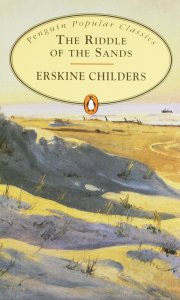
Riddle Of The Sands


My father explained that The Riddle of the Sands was about sailing, as he watched the seventies film version (with, of course, Michael York). I didn’t understand much of pay attention much at the time, but the memory stuck with me.

Without actually reading the book or watching the movie, I became more aware of it.

It was an early book that premised the idea that England’s future enemy was not it’s traditional foe, France, but a rising Germany. It was also an early version of the modern spy story.

A sailing enthusiast becomes convinced that a german yachter tried to get him killed by leading him down a dangerous coastal waterway, so he recruits a college friend to investigate was the Germans could be hiding, the titular riddle (the area is filled with sand bars and shifting sand islands). There is a British traitor, disguises, and a lot of dangerous sailing – which he manages to make exciting (there is no violence or fighting, but plenty of tension).

I will admit that I skipped the very end, which is a brief treatise of how England could secure her coasts against a German invasion using small, light boats arriving unexpectedly from that sandy coast, but I can’t imagine it’s very relevant now.
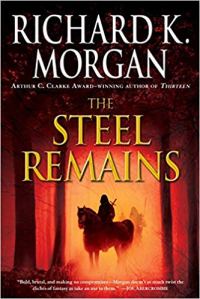
The Steel Remains


Written by the author of Altered Carbon (which I still haven’t read), The Steel Remains is a sort of grimdark fantasy (I hate that term) which partakes of some of the earthier moments of George R.R. Martin’s as yet unfinished septology (is that the word?) but more of the granddaddy (I would say), Glen Cook and his Black Company. Indeed, the three main protagonists would feel right at home in that titular company.
It’s all very good and exciting. The world is well crafted – it’s not unique, but Morgan is good at introducing the world without laying on tons of exposition. There is a sort steampunk overlay, with an alien race that uses barely understood technology that, as Arthur C. Clarke noted, looks very like magic. Of the three protagonists, one is clearly the focus and he’s gay, which is nice to see in terms of diversity (another is from a non-human sort of race that happen to be black).

But then…

He brings all three point of view characters (who also all previously knew each other) together at the very end in a way that just feels entirely too forced; a poorly established deus ex machina. that left me with a bad taste in my mouth.

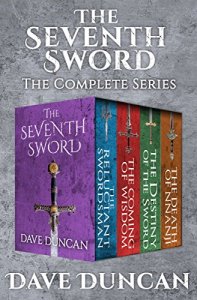
The Seventh Sword Trilogy


I read the first book, The Reluctant Swordsman, five years ago and recently got an opportunity to read the rest of the trilogy (and a fourth book, but I haven’t done so). I gave The Reluctant Swordsman a middling review; enjoyable but not great. But someone commented and encouraged me to give the rest of the series another try.

And I still think they’re middling. Not bad. Far from great. Far from bad, but closer to bad than great. The plot and character development got increasingly unbelievable (I never could figure out what was causing the hero’s jealous mood swings in the final book), without ever becoming so bad that I had to put it down.

But the real problem – which was exacerbated by the longer format of a trilogy – was that the world building was just inadequate. I just couldn’t believe in this world. The economic and social structures were complex without ever feeling like realistic, within the logic of the world. In a single book, where the premise is that a middle aged man gets his fantasy of being placed into the body of a buff and handsome swordsman, that can be overlooked, but not if you drag it out into two more books.

The Man In The High Castle


The missus and I have become fans of the Man in the High Castle television series and it seemed just wrong not to take advantage of the hiatus between the third and fourth season to read the book.
So, I got it from the library and was once again reminded of how deeply weird Philip K. Dick really is. I was also reminded of how much writers like William Gibson were influenced by him. Not just in Dick being porto-cyberpunk, but in how changes to the world and to technology change language.

The antiques dealer, Robert Childan (also one of my favorite characters from the series, which, in case you have only experienced one and not the other, is, like almost everyone else, wildly different from the man in the tv show), and the way he tries to adopt and interiorize Japanese modes of thinking deeply changes his language and even his inner monologue and that, and other similar adjustments, are the most fascinating part of the book.

Gore Vidal’s State Of The Nation


To read Gore Vidal’s essays published in The Nation is, for the most part, to read those of his writings least likely to have stood the test of time. His politically minded writings of the last twenty years of his life do not, to my mind, read as particularly prescient; instead, they feel as naive without necessarily being idealistic. Some are not even very enjoyable to read for his inimitable style.

But, there are always nuggets on insight and joy.

I had forgotten that Jerry Brown – who should have a monument erected in his honor for his last two terms as governor of California –  ran for president in 1992. Rather than spend his time writing about the then almost certain nominations of George Bush, père, and Bill Clinton, he sees something vital in Jerry Brown and Pat Buchanan.

I wrote that most of the essays do not feel prescient, but this one felt positively eerie in its foreknowledge.

His interpretation of how Brown and Buchanan represented the true and beating hearts of the Democratic and Republican parties, respectively, seem to almost exactly match the current transformations of them today. He couldn’t have known it, but Vidal’s Pat Buchanan is a proto-Trump: racist, isolationist and intent on dismantling what Gore called the ‘American Empire’ on those terms.

Brown is similarly depicted as ‘post-imperial,’ but on the grounds that we must focus on humanity and the people writ large.

The Poppy War


This book got a lot of attention and good press and I was genuinely excited to read it. To add some extra the spice, the author is from right here (Washington, DC; though I guess she has since moved). It lauded as a move away from western-centric fantasy and through some interesting, drug based ‘magic.’
But… aside from the Asian names, it did not actually feel that different from a traditional fantasy (poor girl goes to super school, turns out to be even more super than most, becomes a great shaman, which is to say, a sort of wizard). There were some references to the Journey to the West and other allusions to more classical Chinese culture, but even more thinly disguised references to the 20th century wars between Japan and China, as well as the Opium Wars (the name was barely changed) – so thinly disguised that they felt heavy handed rather than allusive; cheap rather than enlightening.

Just because it’s what I do, I may read the second book when it comes out, but I can’t deny that this one was a disappointment.

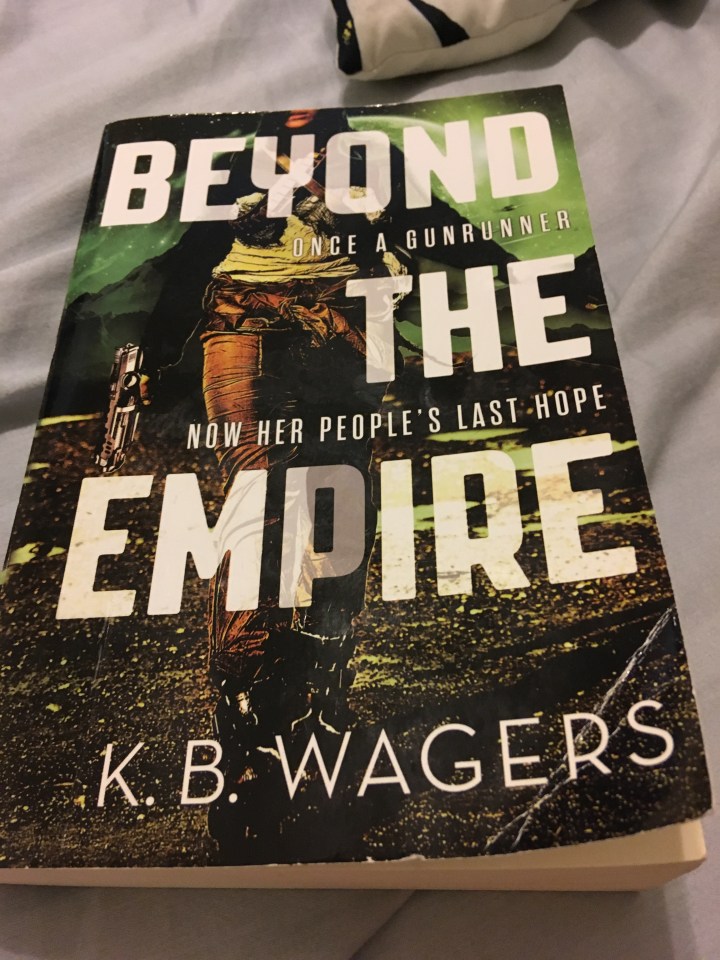
Beyond The Empire


Sliding into this book (3rd in the series) was like getting into a comfortable and super fun bath. Not as good as the first one, but still a blast.

Space opera. Military sci fi. Political sci fi. Feminist sci fi.

The strongest relationship in the trilogy was between a man and woman who respected and loved each other without ever suggesting that they had any desire to ever have sex (with each other). If there was a criticism, it is that this friendship didn’t get the attention it deserved in the final book.

I gather there is a sequel series and I’m down to read it.

A Belated Christmas Present!


‘Walking’ By Henry David Thoreau


Walking began it’s life, according to the introduction, as a lecture. It’s a fine, well-written piece by one of America’s finest stylists.

But Thoreau feels a little juvenile to me nowadays. Frankly, when I was reading this, I kept thinking: wow, I should really read some Emerson.

SOLEIL COU COUPÉ


I was reading Apollonaire’s Zone when I had to pause over the last lines.

My edition translated it as:

Sun throat cut

But I had to stop because something was bothering me.

You may already know what I just realized – that Aimé Césaire had taken the title of his most famous work from that line; only I had only read it in a far more aggressive translation:

Solar throat slashed