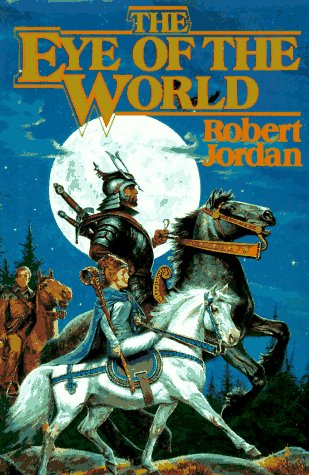
The Wheel of Time


I find myself halfway through the fifth book in the series, the Fires of Heaven. I certainly hadn’t planned on getting wrapped up in an epic, twelve volume plus fantasy. But these things happen. Granted, they happen to me more than most people.

While perusing the West Wing of the National Gallery of Art with my father over the Thanksgiving holiday weekend, I noted that my taste in visual art – paintings and the like – ran to two extremes. I love post-war, avant-garde art and I love dull, boring 18th and 19th century Italianate landscapes – the kind with crumbling Roman ruins and a shepherd in it.

My literary tastes seem to run in similarly divergent directions. I love poetry (though not always the most avant-garde poetics, i.e., Language and Conceptual Poetry) and dense, critical and philosophical tomes. But I also love me some paperback fantasy and science fiction.

I stumbled across the Wheel of Time series in a New Jersey bathroom.

Let me explain: I was managing some political races in South Jersey and was sharing an apartment with my field director who kept a hardback copy of the second book, The Great Hunt, in the bathroom. I read a couple of pages before getting my own place.

I won’t say I was instantly hooked. More that, having started, I felt the need to see how it ended. So I picked up the first book and things escalated and now I’m on the fifth.

I will be the first to admit they are not great literature. The author, Robert Jordan, took a little while to find a voice beyond just that of a second-rate Tolkien hack. Once he’d done so, he found himself falling into the sprawling cast of characters, plot gone out of control trap (which is almost inevitable if you go over ten volumes, I would guess). And he has even less of a sense of humor than Tolkien. But, I keep on reading. And that must mean something.

I should also note that Jordan passed away, lest we be tempted to speak too ill of him.

One day, I will be finished with them and can move on to something else.

Take Your Child to a Bookstore Day


Saturday, December 4, 2010 will be the first annual “Take Your Child to a Bookstore Day.” Naturally, it has my full support.

If you have ever read my posts, you know that I feel very strongly that we, as lovers of culture, art, & literature, should support brick & mortar, independent bookstores.

If you live in the DC area, I would suggest two places for the child in your life – the first is Politics & Prose. A big bookstore, with lots of spaces for kids to run around a little, as well as a children’s section. The other is Capitol Hill Books, my local used bookstore. It is a classic kind of place, with an irascible owner and lots of nooks and crannies where book loving kids can curl up and hide.

Terrance Hayes


Terrance Hayes won the National Book Award this year for his poetry collection, Lighthead. Hayes has been a relatively frequent visitor to DC, based as he is, just a couple of hours away in Philadelphia.

I saw him at the Folger Shakespeare Library in 2008 and he signed my copy of an earlier collection, Hip Logic.

Keep an eye out and catch him the next time he’s in town.

Charles Wright and Pastoral Poetry Further Reconsidered


For some reason, pastoral poetry has been in my thoughts these last couple of years. It’s genesis, I put down to my (re)discovery of Wordsworth a while back.

But much of what I’ve written here was been somewhat critical of contemporary pastoral poetry. I tentatively agreed with the idea that pastoral poetry that does not also participate in a certain eco-poetic-politics is insufficient – the idea that it is not enough to write about the nature when so many dangers to it exist. The example given (not by me) was that it is insufficient to write about the songbird and not about the bulldozer nearby that threatens it. Adam Johnson called it “ecological orientalism.”

I have also jumped on the bandwagon of those who look at W.S. Merwin and see someone whose writing since The Lice and The Carrier of Ladders leave something to be desired. I bring that up because, The Lice, in particular, is such a great example of eco-poetics: pastoral poetry that encompasses the man made dangers threaten the natural world. His more recent writings, while still perhaps good, lack the urgency and conviction of those early eco-poetics. They are, in short, what I find to unpalatable about contemporary pastoral poetry.

But my feelings may change. Even now, I reserve the right to change and evolve.

For example, I used to lump Charles Wright in the same category as Merwin. Wright’s first book was published between The Lice and The Carrier of Ladders, so I think we can safely place them in the same generation of poets. And he has also indulged in his fair share of pastoralisms. But I read him and see someone who, while not writing within the Snyder-esque, deep ecology vein of early Merwin, still finds a way to make his pastoral indulgences relevant. He also gives the aging poet some hope, having not clearly peaked by his forties and continuing to evolve and improve over the years.

I bring this up more to question myself. I am not sure how real the distinctions I make really are and much I am merely justifying unjustifiable prejudice. Because I must be nearly the only person to prefer Wright to Merwin (I know plenty of poets who lean more towards the avant-garde who can’t stand them both and my classically quietist and septagenerian father just loves Merwin and couldn’t care less about Wright).

Oh well. As long as I continue to find Billy Collins offensive, I will know I haven’t completely lost my way.

America Unchained Day – Saturday November 20th


Tomorrow is “America Unchained” Day. The idea is for people to restrict their spending only to locally owned, independent business – eschewing national chains in favor of the metaphorical mom & pop operations in your community.

I am in complete agreement with this goal. I have written a lot about the desire to support your local bookstore over the big chains and most especially over Amazon.com and other, online only retailers.

Tampa Bay’s best independent bookstore (and a personal favorite of mine), Inkwood Books, is promoting the event. They claim that this one day, if strictly followed by every consumer in the two counties, would generate $73 million for the area, because spending at a locally owned business generates 3.5 times as much local economic activity as spending at a national chain.

But we intuitively already know this. Just like we know that supporting the arts with public monies actually results in a net economic gain for the community. But we still take the easy way out – when times get tough, households shop take their money to big box stores and local governments cut funding for the arts. And sadly, each of these actions do their small part to actually extend the tough times, making recessions last just a little bit longer for everyone.

Ok. I’m coming down off my soapbox for now.

But shop local tomorrow – and buy a book from your favorite independent bookstore, will ya?

Slow Poetry


The Atlantic‘s five part series on poetry continues with this piece on “slow poetry.” I skipped over the third in the series, which discussed “flarf.” Why? Because, frankly, I have little interest in flarf. I don’t deny its aesthetic value, merely that those aesthetics have yet to grow on me.

Slow poetry – that sounds like something more up my alley.

Of course, it quite self-consciously reflects the “slow food” movement. The idea of slow, close reading and respect for local small presses is something I can get behind.

He also discusses (all too briefly) the difference between “nature” poetry and contemporary “ecopoetics.” The argument being that traditional, pastoral poetry is insufficient for the poet writing today. If you write about nature without writing about the human threat under which nature lives, you are just engaging in a paternalistic program (he calls it “ecological orientalism”).

Four Quartets


I opted to pick up a copy of T.S. Eliot’s late poetry cycle, Four Quartets the other day. A line from the first poem in the cycle, Burnt Norton, provided the title to one of my favorite British television mysteries, Wire in the Blood (I love the first three seasons – but stopped watching after Hermione Norris left the show). The book was just sitting there, waiting for me, at Capitol Hill Books. How could I not pick it up?

Now, I feel deeply torn. Should I admit? Should I say it? I read these poems years ago, and while I knew then that they were not as good as, say Prufrock or the Wasteland, that was like criticizing a novel for not being as good as Ulysses. It’s too high of a bar to fairly set.

But now, when I read the Quartets, it is like reading some young kid’s effort to write like Eliot. It’s a parody of the high modernist style of his earlier works – that youthful student, in the full flush of first encountering writers like Eliot, Sartre, and Marx and then proceeds to tell his elders all about them (I admit – I was that student in my youth). I try to hammer through it, but I cannot shake the nagging sensation that this is bad writing.

But it’s by Eliot? How can that be?

Maybe I need to set aside a little longer and come back to it in ten or twenty years and see if more experience will not favorably color my views.

Alice Coote


We saw mezzo-soprano Alice Coote, accompanied on piano by Bradley Moore, perform a recital of English poems set to music by English and American composers (Elgar featured prominently among the composers and the Romantics among the poets). We sat in the front row, which is awesome at a Grateful Dead show, but can feel a little awkward at a classical music event – but it was the first time to see a singer perform up close. The experience was a reminder of how little I really know and understand about music, watching the contortions of her face and body as she sang.

Unfortunately, Ms. Coote was suffering from a cold and was a little off, but it was still gorgeous. Not entirely my cup ‘o tea, though – the music, from twentieth century composers, sometimes seemed too close to the popular songbook and I have never been a big fan of musicals (except for, for some reason, The Fantasticks).

When she sang a series of “poems” – actually diary excerpts – by Virginia Woolf, I saw a bit of what we had been missing earlier. In many of the other poems, even such emotive pieces like Byron’s So We’ll Go No More A-Roving, she seemed content to simply perform the recital. But when she arrived at the Woolf pieces, her performance changed. She seemed to be personally and deeply moved by the sentiments. A reminder of how much, for me, a good operatic performance is as much a product of the acting as the singing.

Poetry in DC


I just wanted to give credit to Gina Sangster, who published a letter to the editor in the Washington Post pushing back against the perceived meme that the DC poetry scene is limited to unartful poetry slams.

She named dropped some of my favorite poetry events – from readings at Busboys and Poets to the poetry series at the Folger Shakespeare Library, to the readings at the Library of Congress.

I recently noted my own mixed feelings towards slams, but in addition to featuring to thriving slam scene (which it shares with Baltimore), Washington, DC also features a (relatively) well supported scene for all kinds of poetry.

The Mainstream versus the Experimentalists


Adam Roberts titled his second piece on the state of American poetry, published in The Atlantic, “What Makes a Poem Worth Reading?” But the title (perhaps not even chosen by Roberts, but by a copy editor at the magazine) is misleading. The piece is, in fact, about an ongoing battle within poetry. Ron Silliman refers to it as a struggle between quietists and the post-avant garde. Roberts formulates the same division as “mainstream” versus “experimental” – but in both cases, they are essentially talking about the poets about emerged out of the L-A-N-G-U-A-G-E poetry tradition and, well, pretty much everyone else.

Roberts seems to come down, if only slightly, on the side of  the experimentalists. Though he also seems to be calling for a new experimentalism – one that is more accessible to the average reader (though he also tries – and fails – to grapple with what it means for a poem to be accessible; in his defense, I am quite sure I could not have done any better).

He ends by saying he will talk in future installments about two movements – flarf and slow poetry – which he seems to feel have potential for bridging the “accessibility” gap in experimental poetry.