Warrant


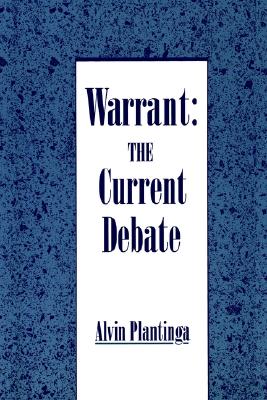
Using my $100 ebook card from Barnes & Noble (thank you, Mu!), I decided to catch up on some western philosophy. Over half of my gift card went to purchase Alvin Plantinga‘s Warrant: The Current Debate. A little bit of a misleading title, because I don’t think anybody but Plantinga was debating “warrant” much before him.

In college, my epistemology professor, Aron Edidin, was a friend of Plantinga and gave us some short articles by him to read. At the time, the class was not impressed – possibly because, as I know understand from having begun this book, our professor did a poor and, arguably, flat out inaccurate job of describing warrant (which he posited as being in addition to “justified” in the traditional formulation of “justified true belief” when, in fact, it was intended to replace “justified”).

My professor did say that Plantinga was writing a trilogy (it had not yet been finished at the time) of books about warrant that would culminate in a argument for a theistic god. At the time, I was a raging atheist, so this did not particularly excite me, but now my interest is piqued (of course, he doesn’t get to that until the third book).

So I am a handful of pages into Plantinga – far enough along to know that, though not entirely my fault, I have been until now misrepresented his work when thinking of it.

Continuing in this vein, I also dropped a $1.99 on a Barnes & Noble edition of William James’ classic, Varieties of Religious Experience.

Automated, Online Submissions


As the careful reader knows, I have developed a certain obsession with automated, online submissions, as used by contemporary literary journals. While I understand their utility, I am still haunted by the notion that, in practice, we lose something. Though it is still possible for editorial staff to use the content management systems to deliver more detailed messages, it is so much easier to simply click “reject” and automatically send some formulaic language to the writer.

No one liked receiving those old letters, with the notes describing the many flaws and deficiencies of our submitted works, but we learned something from them. I don’t get a damn thing from an email that contains the same language as everyone else received.

And of course, the editorial staff can still choose to offer a more detailed critique with their rejections. But how many really do? And how many really do compared to when they had to print out a letter with your name on it and containing the names of one or more of your poems? A letter truly feels more personal, which is what drives editorial staff to write critiques – even if just a hand-written scrawls across and otherwise formulaic letter. But this new method, for all its efficiency, is too detached to encourage that.

The reason I am bringing this up again is simply because I ran into this little article online — http://www.pw.org/content/new_treefree_submission_services – a list and a brief history of some online submission systems. Of those listed, I know that I have dealt with submishmash, though I’m not sure about the others.

Anybody want to disagree with my opinion on these systems?

Christmas Books


Every Christmas now, for going on twenty years, my mother has always found an autographed book to be one of my Christmas presents.

This year, it was How Florida Happened: The Political Education of Buddy MacKay by, of course, Buddy MacKay.

Buddy was the last Democratic governor of Florida – he served for only a few months, having taken office when Walkin’ Lawton Chiles died just before his term ended. Buddy had been his lieutenant governor. Unfortunately, by that time, Buddy had already lost the election to Jeb Bush, who would go on to lay the groundwork for Florida’s current economic and educational failures.

A good man, Buddy MacKay was the last of an old breed of Florida politician who got pushed out the extremists and the lobbyists who now run Tallahassee as their own, private fiefdom.

New York Times Finally Remembers to Review Some Poetry This Week


After going I can’t remember how long without reviewing a single book poetry, the New York Times Sunday Book Review finally made some small amends with a review of a new translation of the nineteenth century Italian poet, Giacomo Leopardi. They gave a positive, dare I say, glowing review of Jonathan Galassi’s translation of the Canti.

Of course, it would be nice if they did this every Sunday. It would also be nice if they drew some attention a poet who wasn’t already dead. But I guess I’ll take what I can get.

New York Times


Once again, the Sunday New York Times has failed me, because another week has gone by where the book reviews failed to review a single book of poetry.

The NYT, in this respect, is the master of the tokenism. But the tokens are getting more tenuous. This Sunday last, for example, they review a posthumous novel by the New York Poet Jim Carroll. Even worse, they reviewer admitted that the novel was not terribly good and suggested a reader would be better off reading some of his excellent poetry. Which begs the question, why not just review some poetry?

This Sunday last, they also did their yearly “Best of” for 2010. The best books – the best fiction and the best non-fiction. But no room for a top ten list of poetry.

This year saw the publication of The Collected Works of Larry Eigner, the stunning Nox by Ann Carson, and Terrance Hayes’ Lighthead. But apparently, none of these, nor any other books of poetry were worth mentioning.

New York Time – you suck.

Zone 3


While browsing a big box bookstores (Barnes & Noble; I know, a little hypocritical of me, especially when I advocate so strongly in favor of local bookstores, but I was with a friend who was shopping at Forever 21 and I needed to get away and B&N was just down the block) I bought a copy of the little lit mag, Zone 3, to read while drinking tea and waiting for my companion’s shopping excursion to be over. I had never seen it before, but it just took a quick browse of the various options to see  that Zone 3 was something interesting.

I’m a poetry reader, rather than a short story reader, and I’m drawn to lit mags to focus heavily on verse. Unfortunately, bookstore chains, even those that stock some lit mags, tend to focus on the more mainstream mags that have mainly have fiction (Granta, Ploughshares, Sewanee Review – that sort of thing). My preference has always been for the smaller publications with a lot of poetry. Half the time, in a Barnes & Noble, that means getting Poetry, which is alright, but you’re not really branching out with that.

Zone 3 is the literary product of Austin Peay State University in Clarksville, Tennessee.

In the issue I read, I would like to single out Shannon Winston’s piece, Figure and Ground, about violence in the Holy Land. I have no idea what here experience there is, but it reads well – a nice combination of romanticism and the quotidian.

Coleman Barks poem, Witness, also deserve some mention for offering a view of youthful drug use that lives in the middle ground most of actually experienced – avoiding both the cliches of addiction or of effective insanity, while also not falling for spiritual hocus pocus. I was actually reminded of a line from Baldwin’s short story, Sonny’s Blues. A character was apologizing for having been the titular Sonny’s entree into drugs. He explained that Sonny had asked him how being high felt and responding with an honest, but hapless, “It feels good.” Of course, that story went down the road into addiction, but the idea of an honest answer – “Yes, illegal drugs have definite legal and physiological dangers associated with them, but they can feel good” – seems refreshing. I have no desire to revisit the mistakes of my youth, but neither will I pretend that I had some sort of cosmic epiphany about their essential nature or my own as a result of them. I simply grew up a little more.

But back to Zone 3. They also had some nice interviews with unusual questions that made the whole thing seem like a absurdist exercise. I can’t really explain it – just check it out.

What Is An Intellectual?


I ask because I’ve been reading two books address that question.

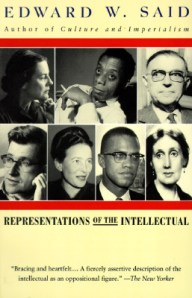
On my Nook, I just finished Tony Judt’s The Burden of Responsibility: Blum, Camus, Aron, and the French Twentieth Century and have been reading (in a more traditional form) Edward Said’s Representations of the Intellectual.

I was, I am ashamed to confess, mostly unaware of the stories and works of Leon Blum and Raymond Aron (like many young men with intellectual pretensions and a smidgen of angst, I feel deeply and platonically in love with the idea of the Albert Camus – the tormented figure on the cover of my edition of his collected journals from 1945-1951 [see picture]: the aggressive sex appeal of Humphrey Bogart and the tormented moral questioning of Soren Kierkegaard).

Edward Said was someone I had read, but never in depth (a fact that this slim volume cannot be said to have remedied).

Whereas Said is explicitly attempting to impose stricter criteria on the intellectual (in an age where every blow hard on Fox News thinks himself to be a public intellectual), trying to take that title away from those whose actions have thrown away the right to call themselves one, Judt takes a less questioning view of the idea of the intellectual. Ultimately, he does not question that those who put themselves forward as intellectuals are exactly that. What he does do is put these three figures (Blum, Camus, and Aron) up as sort of “super-intellectuals.” Figures who somehow exceeded or at least operated outside the traditional lines that mark the French public intellectual. He even denies that Albert Camus was truly a public intellectual (not an intellectual, but a public intellectual) but rather part of a tradition of les moralistes – of moralists. Camus as a tormented Rousseau to Sartre’s self-confident Voltaire.

Said’s main beef is with professionalism, which he sees an insidious force that works to (my words, not his) neuter intellectuals (which point, Said would no longer consider them intellectuals).

It’s a hard road he calls for. One of the pitfalls of professionalism is specialization, which is singled out as a means by which a potential intellectual, with the potential to shake things up, is moved to an area of safety (safety from the perspective of those who might be called out by an “un-neutered” intellectual). This is a hard road, because he calls for the intellectual to be as close as possible to being an Renaissance man – someone who has made reasonably deep studies in a number of different fields. Arguably, it has been impossible for nearly two centuries to be a true Renaissance Man. Not since Goethe has the available scope of human knowledge (at least in the Western world) been sufficiently manageable for one man to be able to write innovative treatises on both the science and mathematics of meteorology and chromatics and to also be a world class novelist, poet, and essayist.

What Said is calling for is resistance to some of the specialization one sees in the literary and philosophical fields that, of necessity, limits wider vision.

But both Judt and Said see their respective figures (three specific figures in Judt’s case; a more nebulous construct in Said’s, though he seems to view Noam Chomsky as a sort of ideal intellectual) as being outside the dominant intellectual sphere.
Emily Dickinson Birthday Tribute/Revolt for a Cause


I will find myself in a quandary next Tuesday as I attempt to cram two events into one evening.

The first event is Revolt for a Cause, which is being put on at the swanky 18th Street Lounge, which represents pretty much the pinnacle of hipster cool in a town as uncool as Washington, DC. The event is a fundraiser for Wayne Kramer’s prison rehabilitation non-profit, Jail Guitar Doors. If you are a fan of classic punk, then to answer your question, yes, it is named after the Clash song, Jail Guitar Doors (incidentally, written in honor of Wayne, who was serving some time in jail when the song came out in the late seventies). I have mentioned before that I am a fan of Wayne, so I certainly don’t want to miss an opportunity to hear him to do an acoustic set for a small gathering – particularly since I’m getting comped on account of the work I have done as a subcontractor for the group throwing the fundraiser, Revolution Messaging.

But I said there was a conflict.

The Folger Shakespeare Library, a little later that evening, is having an Emily Dickinson Birthday Tribute, featuring the poet Lucia Perillo. I confess to knowing nothing about Perillo (I know a good deal about Dickinson – my mother loved her poetry and used to read them to me when I was a child). But before I saw them at the Folger, I knew nothing about Terrance Hayes or Rae Armantrout and had mixed feelings (at best) about Charles Wright. What I’m saying is, I trust their taste enough to take my chances.

Edward Said


I was with a friend watching the Cleveland Cavaliers get stomped by the Miami Heat (starring Cleveland apostate, LeBron James). It was not a pretty sight. My friends was not from Cleveland, but had spent a lot of time there as a fundraiser for Democratic candidates in Ohio last year. We crowded into a Dupont Circle sports bar and watched. Eventually, I gave up and made my way home via the metro while my friend joined some other Ohio expatriates at the Big Hunt.

Before moseying home, I stopped at Kramerbooks to browse and to pick up something to read on the subway. I was bouncing back and forth between selection of poems by Paul Celan and a transcribed lecture from 1993 by Edward Said entitled Representations of the Intellectual.

As you have probably guessed, I went for Said. No disrespect to Celan, but Said was slightly less expensive and small enough to fit in my winter coat’s capacious pockets.

In the early stages, Said is simply juggling with what an intellectual actually is. He seems to be leaning towards a conclusion of the intellectual as someone who is outside the system in many ways – that, in fact, the classic French mandarin might not actually be an intellectual.

This struck me because of how it lined up with Tony Judt’s The Burden of Responsibility: Blum, Camus, Aron, and the French Twentieth Century. I just finished reading the middle section of that book (on my Nook, no less), the part about Albert Camus. He proposed that Camus was not truly a public intellectual, in the way that Jean-Paul Sartre and Simone de Beauvoir were. Instead, he places him in a slightly different tradition, that of the French tradition of les moralistes. Different from our moralists, which, in English, implies a hypocritical and conservative figure who speaks with ill-conceived religious certainty. Rather, une moraliste is someone who exists outside of the mainstream of thought and is constantly wracked by doubt and approaches the problems of the age from an abstracted, alienated perspective. The example he gives is Jean-Jacque Rousseau as le moraliste in contrast to public intellectuals like Diderot, Voltaire, and Montesquieu.

I was struck because Said’s definition of an intellectual appears to be similar or parallel to Judt’s les moralistes.

Of course, Said has the entire rest of the book to flesh out his definition and this similarity may not hold up until the very end. But it is certainly a new way to think about the role of the intellectual in society.

going going


The other day, I pulled a little chapbook called  going   going by Jen Hofer out of my bookcase. I was just looking for something small to put in my pocket and read when going out to grab some noodles and pick up my niece, who was taking one of the Chinatown buses in town.

I remember very clearly buying this chapbook. It was at a Poets Against the War reading at Skylight Books. I went because I love Skylight Books and because Wayne Kramer was reading. Wayne showed up in an orange, prison jumpsuit and read some works in his hyper, rat-a-tat-tat style (he reminds me, in that respect of my friend, the Florida poet Brad Morewood – though Brad has never been, so far as I know, a seminal punk musician like Wayne).

I can also say without a doubt, that this occurred on January 13th, 2008. I know that because Jen wrote it in the chapbook.

going  going is a little handmade number, constructed out of index cards and postcard from Death Valley, clipped together at the upper left hand corner. Whether it was done on a typewriter or not, it wonderfully mimics the font of an old, manual typewriter. The whole thing has a sort of Larry Eigner feel (though I say this having read very little of Eigner – I leave it to my betters to correct me in my comparison).

It is a good, hard edged books of politically aware (if not always explicitly political) poetry. It was put out by the small internet mag and sometime chapbook publisher, Dusie if you wanted to try and find it.