Juvenalia & Slams


It is a humbling experience to look through one’s old writings – you know, the ones that were so deeply praised when you 16, 18, 22? The one that now look like, well, like  they were written by a sixteen year old, eighteen year old, or twenty-two year old.

I used to attend a lot of open mic poetry events, back in the day – from roughly 1990-2002. The early ones took place at people’s homes and then coffeehouses started to come back – not Starbucks style places with lattes, but dingy little places with bad coffee whose main draw was a certain elán  and sense of commitment to a Beatnik style of life. Places like CAMS in Pinellas Park and Mother’s Milk in Clearwater.

These open mics were different from slams, about which I have mixed feelings. But I also have mixed feelings about my mixed feelings. Slams necessarily value performance and the delivery of widely accepted messages (opposition to discrimination, the societal problems caused by socio-economic inequality, love is cool, etc) over craft – rather the opposite of MFA poetry, which can by entirely too “crafty.”

I say have I mixed feelings about my mixed feelings because I also know that I am not an impartial judge, for two reasons. One is simply that, with a few exceptions, I don’t write poems that do well in slams. I have one or two, but they are rarities, so can’t discount the possibility that my anti-slam bias is itself biased by sour grapes.

The other issue is a little more tricky, because it has something to do with race (and a little to do with age). I am a white male, over 35 and I never really got into hip hop when I was younger. And slam poetry is closely intertwined with forms  of rap and hip hop – which is to say, with cultures emerging out of black and latino communities. How much of my mistrust of the quality of slam poetry is simply that of a privileged white male who closely associates himself with the classic forms of Western European culture and who cannot or will not properly understand a culture driven by those who are both younger and of a different ethnic environment.

But to return to my original point…

Once, I looked at my accumulated body of work and it seemed quite large. But, of course, the poems of one’s youth don’t hold up so well, do they? You look through all these puerile pages and wonder why you ever thought well of yourself?

When you reduce it just those that are actually “good,” you see that your true oeuvre is actually just a handful of pieces.

I shudder when I think what the local poets I used with read with must have thought of me. A silly boy writing sad, silly love poems. Humbling to imagine myself.

Leading of course, to wonder what will I think of what I write now in 15 years? Maybe well enough. There seems some evidence that once “peaks” as a poet in one’s late thirties and forties. I am nearing that point.

 

My Library


My little library is nearly complete. It’s the smallest room in the apartment, save the bathroom, but now contains an office chair, my desk (made out of recycled wood by a local furniture maker), a stool, Smith-Corona typewriter, record player, and three pale wood bookshelves.

In other words, the whole get up is basically porn for poets.

During my first evening in my little nook, I sprawled out with a copy of Pedagogy of the Oppressed, a book long recommended to me by my pedagogically inclined friend, Steve. I still have a little room to mix and match books – giving away older copies of The Poet’s Market and switching out some of the trashier reads for the rest of my poetry collection. Plus, of course, all my many, many notebooks.

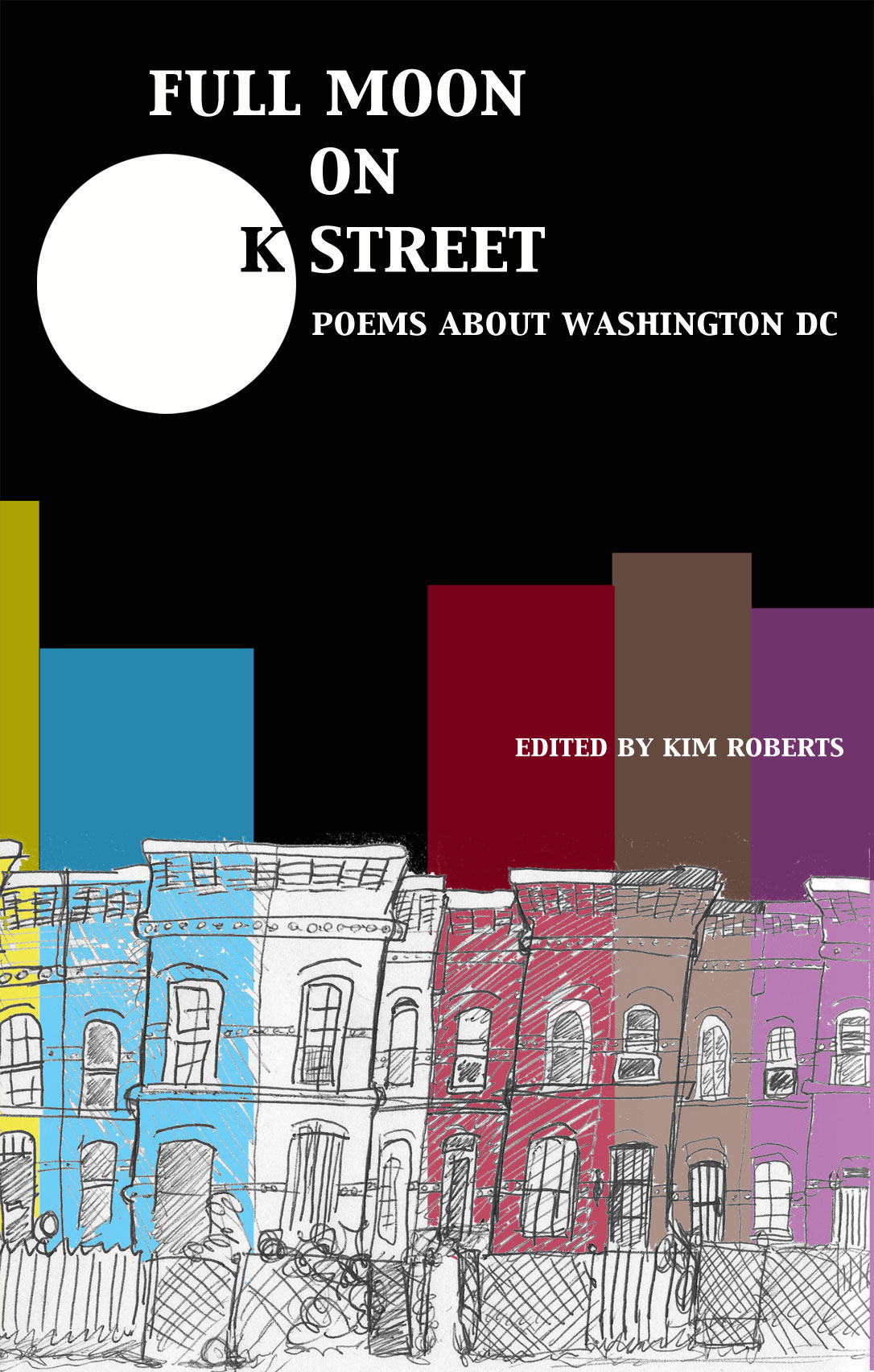
Full Moon on K Street


This book actually came out some time ago. I first heard some of the poems at a reading at the Folger Shakespeare Library, but did not buy the book at that time (I did buy a book of poetry – I always do at these things). I bought it more recently when Busboys & Poets featured the collection, its editor, publisher, and several of its contributors for a packed house a poetry reading on a recent weekend.

Full Moon on K Street is a collection of 101 poems that take place somewhere in Washington, DC by poets who have lived in the city. All the poems were written after 1950. The volume is a fine reminder that Washington, DC is a living, breathing cultural city. It is not just museums and monuments for the dead nor is it just a place where the federal employees goes to work. Washington is also a town filled with activists and organizers, who help create a wonderful bohemian vibe and support places like Busboys & Poets and contribute to a vibrant culture of art and poetry. Full Moon on K Street is partly a chronicle of the side of Washington you can’t see on C-SPAN.

A Defense of Poetry


It is a national or perhaps global tragedy that this is even necessary. I am not going to speak in defense of poetry here – I have done that before and I suspect my point of view is clear.

But I am going to praise The Atlantic for embarking on a five part series about poetry, opening with a piece entitled The Righteous Skeptic’s Guide to Reading Poetry by the Iowa Writer’s Workshop fellow, Adam Roberts.

He opens with describing scenario most of us poetry lovers have encountered – the self-described voracious reader who nonetheless professes some kind of allergy to poetry (almost as bad is the person who reads some poetry, but, in effect, only reads poetry by dead poets – the Romantics and maybe some Frost and Dickinson).

Adams says he intends to make this a sort of “state of the union” for American poetry and will, next week, tackle the idea of accessibility.

Co-Owner of Politics and Prose and Titan of the DC Literary Scene Passes Away


Carla Cohen, one of the two co-owners of Politics & Prose, passed away early this morning. She was 74 years old and suffering from a rare form cancer.

The owners of Politics & Prose have been seeking new owners to buy them out for some time now. Carla Cohen and Barbara Meade turned the bookstore into a nationally recognized bookstore and a DC institution. Even as Barnes & Noble and Borders have struggled, Politics & Prose has, according to all reports, remained solidly profitable. It is believed that there are a number of would-be buyers, but that they were looking for someone they could count on to maintain the store’s cultural, as well as business, legacy.

Like Sylvia Beach, we should recognize the contributions to modern literature of people like Ms. Cohen, who provided a place where books where properly and respectfully flourish.

New Publication


My poem, Pontiac Sunbird, 1994 was accepted by the magazine Ceremony for publication in the Spring 2011 issue. In the meantime, the editor has posted it on their website, The Sheltered Poet.

Spring 2011 seems like it will be a popular time for me – what with four of my poems being published that quarter. Might even make up for the fact that my paying work seems likely to significantly dry up around that time (curse you, political cycle!).

Poetry Reviews


The New York Times book review section on Sunday has been steadily shrinking in size. This is sad, but it isn’t news. We’ve all watched it go from 60-70 pages to about 28 pages now – which is still better than the Washington Post and St Petersburg Times, which has gotten rid of their stand alone book reviews altogether.

One hates to criticize one of the last major venues for book reviews able to reach people not already subscribed to a literary magazine. But I feel I must speak up.

New York Times, where is the poetry?

They used to consistently review a book of poetry every week. No, they were not digging deeply into the catalog, but at least they would review collections from publishers like Copper Canyon.

Then I noticed that sometimes they would review a book of essays by a poet or a biography of a poet and seemed to feel that this “counted” as their contribution to the support of poetry. In recent weeks, they seem to have ceased writing about any poetry or poets.

A stand alone book review section is not a moneymaker for the paper. If they are keeping it, it is as a sort of public service. In which case, commit to public service! Commit to supporting the culture and the better angels of our literacy. Cultural projects that do not demand more of those that consume it, that does not challenge us, is doomed to wither away. A struggling theater will not excite the public with a revival of a tired musical from the middle of the last century or the latest musical mash-up of Puccini’s greatest hits, remixed to faux rock music, as much as by putting on an exciting and truly innovative new work.

Similarly, book reviews will not become relevant and important parts of the national discourse by limiting themselves to dusting off Ken Follett’s latest overblown and overwritten doorstopper not by praising popular mediocrities for their most recently bound collection of clunky phrasings.

Americans should read more poetry. It would expand their minds and challenge them to think in new ways. It would make them into more well rounded human beings. Plus, reading poetry is not so chore – it is a joy, even when it is challenging.

The New York Times (and, in truth, all publications) should take this as their goal. It will make them better papers and do more to ensure their continued relevance than a dozen attempts to embrace so-called “popular” culture.

Maxine Kumin at Politics and Prose


If you’re in the Washington, DC area, don’t forget to check out poet Maxine Kumin read at Politics & Prose this evening. Details here.

re: evolution


re: evolution, another book from Les Figues Press, did not immediately hit me the way that Voice of Ice, Voix de Glace did, but that does not make itless of a work.

The work is divided up in small sections – an “introduction,” 48 “chapters,” a “denouement,” “the end,” and finally a section that mimics (but is not) end notes entitled “research paper.”

The dominant tool is one of deconstructing language, science, and culture. re: evolution also contains more than a whiff of feminism – with the deconstruction seemingly put to the task avoiding redcuctivism by objectification or fetishism. Unfortunately, it also led to the relative absence of any eroticism. Not strictly sexual, but the sense the writer “desires” the words, “desires” the poetry s/he is writing is not there – not for me anyway. But am I just inflicting/projecting my own gendered sexuality onto the work?

My “Man Cave”


I have been given a “man cave” in the new apartment. I don’t exactly know how it got to be called a “man cave.” I feel like “man cave” should be the name of a low budget, swiftly cancelled sitcom starring some particularly egregious and misogynist comedian.

Had I been asked – I would have suggested the room by called “my study.” Because the point is to have  a place to work and write. My current contract will eventually end and I will find myself back at home and unemployed, scrounging for gigs. No doubt, a study would be a relaxing and utilitarian sanctuary. I have a desk – custom made by a furniture maker from Staunton, Virginia out of recycled wood stained black. Some bookcases, which are in no way exceptional, being your standard IKEA fare. My record player – a gift from many years ago to replace the massive old stereo I lugged around to play all my vinyl LPs. A little leather covered chest, designed to hold files and papers, but re-purposed to contain my record collection (a gift from my Uncle Kim that I couldn’t figure out what to do with for years, until I discovered it was the perfect size to hold my LPs). And, of course, my old black typewriter.

I’ll post pictures when it’s completed.