Richard Blade: Slave Of Sarma


I knew about Richard Blade because the first fifteen or so pages of the first Doctor Who novelizations I ever read contained an essay by Harlan Ellison extolling the virtues of the good Doctor vis-a-vis Star Trek and Star Wars and a teaser for the Richard Blade novels.

They are basically Edgar Rice Burroughs’ Mars novels, but with more modern pseudo-science (a fancy computer sends Blade to Dimension X, which seems normally to be a series of worlds teeming with swordplay, derring-do, and beautiful women; and also with a less chivalrous attitude towards women (did we have to know that Blade made the captured princess pee in front of him and his new friend, because they couldn’t let her out of their sight, because I know that I could have done without; likewise with Blade’s rapturous self recommendations of his own sexual prowess).

Honestly, they are not as fun as Burroughs’ planetary romances. The action doesn’t feel as lively and while Blade may be less of a goody two shoes than Burroughs’ two dimensional protagonists, he is also a grade A prof.
Surfacing


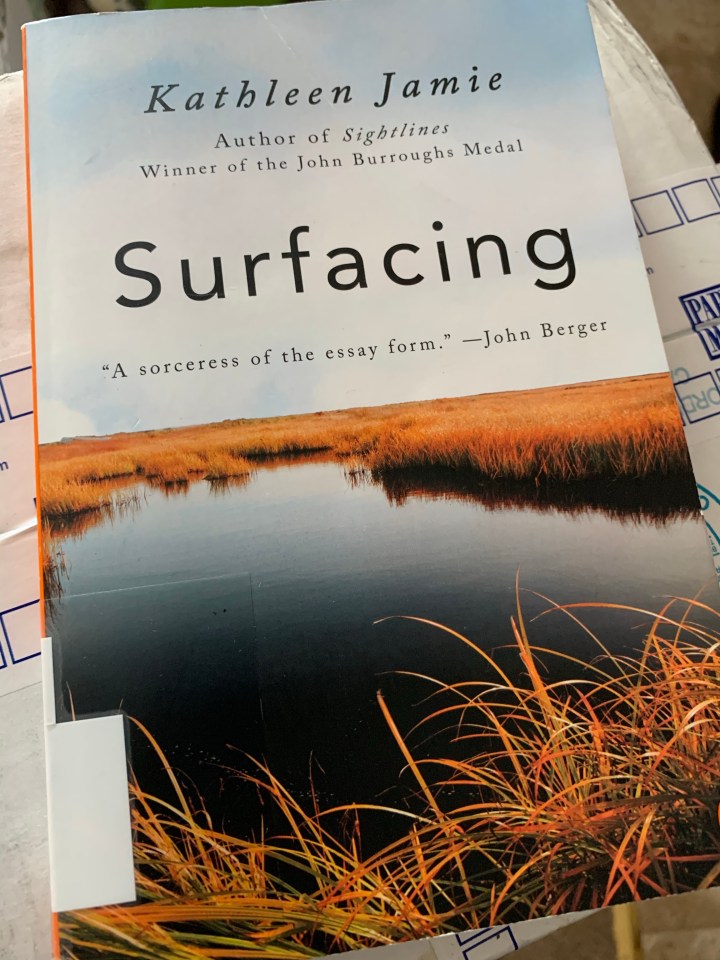
A beautiful book. Perhaps not as rapturously good as the Washington Post‘s review, but beautiful. A poet’s book, as befitting a collection of essays by a poet.

The tent pole pieces, which appear at the beginning (making the latter third a tad disappointing), are fabulous. They are both about visits to archaeological sites of Stone Age settlements. One is in Alaska and the results are inspiring local people to rediscover their cultural history. The other is in the Orkney Islands and is about to be destroyed by erosion. If nothing else, it makes you want to visit a dig site.

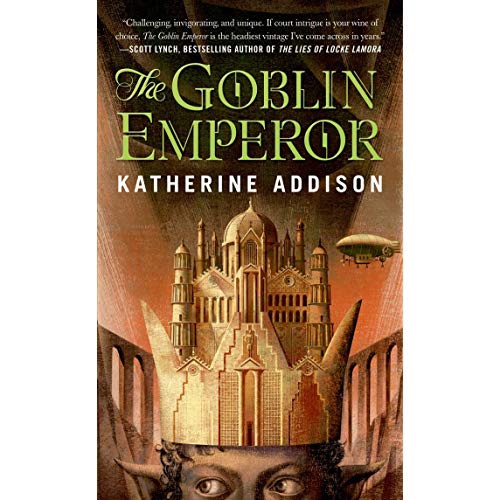
‘The Goblin Emperor’ By Katherine Addison


Not a new story, but an old story well done. The unexpected and unprepared heir to a great empire suddenly finds himself on the throne. This story has some steampunk elements, so the emperor and all his first choice heirs die in an airship accident (?), propelling young Maia to the throne. There appear to be no humans in this fantasy world and this new emperor of an Elven empire is half-goblin.

Naturally, he is a good person, which surprises many and leads to great loyalty by some, while others resent him for his (minor, in my opinion) upsetting of apple carts.

One nice touch: he is not preternaturally gifted at politics. He is frequently in over his head and does not act too much wiser than his eighteen years.

Looking forward to the sequel.

‘Creation’ By Gore Vidal


The tale of Cyrus Spitama, grandson of Zoraoster (yes, that one) and uncle (or great uncle, more likely) of Democritus (yes, that one), who also knew the Persian emperors, Darius and Xerxes, and met the Buddha and Confucius.
Vidal knows that the chronology is not exactly right, I assume, but merely wanted to be able to use his character as thread to address power, family expectations, religion, politics, and, yes, creation.

I picked this particular book because I so enjoyed Julian, but Creation lacks the same quantity and quality sort of wickedly fun, learned name dropping that made that earlier book about the ancient world (albeit, late ancient) such a blast.

I suspect Vidal also thought that Creation was more philosophical than it was.

However, I am glad I read the long version. I gather that when it was originally published, the editor took out a couple hundred pages, thinking it too long. I don’t know which parts were cut, but I can’t imagine losing so much of it.

Prince Of Thorns


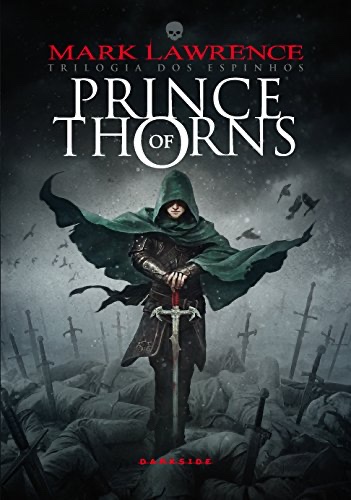
Not easy to get into, but grew on me. The hero is a young sociopath who maybe has an admirable goal? It opens setting him up as such a despicable character that I rather expected the real protagonist show and kill the teenage Jorg Ancrath. But, of course, he was the hero.

The setting is obliquely revealed as being some kind of post-apocalyptic Europe where magic appears to be real. But since left over science is also real, maybe later books will show it to have non-magical explanations. I don’t want to overrate what he does here. Lawrence is good, but this isn’t Gene Wolfe and Jorg isn’t Severin.

Who Will Remember?


This article was almost certainly inspired by Harold Bloom’s death (which I someone didn’t read about until several days after it happened. But it’s something I keep thinking about.

Who will read Harold Bloom in ten years? It’s a repeat of the question I asked after discovering Gore Vidal a few years after his death; and after Christopher Hitchens died. My favorite contemporary poets, too. Will their books even get a second printing?

Mount Analogue


I read about this book years ago. Well over a decade, at least. But out of print, of course.
But on my birthday, my two beautiful angels took me to Solid State Books to pick out a present and while randomly browsing, there it was.

It takes the form of an adventure story, with the narrator meeting a character similar to Professors Lindenbrock or Challenger, but everything driven by symbolic rather than scientific concerns. They are seeking a mountain which has an almost Cartesian reason for existing: it exists because something so necessary must. As you might have guessed, Daumal means ‘analogue’ in a pre-digital sense.

The book ends mid-sentence, the authors having apparently been interrupted by a friend’s visit and then dying before returning to his writing. He was in the middle of the story of a guide, living at the base of Mount Analogue, and how he broke the rules and was forced to remain at the base, rather than pursue a journey to the higher reaches.

This Thing Of Turning Old Books Into Journals Or Handbags Need To Stop


I was walking through a festival in Alexandria when I saw a book that caught my eye.

Charles Lamb’s Tales from Shakespeare.

This was the book that made his fortune and allowed him to become a full time man of letters. I was thrilled.

But no. It’s a blank journal. The old book (it must have been from the thirties or twenties, at least) has been eviscerated and the words of an important figure of the English Romantic movement, a friend of Wordsworth and Coleridge, thrown out to make room for whatever insipid thoughts contemporary humanity sees fit to record.

A bad bargain.

Arguably


It is perhaps because of also reading Vidal’s essays that I checked this out from the library. A powerful and important writer who is likely to still be forgotten. Will my child grow up to read Hitchens?

As the current events he covered recede (into the dark fields of the Republic?), there are still gems that will be worth reading in a quarter century, especially his ruminations on early US history and on his seeming inspiration, Thomas Paine.

Also, as much as one might love listening to his voice, it is easier to forgive and understand his political positions when reading his actual words (I should add that I have only read one of his books that weren’t collected essays). He is, at his best (which he is not always at), at wonderful writer.

United States: Essays 1952-1992


I am continuing my exploration of the oeuvre of Gore Vidal to the surprise and perhaps disappointment of some friends and family who do not necessarily consider him a fit topic for deep delves.

And essays are always a tricky thing. And Vidal’s (but it feels better to call him Gore, doesn’t it?)… Gore’s essays are often considered his finest work, but also his worst. The majority of his political essays, despite his clear eyed and strong understanding of politics up until perhaps Reagan, have not aged like fine wine. Or rather, they are fine wine that was improperly stored and turned sour or else flavorless.

The book is divided into three thematic sections. The first is on literature and is a joy. Both his acclamations and his eviscerations are delicious and the latter want to make me you chortle (that is the word). The second is on politics and while there is much that is good, there is more that is – not necessarily bad, but also not necessarily worth reading anymore. The third and final section is about “state of being,” which, while vague and unwholesomely metaphysical, is also a return to form. He dives into his childhood love of the Oz novels. He writes about himself and his work and life. Politics and literature touch on it and always in a fascinating way.