
Our own Capitol Hill Books takes center stage in this NPR piece about how people still read books.
A kinder, gentler Marquis de Sade. Sort of.

This is the third time I’ve seen a production by the Opera Lafayette, who specialize in eighteenth century French opera, but it was the first opera-comique I’ve seen by them.
A small cast (four singers, a ‘chorus,’ and a dancer) and minimal sets for a small, gem-like romantic comedy. Pascale Beaudin as the female lead, the country girl Denise, was absolutely darling. You wanted to take her home to meet mother. Her eventual beau, Andre, impressed me less, but his buffoonish romantic rival, a baritoned Thomas Dolié, was a great comic foil. The production was performed in the relatively intimate terrace theater (I have no idea how many stages there actually are in the Kennedy Center… but there are a lot).
I’d say go see it… but it’s too late. Suckers.
I actually was not going to go, but I won free tickets from WETA, our local classical music station. The five dollars a month I donate has been more than paid back. I actually found out that I’d won through a suspicious sounding email (apparently, the original winner never responded, so I was next in line – I was told to reply back quickly, because they needed to get the name to will call) and right up until I they handed me the tickets, I had an itch at the back of my head that this was all a phishing scam. But it wasn’t and it was great d–n day.

I bought this book, thinking it was Bloom’s seminal tome, Anxiety of Influence. You can see how I might have made the mistake.
But it’s never a mistake to read Bloom. He is old-fashioned and wedded to a very traditional Western canon, but that doesn’t make it him unenlightened nor unpersipacious – it is just something you have to be aware of and know that you’ll have to learn about writers outside the classical European tradition elsewhere.
I actually started reading this a while ago, but it’s a series of essays, some more connected than others, so I tended to pick it up and put it down again frequently. But about a week ago, I set myself to finish it and did.
When I was very young, freedom beckoned through the poets I first loved: Hart Crane, William Blake, Percy Bysshe Shelley, Wallace Stevens, Walt Whitman, William Butler Yeats, John Milton, and above William Shakespeare in Hamlet, King Lear, Macbeth, and Antony and Cleopatra.
What do you think about that? Shakespeare, of course, looms over everything. Hart Crane is someone I’ve never really read much of and Wallace Stevens has always left me a little cold. But it makes you ask: who are my poets?
Shakespeare and Hamlet, but Julius Caesar would replace those others for me.
Ezra Pound. Adrienne Rich. Charles Simic. T.S. Eliot. Edgar Allan Poe. Allen Ginsberg. Asian and Japanese poets, like Tu Fu, but specifically mediated through translation and specifically through the translations of Kenneth Rexroth.
These poets don’t all still ‘do it’ for me. I can see the flaws in Poe now, more than when I was younger. Ginsberg wrote a handful of great poems and heaping pile of very bad ones. And if you were talking about my favorites now, what about Anne Carson or Fanny Howe? But I discovered them later. Those ones above were the ones I loved early and whose influence is strongest, as a result.
Who are yours?
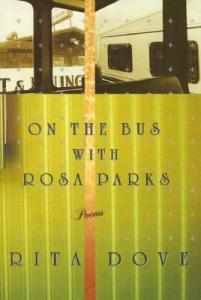
Maybe not my finest example of supporting poetry and poets, but I bought On the Bus with Rosa Parks at Politics and Prose because it was on their remaindered books shelf. If you stop by there, the poetry selections available for between $5.99 and $7.99 are really spectacular.
Rita Dove is a great speaker, able to be simultaneously engaging and intellectually rigorous (the sort of intellectual rigor lacking when Simic and Wright recently shared another stage). She has never been a favorite poet, but she is, at her best, formally interesting (at her worst, she plays with forms for the sake of playing withe forms). I didn’t catch it, but someone in the audience asked about her strategy of making the first stanza of a poem she read into a villanelle. Just a reminder that I need to read more into the traditional forms, sonnets and the like. Can’t all be free verse, my friends, can it?
No one is going to call On the Bus with Rosa Parks her finest collection, but it’s a nice showcase of her strengths. She frequently writes from the perspective of ‘characters’ and while it’s easy to say that those characters are almost invariably black, they are also frequently different from her in every other way. Dove has great way of writing unflinchingly, but also compassionately about the struggles of men with visions and expectations of masculinity.
From Graduation, Grammar School
Joe
sees hi son
flicker. Although
the air is not a glass,
watches as he puts his lips to
the brim–then turns away, bored.
He is not mine, this son
who ripens, quiet
poison on a
shelf.
Mary Ruefle appeared at the Hill Center and was a very engaging presence in the conversation with the Post‘s Ron Charles.
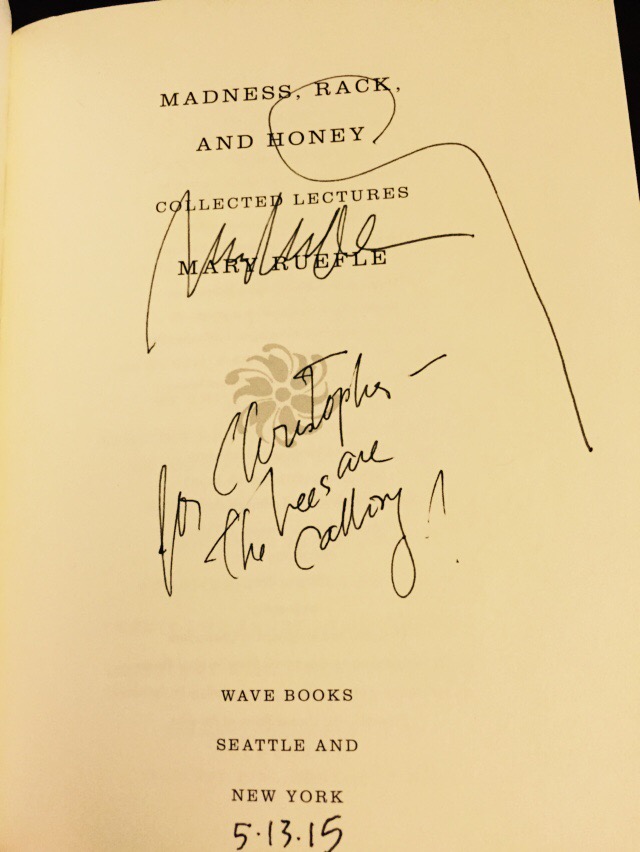
She also signed my copy of Madness, Rack, and Honey – with a special little something on account of my name (which is ‘Honey,’ by the way).

When I bought it at the used bookstore, I was told (not unkindly) by the owner that I was the first man to have bought a Jane Austen novel from him. I think it was a compliment, but you’re never quite sure if it reflects as well on you as you think it does.
So, I’d read it before, enjoyed. That’s that.
But I picked it up again for this book club thing and I was… disappointed. Can one say that about Jane Austen? Pride and Prejudice is a model of gem-like perfection. My second reading of Persuasion left me a little unsatisfied.
Anne Elliot’s interior life lacks the richness of Elizabeth Bennett’s. She is frankly less interesting, yet we are held very much within her third person limited perspective. While one does not read Austen for lush geographical details nor for the richness of her descriptions of rooms or people, I dare you to read Pride and Prejudice and not come away with a very personal vision of the environs. Whereas, Persuasion‘s market town and then Bath are very vague. The people, too, leave me with no clear image of them (as for Pride and Prejudice, my generation has a very clear picture of the characters and they look remarkably like Jennifer Ehle and Colin Firth).
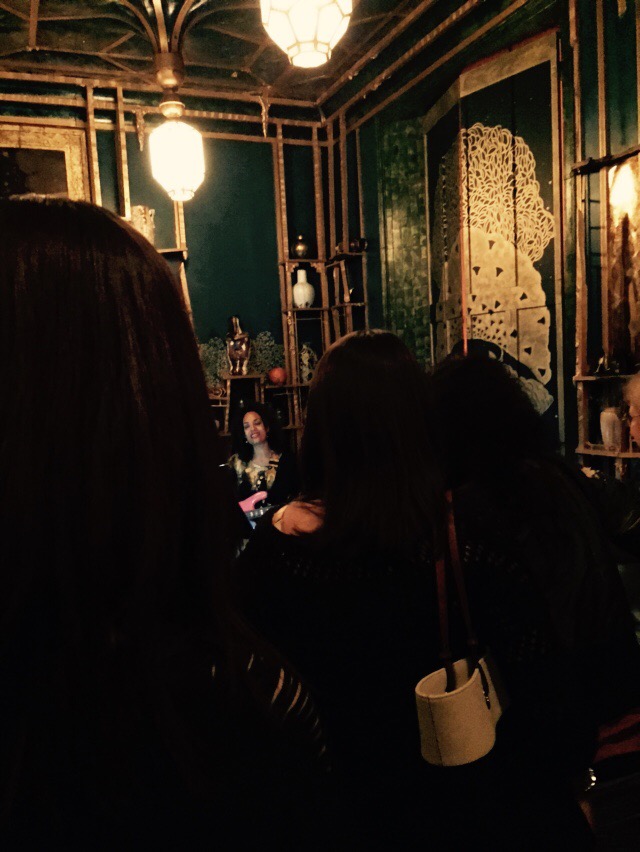
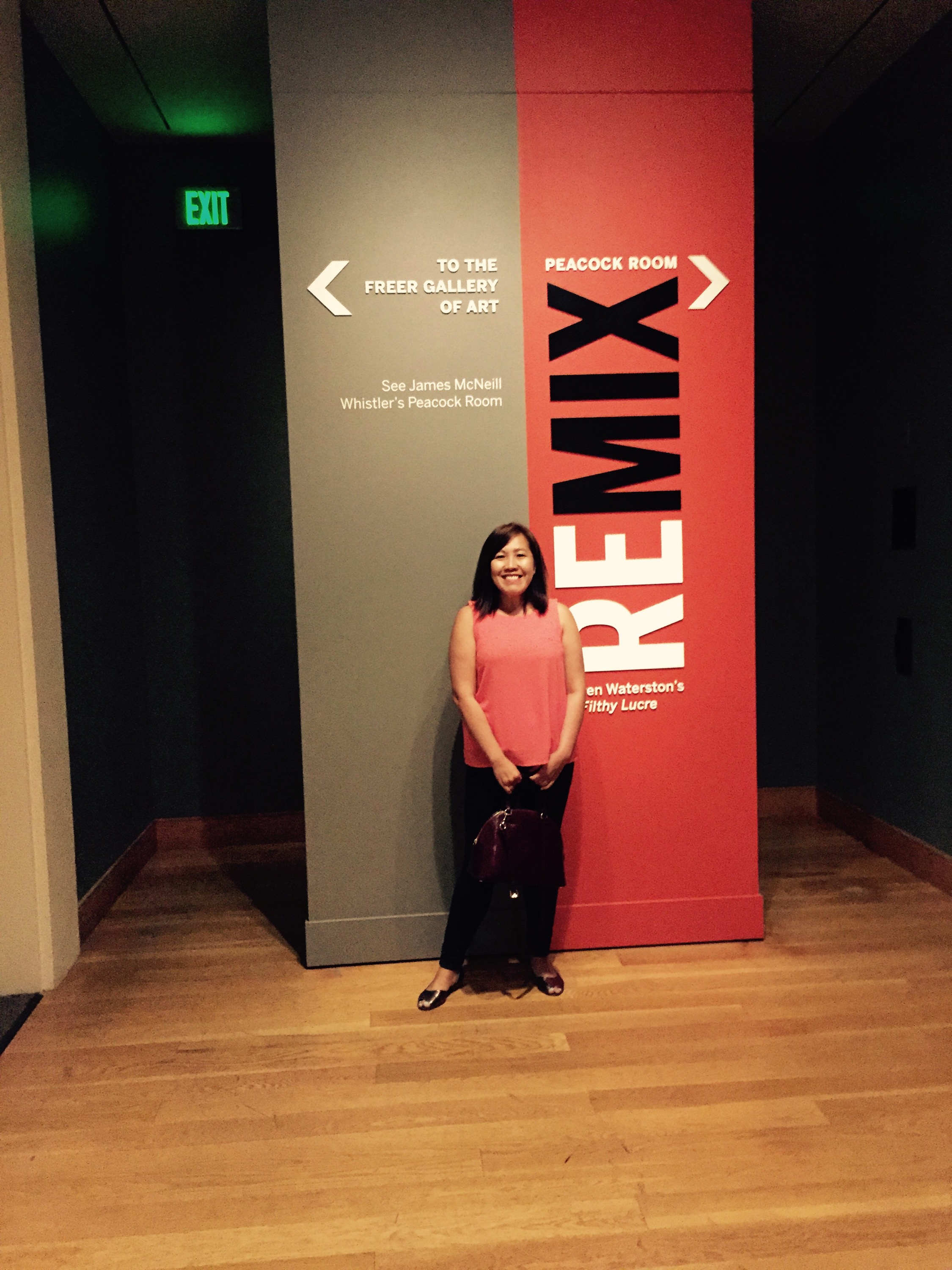
So, instead of that, we went an after hours open house at the Sackler-Freer Gallery (the African and Asian art museums, respectively, of the Smithsonian) where they kicked off an installation project riffing on Whistler’s famed Peacock Room (which is a room he decorated and designed for a wealthy liverpudlian and which has been moved entirely to the Freer Gallery), entitled Filthy Lucre. It’s starting point was the fights over money between Whistler and his patron about the final cost of the Peacock Room. Basically, it’s a closed room installation where the room is redone as someone decaying, sagging. The ceiling bursting with age and water damage; asian pottery shattered; the walls scarred with age and mold and lord knows what else. For the night, the music/performance art group BETTY played within the room. All in all, it was awesome.
As soon as I knew the play was on the schedule for this season, I knew that I wanted to see it. The only Tom Stoppard plays I have seen performed at Arcadia (which, oddly, I have seen on three separate occasions: once in Atlanta; once in Montgomery, Alabama; and once in at the Folger) and The Invention of Love. Being a great lover of Hamlet, it irked me that I’d never had the chance to see this particular play.
For much of the play, it is just the two characters on stage, alone. Other characters walk in an out, but they are peripheral to the ‘real’ world of Hamlet. It’s at once hilarious and terribly sad and if you’re in DC, I hope you’ll see it at the Folger. It made me think of the lines from the Pink Floyd song, Wish You Were Here: Did you exchange/a walk on part in the war/for a leading role in a cage?
Rosencrantz and Guildenstern are trapped as walk on parts in a cage, without any real agency. They exist only to propel the progress of their betters/greaters, i.e., the leading characters in Hamlet. It left me feeling very melancholy because it suggests that it may never be possible to understand one’s purpose, even if one knows one’s purpose, and that knowledge could be meaningless because it comes without a view of the larger picture.
It is probably also the only play I have ever seen that addresses George Berkeley’s metaphysics (in a short, bastardized form: does anything exist if it not perceived?).
I found myself in New York City for work the other week, so naturally I looked to find what bookstores were near my hotel. Weeding out the ones primarily serving Japanese speakers, I came across Revolution Books.
They are attempting to raise funds to move to a new (and more affordable) location and were having a series of readings and performances, as well putting their stocks of used books out for sale – $12 got you a back and all the used books your could fill it with. I wasn’t going to take advantage of that until I saw Rose Macaulay’s The Pleasure of Ruins. So, I added Mary McCarthy’s The Company She Keeps and two books by Robbe-Grillet. My better half is a dyed-in-the-wool capitalist. She would probably be a Republican if the GOP weren’t so obviously crippled by dog whistle racism. But for some reason, she has a fascination with Asian communist leaders, so she added a collection of writings by Ho Chi Minh.
It’s a great resource and I hope that the place survives.


 the coffee philosopher