Perhaps just a sad moan at the state of my life. Direction. Things not done. I’ve always tended towards major depression of clinical depression or whatever the manual calls it these days. Months, really. A year or more, I reckon. Time flies, irrespective of whether you’re having fun. On top of which, for the last two months, I’ve been living alone, in self created squalor. And alone breeds alone, breeds an inability to slip out into the world when it is so much easier not to. When my wife gets back, I’ll be something else than before, not quite able to be what I was or what I seemed, because I’ve lost the facility for it and ‘it’ is so much easier to forget than to learn or relearn. And there will be questions of ‘why’ when they there is no ‘why,’ no cause that incident or MRI can explain and instead of a cause there is just an ‘is,’ like an artistotleian unmoved mover. And here I am, in the stairwell, hiding from someone whose self-righteous indignation I simply cannot handle right now, nor work up sufficient lather to face long enough to deliver a response, much less suffer through criticisms that I can’t handle because I am already static and crippled from the barbs of my own self-loathing, thank you very much, so keep your ideas to yourself, thank you very much for riding metrorail.
Weekend Reading: Community
Once In The West, By Christian Wiman
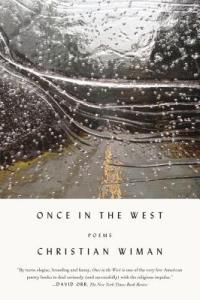 I became intrigued by Christian Wiman, the immediate former editor of Poetry, after seeing the tail end of an interview he gave to Bill Moyers. He was actually speaking mostly about a book he wrote about his faith (and the cancer that almost killed him).
I don’t actually know if any of the poems in Once in the West were written after receiving the diagnosis, but as someone who has had his own experience with a life threatening medical condition and an arduous and uncertain recovery, I certainly wore that lens over my eyes when I read them.
These poems are often religious, but less… theological… than, say Fanny Howe. I don’t think Wiman is Catholic. I could probably just google the answer, but I’m going to guess he’s that Episcopalian. He’s also funny and a little crude in his ‘conversations’ with God.
A solid portion of Wiman’s poetry here are unrhymed couplets. He’s got a prose poem or two, some ones with longer or more unusual stanzas (or no stanzas at all), but the couplets appear in half or more, I would say. Even without rhyme, it gave them a nice, old fashioned feel, like some modern day Alexander Pope.
Below is one of the poems. Not necessarily typical in its quiet, but it does show how the faint, almost but not quite rhymes, assonance, and alliterations give it a feel rather like a Pope or a Thomas Gray.
Less
Silas,
say lessthan silence.
In a dawnlost to all,
but me,be,
Sila, beyondthe hay bale
harboringkittens
no one nowhas the heart
to kill;and touching
nothingtouch
my headso we can be alive,
together,Silas,
as togetherwe are dead.
The Golden Lotus, Vol 1
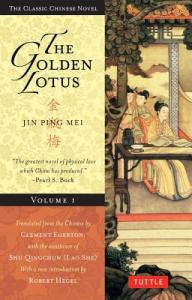 The Golden Lotus, aka, The Plum in the Golden Vase, aka Jin Ping Mei.
I can’t remember where I read about this book, but the minute that I did, I knew that I had to read it. And it hasn’t disappointed, though it’s charms are difficult to explain or put into words.
The book is infamous for descriptions of “physical love” (sex? can we say sex?), but if you’re looking for a titallating read, ninety percent of the internet will do the job much better.
Written in the early seventeenth or late sixteenth century, it takes place centuries earlier, during the notable corrupt Song Dynasty. The main characters are also notably corrupt, led by the wealthy, dissolute, cowardly and not notably bright Ximen Qing.
At the end of volume one, Qing has five wives, one regular mistress (married to one of his employees, who is more or less willing to trade cuckolding for gainful employment), and two servants (one of each sex) with him he sometimes cavorts. And he likes to visit brothels a lot.
At least one of his wives (the deliciously evil and lascivious Jinglian) killed her husband so she could marry Qing and another let not one, but two husbands be falsely accused so that she might be free to marry him.
So we’re not talking sympathetic characters, but it’s still wonderfully compelling and I’m not sure I understand why. Certainly, this vast and different world is endlessly fascinating. The structure is naturalistic and episodic. There’s no traditional plot: time passes and people have sex, waste money, bribe officials, and generally behave like trust fund babies. The part of me raised on the nineteenth century novel is invariably waiting for the author’s moral hand to press down on the scales and give everyone their comeuppance, but would that be for the best? Certainly, I’m not correct to be viewing things through the wrong lens (though it could still happen).
In any case, as soon as I finish Guermantes Way (next up in my Proust re-read), I’ll dive into volume 2.

Today Is The National Book Festival
 I’m working, so I’m not there, but if you’re not working and you live in the DMV, there is no good reason not to go that doesn’t involve funerals, weddings or dinosaurs (and, keep in mind, there will probably be books about dinosaurs available at the festival).
I would especially recommend checking out poets Marilyn Chin, Claudia Rankine and Kwame Alexander.
#LittleSalonDC
There’s a nice article on Little Salon in the WaPo today – and thankfully, no pictures of me (I don’t photograph well; my charms only appear after much time and gin).
It was a wonderful night, this time with free beer.
 And I bought this small painting (acrylic on paper) for my better half. The artist, Dana Ellyn, had a number of frankly disturbing pieces (not an insult, though the Madonn and Child-esque painting of Hillary with a naked baby Bill on his knee must be seen to believed), but I turned around and I saw this three small works featuring pigs and the first one I saw was just so… cute. That’s it, really. It was cute. And I’m not immune to cuteness.
But, with my better half having been out of town for a while (I keep on thinking that people secretly think that she left me and I just haven’t come to grips with it), after buying the piece, I felt myself becoming a little maudlin and not such good company, so I left a little early.
Midweek Staff Meeting – I Would Like A Sword, Please

Romantic Wuxia
 For some reason, I’ve been into the more romantic martial arts films on Netflix these days. I’m acting like it’s somehow surprising. I love a good wuxia and I’m a romantic at heart. House of Flying Daggers and The White Haired Witch made me teary and I’ve been looking for more like them (and don’t tell me Crouching Tiger, Hidden Dragon; yes, I’ve seen it and I’m trying to look for something new; I tried 14 Blades, but while I give Donnie Yen an amazing amount of credit for looking like that at age 52, he’s not the romantic type).
They’re all silly, of course, but I’m an opera fan and a sad (someone always dies in the really good ones) kung fu film is more like opera than it is like a Lethal Weapon movie. Grand, sweeping, melodramatic statements of overwhelming emotion delivered via medium outside of the standard romantic medium. The plots are silly, but that’s missing the point. If the plots of La Boheme or Madam Butterfly were explained in prose, you’d groan in embarrassment, but even a half decent production of either will make you sob if you have any soul (I recently saw a quintessentially mediocre La Boheme and I still sobbed when Mimi was dying).
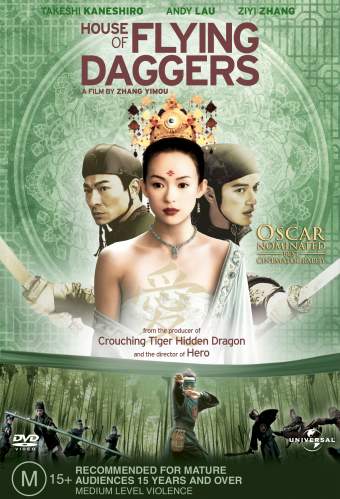
Feel free to pass on any suggestions.
On Care For Our Common Home (Laudato Si’)
 Rather than give thoughts on it (other than – wow! a powerful statement for environmental and economic justice), I’m just going to copy out a bunch of passages that struck me.
Because of us, thousands of species will no longer give glory to God by their very existence, nor convey their message. We have no such right. (33)
“If we scan the regions of our planet, we immediately see that humanity has disappointed God’s expectations [John Paul II] (61)
Respect must also be shown for the various cultural riches of different peoples, their art and poetry, their interior life and spirituality. (63)
They suggest that human life is grounded in three fundamental and closely intertwined relationships: with God, with our neighbor, and with the earth itself. According to the Bible, these three vital relationships has been broken, both outwardly and within us. This rupture is sin. (66)
The Spirit of life dwells in every living creature and call us to enter into relationship with him. Discovering this presence leads up to cultivate the “ecological virtues.” (88)
For believers, this becomes a question of fidelity to the Creator, since God created the world for everyone. Hence every ecological approach needs to incorporate a social perspective which takes into account the fundamental rights of the poor and underprivileged. (93)
Underlying every form of work is a concept of the relationship which we can and must have with what is other than ourselves. (125)
To claim economic freedom while real conditions bar many people from access to it, and while possibilities for employment continue to shrink, is to practice a doublespeak with brings politics into disrepute. (129)
We know that technology based on the use of highly polluting fossil fuels – especially coal, but also oil and, to a lesser degree, gas – need to be progressively replaced without delay. (164)
Saving banks at any cost, making the public pay the price, foregoing a firm commitment to reviewing and reforming the entire system, only reaffirms the absolute power of the financial system, a power which has no future and will only give rise to new crises after slow, costly, and only apparent recovery. (189)
The environment is one of those goods that cannot be adequately safeguarded or promoted by market forces. (190)
If we reason only within the confines of [empirical science], little room would be left for aesthetic sensibility, poetry, or even reason’s ability to grasp the ultimate meaning and purpose of things. (199)
“The external deserts in the world are growing, because the internal deserts have become so vast.” (217)
It must be said that some committed and prayerful Christians, with the excuse of realism and pragmatism, tend to ridicule expressions of concern for the environment. (217)
Mary, the Mother who cared for Jesus, now cares with maternal affection and pain for this wounded world. Just as her pierced heart mourned the death of Jesus, so now she grieves for the sufferings of the crucified poor and for the creatures of this world laid waste by human power. (241)
 the coffee philosopher