It Is Not True That The Democratic Party Has Moved To The Right


I keep on hearing people complaining about how far to the right the Democratic party is, when the Democratic party has moved steadily to the left over the last several years.

Go back in time (and you don’t have to go back very far) and the Democratic Party had no voice (nor even really acknowledged) when it came economic inequality or police violence against communities of color. Democrats didn’t support gay marriage or transgender rights; they didn’t stand up for millions of hard working, undocumented immigrants. Democrats passed national healthcare reform that very nearly would have, had not the Supreme Court and a group of Republican governors and legislators (who clearly don’t care about the health of their neighbors) c—–d in the punch bowl, covered nearly every America.

You want Democratic electeds to move further to the left? That’s fine and I totally agree with you! I have family living in the rural South who are only able to get live saving medical care because of Obamacare, but you can bet I want Medicare for all extended to them. We raised taxes on the wealthiest household in America, but I still want higher taxes on capital gains.

But let’s confuse wanting more with having gotten nothing.

Phaeton


phaeton-300x300-catPhaeton, in this case, is a dramatic and allegorized version of the myth of Phaeton, the son of Apollo (which myth is already pretty allegorical).

This is the third production (though the first two were staged readings) I have seen by Taffety Punk in recent months that is based on a classical source of some kind (Shakespeare and the Bible, in the first cases).

What did I think? Excellent, enjoyable, and problematic. The play was written to sound explicitly like an English translation of an ancient Greek play, a la Sophocle, Aristophanes, etc. The program notes even said it was written in iambic pentameter (though I remember grasping a line in my head and the beats didn’t quite work out). For me, I would rather the playwright not have tried to write in the style of those great playwrights.

The titular Phaeton, in this case, is a secular, social justice reformer and his father (a disembodied voice, sometimes with the rest of the cast performing interpretative dance to embody him) an imperfect and non-omnipotent God, with a capital G, because the references to the Bible are frequent in the second act, so Apollo is definitely symbolic, representative, or whatever of a theistic, more or less Christian god.

Lines like (remembering as best I can), ‘You are my only son, with whom I well pleased,’ and phrases like ‘sacramental blood’ (after Phaeton dies) and ‘plagues of locusts’ drive the point him even further. Apollo is a flawed Christian God and Phaeton is his son, the Christ, but a less spiritual and more political messiah (not that Christ wasn’t highly political, because he was, but you get my point, I hope). There’s even a sort of ‘new,’ sacramental act at the end, which, while not physically resembling the Mass, is also referencing the Mass, in that it is reinforcing Phaeton’s Christ-like role.

A few laugh out loud lines in the first act, but I felt that the Greek model straitjacketed the first act and the Christological revisionism made the second act feel too detached from the first.

‘The Silent Army,’ By James A. Moore


TheSilentArmySo, for the second time in recent memory, I have finished a four volume fantasy series only to see all the author’s hard work undone by some confusing, poorly explained deus ex machina(s).

These books were generally fun, with rival gods, an army of incredibly skilled and physically powerful soldiers, some interesting characters and decently drawn, if not incredibly well described, milieu.

Not only was the character we’d most come to identify with and see as the hero (Merros Dulver, if you care) largely marginalized, but the… solution, I’d guess you call it, was accomplished by a brain damaged minor character who did so by means of having (along with two other people) acquired more or less god-like powers by means… well, I really don’t know. Something was described, but not very well, so I really can’t say.

There seemed to be a hint that Moore would be writing more books in a related series in this fantasy world he’s created, but, honestly, he lost me. Won’t be reading them.

Collected Poems Of Chika Sagawa


SagawaCoverSPDI took my time reading this book because, more than most poetry, each poem needed to be read slowly and read at least twice. She died at age twenty-four, which is not only sad because of how much potential literature was lost, but also a reminder of how little I’d accomplished at twenty-four. Ugh.

As for the poetry itself, you have probably guessed that I found it amazing. We could go into a discussion here about translation and what not, but I’m really not in the mood. It’s free verse and, according to the intro, this was a wildly revelatory new movement in the Japan of the twenties and thirties. Supposedly, there wasn’t even a word for ‘poetry,’ merely ‘haiku’ and ‘tanka.’ Which is something like if, in English, there were no word for poetry, but only sonnet and villanelle. Besides the long nightmare of too many villanelles, imagine the astonishment of T.S. Eliot’s strange poetry suddenly appearing?

In English, we don’t get an appreciation for how formally groundbreaking her poetry was (not that she was the only, or even the first, Japanese writer to experiment with this), but we can appreciate it’s strange beauty. Heavily influenced by French poetry, it also (in my crude, sad, poor understanding of Japanese culture, which is probably just a horrible mash up of ridiculous stereotypes) feels distinctly Japanese.

Nature and the natural movement towards death (and decay? or do I mean ephemerality?) is frequent. I was constantly struck by how often ‘green’ appeared, but not in a natural sense. Or perhaps underlying that everything is part of nature (and inevitably dies? or is inevitably resurrected?). Snow is the second most common… motif? No, not motif. Maybe just a recurring word. And not so recurring as green.

Here is a short one, maybe not the best, but one whose first line repeatedly struck me:

GATE OF SNOW

People’s outdated beliefs are piled up around that house.
— Already pale, like gravestones.
Cool in summer, warm in winter.
For a moment I thought flowers had bloomed
But it was just a flock of aging snow.


East City Bookshop


While I missed its opening, fortuitously scheduled for April 30, also know as Indie Bookstore Day, because I was in Chicago or somewhere like that, I did eventually make my way over to East City Bookshop last Sunday.

It’s a little funky to get to, though it’s very near Eastern Market, and my first impression was a little off putting, it bears further exploration.

I was off put (or put off) because the first floor is small, with not many books. There were many shelves of books placed cover out, instead of spine out, which screams (to me), we have a small and poor selection!

Luckily, there were some stairs to a much larger downstairs which had a very nice and large children’s section and a well curated fiction and poetry section. The poetry section was not large, but I found Ocean Vuong’s much talked about debut (which I eventually bought), and Last Words from Montmartre by the late Taiwanese writer Qiu Miaojin (published by the awesomely reliable folks at NYRB; they had a number of books from that imprint and it’s a sure sign of quality).

While I didn’t partake, there was a big comfy couch and what looked like a play area for artsy activities for kids, though there also seemed to be a lot of wasted space.

In the end, it’s super close to an area where I spend a lot of time and someone clearly spent some time and attention to selection, even if there are some (to my mind) missteps in organization.

‘I Vote The Person, Not The Party’


If you hear someone use that phrase, you know that they overwhelmingly vote for candidates of a single party. This is just something people say and it goes to why the idea that independent voters are important is a myth.

Personally, I hear that phrase most often from people in my extended family who know that I’m a yellow dog Democrat and a former political operative for Democratic candidates and don’t want to say, flat out, they are hard core Republicans or, maybe, and this will be important, don’t want to believe they are party line voters. But when I ask, after hearing that phrase, for the name of the last Democrat they voted for or for the names of the last six presidential candidates they voted for… well, you get the picture.

The overwhelming majority of people who declare themselves independent actually vote almost exclusively for candidates of a single party at the same rate as people who actually declare a party. The majority of people declare themselves independent for a couple of reasons, both related to pride. Being politically independent fits in with an image from American mythology. It is also a way to distance yourself from a political party whose name is in the mud.

Mitt Romney won ‘independent’ voters because the GOP brand was not great, so a lot of folks who might previously have declared themselves Republican, claimed to be independent. But they still voted Republican.

Here’s another prediction. The ‘independent’ vote will be close in November. Trump will either win or come very, very close in the independent share of the vote because a lot of… shall we call them yellow dog Republicans? …will still vote straight ticket GOP, but will be embarrassed of their true party affiliation because, well, Trump is freaking embarrassing.

Midweek Staff Meeting – Irreplaceable


Saudi bombs are destroying the records of humanity’s earliest civilizations, one of the most important routes out of Africa for early human, evidence of neolithic trading empires and more. And we will never, ever get it back.

The correspondence between Mary McCarthy, the novelist that not many people seem to read anymore (Remember The Group?) and Hannah Arendt, the philosopher people can’t seem to stop talking about these days.

How chili peppers migrated from South and Central America to China’s Sichuan province in the seventeenth century and whether the fact that I love spicy food makes me a revolutionary, or, rather, more like to be one.

The oddly important place of philosophy in Wikipedia (but please note: do not actually use Wikipedia to learn about philosophy).

news_1291-890-520-20150611112036

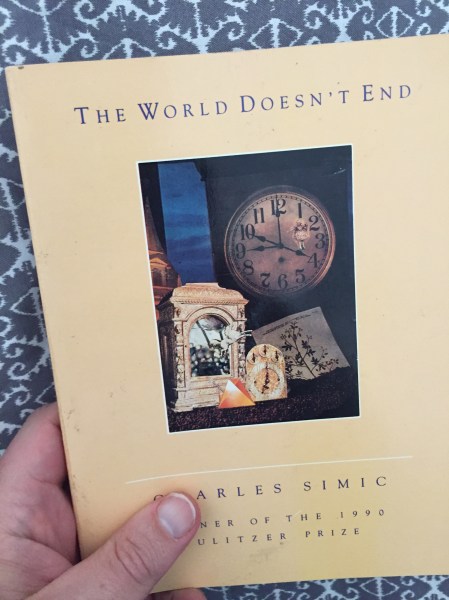
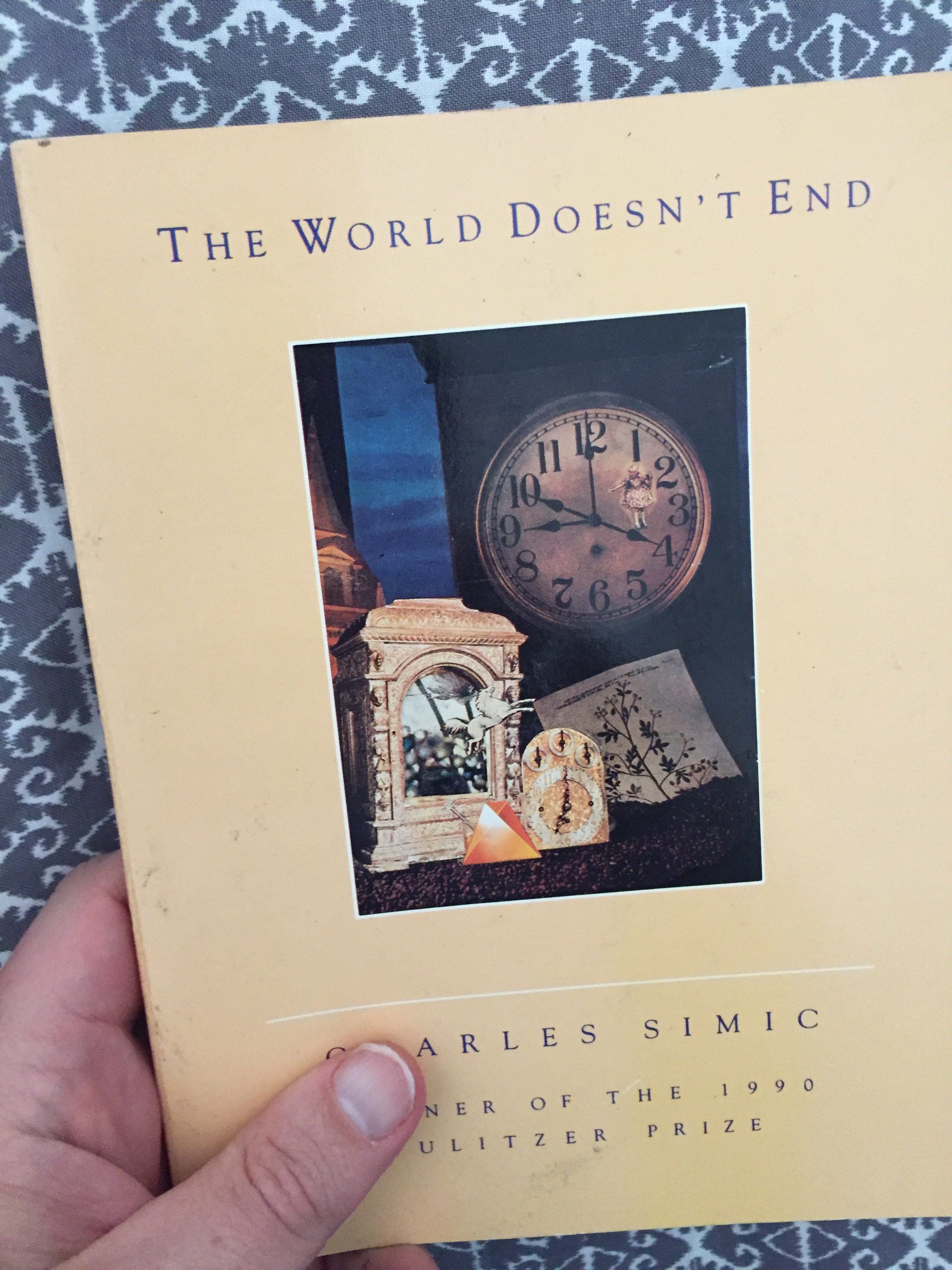
Re-Reading Charles Simic’s ‘The World Doesn’t End’


It’s hard to overstate how much this book affected me, because it opened my eyes to the infinite possibilities of contemporary poetry and poets. Upon re-reading, I found it as good or perhaps better than I remembered. The poems were more melancholy than in memory, as well. The world may not end, but that is also as much to say that suffering does not end, as well.

Happy Independent Bookstore Day!


Washington, DC is unique right now, in having a lively literary scene with plenty of bookstores, but exactly zero chain bookstores.

My own neighborhood has two longstanding used bookstores and, supposedly, today is the first day of a third bookstore on Capitol Hill – East City Bookshop.

I am out of town right now, but am looking forward to checking it out.

‘Beating Again’


At least that’s what they called it on Netflix. Because I got mildly obsessed and did some googling, I gather that the Korean title would translate to Falling for Innocence (the lead character’s name, Soon-Jung, translates to ‘Innocence;’ or it doesn’t, because we can’t fully rule out the possibility that there is an elaborate con out there, run by the internet equivalent of a Korean Cartesian demon, to make me think that is a better translation of the title, when actually the ‘real’ title [if this is, in the Korean Cartesian demon world, even a real show] is actually something about bananas and giraffes and a three legged tree-climbing, Moroccan goat).

I have a bit of a pattern of getting into silly soaps, especially when my better half is away, as she has been for the last four months.

As much as I loved the show, staying up late and showing up sleepy to work in order to binge watch, it’s also highly problematic in its treatment of women. Without going into great detail, an evil corporate raider falls in love with a secretary and switches sides to save the company. There was a slight stigma against relations between secretaries and management, but only slight. That wasn’t the bothersome part; what ate at me was the constant assumption that a man must always be in the superior role in the workplace. Whenever there was an opening for a senior position at one of the corporate interests, a woman was never considered. Sure, she could wield some power through her institutional knowledge, but never was it even conceived during the show that a woman could be in charge. The male lead was upset because his father had founded the company, but his uncle and others had summarily kicked his father out. But Soon-Jung’s father had been a vice-president of the company and while the guy grows up to be a big time exec with a financial firm, she grows up to be a secretary in the same company where her father was been VP. Where’s the nepotism? At the very end, there was  beautiful moment when the writers could have down a twist and made her CEO (while still keeping the happy ending that I desperately wanted, and which I still got, but with a side of male privilege), but… I was about the write ‘they balked,’ but they didn’t, did they? They didn’t balk, because it didn’t even cross their mind.

But here’s the theme song anyway: