Williamsburg & Yorktown


A lovely bookstore on the Yorktown riverfront. I bought a copy of Jefferson’s selected writings.
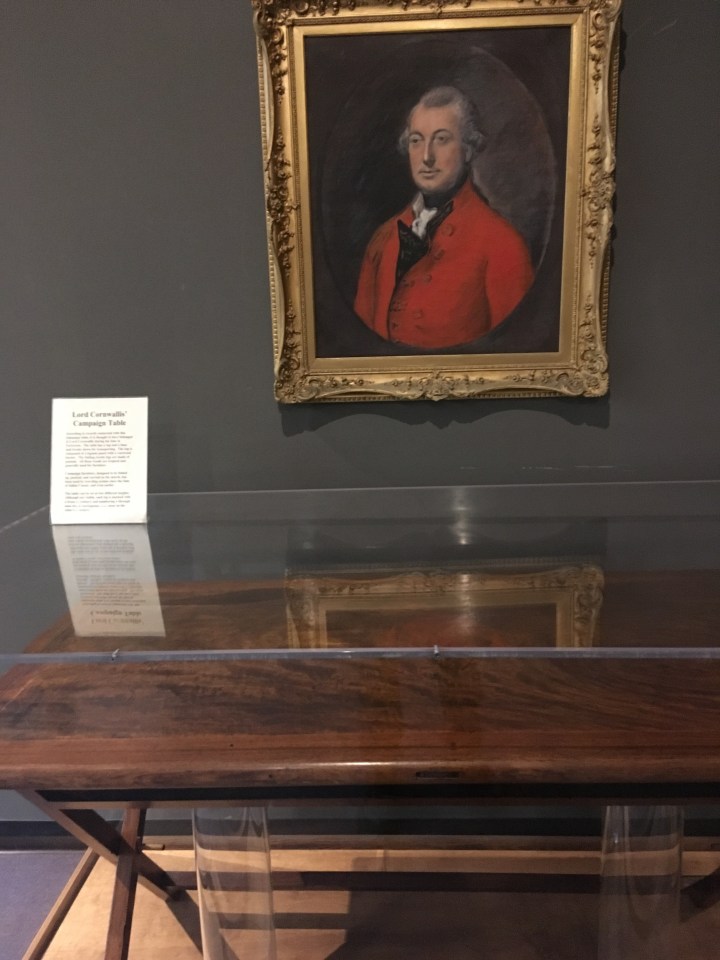
From the Yorktown Battlefield visitor’s center; according to tradition, the campaign table of General Lord Cornwallis.
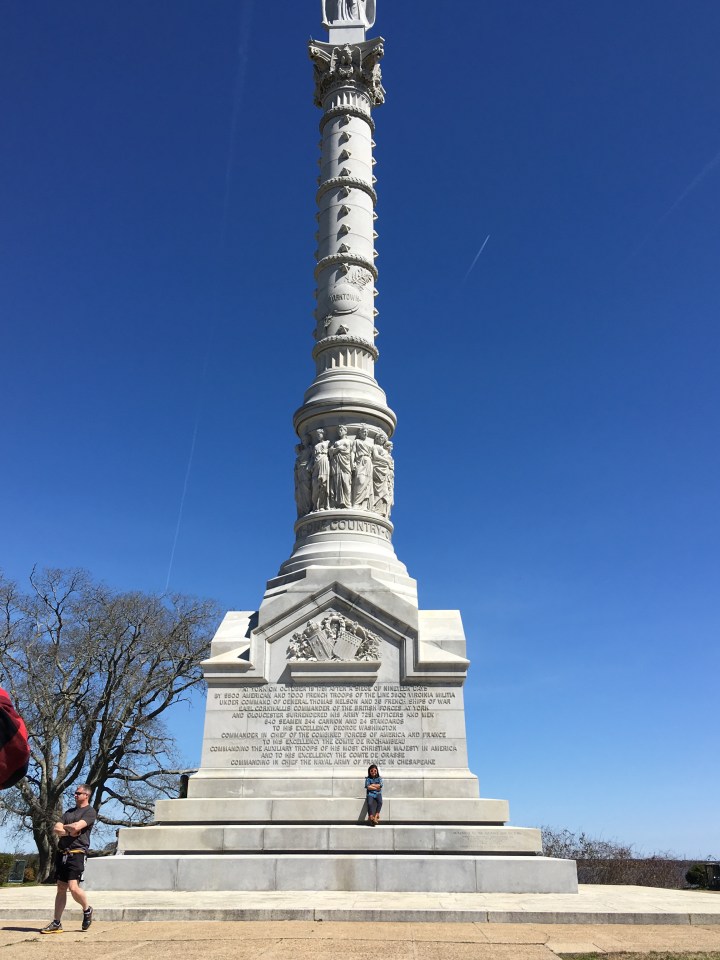
The Yorktown Victory Monument
The rather martial foyer of the Governor’s Palace
I just enjoyed seeing a book edited by the notable leftist historians, Eric Foner, in a government building in the Age of Trump (not that Foner does not deserve his place; his multivolume history of Reconstruction is still the gold standard).
My continued dialogue with the idea of Jefferson
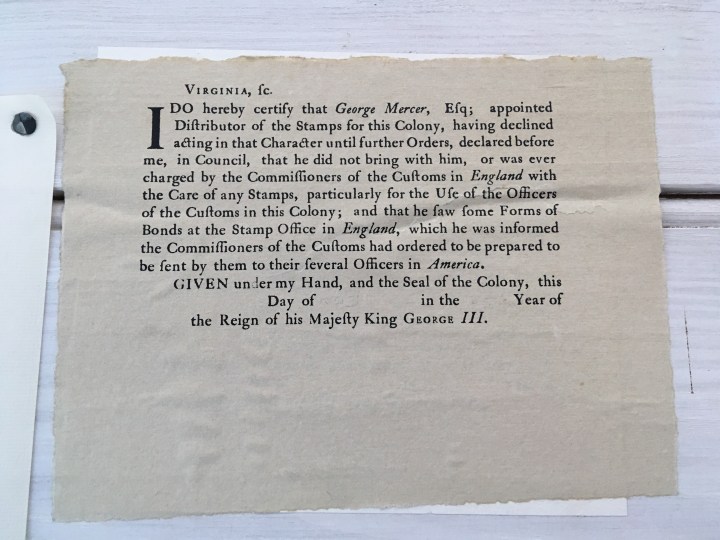
The Charlton Coffeehouse is my favorite stop in Colonial Williamsburg. When I asked about this (initially thinking that Mr. Mercer might have been engaging in some civil disobedience), the “player” turned out to be quite knowledgeable and told me about how Mercer was accosted and assaulted by an angry mob and then submitted this the next day; she also told me about another, similar incident involving a tax collector in Pennsylvania.
The coffeehouse
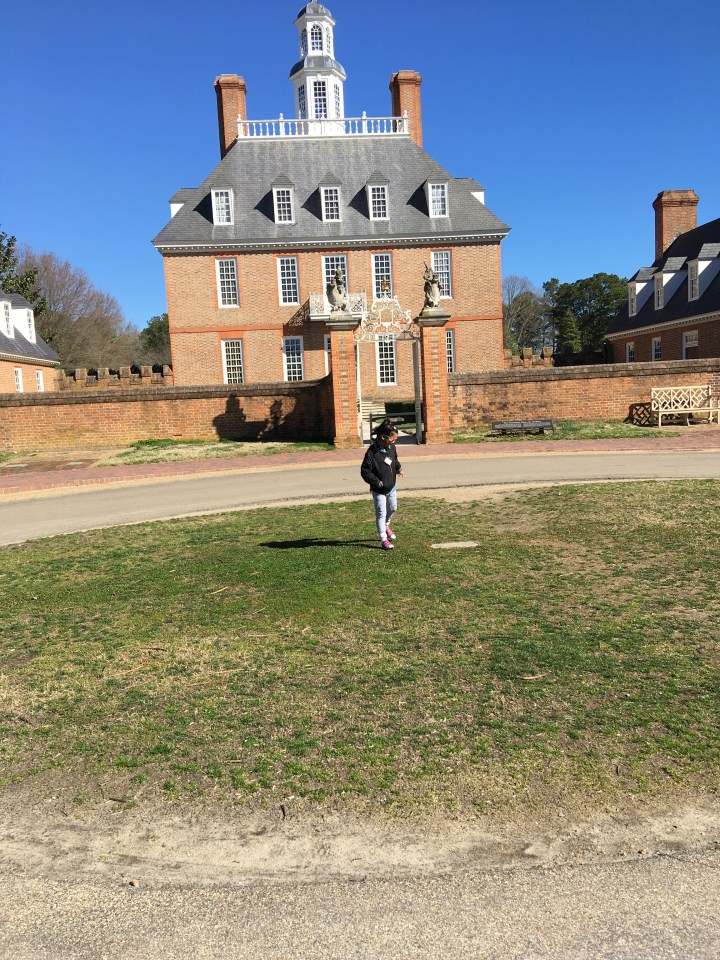
Outside the Governor’s Palace
Inside the Governor’s Palace

We visited Colonial Williamsburg and made a brief stop in Yorktown to visit the Yorktown Battlefield and to, ahem, check out a bookstore. I have continued to read (and feel conflicted) about Thomas Jefferson and was disappointed that the Raleigh Tavern wasn’t open, because it featured prominently in Jefferson’s life while studying in Williamsburg, including being where the Virginia House of Burgesses met after being officially dissolved by the Royal Governor.

So… I Read ‘Crazy Rich Asians’


I can’t exactly say what inspired me to read this book, except that I live with two of Asians (one of whom is an eight year old ball of cute crazy, though not particularly rich). I also saw the movie, yes, and liked it.

The book is better in some ways, less funny in other ways (I got a better feel for who Nick was in the book, but not much feel for Rachel and Peik in the book, the latter of whom was the movie’s highlight and I apologize if you have neither seen the movie nor read the book and don’t know who those people are, but I’m not about the go over the whole plot for reasons that will become apparent), and a lot more ‘plot-y.’

But I guess that’s because it’s a beach book or a romance novel (chick lit? I don’t feel like i should be using that term) and it’s not something I have ever read before. It was fun and I’m glad that I read it (I liked the more ambiguous ending better than the put a bow on it, happy ending of the breezy film, but maybe I liked the film better (because Michelle Yeoh makes every thing better).

So… um, read if it’s your thing. And don’t avoid reading it if it’s not absolutely antithetical to you thing.


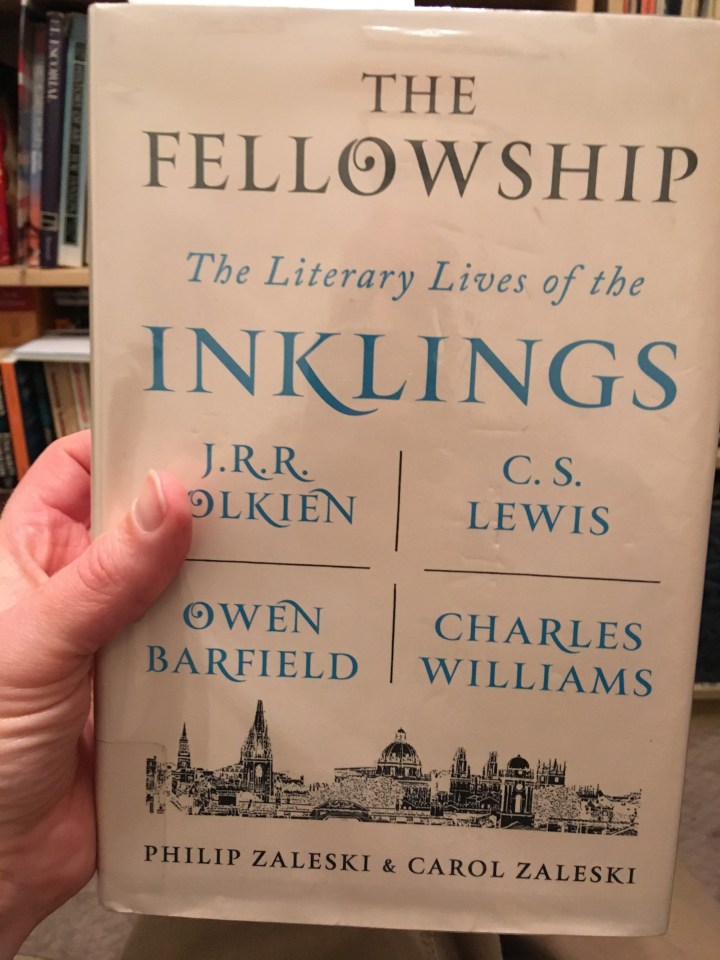
The Fellowship: The Literary Lives Of The Inklings


This is a somewhat half hearted effort to convince the reader that Barfield and Williams are at least half as important as Lewis and Tolkien, undermined by the authors’ own apparent lack of belief in that aspect of the project and by a consensus of opinion which they seem disinclined to challenge.

Towards the end, they set up poor Barfield, by describing his intent to meet the challenge laid down by his peers’ successes and to write his magnum opus. It’s a big set up, narratively, but ends with the admission that few liked it and barely more than that even noticed it was written.

Structurally, they probably could have just focused on Lewis and Tolkien and then included a wider variety of other Inklings.

But, I learned a lot about them and it was interesting, because I like Tolkien and Lewis. I like ’em a lot.

The Zaleskis, without becoming prurient or even mentioning it again, makes a good argument that Lewis and Mrs. Moore were having a sexual affair, which convinced me. It doesn’t change my opinion of him, it’s merely nice to have some resolution, in my mind, on the matter.

Likewise, I had not realized just how devoutly Catholic Tolkien was nor how important it was to his Middle Earth novels (he went to mass daily for most of his life).

But… I can’t help but be a little disappointed. I had been hoping to learn about another Bloomsbury group or another Transcendentalist circle or another Paris in the twenties, instead, learned about a group of intelligent and interesting academics, two of whom happened to become very, very famous and were very important writers. And I put the book feeling that the authors didn’t really like the works of Lewis and Tolkien all that much, which feels almost like a personal insult to one such as I, raised on Narnia and Middle Earth (though they seemed to like two lesser read Tolkienalia, Farmer Giles of Ham and The Smith of Wooton Major, both of which I loved and read over and over again as a child).

Bowles


While dipping into the first few pages of some fifteen hundred odd pages of Gore Vidal essays, I was pleased to see that the inveterate name dropper seemed to admire and appreciate Paul Bowles.
It made me feel guilty because I used to devour Bowles’ estranged works. My Bowles period lasted a good number of years (I even stood outside his house in North Africa, but lacked the courage to knock, despite his well known generosity to random admirers), but it’s been some time since I’ve read him.

We’ll add him to the list.

Riddle Of The Sands


My father explained that The Riddle of the Sands was about sailing, as he watched the seventies film version (with, of course, Michael York). I didn’t understand much of pay attention much at the time, but the memory stuck with me.

Without actually reading the book or watching the movie, I became more aware of it.

It was an early book that premised the idea that England’s future enemy was not it’s traditional foe, France, but a rising Germany. It was also an early version of the modern spy story.

A sailing enthusiast becomes convinced that a german yachter tried to get him killed by leading him down a dangerous coastal waterway, so he recruits a college friend to investigate was the Germans could be hiding, the titular riddle (the area is filled with sand bars and shifting sand islands). There is a British traitor, disguises, and a lot of dangerous sailing – which he manages to make exciting (there is no violence or fighting, but plenty of tension).

I will admit that I skipped the very end, which is a brief treatise of how England could secure her coasts against a German invasion using small, light boats arriving unexpectedly from that sandy coast, but I can’t imagine it’s very relevant now.

Hitchens On Paine


I felt a little bad reading this because I have a nice, inexpensive copy of The Rights of Man which I have never finished and here I am putting the cart before the horse and reading about it before actually reading it. I suppose that makes me like most readers of this book but, to be honest, I have always thought I was better than most people, at least as regards my reading habits, if not morally and hygenically.

We read Hitchens, of course, for Hitchens, regardless of the ostensible focus, but we can see the appeal: a polemicist and pamphleteer in the Enlightenment tradition who made a widely recognized contribution to the course of human events. In dedicating the book to the then president of a post-Saddam Iraq, he must have been hoping, somewhere, that one day he might be recognized in some small way as contributing to a similarly successful product, even if the years appear to have only proven him more wrong on that particular adventure than it seemed even when he wrote this.

I had never heard it before and won’t vouch for its provenance, except to express my belief that Hitchens would have made a good faith effort to examine its sources, but I love the anecdote about William Blake, the mystical poet, warning Paine, the (small ‘r’) republican pamphleteer, that he was in danger of arrest, inspiring the latter to immediately cross the water to revolutionary France.

Learning about Paine’s career was the fascinating. My own knowledge, prior, was rather thin. While no substitute for a biography by a professional biographer or historian, I am not likely to read one, so I’m glad that I got this brief look at his career.

‘Through Nature To God’ By John Fiske


Have you ever had one of those experiences where you agree with someone, but really wish you didn’t, because the person was so annoying?
That is how I felt about Through Nature to God.

How did I even come to this point? I was reading through a selected works of the great American philosopher, Josiah Royce, and came across some references to some other American philosophers from the late nineteenth and early twentieth centuries, including… John Fiske. I decided, foolishly, to look for him and found Through Nature to God.

Whether it was the unsupported leaps, the leaning on poorly understood science (giving, though, some allowance for the fact that our understanding has grown since Fiske was writing), or the references to Herbert Spencer, which always, to me, at least, carry a pungent whiff of social darwinism.

He argues that the biological sciences, mostly, though not exclusively, evolution, argue for  God. He does not make a particular argument for the Judeo-Christian God, but clearly for a theistic one.

While I do, personally, see God working, at a distance, through evolution, his strident tones and arch language make it all seem… icky.

The best thing I can say about it… it’s a short book.

The Phillips Collection


We visited the Phillips Collection the other day because, as it turns out, Tuesdays Through Fridays during the day, it’s free to visit the permanent collection (though not the special/temporary exhibits). While the little fragments we got to see of the exhibit of works by the Cuban artist, Zilia Sánchez, seemed very exciting, the permanent collection also seemed quite enough for the little one.

Like another favorite private museum in DC, the Kreeger, the Phillips Collection has some truly fantastic pieces, including a monumental Renoir that you probably saw in your  college art history text book. I used to go once a year because I used to have a subscription to the Folger’s poetry series and one reading per season would take place there.

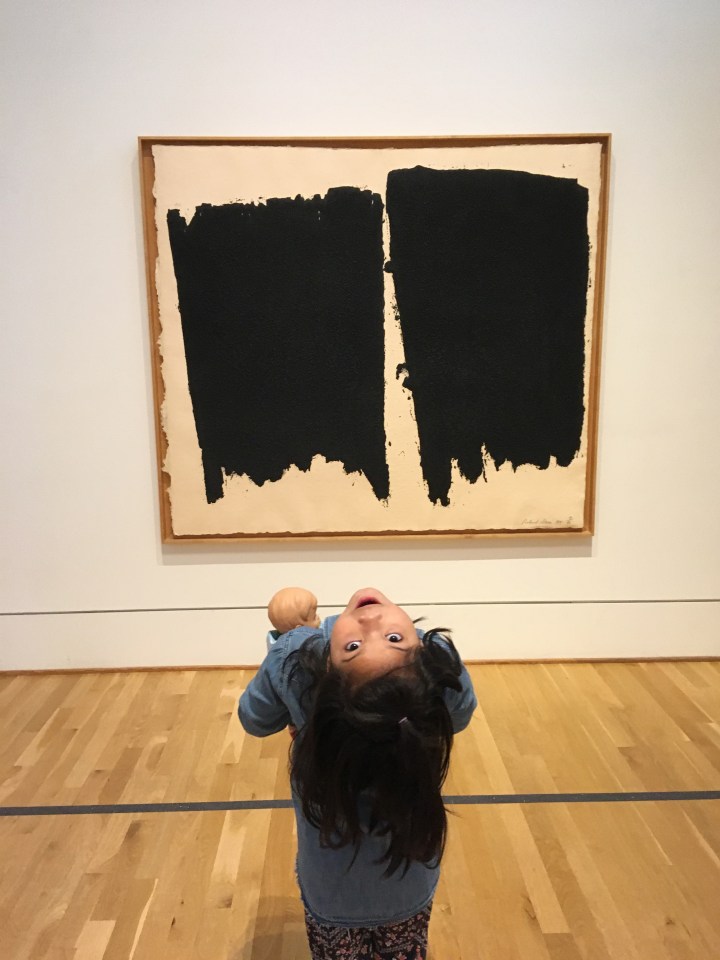
While I have my favorite painting there (a smallish de Kooning), there were the little one’s. And the Richard Serra (you can guess which one that is) is fantastic, as is the Rothko room which also functions a secular chapel, a la… the Rothko Chapel in Texas.

The Steel Remains


Written by the author of Altered Carbon (which I still haven’t read), The Steel Remains is a sort of grimdark fantasy (I hate that term) which partakes of some of the earthier moments of George R.R. Martin’s as yet unfinished septology (is that the word?) but more of the granddaddy (I would say), Glen Cook and his Black Company. Indeed, the three main protagonists would feel right at home in that titular company.
It’s all very good and exciting. The world is well crafted – it’s not unique, but Morgan is good at introducing the world without laying on tons of exposition. There is a sort steampunk overlay, with an alien race that uses barely understood technology that, as Arthur C. Clarke noted, looks very like magic. Of the three protagonists, one is clearly the focus and he’s gay, which is nice to see in terms of diversity (another is from a non-human sort of race that happen to be black).

But then…

He brings all three point of view characters (who also all previously knew each other) together at the very end in a way that just feels entirely too forced; a poorly established deus ex machina. that left me with a bad taste in my mouth.

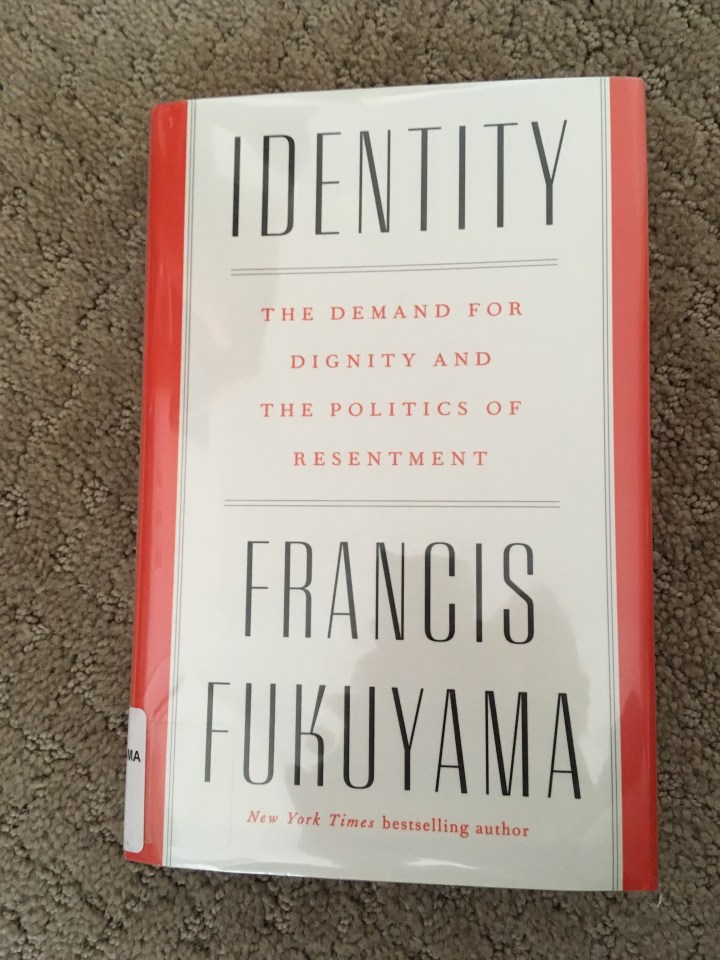
‘Identity: The Demand For Dignity And The Politics Of Resentment’ By Francis Fukuyama


I have grown to have some respect for Fukuyama over the years. While I  never read the book upon which his popular reputation was built, I did read the essay it was built on and his ‘End of History’ thesis is better than its caricature and well worth reading.

And he seems to be properly appalled by how he has found himself lumped in with the neoliberal movement, particular the xenophobic, alt-right academia wing personified by Samuel Huntington (though he also inserts a somewhat jarring and brief defend of Huntington towards the end, where he also manages to y’all about the ‘Protestant work ethic’ without ever mentioning Weber, which strikes me as almost impressively sloppy).

The thesis, which puts the Greek concept of thymos front and center – the need for recognition – and its two iterations, one focused on the personal desire to be treated with equal dignity as others and the other on the personal desire to be treated with greater respect than others. He also has some fascinating ideas about Martin Luther’s theory of grace leading to what become identity politics.

But he undermines every good point he makes with some too timely concern trolling of the contemporary left. He begins by writing a fascinating book with a potentially long shelf life, but then turns a glitter gun on it, only it’s not glitter, it’s the aforementioned concern trolling (which, one suspects, will seem passé if not meaningless in a few years, in its specifics) and short chapters for the short of attention span.