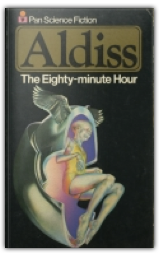
I Have No Idea What Brian Aldiss Is Talking About


I grabbed a copy of The Eighty Minute Hour: A Space Opera from the basement of Capitol Hill Books a few weeks ago for only $3. The author, Brian Aldiss, had been recommended to me as one of the more high-minded purveyors of pulp. Even better – he was British and I confess to being a dedicated Europhile (even if the British have mixed feelings towards their own European-ness).

After considerable effort – and no little motion sickness resulting from mostly reading it on the subway – I finished The Eighty Minute Hour. But I have a confession to make. I have almost no idea what he is writing about.

Though apparently a standalone book, it reads like the third book in a tetralogy. But in such a case, one could at least expect a reasonable amount of exposition. Maybe a little prelude to catch us up. But not here.

Characters were picked up and their names thrown about but never fleshed out. Situations were tossed out there, willy nilly. And the whole thing seemed to come down to a series of deus ex machinas designed to summarily dismiss every challenge that showed up in the plot. To make matters worse – the final deus ex machina, taking place at the very end, wrapped up a plot point that didn’t even exist until 20 pages or so from the end. In other words – it solved the problem of a plot point that never existed for 90% of the book. I’d try to explain the plot, but I can’t. Suffice to say, time distortions caused by a war that is never described and which took place before the book even starts and a computer than magically disappears into the past play major parts. But I’m still not sure how. Oh – and I almost forgot: characters also randomly speak in song (hence, A Space Opera).

Say what you want about a straightforward writer like Dickson (and you can say a lot – he’s hackneyed, that he lacks any sense of pacing or characterization, etc), but I’ll take None But Man over The Eighty Minute Hour.
Pastoral Poetry


Pastoral poetry has a long tradition in poetry – going back to the idylls of the ancient Greeks. Am I a bad person/poet for not being a particular fan of the genre?

I have always been an creature of the urban world. Not in the sense of coming from some conception of the “streets” emerging out of hip hop. My youth in Tampa Bay, the Larchmont neighborhood of Norfolk, and Montgomery is better seen as being suburban, rather than true city life. It was only later in life, when I lived in Los Angeles and Washington that I truly experienced city life (and Washington hasa surprising small town feel to it). No,I say urban strictly as a counterpoint to a more rural, less densely populated community.

Like most poets I know, I am a great fan of the Romantics – and one thinks of Wordsworth, Coleridge, and Southey’s connection to England’s rural Lake District, as as well as the luscious descriptions of Southern Europe in Byron’s Childe Harold. But I have always loved Wordsworth’s interior-minded Prelude more than The Excursion and Shelley’s claustrophoic Prometheus more than Byron’s expansive and natural Childe Harold.

Am I alone in this? Or has poetry, like most of the world, moved into an urban realm? Is there a place for traditional, yet also contemporary, pastoral poetry outside of the politically minded eco-poetics of Snyder and Merwin?

I don’t have answer to that. But I am happy to be proven wrong.

E-Books


I remember watching local news in Minneapolis back in 1995. The anchor was talking about early versions and ideas about e-books (though that term wasn’t in use back then). He referred to paper as being a three dimensional object and this as being one the major changes. As you can tell, that comment stuck with me. Even though e-books still exist in a piece of hardware that exists “somewhere” (whether on a server somewhere or on your e-reader or personal computer), the distinction always feels like that difference between something exists out there in the “ether” versus a physical book on my shelf.

I should probably admit that I don’t have an e-reader, though I suspect that a present for my upcoming birthday will include a Nook.

I expressly indicated that I would prefer Barnes & Noble’s Nook over the more prevalent Amazon Kindle. My reasoning being that I want to support Barnes & Noble over Amazon. While neither is anything close to an independent bookstore, B&N at least keeps physical bookstores and surely that is worth supporting. In addition, the Kindle uses proprietary technology that essentially locks you into Amazon’s Kindle store. With a Nook, I have hope that I could take advantage, for example, of independent bookstores that are talking about banding together the sell e-books.

No Time To Read


There are certain things that drive me crazy. Republicans, for one. I get very particular when it comes to things coming into contact with my clean clothes. Shopping at Wal-Mart for any reason.

And people telling me “they don’t have time to read.”

An old friend told me that he doesn’t have time to read fiction these days. Leaving aside the fact that this was part of a fairly passive-aggressive conversation (the implications being that his life is much fuller and more important than mine – he is too busy doing other critical and intellectual things to read fiction), I want to object to a society that lets people get away with saying “I don’t have time to read” – whether it’s fiction, prose, newspapers or whatever. The very concept is offensive.

I can accept “I’ve been very busy lately and haven’t had much the energy to read much this past week,” but claiming a lack of time is false and should be unacceptable.

And I suspect that most of us who love books have heard this from someone. It’s a way of putting us frivolous bibliophiles in our place and excusing themselves from turning off the television and picking up something whose purpose is to broadly improve the life of the mind.

So – don’t tell me you don’t have time to read. At least be man enough to admit the truth – you have chosen not to read. But you won’t say that, of course. Because that would confront you with the choices you have made instead – to watch American Idol or see the latest bit of trash by Adam Sandler, instead of picking up a book.

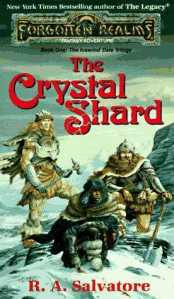
The Crystal Shard


Matt MacKenzie and I were good friends in high school. One of our sources of agreement was a deep love of fantasy novels – and our deep in the closet affection for Dungeons & Dragons.

One weekend, we both picked up, independently, R.A. Salvatore novel, The Crystal Shard. Set in the AD&D (“Advanced Dungeons & Dragons”) world of the Forgotten Realms (which, by that time, had replace Greyhawk and Krynn as the leading locale for AD&D materials).

Both of us absolutely loved it.

Salvatore went on to right three more books in a trilogy featuring the same characters – and then a three part prequel and a whole series of follow-ups (mainly following the most popular character of the series, Drizzt Do’Urden). I confess that found my interest flagging in the novels that made up the rest of the trilogy. The prequels were better, but still lacked the magic of that first effort.

Then I forgot all about it.

Somehow – I don’t recall how – my memory got jogged. But I found myself wanting to revisit the series.

I had been dragged to a distant strip mall shopping center for the purpose of visiting a Jo-Ann Fabric Store. I reluctantly agreed to go, but then quietly slipped off to a nearby Borders Books & Music. Putting aside my preference for shopping at independent bookstores, I dug up a 40% off coupon and purchased a paperback copy of The Crystal Shard.

A review of a book like this is almost besides the point. Either you have affection for the genre it represents or you don’t. It’s not a book that crosses typical genre readership lines, like the immensely overrated Harry Potter novels (by the way – if you really want to read a great book about schools for wizards, let me suggest the infinitely superior and elegiac, A Wizard of Earthsea by LeGuin).

That said, I instantly fell back under its spell. I did so, completely aware of all its flaws – the rampant clichés and shameless theft of Tolkien (though, really, how can you write a good fantasy novel in the classic sense of the genre without stealing from Tolkien? I’m not even sure that counts as a criticism any more). But the story propelled me along and the characters somehow managed to rise above those cringeworthy clichés that suffused them.

Salvatore’s creations will never be confused with, say, Fritz Leiber’s Fafhrd and the Gray Mouser (two fantasy characters who rose above genre clichés and limitations without ever abandoning a pure love of the genre’s mores). But I loved rediscovering them.

I don’t know if I will risk re-reading the follow-ups, though. For the moment, I am not inclined to put the magic at risk.

Fantasy vs Science Fiction


It seems to me that fantasy doesn’t get quite the same level of respect that science fiction gets.

While there have been a number of fantasy novels that have won widespread literary acclaim (I’m thinking of C.S. Lewis’ The Chronicles of Narnia, J.R.R. Tolkien’s Lord of the Rings, and Ursula K. LeGuin’s Earthsea novels), it seems that in the academic world, fantasy gets short shrift compared to science fiction. There is something a little shameful about fantasy that is less present in science fiction.

Some of this may be a sort of gender bias. Not strictly speaking, in terms of “male/female,” but rather, more nebulous conceptions of “masculine/feminine.” Science fiction, because of its relationship to science – relates to to masculine conceptions of the empirical and rational. Though fantasy may be as internally consistent as science fiction, it explicitly does not relate to those empirical conceptions.

In the still gendered world of academia, this makes an interest in science fiction more acceptable than an interest in fantasy. An interest in science fiction, the meme goes, can lead to a career in science or math, providing benefits for science. An interest in fantasy merely leads to a detachment from reality.

A Reason to Push the “School of Quietude” Meme


Ok, fine. I have mixed feelings about the “School of Quietude.” I’m pretty sure that, if Ron Silliman ever deigned to notice me, he would be very disapproving and would probably label me a “quietist” of the worst and most shameful sort.

But, it’s clear that this meme has taken hold. You could probably go on almost any lit blog you wanted, drop the abbreviation “SoQ” and people will know what you’re talking about.

On the Newer Metaphysicals, there is an interesting idea. He would like to see someone on American Idol or some other mainstream, cultural artifact reference someone or something as being part of the “School of Quietude.” This, he says, would be a clear indication that the language of poetry is starting to break through.

Les Figues Press


I first came across Les Figues several years ago at the West Hollywood Book Fair. The small, nonprofit publisher had a booth there and I purchased a copy of Christine Wertheim’s +’me’ S-pace.

Now, I must confess, that having dived into +’me’ S-pace several times, I still have very little idea what she is talking about. Ms. Wertheim does not traffic in easy intelligibilities, but it is no less enjoyable for being difficult.

The literature of Les Figues will always feel deeply tied to a certain avant garde, Southern California aesthetic. I spent several years living in Hollywood, and we knew that the artistes of Northern California (NoCal) looked down on us, but we clung to a belief in our own merit. To me, Les Figues (and also the bookstore, Skylight Books) is deeply representative of this ineffable SoCal aesthetic. It is nothing you might think – nothing to do with Hollywood, celebrity, or surface meaning. Or maybe I’m just talking out of my a–. Your call.

Les Figues is holding a promotion right now – buy two books and get a third free.

For myself, I chose a, re:evolution, and Voice of Ice.

Much like I did for Salt Publishing, I am a sucker for publishers of contemporary poetry and am an easy target for these kinds of promotions. But this is a damn good deal. And they only charge $3 for shipping! I will be getting all three books for only $33 or just $11 each. That’s a steal, as far as I’m concerned.

Neuromancer


I finally finished Fredric Jameson’s collection of essay on science fiction, Archaeologies of the Future: The Desire Called Utopia and Other Science Fictions. I actually bought it something like three or four years ago, but only recently settled down to systematically plow through it. Like any good fan of science fiction, Jameson resists the urge to classify even the best science fiction writers as purveyors of high literature. He does not argue that there is a valid case to be made for the inclusion of writers like Philip K. Dicks and Ursula K. LeGuin, but rather that we should, instead judge writings within the genre primarily on criteria specific to the genre. Of course, when I read Jameson telling me how to judge a literary work, I always think of the gymnastics he performed on Ulysses to explain how it could of any value using the criteria set forth in his book, Political Unconscious (I love Ulysses and have admired Jameson since reading Postmodernism, Or, the Cultural Logic of Late Capitalism, but the two, clearly, just don’t mix very well).

That was a long a digression just to say, while reading Archaeologies, I came across his review of William Gibson‘s Pattern Recognition. Jameson rates Pattern far higher than I  do. I consider it better than, say, his two sequels to Neuromancer, but I also consider most of what Gibson has written since Neuromancer to be disappointing anti-climax compared to that novel.

But reading Jameson on Pattern Recognition did remind me of how much I love Neuromancer. Jameson does hit upon part of the genius of Gibson.

The branding.

The naming of objects, styles, and things in Gibson is wonderfully evocative. The tendency to use brand names and cataloging the create atmosphere is not uncommon on contemporary fiction – think of the lists of possessions in Chuck Palahniuk’s Fight Club, or the use of period signifiers in Bret Easton Ellis’ American Psycho or the obsessive lists of David Foster Wallace’s Infinite Jest (and though I don’t watch it, could the meticulous use of period detail in the television show Mad Men also qualifiy?).

Gibson’s innovation is to use brands that don’t exist, yet which still perform the function of evoking a time and place (though a time and place that doesn’t yet exist). The image evoked is also, necessarily, unique for each reader, because it is unlikely that our minds have filled in the same outlines around these made up brandings.

For example, in Neuromancer, he describes a bar as being a combination of “Japansese traditional and pale Milanese plastics” and a girl as being dressed in “French orbital fatigues.”

The “Milanese plastics” may refer to an actual style – I’m wondering if it doesn’t refer to the Mod interior design style of 1960’s Italian furniture – but I can’t be sure. In the absence of commonplace commercial passenger space flights, I am pretty sure that “French orbital fatigues” is not actually a style of clothing I just missed.

Either way, it sets a mood and allows the brain the fill in details from half remembered images to create a unique environment in which the reader’s mind can populate the book.

I Do Not Like Billy Collins


I don’t like Billy Collins.

There. I said it.

It’s nothing personal. I don’t know the man personally. I just don’t like his poetry.

I don’t necessarily object to poetry that is – shall we say – middlebrow? Without getting into a long discussion, I think we can agree the Collins is not an avatar of the high modernism, or post-avant, or what not. That alone is not a statement on his quality as a poet. Robert Frost is not any of those things either, but I think we can all agree that he’s still pretty awesome.

Picnic, Lightning is why I don’t like him.

Collins specializes in a classic American anti-intellectualism (if you want to argue about this topic, let me just direct you to Hofstadter’s Anti-Intellectualism in American Life and let him argue with you for me). It’s a sort of populist,  “aw shucks” demeanor that posits a faux pragmatism against the silly, nerdy obfuscators.

Fine. Peter Meinke‘s The Poet, Trying to Surprise God is a poem I greatly enjoy and is in the same “aw shucks” vein – as are many of Meinke’s poems.

What I object to is the shameless way Collins tries to have it both ways. Playing the anti-intellectual card and then taking the name of his collection from Nabokov – one of the most intellectual, arch, and hyper-literate writers this side of James Joyce.

I do not appreciate him playing the populist card and then turning to the university English departments and winking at them, as if to say, “I really didn’t mean it.”