What Is An Intellectual?


I ask because I’ve been reading two books address that question.

On my Nook, I just finished Tony Judt’s The Burden of Responsibility: Blum, Camus, Aron, and the French Twentieth Century and have been reading (in a more traditional form) Edward Said’s Representations of the Intellectual.

I was, I am ashamed to confess, mostly unaware of the stories and works of Leon Blum and Raymond Aron (like many young men with intellectual pretensions and a smidgen of angst, I feel deeply and platonically in love with the idea of the Albert Camus – the tormented figure on the cover of my edition of his collected journals from 1945-1951 [see picture]: the aggressive sex appeal of Humphrey Bogart and the tormented moral questioning of Soren Kierkegaard).

Edward Said was someone I had read, but never in depth (a fact that this slim volume cannot be said to have remedied).

Whereas Said is explicitly attempting to impose stricter criteria on the intellectual (in an age where every blow hard on Fox News thinks himself to be a public intellectual), trying to take that title away from those whose actions have thrown away the right to call themselves one, Judt takes a less questioning view of the idea of the intellectual. Ultimately, he does not question that those who put themselves forward as intellectuals are exactly that. What he does do is put these three figures (Blum, Camus, and Aron) up as sort of “super-intellectuals.” Figures who somehow exceeded or at least operated outside the traditional lines that mark the French public intellectual. He even denies that Albert Camus was truly a public intellectual (not an intellectual, but a public intellectual) but rather part of a tradition of les moralistes – of moralists. Camus as a tormented Rousseau to Sartre’s self-confident Voltaire.

Said’s main beef is with professionalism, which he sees an insidious force that works to (my words, not his) neuter intellectuals (which point, Said would no longer consider them intellectuals).

It’s a hard road he calls for. One of the pitfalls of professionalism is specialization, which is singled out as a means by which a potential intellectual, with the potential to shake things up, is moved to an area of safety (safety from the perspective of those who might be called out by an “un-neutered” intellectual). This is a hard road, because he calls for the intellectual to be as close as possible to being an Renaissance man – someone who has made reasonably deep studies in a number of different fields. Arguably, it has been impossible for nearly two centuries to be a true Renaissance Man. Not since Goethe has the available scope of human knowledge (at least in the Western world) been sufficiently manageable for one man to be able to write innovative treatises on both the science and mathematics of meteorology and chromatics and to also be a world class novelist, poet, and essayist.

What Said is calling for is resistance to some of the specialization one sees in the literary and philosophical fields that, of necessity, limits wider vision.

But both Judt and Said see their respective figures (three specific figures in Judt’s case; a more nebulous construct in Said’s, though he seems to view Noam Chomsky as a sort of ideal intellectual) as being outside the dominant intellectual sphere.
Emily Dickinson Birthday Tribute/Revolt for a Cause


I will find myself in a quandary next Tuesday as I attempt to cram two events into one evening.

The first event is Revolt for a Cause, which is being put on at the swanky 18th Street Lounge, which represents pretty much the pinnacle of hipster cool in a town as uncool as Washington, DC. The event is a fundraiser for Wayne Kramer’s prison rehabilitation non-profit, Jail Guitar Doors. If you are a fan of classic punk, then to answer your question, yes, it is named after the Clash song, Jail Guitar Doors (incidentally, written in honor of Wayne, who was serving some time in jail when the song came out in the late seventies). I have mentioned before that I am a fan of Wayne, so I certainly don’t want to miss an opportunity to hear him to do an acoustic set for a small gathering – particularly since I’m getting comped on account of the work I have done as a subcontractor for the group throwing the fundraiser, Revolution Messaging.

But I said there was a conflict.

The Folger Shakespeare Library, a little later that evening, is having an Emily Dickinson Birthday Tribute, featuring the poet Lucia Perillo. I confess to knowing nothing about Perillo (I know a good deal about Dickinson – my mother loved her poetry and used to read them to me when I was a child). But before I saw them at the Folger, I knew nothing about Terrance Hayes or Rae Armantrout and had mixed feelings (at best) about Charles Wright. What I’m saying is, I trust their taste enough to take my chances.

Dungeons & Dragons


Did I mention that I’ve joined an every other weekend Dungeons & Dragons game just outside of the city? I found the game online and had never met any of the participants before the first Saturday we met to create characters. But it’s been great.

A friend of mine, Ryan, tried as well, up in Chicago. He had the disturbing experience of walking into a room filled with legally-fixated (as in an obsession with the official and formal rules of the game, rather than actually being law school students) twenty-two year olds.

Fortunately for me, my little group is roughly my age – the six of us range from barely thirty and mid-forties (I would guess), leaving me pleasantly in the middle. The dungeon master is even a part time opera singer at the WNO (I admit to having been a little googley-eyed and fawning when I found out – I do love watching the opera).

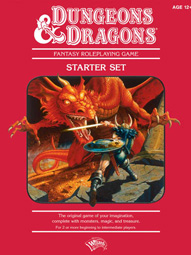
This is the first time I’ve played D&D in at least twenty years (and I actually played Advance Dungeons & Dragons, which is a fine distinction that doesn’t make a big different to the lay person) and I no longer have any of the books I used to assiduously collect (but I am pleased to see that the starter set, the picture shown to the right, is exactly the same cover design was it was twenty-five odd years ago). I’m already being mocked for having purchased the Dark Sun Campaign Setting book from Border’s. And hell if I’m not getting into it.

Every two weeks seems like an abominably long wait, except that, if it occurred more frequently, each of us would miss more games. Every other weekend is something one can set aside as reasonably inviolable in one’s schedule in a way that every weekend cannot.

So, for your information, I am currently playing a half-elf wizard named Cavafy, after the great Alexandrian poet.

Edward Said


I was with a friend watching the Cleveland Cavaliers get stomped by the Miami Heat (starring Cleveland apostate, LeBron James). It was not a pretty sight. My friends was not from Cleveland, but had spent a lot of time there as a fundraiser for Democratic candidates in Ohio last year. We crowded into a Dupont Circle sports bar and watched. Eventually, I gave up and made my way home via the metro while my friend joined some other Ohio expatriates at the Big Hunt.

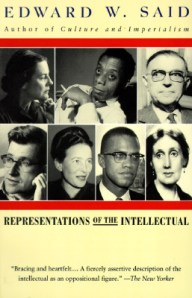
Before moseying home, I stopped at Kramerbooks to browse and to pick up something to read on the subway. I was bouncing back and forth between selection of poems by Paul Celan and a transcribed lecture from 1993 by Edward Said entitled Representations of the Intellectual.

As you have probably guessed, I went for Said. No disrespect to Celan, but Said was slightly less expensive and small enough to fit in my winter coat’s capacious pockets.

In the early stages, Said is simply juggling with what an intellectual actually is. He seems to be leaning towards a conclusion of the intellectual as someone who is outside the system in many ways – that, in fact, the classic French mandarin might not actually be an intellectual.

This struck me because of how it lined up with Tony Judt’s The Burden of Responsibility: Blum, Camus, Aron, and the French Twentieth Century. I just finished reading the middle section of that book (on my Nook, no less), the part about Albert Camus. He proposed that Camus was not truly a public intellectual, in the way that Jean-Paul Sartre and Simone de Beauvoir were. Instead, he places him in a slightly different tradition, that of the French tradition of les moralistes. Different from our moralists, which, in English, implies a hypocritical and conservative figure who speaks with ill-conceived religious certainty. Rather, une moraliste is someone who exists outside of the mainstream of thought and is constantly wracked by doubt and approaches the problems of the age from an abstracted, alienated perspective. The example he gives is Jean-Jacque Rousseau as le moraliste in contrast to public intellectuals like Diderot, Voltaire, and Montesquieu.

I was struck because Said’s definition of an intellectual appears to be similar or parallel to Judt’s les moralistes.

Of course, Said has the entire rest of the book to flesh out his definition and this similarity may not hold up until the very end. But it is certainly a new way to think about the role of the intellectual in society.

going going


The other day, I pulled a little chapbook called  going   going by Jen Hofer out of my bookcase. I was just looking for something small to put in my pocket and read when going out to grab some noodles and pick up my niece, who was taking one of the Chinatown buses in town.

I remember very clearly buying this chapbook. It was at a Poets Against the War reading at Skylight Books. I went because I love Skylight Books and because Wayne Kramer was reading. Wayne showed up in an orange, prison jumpsuit and read some works in his hyper, rat-a-tat-tat style (he reminds me, in that respect of my friend, the Florida poet Brad Morewood – though Brad has never been, so far as I know, a seminal punk musician like Wayne).

I can also say without a doubt, that this occurred on January 13th, 2008. I know that because Jen wrote it in the chapbook.

going  going is a little handmade number, constructed out of index cards and postcard from Death Valley, clipped together at the upper left hand corner. Whether it was done on a typewriter or not, it wonderfully mimics the font of an old, manual typewriter. The whole thing has a sort of Larry Eigner feel (though I say this having read very little of Eigner – I leave it to my betters to correct me in my comparison).

It is a good, hard edged books of politically aware (if not always explicitly political) poetry. It was put out by the small internet mag and sometime chapbook publisher, Dusie if you wanted to try and find it.

The Wheel of Time


I find myself halfway through the fifth book in the series, the Fires of Heaven. I certainly hadn’t planned on getting wrapped up in an epic, twelve volume plus fantasy. But these things happen. Granted, they happen to me more than most people.

While perusing the West Wing of the National Gallery of Art with my father over the Thanksgiving holiday weekend, I noted that my taste in visual art – paintings and the like – ran to two extremes. I love post-war, avant-garde art and I love dull, boring 18th and 19th century Italianate landscapes – the kind with crumbling Roman ruins and a shepherd in it.

My literary tastes seem to run in similarly divergent directions. I love poetry (though not always the most avant-garde poetics, i.e., Language and Conceptual Poetry) and dense, critical and philosophical tomes. But I also love me some paperback fantasy and science fiction.

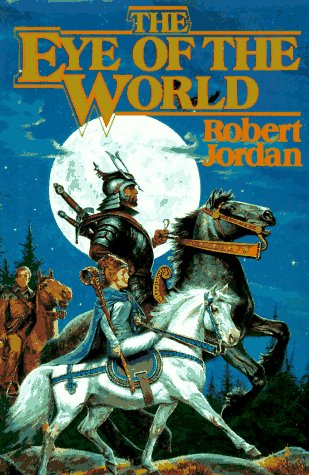
I stumbled across the Wheel of Time series in a New Jersey bathroom.

Let me explain: I was managing some political races in South Jersey and was sharing an apartment with my field director who kept a hardback copy of the second book, The Great Hunt, in the bathroom. I read a couple of pages before getting my own place.

I won’t say I was instantly hooked. More that, having started, I felt the need to see how it ended. So I picked up the first book and things escalated and now I’m on the fifth.

I will be the first to admit they are not great literature. The author, Robert Jordan, took a little while to find a voice beyond just that of a second-rate Tolkien hack. Once he’d done so, he found himself falling into the sprawling cast of characters, plot gone out of control trap (which is almost inevitable if you go over ten volumes, I would guess). And he has even less of a sense of humor than Tolkien. But, I keep on reading. And that must mean something.

I should also note that Jordan passed away, lest we be tempted to speak too ill of him.

One day, I will be finished with them and can move on to something else.

Take Your Child to a Bookstore Day


Saturday, December 4, 2010 will be the first annual “Take Your Child to a Bookstore Day.” Naturally, it has my full support.

If you have ever read my posts, you know that I feel very strongly that we, as lovers of culture, art, & literature, should support brick & mortar, independent bookstores.

If you live in the DC area, I would suggest two places for the child in your life – the first is Politics & Prose. A big bookstore, with lots of spaces for kids to run around a little, as well as a children’s section. The other is Capitol Hill Books, my local used bookstore. It is a classic kind of place, with an irascible owner and lots of nooks and crannies where book loving kids can curl up and hide.

Terrance Hayes


Terrance Hayes won the National Book Award this year for his poetry collection, Lighthead. Hayes has been a relatively frequent visitor to DC, based as he is, just a couple of hours away in Philadelphia.

I saw him at the Folger Shakespeare Library in 2008 and he signed my copy of an earlier collection, Hip Logic.

Keep an eye out and catch him the next time he’s in town.

Charles Wright and Pastoral Poetry Further Reconsidered


For some reason, pastoral poetry has been in my thoughts these last couple of years. It’s genesis, I put down to my (re)discovery of Wordsworth a while back.

But much of what I’ve written here was been somewhat critical of contemporary pastoral poetry. I tentatively agreed with the idea that pastoral poetry that does not also participate in a certain eco-poetic-politics is insufficient – the idea that it is not enough to write about the nature when so many dangers to it exist. The example given (not by me) was that it is insufficient to write about the songbird and not about the bulldozer nearby that threatens it. Adam Johnson called it “ecological orientalism.”

I have also jumped on the bandwagon of those who look at W.S. Merwin and see someone whose writing since The Lice and The Carrier of Ladders leave something to be desired. I bring that up because, The Lice, in particular, is such a great example of eco-poetics: pastoral poetry that encompasses the man made dangers threaten the natural world. His more recent writings, while still perhaps good, lack the urgency and conviction of those early eco-poetics. They are, in short, what I find to unpalatable about contemporary pastoral poetry.

But my feelings may change. Even now, I reserve the right to change and evolve.

For example, I used to lump Charles Wright in the same category as Merwin. Wright’s first book was published between The Lice and The Carrier of Ladders, so I think we can safely place them in the same generation of poets. And he has also indulged in his fair share of pastoralisms. But I read him and see someone who, while not writing within the Snyder-esque, deep ecology vein of early Merwin, still finds a way to make his pastoral indulgences relevant. He also gives the aging poet some hope, having not clearly peaked by his forties and continuing to evolve and improve over the years.

I bring this up more to question myself. I am not sure how real the distinctions I make really are and much I am merely justifying unjustifiable prejudice. Because I must be nearly the only person to prefer Wright to Merwin (I know plenty of poets who lean more towards the avant-garde who can’t stand them both and my classically quietist and septagenerian father just loves Merwin and couldn’t care less about Wright).

Oh well. As long as I continue to find Billy Collins offensive, I will know I haven’t completely lost my way.

America Unchained Day – Saturday November 20th


Tomorrow is “America Unchained” Day. The idea is for people to restrict their spending only to locally owned, independent business – eschewing national chains in favor of the metaphorical mom & pop operations in your community.

I am in complete agreement with this goal. I have written a lot about the desire to support your local bookstore over the big chains and most especially over Amazon.com and other, online only retailers.

Tampa Bay’s best independent bookstore (and a personal favorite of mine), Inkwood Books, is promoting the event. They claim that this one day, if strictly followed by every consumer in the two counties, would generate $73 million for the area, because spending at a locally owned business generates 3.5 times as much local economic activity as spending at a national chain.

But we intuitively already know this. Just like we know that supporting the arts with public monies actually results in a net economic gain for the community. But we still take the easy way out – when times get tough, households shop take their money to big box stores and local governments cut funding for the arts. And sadly, each of these actions do their small part to actually extend the tough times, making recessions last just a little bit longer for everyone.

Ok. I’m coming down off my soapbox for now.

But shop local tomorrow – and buy a book from your favorite independent bookstore, will ya?