Berlin One


While back in Florida, I visited Berlin One, a self-proclaimed art extravaganza taking place at my old haunt, the Ritz in Ybor (I saw more shows there than I can count back in my high school and college years).

A respected and beloved local poet, Brad Morewood, recommended the event to me while I was in town.

Before stopping at the Ritz, I went down the street a bit to the Ybor Arts Colony, a series of studios on the second floor of one the buildings on 7th Avenue, the main drag. I spoke for a bit with Moira Shriver, the wife of the Tampa artist, Jason Shriver, as well as city council candidate, Sara Romeo.

Berlin One itself was crowded with viewers, artists, and designers and enough hipsters to satisfy the most hard core San Francisco scenesters (I notice that ironic moustaches are very popular these days). It felt like my little hometown was growing up.

Ybor City’s artistic glory days were in the 70s, when local artists set up shop in old cigar factories. By the time I came around in 89-90, that scene was already disappearing – the galleries and quirky stores being forced out by clubs and bars catering to overage frat boys.

But maybe, having hit a certain saturation point, something interesting and dare I say – artsy – is coming back?

Moira asked me what I thought about the changes, about how people are trying to take back the area.

I like it. I like it very much.

Slow Poetry


The Atlantic‘s five part series on poetry continues with this piece on “slow poetry.” I skipped over the third in the series, which discussed “flarf.” Why? Because, frankly, I have little interest in flarf. I don’t deny its aesthetic value, merely that those aesthetics have yet to grow on me.

Slow poetry – that sounds like something more up my alley.

Of course, it quite self-consciously reflects the “slow food” movement. The idea of slow, close reading and respect for local small presses is something I can get behind.

He also discusses (all too briefly) the difference between “nature” poetry and contemporary “ecopoetics.” The argument being that traditional, pastoral poetry is insufficient for the poet writing today. If you write about nature without writing about the human threat under which nature lives, you are just engaging in a paternalistic program (he calls it “ecological orientalism”).

Four Quartets


I opted to pick up a copy of T.S. Eliot’s late poetry cycle, Four Quartets the other day. A line from the first poem in the cycle, Burnt Norton, provided the title to one of my favorite British television mysteries, Wire in the Blood (I love the first three seasons – but stopped watching after Hermione Norris left the show). The book was just sitting there, waiting for me, at Capitol Hill Books. How could I not pick it up?

Now, I feel deeply torn. Should I admit? Should I say it? I read these poems years ago, and while I knew then that they were not as good as, say Prufrock or the Wasteland, that was like criticizing a novel for not being as good as Ulysses. It’s too high of a bar to fairly set.

But now, when I read the Quartets, it is like reading some young kid’s effort to write like Eliot. It’s a parody of the high modernist style of his earlier works – that youthful student, in the full flush of first encountering writers like Eliot, Sartre, and Marx and then proceeds to tell his elders all about them (I admit – I was that student in my youth). I try to hammer through it, but I cannot shake the nagging sensation that this is bad writing.

But it’s by Eliot? How can that be?

Maybe I need to set aside a little longer and come back to it in ten or twenty years and see if more experience will not favorably color my views.

Alice Coote


We saw mezzo-soprano Alice Coote, accompanied on piano by Bradley Moore, perform a recital of English poems set to music by English and American composers (Elgar featured prominently among the composers and the Romantics among the poets). We sat in the front row, which is awesome at a Grateful Dead show, but can feel a little awkward at a classical music event – but it was the first time to see a singer perform up close. The experience was a reminder of how little I really know and understand about music, watching the contortions of her face and body as she sang.

Unfortunately, Ms. Coote was suffering from a cold and was a little off, but it was still gorgeous. Not entirely my cup ‘o tea, though – the music, from twentieth century composers, sometimes seemed too close to the popular songbook and I have never been a big fan of musicals (except for, for some reason, The Fantasticks).

When she sang a series of “poems” – actually diary excerpts – by Virginia Woolf, I saw a bit of what we had been missing earlier. In many of the other poems, even such emotive pieces like Byron’s So We’ll Go No More A-Roving, she seemed content to simply perform the recital. But when she arrived at the Woolf pieces, her performance changed. She seemed to be personally and deeply moved by the sentiments. A reminder of how much, for me, a good operatic performance is as much a product of the acting as the singing.

Poetry in DC


I just wanted to give credit to Gina Sangster, who published a letter to the editor in the Washington Post pushing back against the perceived meme that the DC poetry scene is limited to unartful poetry slams.

She named dropped some of my favorite poetry events – from readings at Busboys and Poets to the poetry series at the Folger Shakespeare Library, to the readings at the Library of Congress.

I recently noted my own mixed feelings towards slams, but in addition to featuring to thriving slam scene (which it shares with Baltimore), Washington, DC also features a (relatively) well supported scene for all kinds of poetry.

The Mainstream versus the Experimentalists


Adam Roberts titled his second piece on the state of American poetry, published in The Atlantic, “What Makes a Poem Worth Reading?” But the title (perhaps not even chosen by Roberts, but by a copy editor at the magazine) is misleading. The piece is, in fact, about an ongoing battle within poetry. Ron Silliman refers to it as a struggle between quietists and the post-avant garde. Roberts formulates the same division as “mainstream” versus “experimental” – but in both cases, they are essentially talking about the poets about emerged out of the L-A-N-G-U-A-G-E poetry tradition and, well, pretty much everyone else.

Roberts seems to come down, if only slightly, on the side of  the experimentalists. Though he also seems to be calling for a new experimentalism – one that is more accessible to the average reader (though he also tries – and fails – to grapple with what it means for a poem to be accessible; in his defense, I am quite sure I could not have done any better).

He ends by saying he will talk in future installments about two movements – flarf and slow poetry – which he seems to feel have potential for bridging the “accessibility” gap in experimental poetry.

Juvenalia & Slams


It is a humbling experience to look through one’s old writings – you know, the ones that were so deeply praised when you 16, 18, 22? The one that now look like, well, like  they were written by a sixteen year old, eighteen year old, or twenty-two year old.

I used to attend a lot of open mic poetry events, back in the day – from roughly 1990-2002. The early ones took place at people’s homes and then coffeehouses started to come back – not Starbucks style places with lattes, but dingy little places with bad coffee whose main draw was a certain elán  and sense of commitment to a Beatnik style of life. Places like CAMS in Pinellas Park and Mother’s Milk in Clearwater.

These open mics were different from slams, about which I have mixed feelings. But I also have mixed feelings about my mixed feelings. Slams necessarily value performance and the delivery of widely accepted messages (opposition to discrimination, the societal problems caused by socio-economic inequality, love is cool, etc) over craft – rather the opposite of MFA poetry, which can by entirely too “crafty.”

I say have I mixed feelings about my mixed feelings because I also know that I am not an impartial judge, for two reasons. One is simply that, with a few exceptions, I don’t write poems that do well in slams. I have one or two, but they are rarities, so can’t discount the possibility that my anti-slam bias is itself biased by sour grapes.

The other issue is a little more tricky, because it has something to do with race (and a little to do with age). I am a white male, over 35 and I never really got into hip hop when I was younger. And slam poetry is closely intertwined with forms  of rap and hip hop – which is to say, with cultures emerging out of black and latino communities. How much of my mistrust of the quality of slam poetry is simply that of a privileged white male who closely associates himself with the classic forms of Western European culture and who cannot or will not properly understand a culture driven by those who are both younger and of a different ethnic environment.

But to return to my original point…

Once, I looked at my accumulated body of work and it seemed quite large. But, of course, the poems of one’s youth don’t hold up so well, do they? You look through all these puerile pages and wonder why you ever thought well of yourself?

When you reduce it just those that are actually “good,” you see that your true oeuvre is actually just a handful of pieces.

I shudder when I think what the local poets I used with read with must have thought of me. A silly boy writing sad, silly love poems. Humbling to imagine myself.

Leading of course, to wonder what will I think of what I write now in 15 years? Maybe well enough. There seems some evidence that once “peaks” as a poet in one’s late thirties and forties. I am nearing that point.
 

My Library


My little library is nearly complete. It’s the smallest room in the apartment, save the bathroom, but now contains an office chair, my desk (made out of recycled wood by a local furniture maker), a stool, Smith-Corona typewriter, record player, and three pale wood bookshelves.

In other words, the whole get up is basically porn for poets.

During my first evening in my little nook, I sprawled out with a copy of Pedagogy of the Oppressed, a book long recommended to me by my pedagogically inclined friend, Steve. I still have a little room to mix and match books – giving away older copies of The Poet’s Market and switching out some of the trashier reads for the rest of my poetry collection. Plus, of course, all my many, many notebooks.

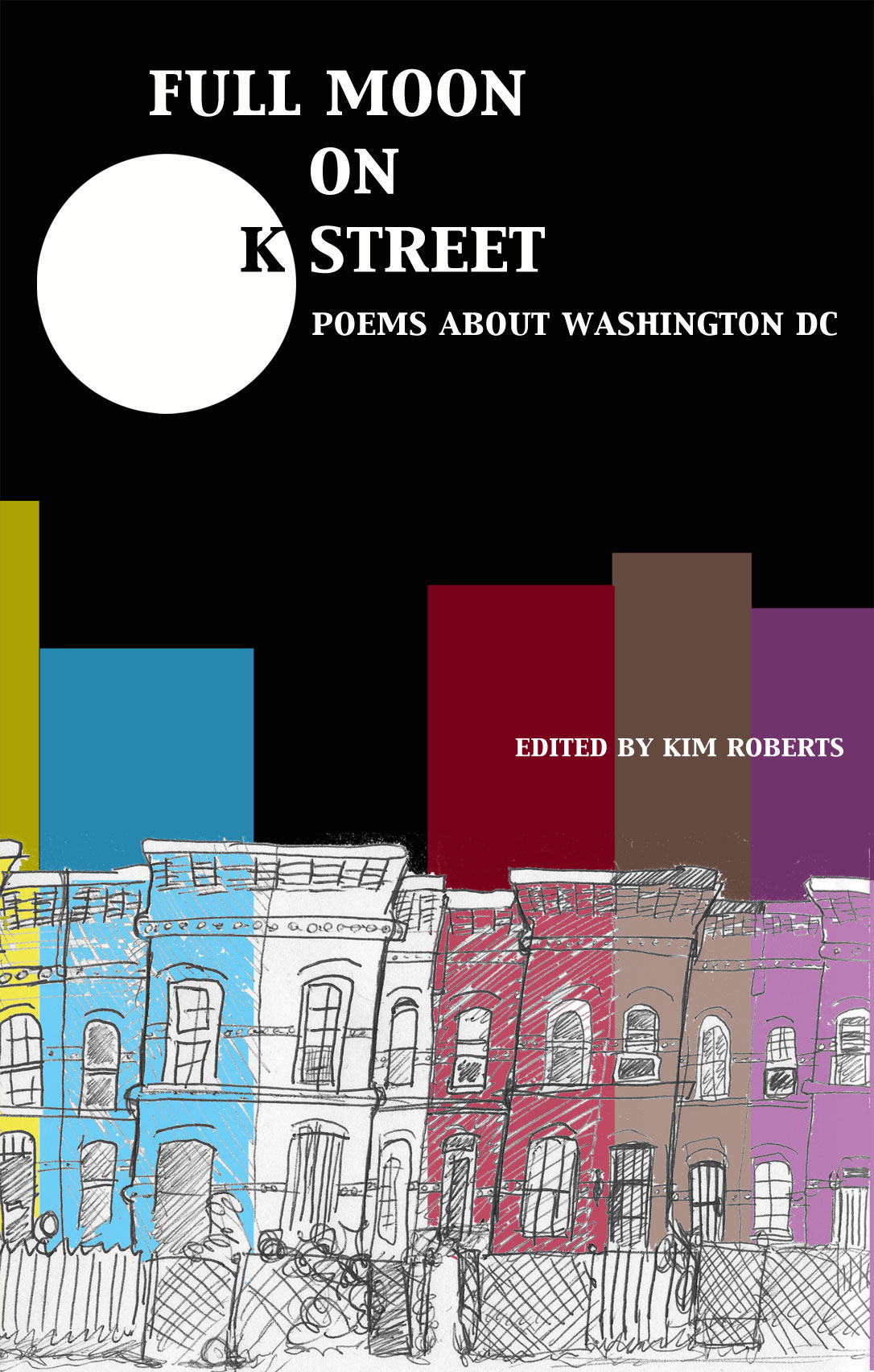
Full Moon on K Street


This book actually came out some time ago. I first heard some of the poems at a reading at the Folger Shakespeare Library, but did not buy the book at that time (I did buy a book of poetry – I always do at these things). I bought it more recently when Busboys & Poets featured the collection, its editor, publisher, and several of its contributors for a packed house a poetry reading on a recent weekend.

Full Moon on K Street is a collection of 101 poems that take place somewhere in Washington, DC by poets who have lived in the city. All the poems were written after 1950. The volume is a fine reminder that Washington, DC is a living, breathing cultural city. It is not just museums and monuments for the dead nor is it just a place where the federal employees goes to work. Washington is also a town filled with activists and organizers, who help create a wonderful bohemian vibe and support places like Busboys & Poets and contribute to a vibrant culture of art and poetry. Full Moon on K Street is partly a chronicle of the side of Washington you can’t see on C-SPAN.

A Defense of Poetry


It is a national or perhaps global tragedy that this is even necessary. I am not going to speak in defense of poetry here – I have done that before and I suspect my point of view is clear.

But I am going to praise The Atlantic for embarking on a five part series about poetry, opening with a piece entitled The Righteous Skeptic’s Guide to Reading Poetry by the Iowa Writer’s Workshop fellow, Adam Roberts.

He opens with describing scenario most of us poetry lovers have encountered – the self-described voracious reader who nonetheless professes some kind of allergy to poetry (almost as bad is the person who reads some poetry, but, in effect, only reads poetry by dead poets – the Romantics and maybe some Frost and Dickinson).

Adams says he intends to make this a sort of “state of the union” for American poetry and will, next week, tackle the idea of accessibility.