The Social Function of the Coffeehouse


Firstly, let me apologize for my extended absence. Not that anyone really noticed. Except for a few family members, I don’t really have any regular readers and my single day record for unique visitors was 51 (and that was back in September). But still, we plug along, sending our thoughts out into the vacuum of (cyber)space.

I was inspired to write here again by this little bit o’ fluff from the New York Times about coffeehouses that don’t allow e-readers in their establishments.

Leaving aside the fact that it seems unfair single out e-readers, unless they are just hard core bibliophiles and this is an effort to protect traditional publishers and bookstores – but let’s be honest, this is just about getting us in and out as quickly as possible so they can maximize profits, it brings to mind the question of the true utility of the coffeehouse.

They are certainly well within their rights to try and maximize their profits, but I cannot help attaching a certain social responsibility for coffeehouses. This comes from my high school and college days, when coffeehouse, by and large, were not places where one found quality coffee, but rather primarily existed as social venues – a place to create gathering places from the sixties, places to read your poetry, play your music, talk politics and art, and play chess with strangers. Now that I’m older and a little more knowledgeable, I would say that the true model were the coffeehouses of 16th century England. Dispensing a bitter, burnt brew, but primarily hotbeds of debate and even relative egalitarianism.

This is not the only model for the coffeehouse, of course. Very near my apartment in Washington, DC is a place called Peregrine Coffee. It specializes in extremely well brewed coffee – and on that level, it succeeds. It has tables and seating and even free wi-fi, but the vibe is not to sit and socialize, but more to get your coffee and go. I have never gone there just to hang out, only to get coffee or to have meetings with people for a very specific purpose. The decor is very stripped down and functional (no big comfy chairs) and inspires an “all business” attitude.
What Is Your Literary Fantasy?


Where do you want to write?

Is it a cabin the woods?

A garret in Paris?

A ramshackle shack on the beach with a hammock and view of poetic sunsets over the water?

Or a small college town, surrounded by the bright lights of academe?

Or the big lights of New York, with parties in the Village?

Is it a being a San Francisco artiste surrounded by the trappings of Lang-Po and the Beats?

An Italianate villa with views olive trees and grape vines?

Are you alone with your thoughts or surrounded by your peers? Do you use a typewriter, a pencil, a quill, a computer or an iPad?

The First Day of the Rest of My Life?


After forcing my way through the last couple of months, I am finally no longer working. I no longer have the energy or the strength to work a full time job. I suppose it is what growing old feels like: the slow, wearing away of one’s physical abilities and the slight and constant pains associated with seemingly inconsequential movements. Supposedly, I have a new kidney coming. I am waiting to see what complications are in store. I have been able to put off dialysis, mainly through sheer , dogged stubborness. But not even the stubborn man can stave off death forever. If this doesn’t work out in a few weeks, waiting another month won’t be an option. Or rather, the options will be between immediate dialysis and death.

When my Aunt Petey slipped into a coma, the family finally decided to take her off dialysis and bring her into her eldest son’s home. The three sisters (my mother, Aunt Millie and Aunt Kerry) gathered around the hospital bed that hospice had installed in the living room and sang old songs like a family in some epic, sod-buster novel. I loved my aunt, but I never liked those kinds of novels. Too far from my urban, over intellectualized existence. When it was my turn to hold vigil, I read from The Consolations of Philosophy by Boethius. She took nearly a week to die. We were unprepared for it to last so long. The doctors said maybe a day or two. She was too full of her body’s own poisons. But there was that stubborness, again. She was frail, but her father, my Paw Paw, only produced one child who wasn’t unnaturally stubborn – and Aunt Petey wasn’t that one.

So why the cliched title? “The First Day of the Rest of My Life?” Is it because I have a new found love of life and a desire to go on. No, my will is more Nietzschean – more wrapped up in thanatos than eros or agape. I just can’t get over how strange it feels to be dying. To face the possibility of measuring out the last moments of earthly existence with Eliot’s coffee spoons.

Warrant


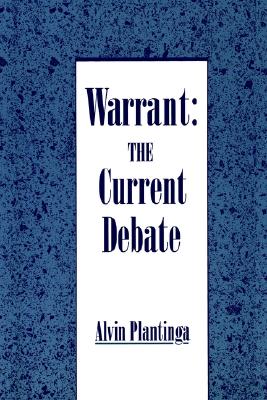
Using my $100 ebook card from Barnes & Noble (thank you, Mu!), I decided to catch up on some western philosophy. Over half of my gift card went to purchase Alvin Plantinga‘s Warrant: The Current Debate. A little bit of a misleading title, because I don’t think anybody but Plantinga was debating “warrant” much before him.

In college, my epistemology professor, Aron Edidin, was a friend of Plantinga and gave us some short articles by him to read. At the time, the class was not impressed – possibly because, as I know understand from having begun this book, our professor did a poor and, arguably, flat out inaccurate job of describing warrant (which he posited as being in addition to “justified” in the traditional formulation of “justified true belief” when, in fact, it was intended to replace “justified”).

My professor did say that Plantinga was writing a trilogy (it had not yet been finished at the time) of books about warrant that would culminate in a argument for a theistic god. At the time, I was a raging atheist, so this did not particularly excite me, but now my interest is piqued (of course, he doesn’t get to that until the third book).

So I am a handful of pages into Plantinga – far enough along to know that, though not entirely my fault, I have been until now misrepresented his work when thinking of it.

Continuing in this vein, I also dropped a $1.99 on a Barnes & Noble edition of William James’ classic, Varieties of Religious Experience.

Automated, Online Submissions


As the careful reader knows, I have developed a certain obsession with automated, online submissions, as used by contemporary literary journals. While I understand their utility, I am still haunted by the notion that, in practice, we lose something. Though it is still possible for editorial staff to use the content management systems to deliver more detailed messages, it is so much easier to simply click “reject” and automatically send some formulaic language to the writer.

No one liked receiving those old letters, with the notes describing the many flaws and deficiencies of our submitted works, but we learned something from them. I don’t get a damn thing from an email that contains the same language as everyone else received.

And of course, the editorial staff can still choose to offer a more detailed critique with their rejections. But how many really do? And how many really do compared to when they had to print out a letter with your name on it and containing the names of one or more of your poems? A letter truly feels more personal, which is what drives editorial staff to write critiques – even if just a hand-written scrawls across and otherwise formulaic letter. But this new method, for all its efficiency, is too detached to encourage that.

The reason I am bringing this up again is simply because I ran into this little article online — http://www.pw.org/content/new_treefree_submission_services – a list and a brief history of some online submission systems. Of those listed, I know that I have dealt with submishmash, though I’m not sure about the others.

Anybody want to disagree with my opinion on these systems?

Christmas Books


Every Christmas now, for going on twenty years, my mother has always found an autographed book to be one of my Christmas presents.

This year, it was How Florida Happened: The Political Education of Buddy MacKay by, of course, Buddy MacKay.

Buddy was the last Democratic governor of Florida – he served for only a few months, having taken office when Walkin’ Lawton Chiles died just before his term ended. Buddy had been his lieutenant governor. Unfortunately, by that time, Buddy had already lost the election to Jeb Bush, who would go on to lay the groundwork for Florida’s current economic and educational failures.

A good man, Buddy MacKay was the last of an old breed of Florida politician who got pushed out the extremists and the lobbyists who now run Tallahassee as their own, private fiefdom.

The Secret Reason We UseFacebook


There is a secret reason we use Facebook. And it’s not self-aggrandizement, not obsessive status updates. It is not even finding out who’s still single.

It is seeing that she got fat.

Maybe not morbidly obese, but definitely not the girl who looked good in a bikini. The one who broke your heart. Who maybe cheated on you. Maybe you thought she was the one. Or maybe you were just angry that you put up with little rat dogs for so long, just to get dumped.

Whatever.

The point is, Facebook has pictures of her looking fat.

There they are. You know that maybe you haven’t aged like find wine either. You’ve got a little more gut and a little less hair. But you haven’t been so foolish as to post, where any ex-girlfriend could find them, photos that clearly depict your decay.

But she has.

This doesn’t reflect well on me or you or any of us. It’s a selfish, un-Christ-like pleasure. But it goes down like a cold beer after a long day at work. You hear the whoosh of air when you crack the cap and that first, refreshing, foamy wave of sweet beery goodness flow over tongue, washing away the world’s pain as it goes down.

It won’t last forever. It may be associated with painful hangovers and shrunken livers. It does not replace true love, sunsets, and great art.

But it feels so damn good for just a little while, doesn’t it?

New Kidney


My cousin called me the other day to tell me that the transplant center in Baltimore had declared us a match. I could accept her kidney.

Her mother had donated a kidney to my mother. So this was keeping with a sort of tradition.

It is difficult to explain how feels to be told that you are now significantly less likely to die in the next six months. That, some day soon – perhaps in as little as a month – you will feel better in ways you can’t even understand right now, because it’s been so long since you weren’t feeling the constant ache, fatigue, and pains of a body slowly poisoning itself.

In the movies or books, poison moves swiftly. I don’t remember the context, but my friend Ryan, back in 1995, assured me that, no, being poisoned is actually an exceedingly painful way to die. Well, I can now vouch for that truth.

Of course, I haven’t died. Not yet. And I may not now for many years.

End Stage Renal Failure


First your’re just tired. Then stairs get tough. Standing (more so than walking) is tough. Your girlfriend wants to go out for dinner and movie and you have to explain that you only have the energy to do one of those thing. Then one day, it all breaks. You can’t go out at all. You can do one thing day. I have to start taking days off work because you just can’t move. If you do work, that’s all you can do. If you don’t work – you can do one thing that day outside of the house. And you feel a little ashamed on the subway because you have to sit down and sometimes it is crowded and an older lady has to stand and you want to give her your seat, but you just can’t stand for that long. And you think everyone is looking at you because here you are, a healthy looking young man making this old woman stand. You tell your girlfriend about this experience and make a joke about how even though you probably look better than you have in years (because you’re losing weight), you actually feel so awful in a way you can’t even describe. And she looks at you funny and says that everyone has commented about sick you look these, but no one has said it your face. And in someone ways, you feel better, because maybe the old lady understood that you weren’t well, but you’d also been clinging to the fantasy that you still looked ok, but apparently people have been able to tell for weeks or even months that you’ve been dying at a significantly faster rate than other people.

Reconciliation


I don’t go to confession (or reconciliation – which  is the correct term, I believe) very often. Far less often than I should. And I admit to leaving the sanctity of the confessional with mixed feelings about sex and sexuality and am a terribly hypocrite for at least a week afterwards (like the child who tries to be good, starting 48 hours before Christmas, to make up for having been so rotten the previous 11 months and 3 weeks.)

But I will say this – 2 out of 3 times, something good happens to me within a few hours of receiving absolution.

This time, I found out that my cousin’s kidney is a match for me and that a transplant can go through. I’m not saying this is causal, but it can feel that way sometimes.