Not prepared to sign up, but it’s great idea. I had a completely unfeasible idea for a bookstore where I’d ask the customer some questions and give them an appropriate book. If they liked crap romance novels, for example, I might give them something by Jane Austen.
Ezra Pound: Canto LXV
At seventeen pages, this is a doozy.
It’s about the American Revolutionary War. Sort of.
This being Pound, it’s also about finance. But less banking than international trade. And international relations. But mainly as they relate to trade.
And mainly trade by sea.
Pound engages in one of his strategies of listmaking, as of lists that might be compiled by ‘characters’ in his Cantos, often written in a sort of short hand.
Benjamin Franklin appears prominently, but I think this has more to do with the prominence of France (Franklin having been ambassador to France on behalf of the Continental Congress) than of a particular focus on Franklin.
While writing about France, he even manages to toss in some ancient history:
Laws of the Visigoths and Justinian still in use in Galicia
(Yes, I know that Galicia is in Spain, but the references to Spain are made, so to speak, by ‘characters’ in France).
Want To Be A Public Intellectual?
There’s an app for that. Well, technically, it’s a website, not an app.
The First Temple
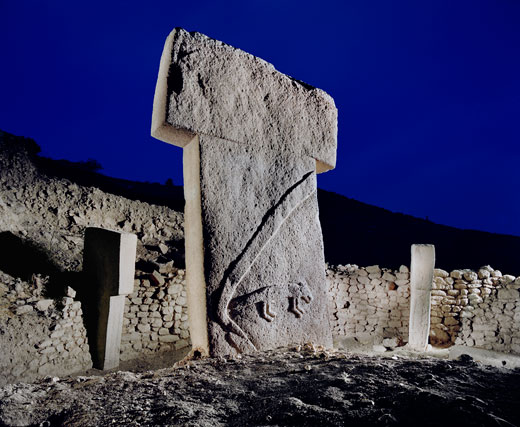
Apparently, this is the oldest temple we yet know about.
There’s something so amazing about how neolithic cultures came together to create these structures and societies. It’s one of the many things I wish I had studied more of (my wishlist of books includes a couple on neolithic and copper/early bronze age Ireland). Also makes one a little sad to know that you’ll never become are proficient in one’s understanding of the era as one would like. Or, at least that such proficiency would come at the expense of spending that time with some other area of study. Life is a zero sum game sometimes.
X
George Kennan wrote two hugely influential documents.
The first was the so-called Long Telegram and the second was technically called Sources of Soviet Conduct but is better known as X, the nom de plume he used when publishing the article.
Here’s X.
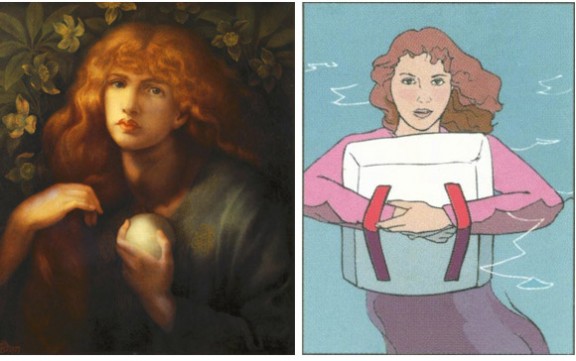
Airline Safety Manuals As Art?
Andy Warhol In DC
There are not one but two different Warhol exhibitions in DC right now.
And both can be seen for free.
One is at the Hirschorn Museum and the other at the National Gallery of Art.
And here is an article blaming Andy Warhol for excesses in the contemporary art market. Just thought I’d throw that in there.
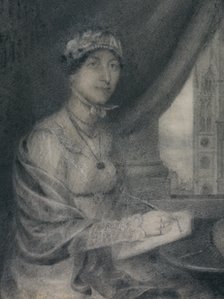
For All You Jane Austen Fans
But I Like Klimt!
I’m a sucker for a good piece on either the philosophy or economics or art. This article is the latter.
But the article also pissed me off.
The author is very tough on Klimt. Namely on the Klimt bought by the Neue Galerie in New York City for $135 million. Now I’m not commenting on the price of that piece, but I love Klimt. I even took a pilgrimage to the Neue Galerie to see their collection of Klimts and Seccessionist Art.
This is what the author has to say:
The crowds lining up to see Lauder’s Klimt in 2006 must have figured that looking at the most expensive work in the world would also expose them to one of the greatest. They were wrong. Almost no one would say that Klimt is crucial to the history of art.
Darn it, I like Klimt. A lot. He’s one of my favorites. I was introduced to him by an ex whose tendency (desire) to create chaos and destruction around her, while maintaining the adamant position that it’s constant presence in her vicinity was purely coincidental (if you are a man over the age of twenty-five, you have dated some version of this girl), could be seen as being mirrored in Klimt’s later portraits, with the serene subject surrounded by a glittering and chaotic abstract background.
Getting back to the art – what is the working definition of ‘crucial’ operating here? He’s not important?
Ugh.
Emily Dickinson & Aracelis Girmay

Last night was the last Folger poetry event of the year (though only half way through the season).
The raison d’etre was the upcoming birthday of Emily Dickinson. The reader was the poet Aracelis Girmay, who interspersed readings from her own work with poems and letters by Dickinson. Afterwards, there was a delicious black cake, made according to Dickinson’s own recipe (very rich, with a strong flavor or brandy, and pleasantly and slightly gooey).
Girmay is not a particularly good reader. She rushes too much sometimes, too many ‘ums’ and the like, but her clear enthusiasm, especially her enthusiasm for Emily Dickinson, carried her past those faults. Passion goes a very long way. Plus, she came across as very sincere and generous.
After her reading, there was a conversation moderated by Alice Quinn, the executive director of the Poetry Society of America.
I say ‘moderated,’ but actually, something more than half of the ‘conversation’ was a monologue by Quinn. While I appreciate her passion for Dickinson and her appreciation for what a Ms. Susan Howe has written about Dickinson, I was under the impression that the whole point was hear was Girmay had to say about Dickinson and her own work and also to take audience questions. But, hey, what do I know?
While I believe Quinn’s intentions were genuine and that she just caught up in the opportunity to rave about a much beloved poet who has been of great importance to many women poets, in particular, the effect was of someone who wanted to lecture and show off her own erudition, rather than do anything like moderate a conversation.
I purchased Girmay’s Kingdom Animalia before the reading started from the Folger’s bookshop. I was very impressed by just a casual glance at her work and have been more impressed as I have read more. She isn’t someone I had read before, though her name has come up frequently when following the doings and goings on of poetry.
I was also fortunate enough to be the first in line to get my book signed and so got a bit more time with her than I otherwise might have and she was just as generous and sincere sounding one on one as she was on the stage.
She is definitely a poet I might recommend to a parent who has an adolescent child interested in poetry. Understandable and clear, but not lacking in formal or thematic complexity, I could see it as the kind of thing that might act as a bridge for a sixteen year old, would be poet, connecting him or her to contemporary, ‘grown up’ poetry.

