 I was with a friend watching the Cleveland Cavaliers get stomped by the Miami Heat (starring Cleveland apostate, LeBron James). It was not a pretty sight. My friends was not from Cleveland, but had spent a lot of time there as a fundraiser for Democratic candidates in Ohio last year. We crowded into a Dupont Circle sports bar and watched. Eventually, I gave up and made my way home via the metro while my friend joined some other Ohio expatriates at the Big Hunt.
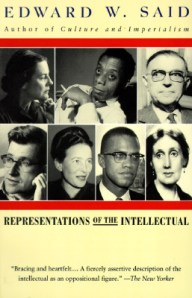
Before moseying home, I stopped at Kramerbooks to browse and to pick up something to read on the subway. I was bouncing back and forth between selection of poems by Paul Celan and a transcribed lecture from 1993 by Edward Said entitled Representations of the Intellectual.
As you have probably guessed, I went for Said. No disrespect to Celan, but Said was slightly less expensive and small enough to fit in my winter coat’s capacious pockets.
In the early stages, Said is simply juggling with what an intellectual actually is. He seems to be leaning towards a conclusion of the intellectual as someone who is outside the system in many ways – that, in fact, the classic French mandarin might not actually be an intellectual.
This struck me because of how it lined up with Tony Judt’s The Burden of Responsibility: Blum, Camus, Aron, and the French Twentieth Century. I just finished reading the middle section of that book (on my Nook, no less), the part about Albert Camus. He proposed that Camus was not truly a public intellectual, in the way that Jean-Paul Sartre and Simone de Beauvoir were. Instead, he places him in a slightly different tradition, that of the French tradition of les moralistes. Different from our moralists, which, in English, implies a hypocritical and conservative figure who speaks with ill-conceived religious certainty. Rather, une moraliste is someone who exists outside of the mainstream of thought and is constantly wracked by doubt and approaches the problems of the age from an abstracted, alienated perspective. The example he gives is Jean-Jacque Rousseau as le moraliste in contrast to public intellectuals like Diderot, Voltaire, and Montesquieu.
I was struck because Said’s definition of an intellectual appears to be similar or parallel to Judt’s les moralistes.
Of course, Said has the entire rest of the book to flesh out his definition and this similarity may not hold up until the very end. But it is certainly a new way to think about the role of the intellectual in society.
 the coffee philosopher