 It is a book that both is and is not to be read in terms of its literary value and impossible to disentangle this book from modern history. While I enjoyed it, it was also difficult for me to fully appreciate because I never fully reconciled the conflicted nature of the collection.
‘June Fourth Elegies’ By Liu Xiaobo
I already owned this book, but re-read it because of the tragic death of Liu Xiaobo, which, felt both inevitable and like a punch to the gut.
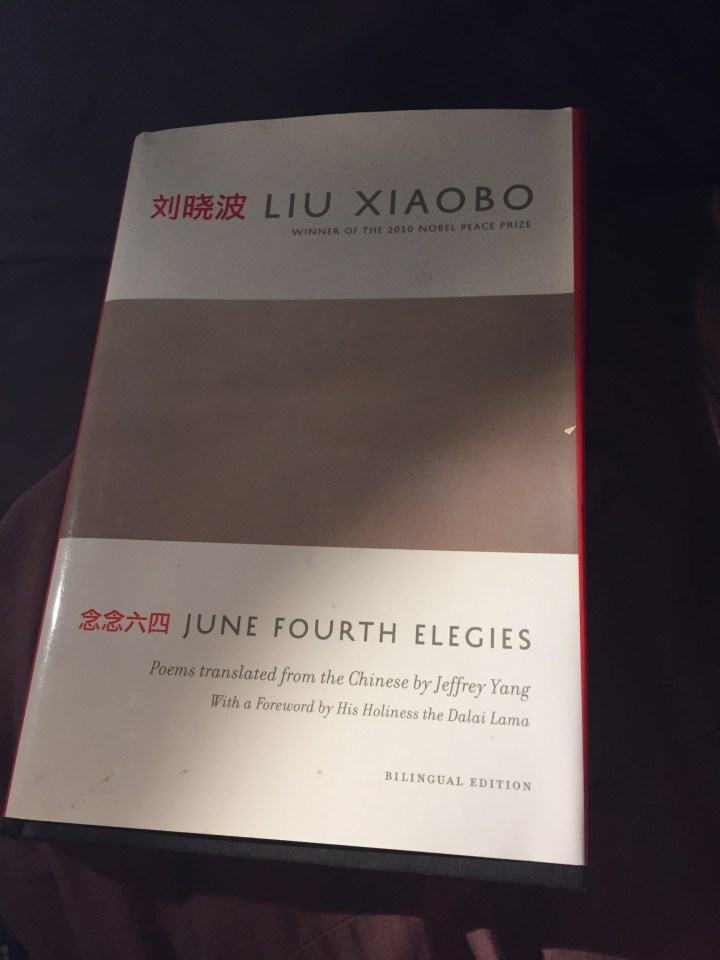 Of course, I ‘know’ him primarily as a poet, rather than as an activist. But now that he’s gone, I can’t separate the two enough to judge this series of poetic remembrances of Tiananmen Square, bookended with poems to his wife (also a poet: Liu Xia).
It does make our (still righteous) national grievances against Trump seem small.
‘Ex Machina’ & Ted Lieu
 Ex Machina is an excellent, creepy, and faintly problematic movie. Ted Lieu is a congressman from Southern California. As a just meaningless side note and, arguably, a moment of pointless name dropping, I met him a dozen years ago when I canvassed for him when he ran in a special election for an open seat in the California General Assembly.
This was part of a series by a nonprofit called Future Tense. It’s one of many semi-political, semi-advocacy, vaguely but not quite thinktank-y orgs that exist all around DC.
Lieu spoke well and amusingly and amazingly non-partisanly about technology legislation around the hacking of driverless cars, cells, etc. But I’ve always liked him. He even mentioned universal basic income or UBI as something worth attaining.
This was the second time I’d seen Ex Machina and I was able to better appreciate parts of the performance, script, and direction better. Like watching a surprising mystery, it can be fun to go back and re-see things again, knowing what one knows. The manipulations of the sparse cast.
But… the nudity seems problematic. There’s not a lot, except, towards the very end, there is a scene with great deal of extended nudity (there was an earlier nude scene which felt less problematic, as well), all of women (and all, my better half noted, women of a certain body type). I can understand why the director did it, in one sense, and I can outline why, I expect, he felt needed and why he felt it was okay. The gaze was female, for example. It was about becoming a woman (and a human). More reasons, too. But even though it probably wasn’t more than a minute or two, it felt like it lingered and it’s hard to fully explain away voyeurism. I won’t truly condemn voyeurism (I’m a man who’s used the internet, so it would be disingenuous), but maybe this movie didn’t need it.
Beatriz At Dinner
 The movie had gotten great reviews and while it wasn’t absolutely at the top of my ‘if you’re going to see a movie that’s out right now, it’s definitely this one’ list, it was on that list, so when a friend suggested we all see Beatriz at Dinner, I was one hundred percent down with it.
And it’s a really good movie. It’s a little too cinematic, though, not trusting in its actors (Salma Hayek is great and plays Beatriz’s subtle, aggressive power very well and John Lithgow makes a truly horrible person three dimensional, yet also sympathetic because he is a real, three dimensional human being, without shying away from the fact that he is an awful blight). I feel like it could have been a more politically and ecologically minded My Dinner with Andre (one of my all time favorite movies), if the director had trusted the audience to be able find the clash of ideas in conversation to be riveting.
Also: Chekhov’s gun appears.
If you don’t know what that means, don’t just look it up online. Read a book. Go to the library.
A Political Vision For The Democratic Party
I come here not praise vision but to bury it.
Funny thing. You see, it’s wildly overrated, especially in non-presidential election cycles. The GOP has never had a much of a positive vision over the last couple of decades and they have done just fine, running against Democratic presidents, with just a frisson triggered by Newt’s inane contracts or Ryan’s incoherent mimicry of a low rent kind of DC-specific wonkishness.
The folks who talk about the Democratic Party’s need to craft a proactive vision are generally selling something. What they hope to get paid in is usually leadership within the party (often of an informal kind) for politicians, intellectual respect (and a book deal) for columnists, and paying clients for consultants.
Though none of the federal races have tipped all the way over, we have seen that running against Trump and the GOP works quite well.
And opposing these things implies a certain positive message. Running against Trumpcare/Ryancare/McConnelcare implies that people deserve healthcare, which is a positive message. Running against cutting healthcare for old people, sick people, veterans, and poor people (often overlapping groups) implies a stance against inequality and favoring the rich over everyone else.
Democrats can run quite handily without the vision of the sort that pols, writers, and consultants have been saying is absolutely essential. Which should be taken to mean that invidious candidates don’t need a message and that they don’t need to be disciplined about staying on message, but that’s just electoral politics 101z
My own two cents (and if anyone wants to anoint me a leader, give me a byline in a magazine, or hire to share my wisdom with your organization, feel free) is that Democrats just need good candidates for the districts and states in question. They need to be able to raise money (being right can’t substitute for totally inadequate resources), but also to be a cultural fit for the area. But maybe you shouldn’t reward me for saying this, because, actually, most of the folks who actually know what they’re doing have already said it, only they are less strident than the vision-mongers because they have less of an angle.
What It Means When A Poll Says Trump’s Support Drops Among Independents
‘Independent’ is almost always misleading. People may call themselves independent, politically speaking but the vast majority of the time, that person actually has a marked political preference in his or her voting habits.
When a president is particularly unpopular, the number of independents will rise because voters of the president’s party feel a little embarrassed from the association and claim to be independent, but the basic leanings are not changed for most.
In this case, a NPR/Marist poll showing a seventeen percent drop in Trump’s approval rating is probably showing a segment of formerly GOP identifying voters now identifying as independent, with a significant, if not a majority, of those folks actually turning against the president. It probably also shows some Dem leaning folks who aren’t convinced that party has their act together, so while they are likely Democratic in their voting, won’t yet identify with the party.
This is terrible news for Trump and his party, but the real turning point won’t be until more people start identifying as Democratic.
The Second Strata
Trump has been successful in recruiting politicians like Pence, whose career had plateaued and was suffering from low approval ratings (see also, Nikki Haley) or were already termed out of office with no obvious place to go (Sonny Perdue) and also the already super wealthy (Tillerson and Mnuchin).
But there is a second strata of positions below the level of Cabinet Secretary and related positions. At that level, the level of the real subject matter experts, he has struggled to find people for roles like solicitor general or deputy cabinet members specializing in a policy area. Why? Because that class of people still have something to lose. And they believe that they will end up losing by joining his administration. Those who ask themselves, what kind of job will I be able to get after I serve Trump are implicitly answering that too many potential clients won’t want to hire someone tainted by association with Trump.
When Does Intent Cease To Matter?
Most philosophy of ethics views intentionality as key. Was the mental intention good or bad?
I have been thinking about this in the context of recent presidents. Trump almost certainly did not mean to give Israeli intelligence to Hezbollah (though it’s questionable how much of a pass he gets for his apparent intention being ‘show off to Russian officials in order to bolster self-esteem and impress Vladimir Putin’).
But I actually am thinking more about this in the context of George ‘Dubya’ Bush. One can feel almost nostalgic for Dubya while in the thrall of dangerous insecure man-child. At worst, one thinks, he was merely a well-meaning idiot. And didn’t he direct a lot of money towards fighting the spread HIV internationally?
It’s easy to forget all the terrible, ethical lapses of his presidency; of a war driven by Freudian conflicts vis-a-vis, his father.
But even if we accept the premise that he was well-meaning, at what point does intention not matter? Even if he did not intend so many deaths, so many maimings, so much destruction, so much lost, at what point does the water of consequences burst the dam of intention? When is ‘I meant well’ (truly stated) not enough to stave off sin?
Donald, Aldous & George
There have been a few essays lately that argue that we were all blinded by the Cold War-infused popularity of 1984 that we missed the real threat, which more resembled the soporific entertainments of Brave New World, because it was the mindless, meaningless, fact-free Huxleyian discourse of Fox News, et al, that led to Trump. Because it’s all just spectacle (hints of Bataille, eh?), the results can be argued to be effectively meaningless, but what matter is something, anything different to shake things up and make things less boring (also a contrarian response to measured stoicism of ‘No Drama Obama?’).
But now that he’s president, let’s take a moment to raise our glasses to Orwell.
No, I don’t think he’s going to lead America to an authoritarian dystopia driven by an ideology-free ideology (which means, if he does, I’ll be one of those excoriated in future histories for not having recognized the danger posed by an authoritarian, racist, anti-semitic, delusional, narcissist rising to the presidency… which does sound pretty bad, when you say it out loud).
But when you read how large numbers of Trump supporters think he’s accomplished a great many actual things in this, the first 90-odd days of his presidency, when so far, his only tangible accomplishment was nominating Neal Gorsuch for the Supreme Court (his confirmation was solely down to the hard work of Mitch McConnell and his selection was done by those most uber-establishment of establishment folks at the Heritage Foundation). Call ’em alternative facts, call ’em lies, call ’em spin, call ’em what you will, but it all comes down to ‘it just ain’t so.’
And I don’t think that many of those supporters are unaware that he hasn’t actually accomplished, in any real sense, well, anything. We are all guilty, I suspect, of some kinds of antinomial thinking, but this is more of the willful ignorance than Kant’s antimonies. And Winston always wondered if most people actually believed or just accepted because it was easier to go along with those who did truly believe (which, again, bodes poorly for how people like me will be characterized in future histories).
But no, I’m still not predicting the end of American democracy. Neoliberal twit that he can be, I still hope that Fukayama’s predictions of an enduring liberal order are correct, in broad strokes. Maybe, on an intellectual level, I’m just hedging my bets here.
It’s A Brave New World, As They Say (I Think That My Father Used To Say That, Even Though He Was Never A Particular Fan Of Aldous Huxley; For Myself, I Think That ‘Crome Yellow’ Is An Underrated Novel If You Want To Read Something By Him That’s Not, You Know, ‘Brave New World’)
Perhaps it is because I (and other residents of the District and, indeed, almost everyone in America) have been protected by what has become a comforting layer of incompetence that covers everything he does like a bulletproof vest whose actual purpose is to protect everyone around the wearer.
Or maybe it’s because he’s never here and is busy inflicting himself on the patrons Palm Beach County’s Mar-A-Lago retreat for the super wealthy.
More likely though, I have been deluding myself.
After all, I have spent my career trying to make things better for this country. More specifically, I have spent more than a half decade helping to make tangible improvements in the lives of several groups working people in the DMV (that’s DC, Maryland, and Virginia). And this administration really has no time for that kind of thing. Insofar as they have an interest, it is in seeing that kind of work stopped.
Because his comforting incompetence has stalled so many of his priorities (so many of them hilariously and depressingly opposite from those he campaigned on), I haven’t had to think too much about the ways they would devastate the lives of my friends, my family, my neighbors, etc.
I assume the United States of America will survive this. It seems an article of faith. We survived a Civil War. We survived moral blights like chattel slavery, Japanese internment, and a mixture of accidentally and deliberately genoicidal actions towards native peoples, and while we didn’t come out as well as we might have hoped, we did come out a little better, surely. Of course, that ‘we’ is a white people ‘we.’ A reminder of an easily slippery slope. unless you somehow think American Indians came out better for my ancestors arriving and eventually founding this country, in which case, you are too stupid for me to even bother trying to sell you a bridge or mineral rights of a magazine subscription.
That easy slope is why he is so dangerous, too, right?
And maybe I’ll be fine, because I’m white and male and straight. And maybe my person of color better half will be fine because she will be protected by my beneficent aura of whiteness.
Or maybe we are all simply f–ked.
 the coffee philosopher