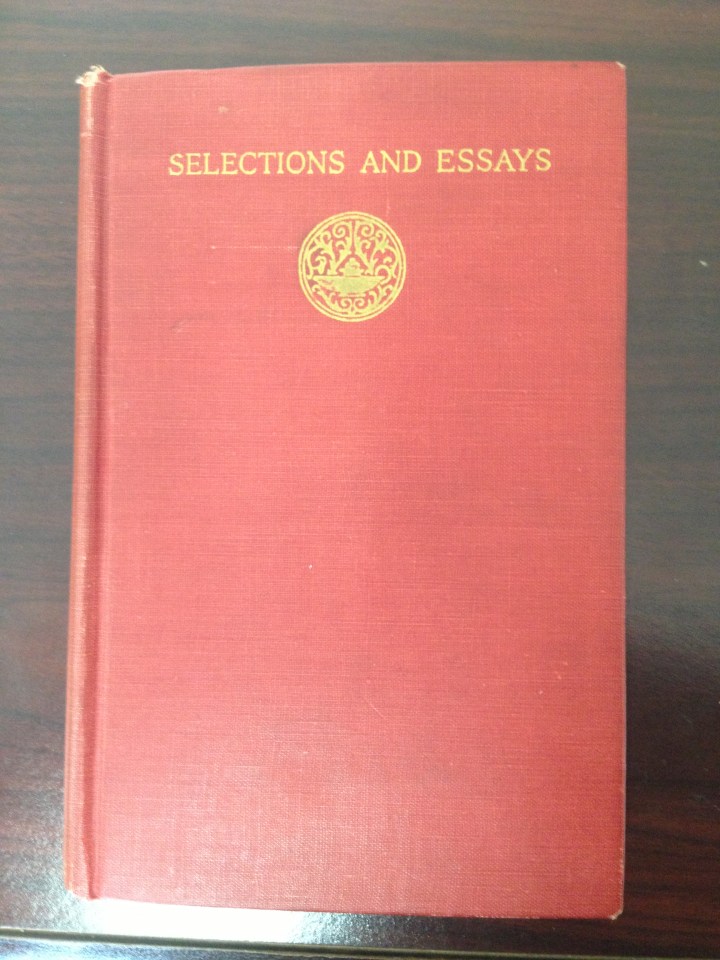
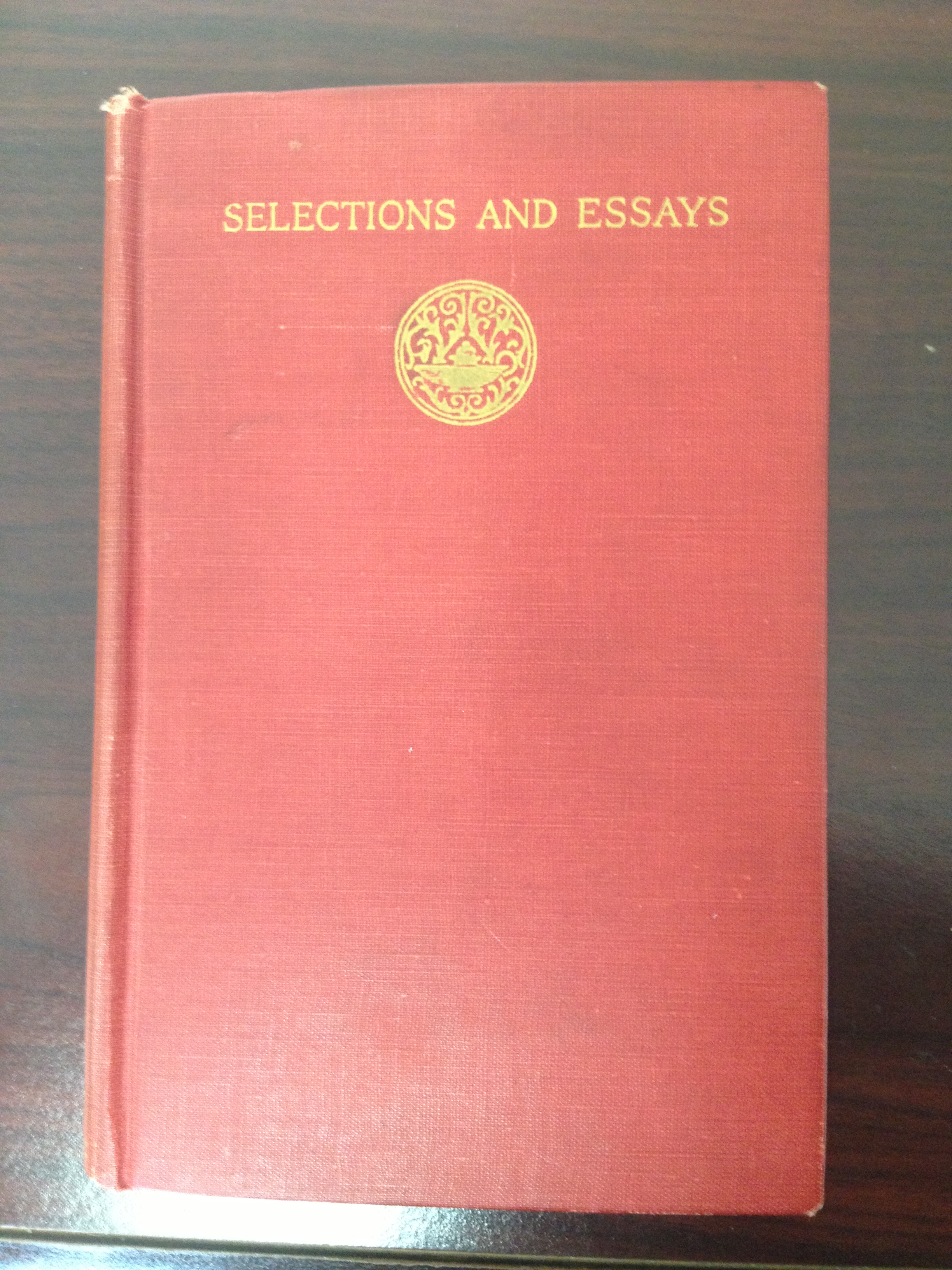
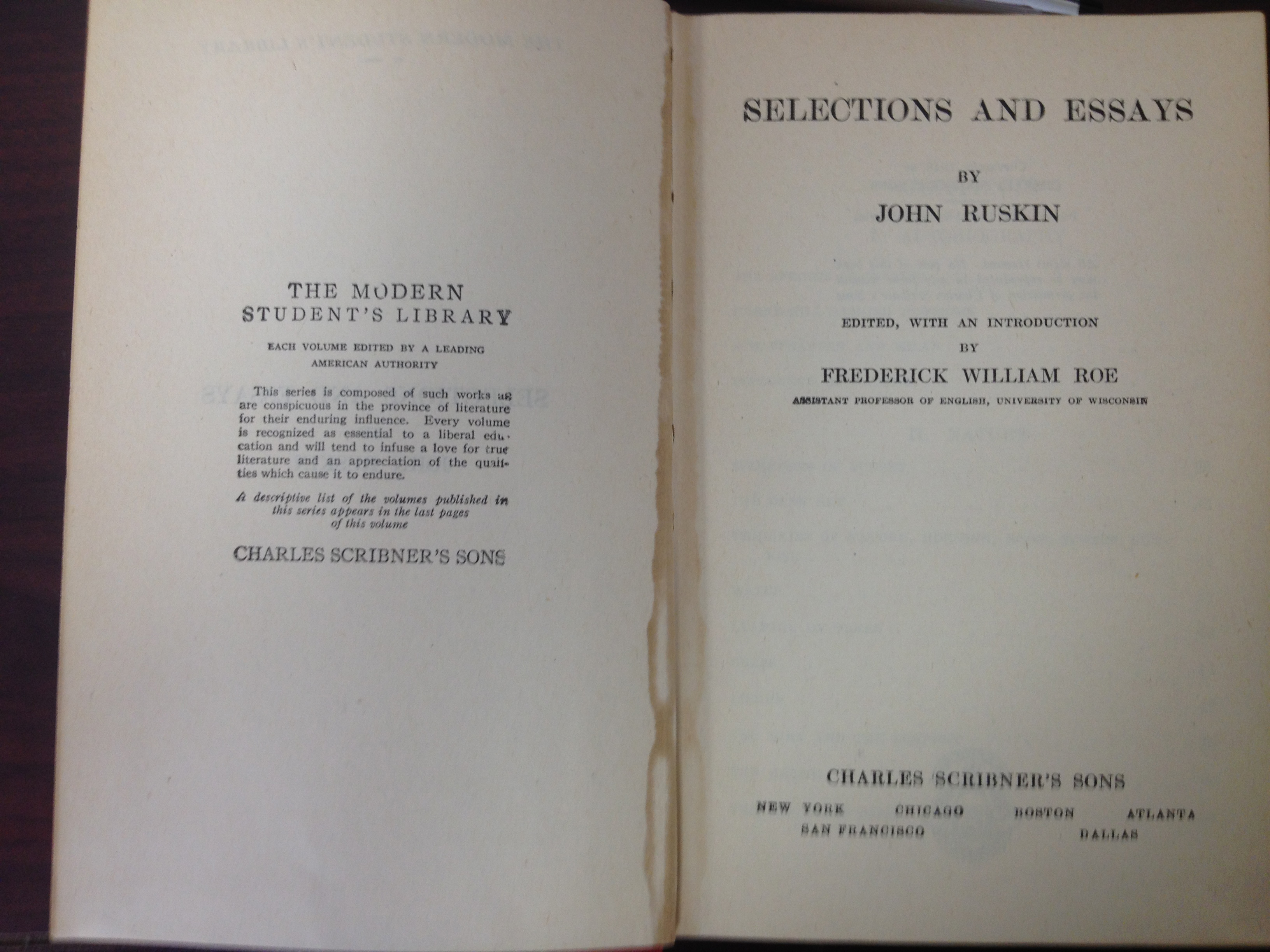
 At the Lantern, in Georgetown, a fantastic (and cheap!) used bookstore filled with high quality, interesting books, I gathered up a whole mess o’ reading, including this collection by the nineteenth century art critic, John Ruskin.
Ruskin was a cheerleader for the Pre-Raphaelite painters.
In fact, when I was buying the book (books, in truth; five to be exact), the sweet young girl (I’m guessing a Georgetown student) at the desk and I got into a conversation about him and the Pre-Raphaelites. She was planning on seeing the exhibit and asked, rather pointedly, where I found the book. I think she had been looking for a collection of Ruskin’s writings and was a little miffed that I, a stranger to this place, had found it first. Then the conversation moved to Andrew Lloyd Webber (the older woman who runs the shop joining in at this point). In case you were wondering, I like Jesus Christ Superstar and that’s it. The rest is trash.
So, Selections and Essays dives very quickly into selections that get into the heart of what informed Ruskin’s taste and his theory of art.
Firstly, in some autobiographical pieces, he returns again and again to how his mother required him to read deeply into the Bible, memorizing passages and reading the whole thing from cover to cover several times as a child. There’s also some stuff about reading Sir Walter Scott’s Waverly novels over and over again as a family, but I think that’s less relevant (which no doubt means it is the coda to all of Ruskin’s later thought).
Then, in his rapt discussions of the appearances of nature in nature (first, the thick, creamy, curdling, overlapping, massy foam, which remains for a moment only after the fall of the wave), you can see how Ruskin could have appreciated Turner’s later and more impressionistic (small ‘i’ – Turner was no Impressionist) landscapes.
Ruskin believed that personal, moral feelings were imparted to art (and therefore necessary for art?) and that art called for an accurate, yet also naturalistic depiction of the natural world, by which I mean, the rural world (no urban cityscapes, for him, no thank you, please). The moral is especially critical. He ultimately see aesthetics as a moral science (he even prefers to call it theoria or the theoretic faculty to distinguish it from traditional aesthetics).
He is almost prescriptive. When ostensibly writing about art, he is actually writing about nature, but, really, he is writing how artists ought to depict nature by describing how nature appears to the viewer (sometimes, from several different viewing angles).
Let us have learned and faithful historical paintings – touching and thoughtful representations of human nature, in dramatical painting…
Because of his relation to the Pre-Raphaelites, I noticed that he called Michel Angelo [sic] the ‘Homer of Painting,’ Michelangelo being, as it were, Raphael’s immediate predecessor, a true ‘Pre-Raphaelite.’
To ramble a bit, have you read Elaine Scarry’s On Beauty and Being Just? Because she must have read Ruskin. They’re coming at from different angles, in the sense that Scarry begins with the idea that, these days, there is a need to justify beauty and uses moral reasoning to do so. Ruskin, of 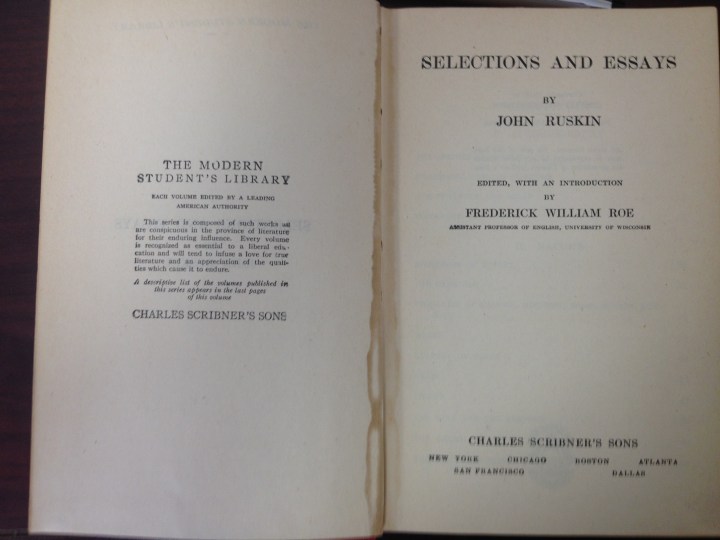 course, is not justifying beauty, but he still finds its core in moral reasoning.
I didn’t quite know what to think about his political writings, which, apparently, were his obsession (in an early essay he is clear that he comes from a family of lifelong Tories and also so self-identifies, though he sounds to me like an advocate of what today would be called democratic-socialism or European style socialism). He claims to hate liberalism, which seems confusing (because he is surely advocating liberal ideas) until you remember that in the nineteenth century ‘Liberal’ meant more a sort of middle class libertarianism.
These were the days when ‘economics’ was called study of ‘political economy’ and he clearly shows the difference that makes (and also how poorly understood much of economics was; this is not a criticism of Ruskin, but things got a lot clearer post-Keynes). He rightly understands that wealth (riches, he says) is actually about power. I don’t know how widely understood or how widely stated that was, but if it was neither, here’s a fine example of how the mindset taken when the field is called ‘political economy’ can lead to some good insights.
I noted one passage on page 340 that stuck out because he seemed to be advocating for Glass-Stegall!
…that the private business of speculating with other people’s money should take another name than ‘banking.’
The most shocking passages are when he writes critically, dismissively of Greek art and architecture. I had never heard of a nineteenth century Englishman writing less than admiringly, fawningly about the glories of Greece. Frankly, I don’t know what to think. I mean, I like ancient Greek art and architecture and poetry and culture. I feel like I’ve been found out as some sort of Dwight McDonald style midcult bourgeois fraud. Once again though, you can see that connection to the ideas that inspired the Pre-Raphaelites, this deep love, almost to the exclusion of all else, of the art and architecture of the period in western Europe from the eleventh century until just before Raphael.
 the coffee philosopher