Was Surrealism A Mistake?


No.

Not it was not.

This article says otherwise, but it’s a bit of a weak cup of tea (though, in the author’s defense, he’s not given much of a word count to make his case).

No one is asking a writer who submitting an article to the American Conservative to make a fierce case for the Marxian tinged politics of Andre Breton, but it’s more than a little disingenuous the way that surrealism has been dismissed artistically.

He starts by taking a very narrow view of surrealism. So narrow, that it is entirely limited to those who lived entirely by the strictures of Breton. By that definition, the following individuals were not surrealist: Salvador Dali, Rene Char, and the later works (after, say Capital of Pain) of Paul Eluard. This is a very narrow view of the surrealist practice.

And his use of American artists from the mid-century as an example of the… inadequacy?… of surrealism is irritating. I expect artists to appropriate and oedipally reject their predecessors, but that’s not a sign of their predecessors failure. By that metric, the impressionists were a failure because Matisse and Picasso weren’t painting in the style of Monet, but appropriating portions of his style and rejecting others. That’s not failure; that’s life.

Just In Case You Forgot


The Pope and the Catholic Church are not cool with economic inequality and really aren’t comfortable with depending on an unregulated, wild west economy to fix it.

This is in no way aimed at Paul Ryan.

 204. We can no longer trust in the unseen forces and the invisible hand of the market. Growth in justice requires more than economic growth, while presupposing such growth: it requires decisions, programmes, mechanisms and processes specifically geared to a better distribution of income, the creation of sources of employment and an integral promotion of the poor which goes beyond a simple welfare mentality. I am far from proposing an irresponsible populism, but the economy can no longer turn to remedies that are a new poison, such as attempting to increase profits by reducing the work force and thereby adding to the ranks of the excluded.

From Evangelii Gaudium

Jeremiad, Or, Steve Jobs was A Shill For Consumerism


1378579728I bought George Moore’s Confessions of a Young Man at the Lantern, thinking that it was by G.E. Moore. Not so. But this Moore is a lively, if inconsistent writer. At something over a quarter of the way through, after Moore has abandoned painting for lack of talent and determined to take up poetry, he writes about Mallarmé.

Moore had been educating himself in French poetry, starting with Victor Hugo and working his way up to contemporary French poets (contemporary, in this case, meaning the 1870s) in a process of (somewhat) calculated autodidacticism.

He writes about ‘Mallarmé’s Tuesday evening, a few friends sitting round the hearth, the lamp on the table.’

I kept reading for another half dozen sentences before pulling up short and going back to that sentence and finally comprehending that he had been attending weekly literary salons at the home of Stéphane Mallarmé. My mind was blown by the reality of what I have missed by being born too late.

And yes, it is different now. It’s worse.

Our cultural heroes and leaders are not writers and poets and dramatists, nor essayists and philosophers, but libertarian technophiles who see the latest app as part of an inexorable process that magically culminates in the alleviation of suffering or hunger or some other global ill. The whole shebang is a self deluded shell games, like the South Park underwear gnomes, they convinced that they have embarked on the first step of a messianic journey that leads inexorably, inexplicably – magically! – to some greater end.

At the same time, we have not yet completely thrown off our adulation of pirating financiers nor the revelation of the fast descent into madness, pain, and suicide of Lord only knows how many former college and NFL players much diminished our fawning love athletes playing dangerous games of brute force.

I’m not claiming that Baudelaire’s debaucheries are to be emulated nor Shelley’s private (as opposed to public) morals modeled, but for fuck’s sake, can we stop calling Steve Jobs a great man? He was a megalomaniacal marketer. For fuck’s sake, people! I have an iPhone, but the building of a fief-like cult of consumption within a consumer addled culture has not broadened our minds, lifted our souls, nor made the world an appreciably better place. Indeed, it can be argued that Steve Jobs most lasting legacy will the impact of a spate of Chinese suicides on the families they left behind.

So… for fuck’s sake, people, shape up!

I know it’s hard, because it’s all so seductive. I used to work for a couple of tech forward firms, including a semi-early adopter of using emails to ‘activate’ activists and, later, a company that managed text messages for nonprofits and political campaigns. I wrote texts and copy for smartphone apps and social media and told their clients how these new strategies that I developed, these new technologies that I was selling would change everything! The people who signed my checks, they absolutely believed it. And, in some small, meaningless, tactical way, they were right, but in a larger, more important way, they were dead wrong and all the world’s souls will ultimately suffer for not seeing it.


 

The Koch-topus (Courtesy Of The WaPo)


fb020f0e3

Monday Morning Staff Meeting


The future was then!

Still remembering Amiri Baraka.

Being an author (wordsmith) in Asheville, North Carolina is awesome. Too bad the right wing government in Raleigh is so transparently abhorrent.

Probably.

Don’t cry. Or, actually, do.

Black Boy (By Richard Wright)


9780061130243Believe it or not, just last month was the first time that I had read Wright’s autobiography, Black Boy. It was one of the books that I read in Thailand. It has been sitting in my e-reader (a statement with some metaphysical implications; what/where is a book when it is in, no the general ether, but the ether of a particular device?)

It’s not the sort of thing that’s put on the high school curriculum, at least not in a state, like Florida, where the powers that be have very little interest in the history (nor the future) of African-Americans.

Good lord is it a wonderful, beautiful, brutal read. The first section, covering his life in the South in the early twentieth century. Yikes. Anyway who complains about cultures of violence or the use of the n-word within the black community needs to read this book (incidentally, Ta-Nehisi Coates has been writing some great stuff on this very topic lately; look it up). He writes about poor black kids and the bravado driven by this constant, crushing fear of white people. An uncle killed by whites for the crime of having been financially success and his aunt and mother afraid the leave the house or even ask for the body (much less assume ownership of the business or property). White employers trying to goad the author into literally killing another black adolescent. It’s just terrible to read and more terrible for knowing that it all happened – and that far worse happened, only without a future Pulitzer Prizer winner to chronicle them.

The second part covers his joining and departing the Communist Party. He leaves without disavowing the believe in class struggle and, really, without relinquishing his own, personal communism (small ‘c’), only relinquishing membership in a top down organization.

It reminded me of when I read the piece that Arthur Koestler (now there’s a fellow that no one reads anymore! and I stand by my prediction that, soon enough, Christopher Hitchens, for all his wonderful prose-fying, will find his work placed in the same basket) contributed to the collection The God That Failed. No one is praising Stalinism or suggesting that it was anything but a blight, but, despite the disavowals, not even a staunch anti-communist like Koestler can avoid capturing some of the romance of being a leftist and radical and a communist in the twenties and thirties. The idealism of it all. Wright doesn’t try to walk back the great thrills of that time in his life, like Koestler does, and the work is better for it. It reminds me of a review of a recent Family Guy episode where Peter takes up smoking. Yes, smoking is bad for you. Awful. The world would be a better place if no one smoked anymore. But it’s cool. It just is. Humphrey Bogart looked cooler smoking. Audry Hepburn looked sexier lighting her cigarette. And let’s not even talk about the way Catherine Deneuve could send shiver up the spines of any human (male or female, gay or straight) with the slightest fraction of sex drive just by blowing a puff of smoke from a gauloise. I feel that being a communist in the early thirties was like that.

Midweek Staff Meeting – Bigger Than Jerry Lewis


RTX1851Y

So… Judith Butler is a household name in France. Especially among conservatives. Ok…

Starving mid-list writers face a future of, well, starvation. Poverty, certainly.

Don’t tell me that politically engaged writers have disappeared. Actually, that conversation was about poets. They haven’t disappeared either, but this one is about a fiction writer and essayist.

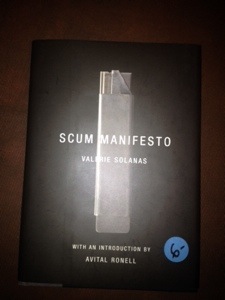
SCUM Manifesto


I picked this up for just six dollars at Red Emma’s in Baltimore. If you haven’t been and you live in the DMV… well, why the heck haven’t you been? Seriously? If you’re a fan of poetry, zines, punk rock, gender studies, African-American studies, anarchism, or just cool places, you should be checking this place out.

20140311-113328.jpgBut on to SCUM Manifesto.

I should add that I would not have known about this book were it not for the awesome movie, I Shot Andy Warhol, starring the awesome indie queen, Lily Taylor, who played Valerie Solanas, the author of SCUM (and also the woman who shot Andy Warhol).

First of all, it’s a manifesto, not a proposal, not an analysis. It’s not Das Kapital, it’s the Communist Manifesto. One is a detailed analysis of a socio-economic system and the other a cri de couer. A manifesto does not necessarily prove, debate, or analyze; it’s function is to assert, to demand, and to polemicize.

I say this because it’s easy to criticize without realizing that you’ve missed the point. Her statement that the man, with his Y chromosome is incomplete X chromosome because it’s literally missing one of the lines that make up the letter X is not meant to be taken literally (did you see that? two ‘litterally’s in one sentence, but ending with the assertion, don’t take it literally; pretty cool, huh?).

SCUM is also surprisingly utopian. Or maybe not surprisingly. I was born in 1974, so I missed the sixties, but I wonder whether that utopian strain is not just something endemic to the decade in which it was written?

One thing that tripped me up is her dismissal of sex and sexuality. Solanas, by all accounts, was not interested in sex (though she was nominally lesbian). Her assertion that it would be easy for slightly over half the human race to give up sex kept tripping me up, mentally, and taking me out of the moment.

Finally, the introduction by Avital Ronell. She talks too much. Now, don’t get me wrong. She’s a very important philosopher, but the introduction is nearly half the length of entire book. Maybe the publisher wanted filler, I don’t know, but it felt like she was taking up psychic space that would have been better left to star of this show.

Protest Poetry And Dissident Poetry


For some reason, I decided to re-read bits of a speech that the late great Adrienne Rich had given upon the occasion of being given an award (her remarks were published by Norton as a sort of chapbook under the title  Poetry and Commitment).

She references the American poet James Scully, who (according to Rich)  calls ‘protest poetry’ conceptually shallow, reactive, predictable, and typically featuring hand wringing from the sidelines. She then includes brief quote from Scully:

Dissident poetry, however, does not respect boundaries between private and public, self and other. In breaking boundaries it breaks silences, speaking for, or at best, with the silenced; opening poetry up, putting it into the middle of life… It is a poetry that talks back, that would act as part of the world, not simply as a mirror of it.

This struck me because it came after some conversations with my father about political poetry, or, rather, its relative absence, at least in American poetry. And, of course, the recent passing of Amiri Baraka, the poet formerly known as LeRoi Jones.

Maybe Baraka exemplified best what Rich talks about, being committed.

She defends Shelley’s much maligned line about poets being unacknowledged legislators because Shelley did not know how nor conceived that he could separate his deeply held, liberal political views with his poetry nor that any other poet could. They were all from the same wellspring.

This just all sort of falls when I’m reading a lot of politically minded poetry. I picked some bell hooks the other night and am also reading Diane Di Prima’s Revolutionary Letters and even (though it’s not poetry) Solanas’ SCUM Manifesto (with an obnoxiously long foreword, I might add).

In honor of all this, here’s my terrible, awful attempt at what Scully would rightfully sneer at as protest poetry. He would probably also note that rhyming is not really my strong suit. Well, at least it’s political. I guess. I’ll almost certainly live to wish that I’d burned it, instead.


Rick Scott: An Ode

At last, I come arrayed
In the fanfare of the common cracker man
Humble, tacky but no frayed –
Dispatching notes of great jay
And for your acknowledgement and unhesitating belief, I have prayed.
 
The winnings you have won,
The challenges you have overcome –
Nothing to the great evil I have undone!
 
Tidings of unvarnished truth I bring!
My great employment, great employments wrought.
Corporate friends with good goods come to kiss the sun kissed ring,
Promises kept to a tee – seven hundred thousand on the nose!
My regal and trustworthy success a contrast to the old, faded king.
 
My jealous enemies name me Skeletor™
And cry that my greatest victories I falsely forge
But their spiteful, jealous facts I will ignore!
 
Your tax dollars I have given
To my honest, grafting friends
And for you, eight dollar an hour jobs, promised then forgiven.
No vow was ever truer kept:
Every poor man’s dollar, every corporation’s promise, only slightly riven.
 
And to those shallow, faithless, disbelieving fools who say
I promised you more jobs than just those created by Obama’s daring play,
Do not throw those lying tapes, videos and quotes in my face – nay, I say, nay!

Midweek Staff Meeting – My Blood Is Superior


Lotl_-_The_Sleestak_God_002

Just give it up already. You’ll be healthier.

I could write on a train. In fact, I’m pretty sure I already have. So. You know. Call me.

Is poetry not literature, but something else? Was it, but is no longer?

The honest answer is: maybe?

I don’t know. All of them?

What we can learn from Schiller about the beautiful. It’s not mentioned, but Elaine Scarry wrote a great book on beauty, called On Beauty and Being Just and I recommend that. I honestly haven’t read the Schiller book in question. I don’t actually think I’ve read any Schiller, unless you count the chorus to Beethoven’s Ninth. My local public radio station has taken to playing just the second movement of the Ninth. That’s like half a handjob. I mean, yeah, it feels good, but without the finale, I’d really rather you didn’t even start it.