The accelerating death spiral of university presses.
What is it like to be the merely talented child of a towering genius?
The Pope and the Catholic Church are not cool with economic inequality and really aren’t comfortable with depending on an unregulated, wild west economy to fix it.
This is in no way aimed at Paul Ryan.
204. We can no longer trust in the unseen forces and the invisible hand of the market. Growth in justice requires more than economic growth, while presupposing such growth: it requires decisions, programmes, mechanisms and processes specifically geared to a better distribution of income, the creation of sources of employment and an integral promotion of the poor which goes beyond a simple welfare mentality. I am far from proposing an irresponsible populism, but the economy can no longer turn to remedies that are a new poison, such as attempting to increase profits by reducing the work force and thereby adding to the ranks of the excluded.
From Evangelii Gaudium
 Believe it or not, just last month was the first time that I had read Wright’s autobiography, Black Boy. It was one of the books that I read in Thailand. It has been sitting in my e-reader (a statement with some metaphysical implications; what/where is a book when it is in, no the general ether, but the ether of a particular device?)
It’s not the sort of thing that’s put on the high school curriculum, at least not in a state, like Florida, where the powers that be have very little interest in the history (nor the future) of African-Americans.
Good lord is it a wonderful, beautiful, brutal read. The first section, covering his life in the South in the early twentieth century. Yikes. Anyway who complains about cultures of violence or the use of the n-word within the black community needs to read this book (incidentally, Ta-Nehisi Coates has been writing some great stuff on this very topic lately; look it up). He writes about poor black kids and the bravado driven by this constant, crushing fear of white people. An uncle killed by whites for the crime of having been financially success and his aunt and mother afraid the leave the house or even ask for the body (much less assume ownership of the business or property). White employers trying to goad the author into literally killing another black adolescent. It’s just terrible to read and more terrible for knowing that it all happened – and that far worse happened, only without a future Pulitzer Prizer winner to chronicle them.
The second part covers his joining and departing the Communist Party. He leaves without disavowing the believe in class struggle and, really, without relinquishing his own, personal communism (small ‘c’), only relinquishing membership in a top down organization.
It reminded me of when I read the piece that Arthur Koestler (now there’s a fellow that no one reads anymore! and I stand by my prediction that, soon enough, Christopher Hitchens, for all his wonderful prose-fying, will find his work placed in the same basket) contributed to the collection The God That Failed. No one is praising Stalinism or suggesting that it was anything but a blight, but, despite the disavowals, not even a staunch anti-communist like Koestler can avoid capturing some of the romance of being a leftist and radical and a communist in the twenties and thirties. The idealism of it all. Wright doesn’t try to walk back the great thrills of that time in his life, like Koestler does, and the work is better for it. It reminds me of a review of a recent Family Guy episode where Peter takes up smoking. Yes, smoking is bad for you. Awful. The world would be a better place if no one smoked anymore. But it’s cool. It just is. Humphrey Bogart looked cooler smoking. Audry Hepburn looked sexier lighting her cigarette. And let’s not even talk about the way Catherine Deneuve could send shiver up the spines of any human (male or female, gay or straight) with the slightest fraction of sex drive just by blowing a puff of smoke from a gauloise. I feel that being a communist in the early thirties was like that.
I picked this up for just six dollars at Red Emma’s in Baltimore. If you haven’t been and you live in the DMV… well, why the heck haven’t you been? Seriously? If you’re a fan of poetry, zines, punk rock, gender studies, African-American studies, anarchism, or just cool places, you should be checking this place out.
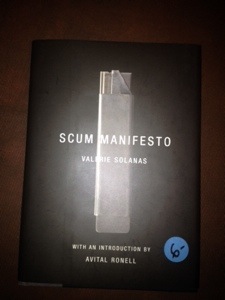 But on to SCUM Manifesto.
I should add that I would not have known about this book were it not for the awesome movie, I Shot Andy Warhol, starring the awesome indie queen, Lily Taylor, who played Valerie Solanas, the author of SCUM (and also the woman who shot Andy Warhol).
First of all, it’s a manifesto, not a proposal, not an analysis. It’s not Das Kapital, it’s the Communist Manifesto. One is a detailed analysis of a socio-economic system and the other a cri de couer. A manifesto does not necessarily prove, debate, or analyze; it’s function is to assert, to demand, and to polemicize.
I say this because it’s easy to criticize without realizing that you’ve missed the point. Her statement that the man, with his Y chromosome is incomplete X chromosome because it’s literally missing one of the lines that make up the letter X is not meant to be taken literally (did you see that? two ‘litterally’s in one sentence, but ending with the assertion, don’t take it literally; pretty cool, huh?).
SCUM is also surprisingly utopian. Or maybe not surprisingly. I was born in 1974, so I missed the sixties, but I wonder whether that utopian strain is not just something endemic to the decade in which it was written?
One thing that tripped me up is her dismissal of sex and sexuality. Solanas, by all accounts, was not interested in sex (though she was nominally lesbian). Her assertion that it would be easy for slightly over half the human race to give up sex kept tripping me up, mentally, and taking me out of the moment.
Finally, the introduction by Avital Ronell. She talks too much. Now, don’t get me wrong. She’s a very important philosopher, but the introduction is nearly half the length of entire book. Maybe the publisher wanted filler, I don’t know, but it felt like she was taking up psychic space that would have been better left to star of this show.



 the coffee philosopher