
‘Beating Again’
At least that’s what they called it on Netflix. Because I got mildly obsessed and did some googling, I gather that the Korean title would translate to Falling for Innocence (the lead character’s name, Soon-Jung, translates to ‘Innocence;’ or it doesn’t, because we can’t fully rule out the possibility that there is an elaborate con out there, run by the internet equivalent of a Korean Cartesian demon, to make me think that is a better translation of the title, when actually the ‘real’ title [if this is, in the Korean Cartesian demon world, even a real show] is actually something about bananas and giraffes and a three legged tree-climbing, Moroccan goat).
I have a bit of a pattern of getting into silly soaps, especially when my better half is away, as she has been for the last four months.
As much as I loved the show, staying up late and showing up sleepy to work in order to binge watch, it’s also highly problematic in its treatment of women. Without going into great detail, an evil corporate raider falls in love with a secretary and switches sides to save the company. There was a slight stigma against relations between secretaries and management, but only slight. That wasn’t the bothersome part; what ate at me was the constant assumption that a man must always be in the superior role in the workplace. Whenever there was an opening for a senior position at one of the corporate interests, a woman was never considered. Sure, she could wield some power through her institutional knowledge, but never was it even conceived during the show that a woman could be in charge. The male lead was upset because his father had founded the company, but his uncle and others had summarily kicked his father out. But Soon-Jung’s father had been a vice-president of the company and while the guy grows up to be a big time exec with a financial firm, she grows up to be a secretary in the same company where her father was been VP. Where’s the nepotism? At the very end, there was beautiful moment when the writers could have down a twist and made her CEO (while still keeping the happy ending that I desperately wanted, and which I still got, but with a side of male privilege), but… I was about the write ‘they balked,’ but they didn’t, did they? They didn’t balk, because it didn’t even cross their mind.
But here’s the theme song anyway:
The Social Contract
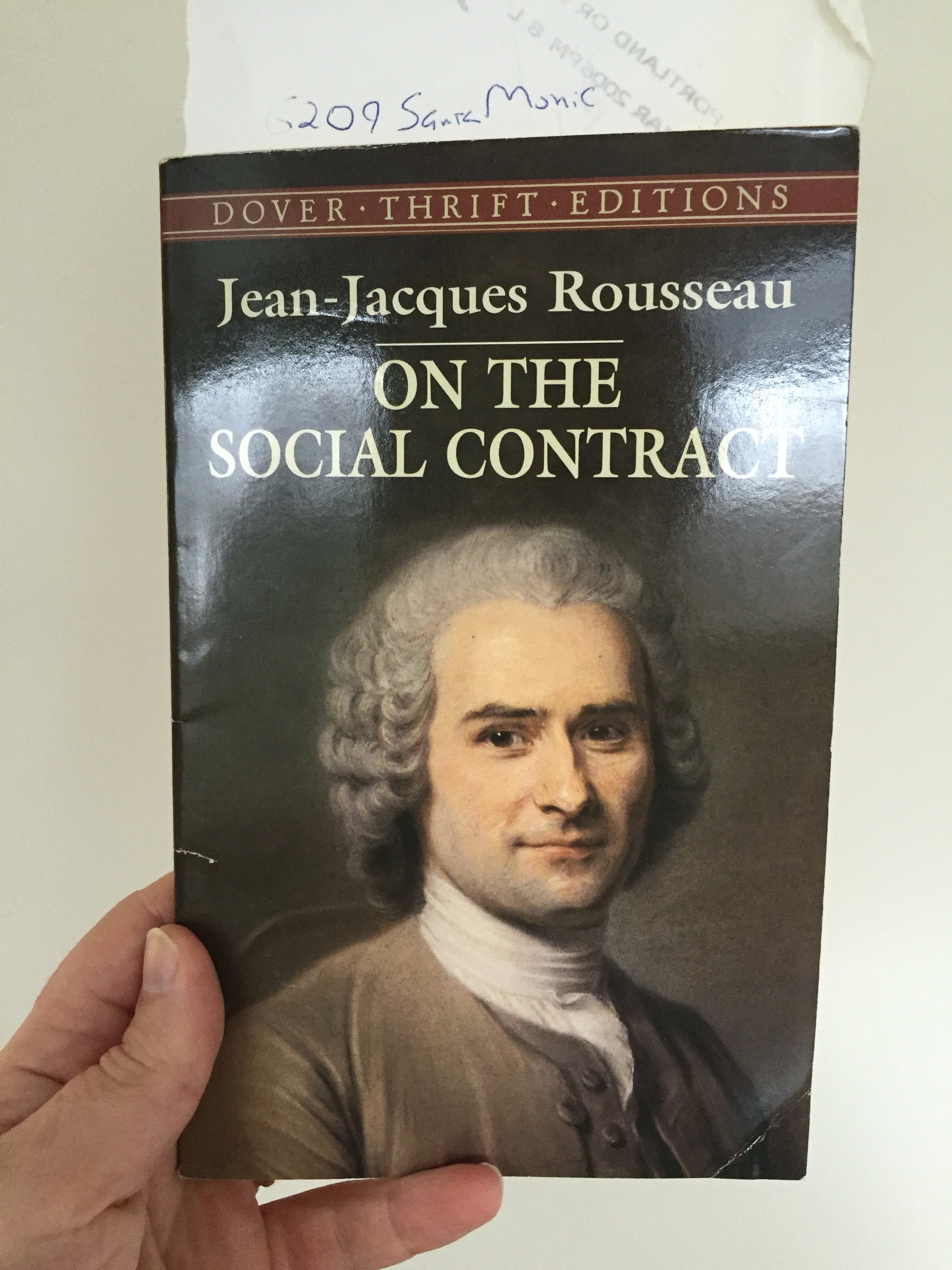 I’m not going to explain Rousseau’s Social Contract. Frankly, if you’re reading this, you can look up what better folks than I have to say about the Swiss philosopher meant or should have meant or maybe meant. Also, you probably have access to a public library. And if that public library is poorly stocked in terms of Enlightenment philosophy and commentary, there are university libraries. Maybe you can’t check out a book, but there is pretty much no barrier to simply going inside and spending a few hours reading up on the subject.
What struck me was how some of his remarks are quite prophetic in their implicit criticism of some of the structural problems affecting the American (and global) economy.
Very early on, he criticizes what today we might call rentier capitalism. In The Social Contract, he is speaking purely about land (possession of agricultural still being the avenue towards wealth and the source of the aristocracy’s wealth), but the idea is easily transferable to modern financial instruments.
Possession of land, he says, must, in part, be justified by ‘labor and cultivation.’ Modern financial instruments do little to actually invest in production or innovation or much of anything (if I buy AT&T stock, AT&T does not suddenly have extra capital to expand broadband access; rather, I have simply given money to the someone who used to own the stock). In other words, they do not participate in ‘labor and cultivation.’
Later, he also explicitly attacks finance directly, as a destructive force that drives government away from the business of public service and which replaces ‘community’ (though he references the city-state, which shouldn’t be taken too literally, but rather as a reference to Greek philosophy and an idealized, Athenian-style polis) with money.
On economic inequality:
It is precisely because the force of circumstances tends continually to destroy equality that the force of legislation should always tend to its maintenance.
His distinction between ‘will’ and ‘force’ are in the context of the difference between the legislative and executive branches, which is less interesting and, in one sense, posits ‘will’ as the act of legislation and ‘force’ as the act of execution of said legislation (later, he also says that separation of the legislative and executive is necessary in a democracy). But he is pretty explicit that will is a moral cause (using ’cause’ in a loose, but not too loose, philosophical sense).
He gets what Machiavelli was trying to do in The Prince. Ostensibly writing for a prince, but actually writing for a future, restored republic.
Rather interestingly, he notes that, sometimes, slavery was a necessity for a form of democracy. He notes that widespread use of slaves in ancient Sparta might have been what allowed Spartan citizens to be free to participate in the government and direction of their city.
It’s interesting because, more and more, it is clear that American democracy was built on the economic back of slavery – that only the economic benefits (benefits for the white, male elite who created American democracy) of slavery allowed for the existence of America, both intellectually and practically.
The old copy of the book that I read had a slip of paper in it (actually, a piece torn from an envelope), with an address in my writing to the Open Fist Theatre Company in Los Angeles. It’s not far from my old apartment in Hollywood, though I don’t remember going there.
A Philosophical Inquiry Into The Origin Of Our Ideas Of The Sublime and Beautiful
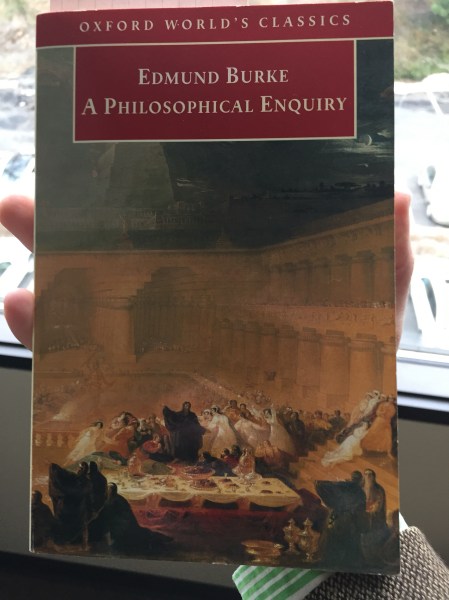
 I was just doing my lonely wandering thing and slipped into that old favorite, Capitol Hill Books, and sort of casually looked for something to spend my store credit on. There were one or two books of poetry (I can’t even remember which ones) and a couple of sci fi/fantasy novels that caught my eye, but not enough to pick up, but rather than keep in the back of my head while I looked for something better.
Somehow, while drifting over the philosophy shelves, my eye was caught by a faded Oxford edition whose spine had the inadequate title A Philosophical Inquiry. I picked it up because I figured this had to be an eighteenth or early nineteenth century something or other. Well, you can obviously tell what it turned out to be.
I have a little selection of random Burkean stuff (letters, speeches, essays, and excerpts), but have long been curious about this early and atypical seeming work. I know that he published it as a sort of offering to provide him entry into London’s literary and intellectual society.
I’m simultaneously making my very slow way through the work that Adam Smith considered his magnum opus and lasting claim to fame. Hint: it’s not Wealth of Nations.
Ok, it’s his Theory of Moral Sentiments.
While, having not finished it, I should probably not make too many claims for my understanding of it, but the idea seems to be a combination of a sort of innate (biological? evolutionary?) a priori moral sense that is defined in relation to others, in a natural tendency to seek the moral approbation of others and follow a sort of moral peer pressure.
While not the most interesting bit of Burke’s book, his idea of ‘taste’ strikes me as downright Smithian (Smithite?). In some senses, beauty and appreciation of the aesthetic good is innate, but it is also guided by educated taste makers who help develop a sort of cultural peer pressure, similar to the broader peer pressure Smith seems to stipulate and motivating moral behavior (or moral sentiments, as he would put it in his classic, eighteenth century fashion).
His answer as to the origins of the sublime are surprisingly psychological. The sublime comes from negative emotions. Even though we usually experience the sublime in something beautiful, the source of its sublimity is not its beauty, per se, but it’s connections to pain and fear.
One example is charging bull. A bull quietly chewing cud is not sublime. A bull hitched to a plow and helping till a field is useful, but not sublime. An angry bull charging at you can be sublime, however, because you can be struck by its size (reminding you of your own smallness in the universe) and ferocity and the fear inspired can be sublime.
Part of this is because pain is greater than pleasure, illustrated, he argues by the fact that we will do more to avoid pain than we will the achieve pleasure, which is also why he believe that the sublime must have its origins in pain.
For some reason, this little bit struck me. An example of how the painful end of the spectrum lends itself to the sublime. Also, what an absolutely amazing depiction of Stonehenge. Alone, that passage is worth the price of admission (‘Nay, the rudeness of the work increases this cause of grandeur, as it excludes the idea of art, and contrivance;’).

The word ‘aweful’ appears, a reminder of the actual root of ‘awful,’ which has been reduced from causing a terrible awe to a rather minor nastiness.
At times, Burke seems to take a sort of sadistic glee in the ‘painful’ origins of the sublime, which also helps, stylistically speaking, to compensate for his tendency to engage in something very close to an eighteenth century equivalent to listicles (there are a lot of very short sections, like the one pictured, that can get very repetitive and which do not all seem to add very much to the topic).
At one point, he rather succinctly sums up one of his important premises: For sublime objects are vast in their dimensions, beautiful ones comparatively small…
The association with ‘vastness,’ is really, I would say, an association with (terror or awe inducing) infinite (he uses the term ‘artificial infinite’ to capture this idea), whereas he views beauty as small and precious (in both senses of the word). Because the more powerful sublime has its… not origins, but, to use a term Burke himself uses to describe it, its foundations in pain and fear. Beauty, meanwhile, has its less powerful foundations in pleasure and positive emotions.
He ends with about a dozen pages on words, including poetry. By words, he means a bit of linguistic theory and classical rhetoric. It’s all interesting enough, but he never really explains what it has to do with the sublime nor with the beautiful.
If I can find it, I need to find that old selection of Burke’s writings and try and look for parallels. While I’m sure that this is an outlier in terms of his output – he was a politician and orator, not a philosopher – surely there must be hints of some of his ideas and prejudices underlying his other writings and positions.
Staged Reading Of A New Play At The Capitol Hill Arts Workshop
I’d had a ticket for this, but then the blizzard came and it was rescheduled. It wasn’t a full on production but a staged reading of a new play titled First Citizen, presenting the little performed Shakespeare play, Coriolanus, from (mostly) the point of view of four ‘citizens’ who more or less represented different classes and different political viewpoints. Rather like Stoppard’s Rosencrantz and Guildenstern Are Dead, the play interspersed actual dialogue from Shakespeare with the new dialogue of First Citizen. Afterwards, was a talk back session; I had been expecting it to be more question and answer, but it was more like an open critique.
Some of the critiques I disagreed with, especially since most centered around historicity. Whether characters accurately reflected socio-economic realities of that time (late Republic) of Roman history. Whether we needed more background on Roman politics (what are the roles of the Consul and Tribunes?).
My personal response was different. As to historicity, first of all, it’s in dialogue with Shakepeare who, despite writing plays known as ‘history plays,’ should not be considered a historical source, so let’s not ask it to be historically accurate (but let’s do ask it to be presently relevant). Secondly, knowing some of the basics of the political system of one of the founding civilizations of what we know as western civilization is not, actually, too much to ask. I don’t want to get into (relevant) questions of euro-centrism in education, but knowing the barest minimum about the Roman Republic is pretty basic stuff (and does not preclude nor exclude also having a basic knowledge about Imperial China’s bureaucratic system).
On the positive side, the play handled political questions well. It was a political play about the best path for change that benefits the mass of people and it did an excellent job of not reaching conclusions, by which I mean, every point of view was challenged, so that the audience was denied a pat, self-satisfied answer and was instead given more questions.
On the negative, and it’s a small point, I thought that the non-‘direct from Coriolanus‘ dialogue was too much in the middle. It bounced a bit between colloquial and vaguely Shakespearean. Don’t try to compete, I say. I would have liked the original dialogue to be more colloquial and more modern in tone.
But really good and if it is put on around here, I would go see it.
Platonism In Boethius
Actually, it’s more Plato, than Platonism, which is arguably something different than the the ideas of Plato. Arguably.
I have a strange attachment to Boethius’ Consolations of Philosophy. Over a decade ago, my Aunt Petey was in a coma and she was taken off, to use the sterile, clinical phrasing, nutrition and hydration and then brought to her eldest son’s home, where the family gathered and waited.
At one point, I stood beside her bed and started reading aloud from Consolations. Maybe because I was reading it anyway or maybe because it was written by a man waiting to die. Maybe I just thought my family would think me extra super smart if I did it. Maybe I was just killing time, even as my aunt was killing time in a far more literal sense. I honestly don’t remember why.
But whatever my motivations, certainly, something like that burns a particular work onto the brain.
When I read Gorgias, I was unexpectedly hit by some parallels. There are some obvious between the Beothius of Consolations (the only Boethius that I know) and the Plato I know from his broader corpus (though I haven’t read all of Plato): their lack of respect for poetry (which, granted, was more like theater or even pagan ritual at the time) and the fact that the Socrates of Plato’s dialogues, including Gorgias, is always in a state of waiting to be taken away to die, much as my Boethius is in a cell, waiting for eventual punishment (which turned out to be execution, as he suspected).
Gorgias had an unexpected metaphysical aspect, as Socrates argued for the scales of justice righting themselves in the world hereafter as a way for the correct path – the best life, as it were – to be finally rewarded, even if lots of bad things happened to good people in this one, along with some pretty awful people seemingly to live pretty fun loving and enjoyable existences. In the Consolations, the figure of Philosophy (a woman, by the way) seems to take Socrates’ role and lead Boethius to the realization that his unjust accusers are, for this metaphysical reason, ultimately less happy than a just and good man, even if he is about to be tortured and killed.
Midweek Staff Meeting – I Saw That!
 So, I finally got around to seeing this amazing Sotatsu exhibit at the Sackler. It’s around until Sunday, so go see it!
‘Art Theory: A Very Short Introduction’
 My father gifted me this book just before I left for Thailand – a fortuitous thing, because lightweight (physically speaking), thin and interesting are very important for something that has to be carried around for an extended period of time and compete with clothes, meds, and tchotchkes for space.
The author came it the subject from the perspective of a philosopher and quickly moved into a fairly spirited defense of conceptual and avant-garde art, which, as an appreciator of conceptual and avant-garde art, I appreciated.
The place where she lost was in talking about film, which is odd, because she has, apparently, written a book on film studies. She totally missed that Starship Troopers is a biting and vicious satire. She also got The Matrix wrong, but I tend to think that movie is overrated – less an intellectual achievement than fine popcorn actioner that figured out how to use Keanu Reeves limited, but still excellent talents (when properly harnessed).
‘Sidney Chambers and the Shadow of Death’ By James Runcie
 I saw part of an episode of the PBS Mystery (presumably, originally a BBC thing) of this, which is why I decided to download it onto my Nook for my trip to Thailand. My mother loves British mysteries, but I never got beyond Sherlock Holmes and a couple of Agatha Christie stories.
Well, this is not a novel. Really, it’s a chronologically arranged short story collection. I’m guessing each episode of Grantchester Mysteries is a story from this or another Sidney Chambers story (who is an Anglican priest for the Grantchester parish).
The stories are okay. The landscape and time period (early fifties) done in broad strokes, rather than vivid ones. I’m still not sure what, if anything, makes this dude a good detective.
Also, a couple of things ate at me. In one story, I felt a little horrified by the ending. Did we establish that a doctor was probably giving patients extra large doses of morphine to euthanize them unwillingly and did we then decide that we’d probably (by means of surprisingly secular sermon) convinced him not to do that again and then walk away from it?
And did a priest give disturbingly blase answer to how he was able to deal with having shot people in WWII (before he was a priest)? While we can all agree that Nazi Germany absolutely had to be stopped, I expect my men of God to feel, at the very least, a little squeamish about any taking of human life, no matter how morally justified. Maybe that’s just me.
I probably won’t read any more. I suspect it’s a decent or perhaps even better than average genre book. But it’s not in my preferred genres, so I’m unwilling to cut it the slack I might to a science fiction novel.
‘Gorgias’ By Plato
 I was inspired to read Gorgias because Quintilian mentioned it frequently. I was frankly disappointed. Maybe it’s been a while since I read Plato. Maybe I just need to read more Plato to reacquaint myself with a greater portion of his ouevre and philosophical mission.
Quintilian often wrote about the true orator being also a moral person; the two things were inseparable, he claimed. This was in direct response to Plato’s critique (through Socrates) of oratory. He portrayed oratory as a loose cannon; a dangerous skill, untethered from morality and justice. Like giving someone gun, but not talking about gun safety, ethics, caution, nor even attaching a brief note saying, ‘please don’t point this at unarmed black children.’
One way or another, he is critiquing the means of advancing ideas in a democratic milieu, whether through money/power, oratory, or whatnot. Which, we can debate, but Plato’s viewpoint is fundamentally undemocratic and the characters he set Socrates up against, including Gorgias, are such sad straw men.
The introduction of the importance of the afterlife in determining morality was interesting, but the previous argument reminded me a lot of Boethius’ argument for morality in The Consolations of Philosophy.
 the coffee philosopher