Francis Fukuyama & ‘Children Of Men’


As part of series called Future Tense, I dragged my better half to see the movie Children of Men, followed by a brief lecture/Q&A featuring Francis Fukuyama (who actually introduced himself as ‘Frank’ Fukuyama; nothing intrinsically weird about that, but it did strike me, because I only know him as a sort of public intellectual and semi-repentant neo-conservative.

I loved the movie when it first came out, though I spent almost the entire movie on the verge of tears. This time, I was able to appreciate Clive Owen’s wry humor (and also accept that he would not have been a good James Bond; while Daniel Craig added a wonderful element of questioning Bond’s existence, a Clive Owen Bond would have been entirely too despairing).

Let me first admit that I have never read anymore longer than a magazine essay by Fukuyama. Yes, I am the guy in DC who does not own The End of History, in case you were wondering who that person was. Mostly because I know him as a neo-conservative/neo-liberal (hint: they’re the same thing), even though I also know he has backed off those tendencies over the last decade.

But that doesn’t mean I wasn’t interested in hearing what he had to say.

He was surprisingly religious and, as a moderator in a Q&A, he took care of the perennial issue of ‘let me ask a question that is actually a long statement intended to show how smart I am but which really shows that I once read an article from a two year old copy of The Economist while waiting to get a crown replaced.’ What he did was to give a brief lecture and then ask a question, so at least the people were supposed to speak and ramble.

While he asked several questions, they were ultimately about what the world might look like if there were no future. While I resisted the temptation to raise my hand and ask to be heard, I will admit that I had a rough idea of a comment in mind. I thought of de Sade’s Philosophy of the Bedroom. Specifically, I thought of that weird interlude when one of the characters suggests they pause their orgy and read an essay. You can google this. My point is that he talks about the death of God, which is the death of the king during the French Revolution. By executing the king, revolutionaries have killed the idea of order and limits coming from a higher power and they should accept that they have made it so that nothing is forbidden anymore. My insight from that is that the death of God can be something besides just a loss of faith (or an enormous, otherwise omnipotent being feeling dead from the sky), but also be something like, say, the loss of fertility. And then, in the words of Uncle Billy Burroughs, everything is permitted, nothing is forbidden.

Fukuyama also told me something I didn’t know: the title comes from the King James Bible’s translation of Psalm 90

Thou turnest man to destruction; and sayest, Return, ye children of men

It’s a prayer by Moses, by the way. And Fukuyama put in a nice plug for the King James version, telling folks how much they’re missing when they read those silly ‘modern’ language versions.
‘Rhetoric’ By Aristotle


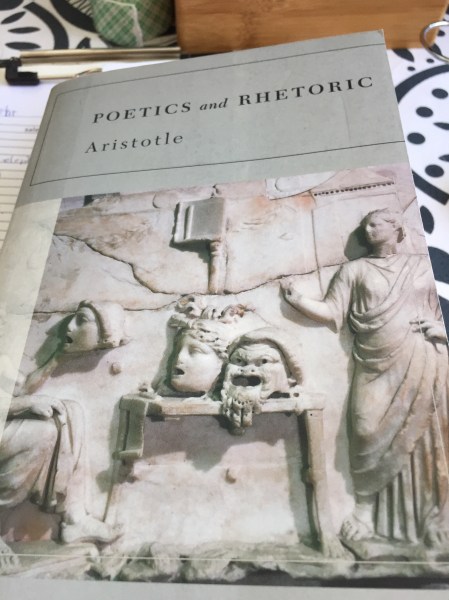
I probably owned this book for at least a decade before I started reading it recently. Just a quick glance would have indicated it’s not nearly so long as it appears. First, because it also have the Poetics, which I’ve already read (not that it would hurt me to read it again, but we are focusing on reading Rhetoric for the first time) and second, because the left hand side of the page is just for notes on the text, which, even if you read them, means lots and lots of empty real estate on half of the pages.

I’ve been on a minor ancient (western) philosophy kick, having also read some Sextus Empiricus recently.

My motivation for picking this book was two fold: availability (I owned it) and a (misguided) belief that this would actually contain a great deal of logic. I don’t know where I got the idea, but I had been under the impression that a good chunk of Aristotle’s inductive logic writings could be found here. Smart readers of this blog will have figured out by now that I was wrong (less intelligent readers may still be waiting for the answer to be revealed).

Can’t really say that I got many deep insights in the actual art of rhetoric. In that respect, Quintilian is a much better guide. There was a little logic, in the form of Aristotle’s frequent references to enthymeme’s, a type of syllogism. But, of course, syllogisms themselves are discussed in the Topics, not Rhetoric.

So do I get some more Aristotle? Something beyond his Politics or De Anima and try to find one of his actual books on logic?

Maybe, but it seems like a lot of work and possibly relatively expensive and I’d have to hide the purchase from my better half.

No, I’ve got a nice looking copy of Cicero’s De Oficia on the shelf that I saw the other day, and that seems like a much more likely choice.

‘Sextus Empiricus And Greek Scepticism’ By Mary Mills Patrick


This book should really say ‘by Mary Mills Patrick and Sextus Empiricus’ because the final forty odd pages is actually a translation of a sort of primer on Sextus’ brand of Scepticism (Pyrrhonism, if you’re curious). As far as I can tell, this book (which I downloaded from Project Gutenberg) is an 1894 doctoral thesis.

Dr. Patrick certainly does fill up the original writing (not the translation) with a lot of filler, some of which feels contradicted by the subsequent translation of Sextus’ actual words. It’s not uninteresting; the section where she tries to determine where Sextus likely taught and lectured was pretty cool, actually. But then she goes into an odd attack on the Sceptics and Pyrrhonists for ultimately being a sterile school of philosophy. She writes that they set the stage for future scientific advances, with their focus on method and examination of phenomena, but kind of wuss out on actually taking it to the next level.

Especially after reading the actual writing of Sextus, I call garbage on that.

It reminds of when my former stepmother asked me about a college course I was taking – symbolic logic, so be precise. Though raised Catholic and, at that time, attending the Episcopal church, her personal brand of faith was very much in the Southern, white, evangelical tradition. So naturally she asked me what I was learning had to say about abortion. I really didn’t know how to answer that except, ‘well, um… nothing, really.’

‘Well, shouldn’t it?’ she asked.

And, of course, the answer was, no, not really.

And the same here. I’m sorry that a philosopher of late antiquity didn’t properly follow through and start the Copernican Revolution for you over a thousand years ahead of schedule, but maybe we could just be satisfied with what he actually wrote and did, which was pretty cool.

To briefly talk about the bits that make up the majority of the translation, it’s about various ‘tropes’ that explain why we should suspend judgement in terms of claiming knowledge. These are things like noting that various animals clearly perceive things differently, so why should we assume our perceptions are more accurate? Similarly, different people perceive differently. There’s more, but I’m not going to list them all because the book is free, for heaven’s sake, so you can read it yourself. But suffice to say, it made a lot of sense to me an I got a kick out of it. I do wish that she hadn’t chosen to leave so many Greek words and phrases untranslated. Sometimes, through context, I knew a word to be ataraxia (a state of being untroubled) and once I was certain it was an anecdote that I was familiar with (about it supposedly, according to ancient Greeks, being acceptable in India to have sex in public; a weird example of a two thousand year old urban myth), but often I just wound up shrugging my shoulders.

The Beer Goggles Of Late Antiquity


There are also differences depending on drunkeness and sobriety, as that which we consider ugly when we are sober does not appear ugly to us when we are drunk. – Sextus Empiricus

‘The Left In Dark Times’ By Bernard-Henri Lévy


9780812974720I bought The Left in Dark Times because I wanted to read something by Bernard-Henri Lévy and I thought that this book, rather than his reportage/current events style books, would be a good introduction to his actual thinking. While sometimes called a philosopher, I’m not really sure it applies, but I wanted something vaguely rigorous by him (which, as it turns, this isn’t, exactly).

You may know Bernard-Henri Lévy (sometimes known as BHL; he’s that famous in France) as that rick looking French guy on TV with the leonine mane of grey/white hair, dark suit, a white shirt that is always unbuttoned two buttons below what is appropriate to the situation, yet always staying above the critical belly button line.

The Left in Dark Times feels terribly dated. It is something from a time that feels very long ago; before the ‘Great Recession,’ before the more recent global economic contractions (Greece, China, etc). Before we were expelled from an economic eden where risky trade and capital entrepreneurship would lift all boats, if we just let it. In this book, economics aren’t a ‘thing’ at all.

The left is in dark times because, he writes, economic democratic-socialism has been, somehow, disproven, by the good times of the early and mid noughties. For him, the true Left (capital L) is in international humanitarian interventionism. Which is not, in itself, bad, but now, things feel so tied to the economy as causing so many humanitarian problems through indirect means. He scoffs at the idea of a malignant economic imperialism and colonialism, but these days, their ill effects feel all too true.

Let’s just say it: his Left feels more like neo-liberalism. The vapours hanging over his exhortations are pre-lapsarian, before Tony Blair and New Labor fell from grace. We can no long say, can we, that humanitarian crises are unrelated to the failures of unregulated, neo-liberal, rentier capitalism.

He writes a lot about the anti-semitism and the ‘Palestinian question.’ I agree with him on a two state solution, but I don’t agree with his positioning on things like BDS and attitudes towards Israel, but as a Jew (BHL, not me), I give him some leeway here, especially since I am not so blind as to understand that anti-semitism is a much more pervasive problem in France and in Europe, in general, than it is in America (or is worse in America than I know? with Trump’s appropriation of anti-semitic imagery, is it an underappreciated issue here, too?).

He ends (not really; there’s a meandering and surprisingly long epilogue) with a passionate defense of the Universal, by which he means universal human values. He does defend Europe, but is careful not to mean merely an extension of an idea of western values to the world. His Universals are, though, the justification for interventionism. Reading just made me sad, coming on the heels of the Brexit and dissolution of trust between northern and southern Europe (really, between southern Europe and Germany). He becomes oddly religious. Or almost religious. He defends (sort of, and then backs away) Jewish concepts of prophecy and the prophetic tradition as linked to the Universal. I like one phrase, near the end: “The Universal works more by influence than incorporation.” I can get behind such a Universal. It feels kindred to King’s moral arc.

Ultimately, he is a Hitchens like figure. Tied to a time and a place and an ideology that makes him more than normally timely and less than normally timeless. And, while it might be the translation, he lacks Hitchens’ genius for scintillating polemics that make him, still, a worthwhile read for students of essayistic style.

American Marxist


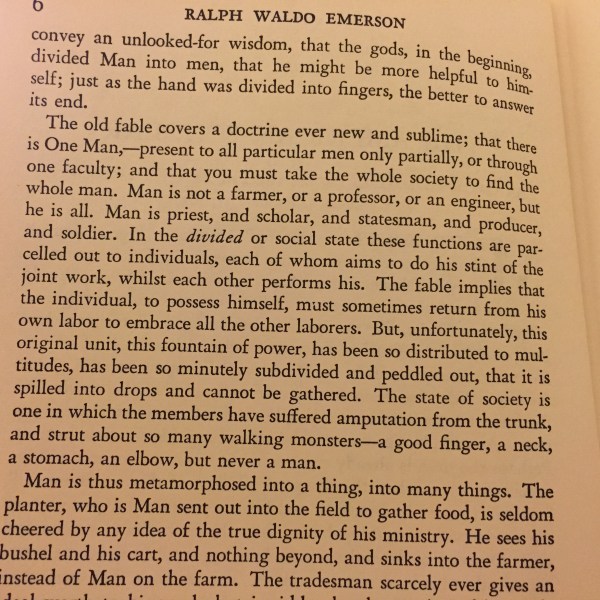
The paragraph is from Ralph Waldo Emerson’s essay, The American Scholar. While reading it before bed the other night, I wondered whether or not it was just or whether he really seemed to be describing the Marxian concept of people’s alienation from the fruit of their labors? Of course, his solution is more spiritual, combined with what might now be described as college town, farmer’s market, DIY liberalism (and Marx never really wrote out the solutions, did he? No, not really).

Contemplation, No Contemplation


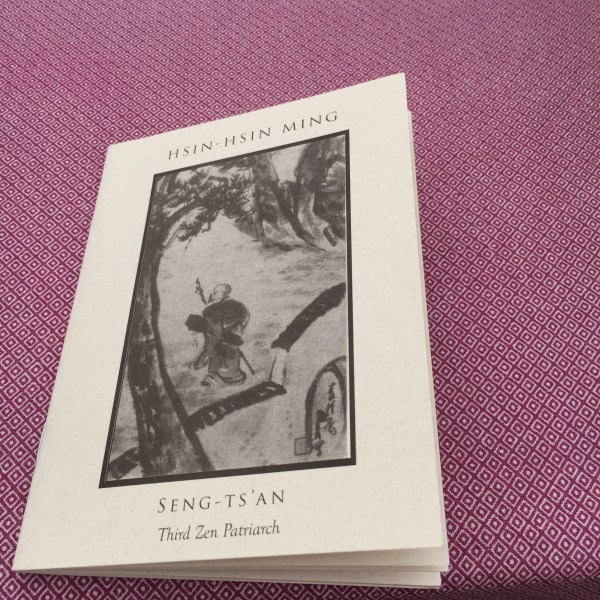
While working for my better half at Eastern Market, I read Tseng Ts’an’s The Hsin-Hsin Ming, a poem illustrating some principles of Zen Buddhism. At the same time, I’ve been doing some very casual, very unsystematic tasting of some ancient, classical philosophers: Aristotle (The Rhetoric), Marcus Aurelius (Meditations), Plato (Gorgias), Plotinus (glancing at, but by no means understanding The Enneads), Quintillan (Orator’s Education), and Cicero (On Duties). None of these particular works address the particular issue I was thinking of, though. However, in other works, all of them do express very clearly that, in some way, shape, or form, the best life (good life, virtuous life) is a life of contemplation and philosophy, through a combination of reading, study, and dialogue with others. Tseng Ts’an expressly forbids seeking ‘Englightenment.’ He expressly tells the reader not to meditate nor contemplate. He doesn’t want you studying, nor reading, not engaging in dialogue on things.

Ecce Homo


Re-reading Ecce Homo after reading Gros on Nietzsche has given me a new perspective. In my mind, Nietzsche was urban or housebound or almost an invalid. A cantankerous, mustachioed German. But Gros opened me up to Nietzsche the walker, the nature lover. And now, I can see his relationship with and affection for the natural world and he seems more like Thoreau than the Underground Man.

Also, as per Gros, rejects bookishness here, claiming he would travel with just a few books (this weekend, I refused to travel a mile to Eastern Market without three books). Later, when commenting on his earlier book, Human, All Too Human, he writes:

I was redeemed from the ‘book,’ for years at a time, I read nothing – the greatest favour I have ever done myself! – That deepest self, as it were buried and grown silent under a constant compulsion to listen to other selves (- and that is what reading means!) awoke slowly, timidly, doubtfully – but at length it spoke again.

Don’t know how I didn’t remember this, but he consistently rejects all things German and proclaims himself Polish and Poland his fatherland. He also constantly returns to Zarathustra, clearly rating it as his greatest work. While Birth of Tragedy does not get so much attention, Dionysos does, with the dionysian aspect being referenced again and again.

I’d been wanting to pick up the companion of my teens and twenties again, but Ecce Homo was probably not the best choice, especially since much of it is a commentary on earlier books by Nietzsche – books that I hadn’t read in a while (else a revisiting to him would be unnecessary).

‘A Short History Of Chinese Philosophy’ By Fung Yu-Lan


9780684836348I was really enjoying this and what I was learning, until I stopped to think about it. Fung is very good on the history, but how much had I actually learned about Chinese philosophy from my reading?

Plenty, certainly, but it seemed like it was more about a more or less chronological succession of figures and their relationship to political-historical milieus than actual philosophy. And he allows various major currents, particularly Taoism and Confucianism, to seem surprisingly philosophically undifferentiated, as if the the major differences between them were in the historical place of major thinkers within the traditions, rather than the philosophical traditions themselves.

Now, he does lay out some wonderful categories of major schools in Chinese philosophy and, while acknowledging their limitations, uses them as a wonderful framework for helping the reader keep up. And I don’t want to suggest that I didn’t learn anything from this book, only that I had hoped to learn – or to feel like I had learned – a bit more about philosophy.

His account of more contemporary philosophy feels incomplete and mostly focused on the influences of and correspondences with western thought. There is an account of ‘intuitive mind’ in later neo-Confucianism, which resembles Socrates’ helping a slave to ‘remember’ a priori knowledge in The Meno.

It was also interesting to learn that the first western philosophy to be introduced to China was primarily non- or anti-metaphysical: Betrand Russell, John Dewey, JS Mill, and William Jevons. He says that the introduction of formal logic was the biggest influence from the west, but that it was more of a coincidence that it was analytic texts that first arrived than  any particular affinity.

‘A Philosophy of Walking,’ By Frédéric Gros


I had a B&N gift card, a coupon, and an hour to kill when I bought this book, which is light reading; something playful that is a very good way to kill an hour or two.

The structure is more or less alternating chapters, with a introspective musings by the author on the nature of walking (and of walking in nature; urban walking gets short shrift) being followed by a biographical sketch of writer or philosopher (usually, though also Gandhi).

Overall, the first half or so of the book is the best. The first author delved into deeply is Friedrich Nietzsche and his story of the German philosopher’s mental and physical decline was downright moving and his deftly illustrated the importance of (usually solitary) long walks in the countryside to his process and mental well being. The section on Rimbaud was almost as good. The one on Kant provided an interesting counterpoint to Nietzsche. The one on Rousseau… was okay. I said he gives short shrift to cities (the walking about which Gros philosophizes is more hiking than a stroll) and the chapter on, ostensibly, Baudelaire, the great flâneur, contrives to be mostly about Walter Benjamin and is not terribly respectful of that mode.

But shouldn’t criticize too much. It is not philosophy, in an academic sense, but a brisk read. Perfect, perhaps, to take on a long, silent walk. Silent because, as Gros writes, ‘But above all, silence is the dissipation of our language.’