Did you know that Douglas Adams died on this day in 2001?
And do you know where your towel is? ‘Cause a cool frood always has one.
Did you know that Douglas Adams died on this day in 2001?
And do you know where your towel is? ‘Cause a cool frood always has one.
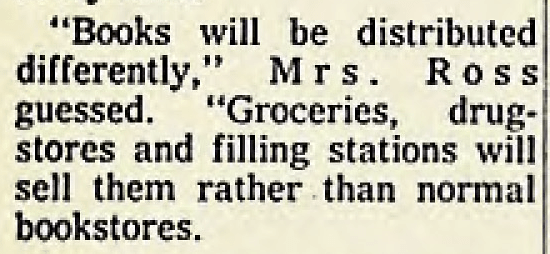 This blog posting, A 1962 Vision of the Twenty-First Century Book Trade, made me unexpectedly nostalgic.
First off, let me acknowledge some of the prescience of those prognosticators of fifty years past. The prediction about microfilm could easily be seen as prefiguring the e-reader. And they predict modern audio books and reading on computers and one person was right on in predicting the rise of the Borders and Barnes & Noble style bookstores (though he did not predict their struggles).
But it was Mrs. Ross’ comment about books being sold in groceries, drugstores, and filling stations.
Of course, one of the big stories of the book business has been how warehouse stores like Wal-Mart have cannibalized a decent percentage of the business of bookstores by stocking a small collection of best sellers.
But I remember the circular, spinning wire racks in drugstores filled with thin paperbacks. Mostly of the Harlequin and Zane Grey type, but sometimes with some kids novels or science fiction or fantasy. You can still find a few thick romance tomes in drugstores, but I haven’t seen one of those wire racks filled with pulps in a drugstore since visiting Arkansas for my aunt’s wedding. We stopped in a drugstore (with a soda fountain counter) and there it was. The last I can remember in such a place.
I know I must have bought a few books from such racks. Though as a kid, mostly I just looked at the cover art and read the back of the book in awe.
Mrs. Ross was right, but the books in drugstores didn’t really make it to the twenty-first century.
 Today is Aldous Huxley’s birthday. I will celebrate not by reading Brave New World, but by reading his first novel and one of my guilty pleasures: Crome Yellow.
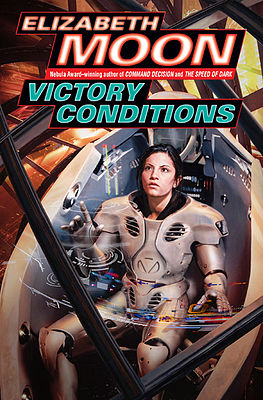 So. I bought this book called Victory Conditions during my last stop the Borders Books & Music near the Jo-Ann’s Fabrics in Columbia, Maryland. I would browse the books while my better half browsed fabrics for her business. Of course, during this visit, the shelves had become nearly barren (and everything hopelessly out of order, but you can hardly expect the inmates on death row to take a huge interest in keeping their cell neat with their execution day coming hard upon).
I had thought Elizabeth Moon’s Victory Conditions to be a likely space opera type of book. A quick glance did not necessarily prove it to be later book in a series – it could have been a stand alone novel beginning en media res.
Alas, it was not. In fact, Victory Conditions is the fifth (and final) book in Moon’s Vatta’s War series.
But should I really say ‘alas?’ After all, anything the encourages anyone in America (or the world) to read some more is surely a good thing? Even me, who believes himself to be a pretty prolific reader.
So not ‘alas.’ Merely ‘is the fifth (and final) book in Moon’s Vatta’s War series.’ As comics who make fun of Martha Stewart say, ‘it’s a good thing.’
Being obstinate and a sucker for diving into sci fi and fantasy series that will take me too long to finish by half, I did not resist to urge to finish this thing that, in all honesty, I hadn’t really started. It was more like an urge to turn a $3.00 investment into something closer to $35.00 (once I’d bought the first four books).
It’s finally over. I finished.
Was it worth it? Well, I won’t be reading them again, who reads a series of more than two or three books again? Except for Lewis’ beloved (by me, at least) The Chronicles of Narnia and the first four books of Martin’s Song of Fire and Ice (I was preparing for the long awaited fifth book, not realizing that it’s actually release would still be some two years then), not many (I would, of course, include the much read by me Lord of the Rings, if you add The Hobbit to make it a quartet – though I’ve only read The Silmarillion once). I’ll be taking them down to my neighborhood used bookstore (Capitol Hill Books) and exchanging them for store credit that I will use to buy more sci fi and fantasy.
But this was a solid series. Solid writing. The arc was unimaginative, in terms of the narrative structure within each book (the location of various set pieces within each book was pretty standard), though the twists and challenges Moon placed in front of her heroine and her assembled heroes was often surprising. The world building is well done and thorough, though also more workmanlike to truly original or inventive. The final book was disappointing in that the big finale – the epic last space battle against the pirates – was neither very tense nor vividly depicted. The earlier space battles in previous books were typically both, so this was a bit of an unfortunate aberration, especially unfortunate because it was the author’s last chance to reward her dedicated readers of this series.
I would recommend it to someone who enjoy old school science fiction with cool space battles, though I would not suggest it as an entry point into the genre (that would have to be either a short story by Asimov or Bradbury or a novel by LeGuin).
Somewhere, on some blog, written by some person – I saw a recommendation (of sorts) for Arthur C. Clarke’s Dolphin Island. I think I was googling for recommendations for science fiction books to read.
So when I saw Dolphin Island on the shelves of Royal Oak Bookshop, I picked it up (it was just $1 – the prices at that place are fantastically generous).
The book seems pretty far distant what I remember on that blog. I seem to remember it being described as a bit more apocalyptic.
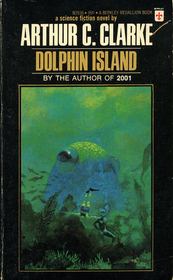 Instead, it’s a gentle novel for young adults.
Which is fine. I gave it to my mother to give to a twelve year old of her acquaintance who has developed an interest in science fiction.
The really big things in this novel are picked and quickly dropped, unresolved. For example, the crashed alien space ship that’s leaking radiation and whose location is only known to the ancient storyteller caste of dolphin society. The effort broker some kind of truce between killer whales and their occasional prey, dolphins. Call me crazy, but when these things are brought up in novel (particularly a fairly straightforward one – I’ll admit to having slightly different standards for Thomas Pynchon writings), I sort of expect some kind of, well, anything. A resolution, maybe? Some kind of answer (were they nice aliens?)?
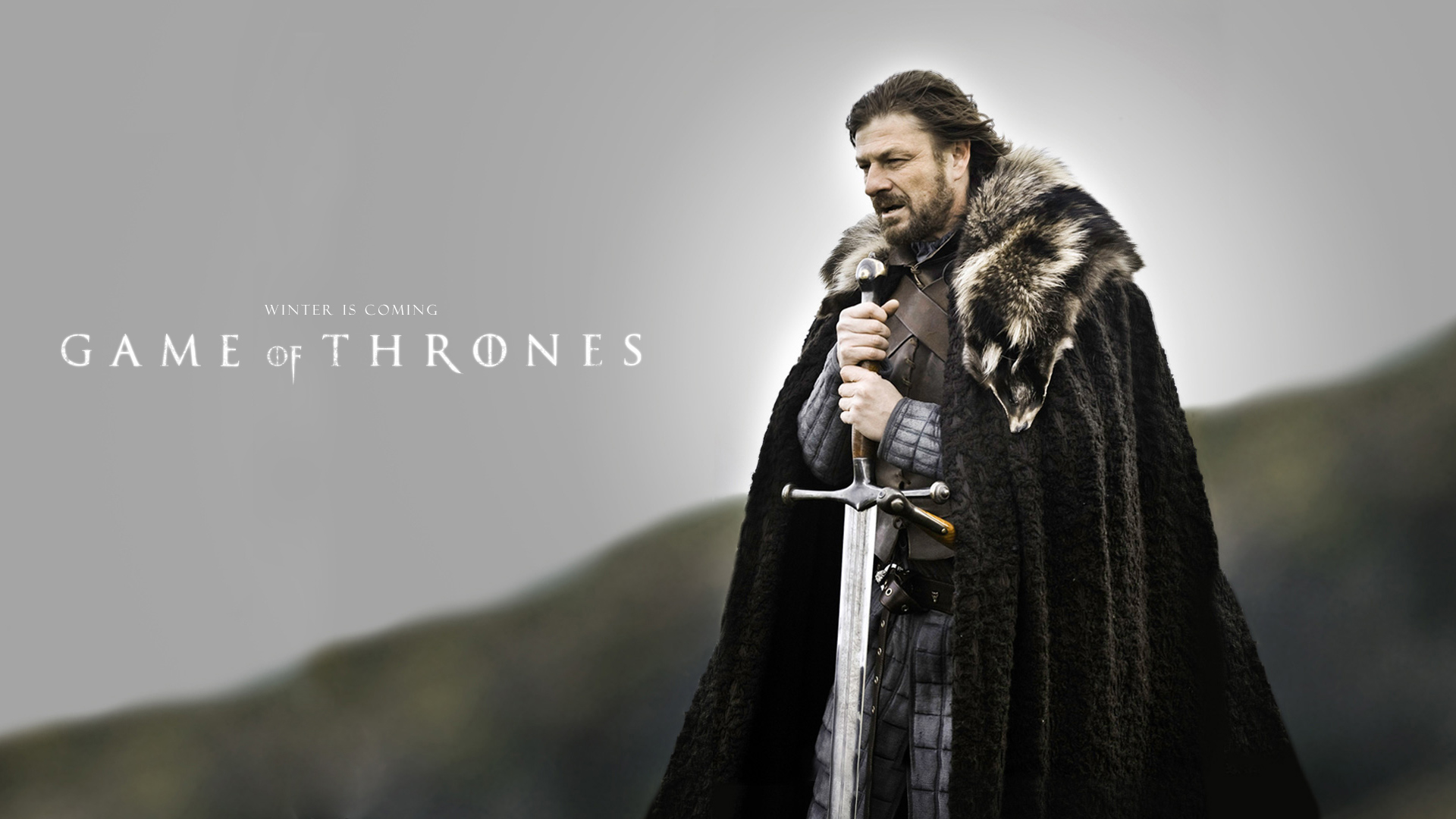 Even though I don’t get HBO, I’m very happy that Game of Thrones is being made into an extended series. I first discovered the George Martin’s Song of Fire and Ice series (of which Game of Thrones is the first volume) five or six years ago when I read a review of the then newly arrived fourth volume, A Feast For Crows, in the Los Angeles Times. I was inspired to read the first one and eventually all the volumes available.
Martin has been promising the fifth volume for years now. Once, when it was rumored that it would finally be released, I re-read the first four books so that I wouldn’t be completely lost when I read the new one (which is supposed to be titled A Dance of Dragons), on account of the series being notably complex in terms of plot and characters.
Part of the reason I’m excited about the series is that maybe Martin’s publisher will tie him down in front of his computer or typewriter or pen and paper until he finishes the damn fifth volume. Unless he speeds up, my grandchildren will have to read the projected final volume to my tombstone.
It is a very gritty series, with characters you love dying and characters you hate being revealed to be more three dimensional and harder to hate (you eventually get to see the good side of a character who in the first tome, pushes a child out of tower window to plunge to his – not death, but a long coma and paralysis from the waist down). The writing style is not necessarily notable, but it is efficient and enjoyable. Like much of the best sci-fi and fantasy writing, it stays out of the way and services the plot, setting, and characters.
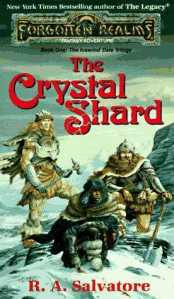 Matt MacKenzie and I were good friends in high school. One of our sources of agreement was a deep love of fantasy novels – and our deep in the closet affection for Dungeons & Dragons.
One weekend, we both picked up, independently, R.A. Salvatore novel, The Crystal Shard. Set in the AD&D (“Advanced Dungeons & Dragons”) world of the Forgotten Realms (which, by that time, had replace Greyhawk and Krynn as the leading locale for AD&D materials).
Both of us absolutely loved it.
Salvatore went on to right three more books in a trilogy featuring the same characters – and then a three part prequel and a whole series of follow-ups (mainly following the most popular character of the series, Drizzt Do’Urden). I confess that found my interest flagging in the novels that made up the rest of the trilogy. The prequels were better, but still lacked the magic of that first effort.
Then I forgot all about it.
Somehow – I don’t recall how – my memory got jogged. But I found myself wanting to revisit the series.
I had been dragged to a distant strip mall shopping center for the purpose of visiting a Jo-Ann Fabric Store. I reluctantly agreed to go, but then quietly slipped off to a nearby Borders Books & Music. Putting aside my preference for shopping at independent bookstores, I dug up a 40% off coupon and purchased a paperback copy of The Crystal Shard.
A review of a book like this is almost besides the point. Either you have affection for the genre it represents or you don’t. It’s not a book that crosses typical genre readership lines, like the immensely overrated Harry Potter novels (by the way – if you really want to read a great book about schools for wizards, let me suggest the infinitely superior and elegiac, A Wizard of Earthsea by LeGuin).
That said, I instantly fell back under its spell. I did so, completely aware of all its flaws – the rampant clichés and shameless theft of Tolkien (though, really, how can you write a good fantasy novel in the classic sense of the genre without stealing from Tolkien? I’m not even sure that counts as a criticism any more). But the story propelled me along and the characters somehow managed to rise above those cringeworthy clichés that suffused them.
Salvatore’s creations will never be confused with, say, Fritz Leiber’s Fafhrd and the Gray Mouser (two fantasy characters who rose above genre clichés and limitations without ever abandoning a pure love of the genre’s mores). But I loved rediscovering them.
I don’t know if I will risk re-reading the follow-ups, though. For the moment, I am not inclined to put the magic at risk.
 the coffee philosopher