…because Captain James T. Kirk would kick Chuck’s and then convince Chuck’s wife, daughters, and granddaughters to have a big sexy orgy with him, only to leave them all jealous while he makes it with a super hot green alien chick.
“Mistakes Were Made…”
Our little band of D&D’ers (fourth edition, to be specific) first got together sometime in 2010. I think. Maybe it was 2009. Let’s just say “over two years ago” and call it close enough for horseshoes and hand grenades, shall we?
I got very lucky. I was in my mid-thirties (and am now closer to forty than thirty) and had heard horror stories of men my age walking into games filled with angst and acne ridden teens. Actually, not so much “stories” as a single story related to me by my friend Ryan, who is also my sci-fi/fantasy friend (sort of like I also have my “soccer buddy” and “politics friends”).
There were six of us to start with: three hard core gamers (including the DM); one sitting somewhere between journeyman and master player; and a newbie. And me, who was skating by on memories of playing Advanced Dungeons & Dragons (and also Star Frontiers – anyone remember that game? highly underrated) back when there was such a thing and when the whole franchise was owned by TSR and no one had heard of a company called “Wizards of the Coast.”
We played in the post-apocalyptic desert world of Athas. I was a half-elf mage named Cavafy (so named after the great poet and chronicler of Alexandria’s demi-monde). Players came and left. One left, ostensibly to become a DM somewhere else, but mostly, I think, out a certain frustration with the less experienced players (no doubt including myself). Another became a new father. A third’s (the truest newbie) heart simply wasn’t in it. We added a new player, a congressional staffer who, like me, was able to draw on memories of playing as a younger man, when we all had more hair.
As a wannabe writer, ideas kept rolling around in my head for a campaign of my own – an opportunity for me to take on the sacred mantle of Dungeon Master and show off my imagination (which, as I learned, was exactly the wrong way to look at it).
I broached the matter with our DM and (still) de facto leader of our band who, agreed, in theory, to let me try my hand for one or two sessions. But the right moment didn’t arrive until suddenly, it did.
A proper moment in the lives and schedules of both our real selves and our characters emerged simultaneously and we shelved the old world and picked up a new one. Mine.
And I had so many ideas. Too many actually.
It is not, I found, like writing a short story. It is more, to dip into what I’ve learned in my former and sometimes profession, more like managing a political campaign: you’re going try something, but you know there will always be a reaction from the other side and a you’ll be surprised by it a significant portion of the time.
For example, I grew enamored of the idea of “natural rolls.” By which I mean, the players roll their ability scores the very old fashioned way: 3d6 in order. Then, they would create a character based on the randomness of the scores they got, rather than shaping to scores to the kind of character they wanted to play.
Which was cool in one way. It forced the players to get out of some preconceived notions of what they wanted to be and experiment with something they maybe hadn’t expected.
Too bad I didn’t do the same thing (escape from my preconceived notions, that is). Also too bad that I didn’t do anything with the conceit of the characters being “ordinary.” Instead, I’ve wound up giving the players to option to boost their scores up a bit to make things more “normal” (for a D&D character, that is).
And the first session was, well, only moderately successful. I hadn’t developed the knack for keeping the action moving nor for seeming authoritative (which is not the same as authoritarian, which is a pretty negative quality in 99.9% of life’s little moments).
Worst of all, it was too guided. An opening session, with new characters in a new world, tends to be a little directed, pushing the characters down a path. And that’s okay. But I didn’t leave nearly enough room for player agency and that’s something I’ve been struggling with. Sometimes my solution becomes almost like those old, Endless Quest books (also published by TSR), where choice becomes “do you want to do A or would you rather do B?” rather than true freedom.
But I had done it. My first campaign, created (though only partially built as yet) from the ground up. A new world, with peoples, nations, and history.
The continent of Loa, home of a small band of (semi) heroic refugees from the now fallen Sunward Empire, which fell, despite the characters’ best efforts, on the first day of the imaginary world’s entrance into the (semi) real world on a Saturday afternoon, in the meeting room of the Alexandria, Virginia branch of the Fraternal Order of Eagles.
Macmillan Stands Up To The Man
I’ve pasted below a letter from John Sargent, the CEO of Macmillan. Mainly, because I love it.
Standing up to Amazon and refusing to admit that policies designed to help Amazon build and maintain a stranglehold on the book selling business.
Emphasizing the human aspect of what publishers bring: editors who find books that will be worth the public’s time and who subsequently work with the author to bring out the best in those books; sales reps who are committed to working with booksellers to make sure the public will see and notice worthwhile books; in general, people willing to bring their personal love of books (and love of a particular book) into their work to help share those books with we, the people.
I also like the idea of being okay with Macmillan’s size. I know Macmillan as the parent of the Tor imprint, which is probably to best and biggest publisher of old fashioned, mass market science fiction and fantasy paperbacks. My bookshelves are filled with books with the Tor logo on the spine and I’m cool with that (though a shout out to some of the publishers and imprints I first learned from crouching in the sci fi and fantasy aisles of used bookstores – like Ace, Bantam, and Del Rey)

To Macmillan Trade Authors, Illustrators, and Agents,
Last weekend I wrote you a letter which I planned to send today. Last night, Penguin settled their lawsuit with the DOJ, and Random House agreed to be governed by its terms. After some long thought, I’m sending you the letter I wrote unchanged. That is because our position has not changed. So please read on.
Holiday greetings! In the tradition of a year-end letter, I thought I would send you an update about Macmillan and a few words on publishing in general. Fear not, no family photos; instead some thoughts on flightless birds and consolidation, on the Department of Justice, on the digital transformation and on the future of our great enterprise.
Many of you have asked what the Penguin/Random merger means for us, and what the chances are of a Harper/Simon merger. I think the Random/Penguin merger is based on financial engineering, and as such is good for the financial statements of the two companies. I think others have the same sort of opportunity, but I have no idea if they are talking.
I do know that we are not in discussions, with anyone. This will leave us where we have always been, the smallest of the big publishers. It has never hurt us in the past, and I expect it will not hurt us in the future. Publishing trade books is, in the end, a human endeavor. The relationship between editor and author does not scale. Nor do the relationships between sales rep and bookseller or between publicist and producer. Certainly there are some advantages to being big, but the essence of the business is not a function of size. You need a certain level of capital and infrastructure, but that does not require being a behemoth. We will be more than fine in the land of the giants. I expect we will continue to grow and prosper.
And now for the DOJ. As part of the court-ordered mediation, I wrote a letter to the DOJ explaining why we were not going to settle our lawsuit. It occurred to me then that I had not been in contact with you since the lawsuit was filed, and that as our partners in publishing you should know what we are doing and why.
There are two reasons we decided not to settle. First, it is hard to settle when you have done nothing wrong. Much as the lawyers explain to me that settling is completely standard business procedure, it still seems fundamentally flawed to me somehow. Call me old-fashioned. The second reason is the more important one. Since the very beginning, the government’s demands have never wavered in all our discussions. They still insist on the two year discounting regime that forms the heart of the agreement signed by the three settling publishers. It was our belief that Amazon would use that entire discount for the two years. That would mean that retailers who felt they needed to match prices with Amazon would have no revenue from e-books from five of the big publishers (and possibly the sixth) for two years. Not no profit, no revenue. For two years. We felt that few retailers could survive this or would choose to survive this. Simultaneous discounting across the major publishers (you could think of it as government-mandated collusive pricing) would lead to an unhealthy marketplace. As we heard of each successive publisher settling, the need to support retailers, both digital and bricks and mortar, became more important.
So what has happened since? The motions and the judge’s responses are public record. We have completed the court-ordered mediation process with the DOJ without any progress toward settlement. The trial date remains June 2013. Discovery and depositions continue. The legal bills look like the unit sales numbers for 50 Shades of Grey.
We decided shortly after the suit was filed that we would cancel all our retailer e-book contracts and negotiate new ones. We did this with all our customers except one whose term was not up yet. All the new contracts are compliant with the government’s requests in their complaint. They contain no most-favored nations clauses and no price limits. They also allow 10 percent discounting on individual books priced at $13.99 and above. In short, we complied with the demands of the complaint the DOJ filed. Needless to say, we continue to see the lawsuit as pointless and destructive. Meanwhile, the settling publishers have apparently reached terms with retailers. There is some discounting, but because it is not across the board the impact appears to be limited.
We have also been pursued by 33 states, by a large combined class, by the EU, and now even our friends in Canada are taking a look. We are proceeding in the discovery process with the states and the class. We settled with the EU because of many differences in their system and because the discounting change will not materially affect the market there for us.
Which leaves me with the final and more jolly topic of this missive-matters digital now and in the future. At this writing 26% of our total sales this year have been digital. It is good to remember that means 74% of Macmillan’s total sales are ink on paper books. Just as in 2011, the percentage of e-book sales has remained consistent week by week through the year for the most part (the big uplift in the last two years has occurred the week after Christmas). Our e-book business has been softer of late, particularly for the last few weeks, even as the number of reading devices continues to grow. Interesting.
We continue to invest heavily in the digital side of the business, from anti-piracy efforts to social marketing tools. We are not managing our business with an expectation of a final e-book percentage. We are focusing instead on the rate of change. Consumers will decide in the end how they want to read books, and we will deliver your books in all the formats they desire. Our job is to get to this final state with an even playing field for retailers, a healthy marketplace, and the maximum possible distribution of your work in all formats.
And we will keep experimenting to determine the best way forward. This year we went DRM-free at TOR. It is still too early to tell the outcome, but initial results suggest there was no increase in piracy. In early 2013 we will launch library lending of e-books. As you probably know, we have not sold e-books to libraries to date, though we have been working for three years to find a model that works for the libraries, but that didn’t undermine our retail partners and didn’t jeopardize our fundamental business model. We have found a model we believe works for a limited part of our list, so we will now move forward.
The best news as we enter this holiday season is that independent booksellers have had a good year, booksellers in general have had the time to adjust their product mix and store counts, and consumers continue to value and buy real books. Piracy continues to be an issue, but it has not exploded. More people are reading more books. The playing field in e-book retailing, while not even, has not yet tilted too far. There is a bright future out there.
Let me end by saying there are plenty of bumps left in the long road ahead, but it is a good journey well worth taking. Thanks for riding with us here at Macmillan. We are looking forward to the years ahead!
Happy holidays to you and yours.
All best, John
Midweek Staff Meeting – The Key To A Healthy Relationship Is Roleplaying
The Wheel That Just Won’t Quit
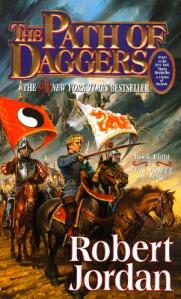 I may never forgive my former staffer for leaving a copy of The Great Hunt – book two of Robert Jordan’s (now Brandon Sanderson’s) sprawling, awkward fantasy epic, The Wheel of Time.
I swear, it’s not that good, but still, I’m addicted. So I guess there must be something to it. For heaven’s sake, even Paul Krugman reads that darn books. May Tor is putting something in the binding glue. Like opiates, maybe.
Are there any big Wheel of Time fans who can explain it me?
I couldn’t find my copy of book eight (eight?! that means, yes, I’ve already read seven of these freaking novels; glaciers advance faster than this), so I wound up getting another darn copy the other night (fortunately, these are mostly all cheaply available as mass market paperbacks).
Even though it had been sometime and the thing is massive, it is easy to jump right back in. The classic fantasy tropes and types are there and it’s not so hard to remind one’s self of the major players and their positions and roles in the series (I don’t even bother to keep track of geography; I swear, he just added new countries and major players that didn’t exist before in every book – and that he did this just to keep dragging this thing.
However, like it or not, this may be the defining fantasy epic of the last twenty-five years (I don’t count kid’s lit like Harry Potter and I can’t if Martin’s Song of Fire and Ice will wind up supplanting Wheel of Time or if it has too much sui generis in it to fit the bill).
So, I don’t want to do that Al Pacino routine from The Godfather III but heck if it don’t keep dragging me back in anyway.
On Progress
I wanted to draw some attention to this George Scialabba essay, Progress and Prejudice.
It’s a discursive, elegiac (nostalgic, really, but ‘elegiac’ sounds better, and there is an unspoken mournfulness in his particular nostalgia, so we may call it a sort of elegy) and looks at what formed his own idea of progress and the writers of the past, mostly those who regretted it, but also some who… I don’t know? Accepted it without too many regrets.
He puts a significant portion of the words in talking about Arthur C. Clarke’s Childhood’s End, which I read not so long ago. Scialabba put his finger on several things that passed me by until he brought them up, including the theological aspect of the novel.
Education For Immigrants
Lost in time. Surrounded by evil. Low on gas.
That’s right. I’m making an elderly Thai couple here in this country on a tourist visa watch Evil Dead 3: Army of Darkness.
How Awesome Is This?
Oh. And Merry Christmas.
Anyway, important stuff. Paul Krugman goes into more detail about how Isaac Asimov has been his touchstone (he also mentions liking Robert Jordan’s epic fantasy cycle, The Wheel of Time; in other words, Krugman is a serious geek, down to the very fiber of his being).
Paul Krugman: Asimov’s Foundation novels grounded my economics: The fantastical tale offers a still-inspiring dream of a social science that could save civilisation
Midweek Staff Meeting – 12-12-12, Secret Radicals
Comic Book Store Day
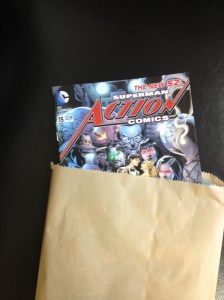 So, yesterday, I went into the comic store to buy the latest comics. Most comic book titles come out monthly, but staggered, so that every week several different titles have their latest editions come out. It’s a ritual I have never participated in before, though I’ve seen it well documented on The Big Bang Theory (and also well mocked; though how that show is actually less than kind to nerds while pretending to be nerd-centric is a whole ‘nother thing altogether).
I went during lunch, and even though Beyond Comics (the comic book store just around the corner from my office) only opened a little over an hour earlier, there was a decent crowd of shoppers and browsers (including, thankfully, a couple my age and one gentleman who looked to be in his late forties).
Yesterday was Action Comics, the original Superman title. I bought #15, along with Aquaman #14. The kind lady behind the counter put my comics into a flat paper bag, as if they were pornography, and I left.
Not much happened, but it felt fun. Knowing what I was looking for and getting the Action Comic title fresh of the presses, at it were (today is the first day it was available). I felt like a true nerd, and since I am a nerd, that felt pretty good.
I will say, that I’m findng Action Comics, overall, a little hard to follow. The New 52 titles are a reboot, but some knowledge of what has happened in the last twenty years helps and just don’t know a whole lot about that. The artwork has a nice, old fashioned feel to it. Sort of a Jack Kirby, silver era feel to it, which I like.
Aquaman has too many people joking about the uselessness of Aquaman (even when he saves the eastern seaboard from an invasion of deep sea, humanoid angler fish), but the artwork is very, very good. The whole thing has a sticky, Lovecraftian feel to it (I gather that the New 52 Swamp Thing and Animal Man titles also have that organic, alien, decaying thing going, but I’m sorry, I’m not going to start reading anymore titles).
 the coffee philosopher