If reading be foolish without remembering, memory being the only treasure of knowledge, those words which are fittest for memory, are likewise most convenient for knowledge. Now, that verse far exceedeth prose in the knitting up of the memory, the reason is manifest: the words, besides their delight, which hath a great affinity to memory, being so set as one cannot be lost, but the whole work fails: which accusing itself, calleth the remembrance back to itself, and so most strongly confirmeth it.
Weekend Reading – If You Don’t Find This Cool There Is Something Irrevocably Wrong With You
William Butler Yeats on modern poetry!
Midweek Staff Meeting – Don’t Go Mistaking Me

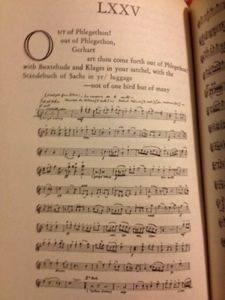
Ezra Pound: Canto LXXV
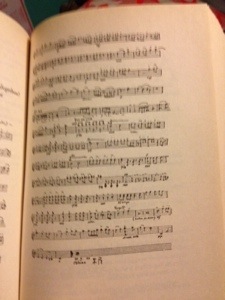
Okay. It’s mostly sheets of music. I can’t read music. Can’t even play an instrument. Not even the triangle. I’m really bad.
If you’re musically inclined, make what you will of what’s below. It’s probably something famous.
So… apparently, ‘Gerhart’ was pianist friend of Pound and he transcribed the music below, which was originally composed by Clement Jannequin for four voices. Phlegethon is one of the rivers of the ancient Greek underworld.
‘Essay On Man’
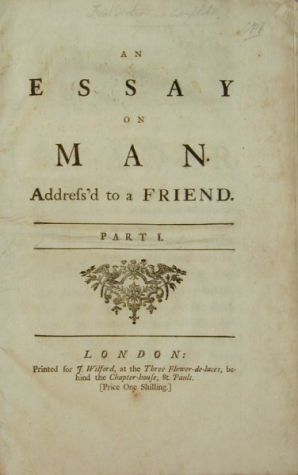 I read a short collection by Alexander Pope last year – a collection that contained this poem – but I honestly rushed through it. While the collection may not have been long, reading essays in the form of three hundred year old heroic couplets is not a swift process, so I went back to leafed through it again.
The emphasis Pope seemed to put on the existence of angels felt to me like a product of Catholicism. Don’t get me wrong, angels are not a major part of this poem, but when he talked about Man wanting to emulate the angels, the angels did not at all seem like a metaphor, but a reference to actually, heavenly beings. And, by the way, it was not considered as a compliment, because the whole poem is about accepting Man’s place in the world.
The whole thing was very Leibniz-ian, with a ‘best of all possible worlds’ aspect to it (though I don’t recall Voltaire ever publishing a satire against Pope; probably because, on the whole, he would have seen pope as a kindred, satirical spirit). Questioning how things are being put as being tantamount to questioning God.
I don’t know. Maybe more thoughts to come later. Or not.
Ezra Pound: Canto LXXIV
In case it was not already obvious, we are back to reading The Cantos. So, that’s what we’re doing this year. No New Year’s Resolution, though. I don’t know if I’ll finish them. I do have other things to do – including other things to read (we’re still not done with the final book in The Wheel of Time, so lots of catching up to do).
Apparently, this is actually the beginning of the Pisan Cantos. I don’t know what the other section was. Just that it was… short.
The themes remain (Chinese characters, finance, anti-communism, anti-semitism, Italian history), but the style has changed. Not radically, but noticeably.
There’s a reference to Hemingway, which may not seem like much, by this adds a bit of autobiography that I didn’t notice before, and that’s not a small thing. Also, I feel like Pound has moved into the thirties. Obviously, this was written after the Second World War, but the earlier bits were still well within what we might call high modernism. This is still that, but I feel like I can detect some surrealist influence. The lines feel more loose, more free flowing, more driven by the unconscious. Or maybe it’s just stream of consciousness. But I stand by what I said. It’s evolving into something influenced by surrealists.
A brief reference to Tangiers pulled me up short. Was Pound connected, did he follow, was he friendly to writers like Paul Bowles and William S. Burroughs? Also, was this Canto finished when Burroughs and the Beats were making pilgrimages to that North African port city?
A mention of Leviticus XIX and First Thessalonians 4, 11 (the differing nomenclature comes from Pound). The first, Leviticus, is when God instructing Moses in how the Israelites should behave. The second are instructions from Paul. God’s instructions are lengthy and precise, but Paul speaks more generally. And passage 4:11 goes as follows:
And that ye study to be quiet, and to do your own business, and to work with your own hands, as we commanded you;
Is that a reference to what Pound intends to do, post-War, post imprisonment?
Some disparaging, colloquial quotes about Italian generals and the Duke (Il Duce? A Mussolini reference?) indicate… what? Is he mourning the end of Fascist Italy? I think that the quotes, with their lower class tone, are more likely intended to be mocking the speaker than the speaker’s subject.
And a lot of references to modern art and writers. Hemingway, I already noted. But also ‘Mr Joyce’ (surely James Joyce) and Manet and Degas…
(made in Ragus) and : what art do you handle?
” The best ” And the moderns? ” Oh, nothing modern
we couldn’t sell anything modern.”
This is a melancholy bit. The whole thing, actually. I can hear Pound adjusting to a new world, one that doesn’t respect… him? The world he loved, he helped created (I am not speaking here of those odious politics, but of how he made literary modernism possible: Eliot, Joyce, Hemingway – all benefitted enormously from his great artistic generosity; maybe be wasn’t the greatest writer of his era, but he made much of it possible).
Weekend Reading – More Stuff About Things Declining Or Dying Out Or What Not

Ezra Pound: Canto LXXIII
WTF?
It’s in Italian. And no translation.
All I can tell you about this is that he’s using a lot enjambment, which also creates a lot of white space in the poetry… shall we say ‘column?’
Midweek Staff Meeting – Death Of A Poet

Ezra Pound: Canto LXXII
I was little concerned when opened up to the new section and started in on LXXII because, well, it was in Italian.
Fortunately, Pound had the generosity to repeat the entire Canto in English.
This is a fairly self referential Canto, and not just because Pound writes:
But I will give you a place in a Canto
giving you voice. But if you want to go on fighting
go take some young chap, flaccid & a half-wit
to give him a bit of courage and some brains
to give Italy another hero among so many
It’s also not hard to see Pound, despite a bit of dismissal there, still remaining sympathetic to the WWII Italian (fascist?) cause. And he’s got to get in this little bit of anti-semitism:
Exuded the great usurer Geryon, prototype
of Churchill’s backers. And there came singing
I’m not sure how he reads Geryon as being relevant (I can’t help but think of Anne Carson’s great novel in verse about Geryon, though), but it’s easy to read ‘usurers’ and ‘Churchill’s backers.’
The tone of angry dismissal and disappointment runs throughout, but the sense of loss in Pound’s tone is also ever present.
Part way through, Marinetti enters the dialogue. Of monologue. Pound has a one sided conversation with an absent (and mourned for?) Marinetti, the great (and proto-fascist) futurist poet.
 the coffee philosopher