Midweek Staff Meeting: Telecommuting


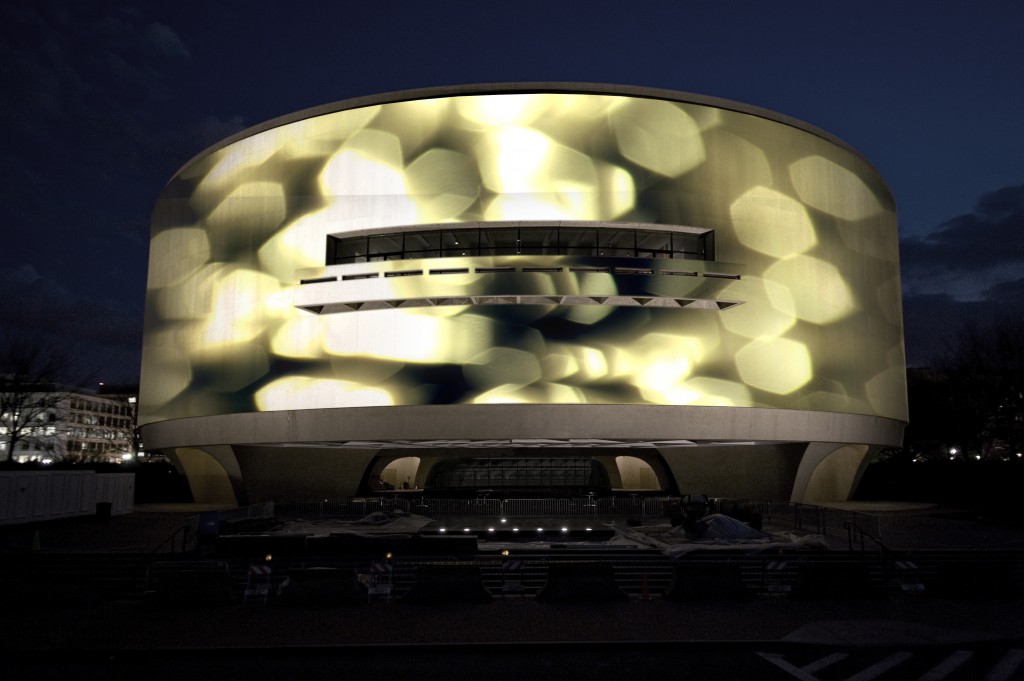
hirshhorn-song-1-1024x681I actually have no article to post here about telecommuting, but his Holiness is visiting DC and, even though I am writing this Monday evening, I feel confident saying that traffic will indeed by horrible and snarling today (Wednesday). A lot of folks are telecommuting and, really, I’m hoping I will be allowed to, as well, though it’s hard to say and my office doesn’t really have a policy on this.

Hume and Buddhism. Actually, I think this kind of link can be a little tendentious, especially trying to show that Hume was actually influenced by Buddhism. But, whatever. Hume is really cool, regardless.

You will be missed, C.K. Williams.

A nice, balanced article about the new head of my favorite museum in DC, the Hirshhorn.


Weekend Reading: Grillo


The Colonial Market & Fair at Mount Vernon is nice excuse to visit a very nice that happens to be very close by. Not ‘let’s jump on the Metro’ close, but definitely ‘it’s a short and fairly pleasant drive, much of along the river’ close.

It’s cool that people are supporting lit mags, but I’m not sure if this is a sustainable model. Also, stop throwing the word ‘avant-garde’ around so much. It doesn’t mean what you think it means.

Now I want to get this new translation of Mallarme.

‘Salad Anniversary’ By Machi Tawara


Salad AnniversaryI saw this collection on the shelf at a bookstore and while I didn’t get it at the time, for some reason it gnawed me. I did some googling and read about the book and the author and, somewhat trepidatiously, finally sat down to read it.

Machi Tawara is not Yeats nor Dante nor Milton nor Eliot nor Ashberry – at least not in translation (I know that I am missing a ton of information and shading, not in the least because they are all written in tanka form and Japan’s specialized poetry forms don’t really translate directly to English without losing their form). They’re a little sappy, more than a little youthful, a bit twee, and they should be trite, but, instead, they are delightful. I can see why the book became a bestseller in Japan.

Mostly about falling in love, losing love, being in love (and a bit about being a teacher and living alone), there is nothing groundbreaking about any of it, but as soon as I had finished, I wanted to go back and read it again.

The individual tanka are translated here as three line verses (in Japanese, they would be a single, vertical line). Each one makes for self contained poem, while simultaneously making for a continuous narrative.

From a poetic sequence entitled Hashimoto High School (where the then twenty-something Tawara taught):

Girls in middy blouses
scurry through the streets
as if keeping someone waiting

Writing the character for “youth”
somehow I’m struck
by all those horizontal lines

Besides that first tanka‘s echoes of Pound’s metro station, each tanka works perfectly as a self-contained poem, but also lends itself to a clear, more or less linear sequence.
‘They Pretend To Be Us While Pretending We Don’t Exist’


The Michael Derrick Hudson debacle has been embarrassing. I love poetry and advocate for it to my friends and co-workers, but when this sort of garbage is what gets it into the news… well, it ain’t good.

I’ve been reading Jenny Zhang’s poetry collection, Dear Jenny, We Are All Find, so I perked up when I saw she’d responded to the poetry s–tstorm on BuzzFeed in an essay entitled, They Pretend To Be Us While Pretending We Don’t Exist.

Nicely puts to bed the lie of some kind of supposed advantage that poets of color have in getting published and respected. Shouldn’t need to be said, because it doesn’t take much looking to figure out that published poets in America are largely white and male.

At Stanford, a white girl (well-meaning, of course) wrote a story about a Chinese American woman living in modern-day San Francisco (this was the early 2000s) who wanted to marry a white guy but was forced into an arranged marriage with a Chinese man and it was called The Dim Sum of All Things. (Laugh now, cry later!) I don’t think I’m being unreasonable when I say the reality of that story was fucked and so was the fantasy. She got into a highly coveted advanced fiction writing class taught by a famous writer and I didn’t. The story I submitted was also about Chinese Americans living in modern-day America, but it didn’t involve arranged marriage or dim sum or sensuous descriptions of chopsticks. This didn’t mean the teacher made a wrong choice. He made a subjective choice.


Favorite Bookstores: The Clearance Shelves At Politics & Prose


If, when you walk into Politics & Prose, you take the stairs down and then take a left and walk along the wall of the stairs, you will find shelves of various things, including drama and, most importantly, poetry.

Lots of poetry. Good poetry. Inexepensively priced poetry. Hardback copies for $7.99. Paperbacks for $6.99, $5.99, $4.99, $3.99.

I’ve bought books by Christian Wiman, Rita Dove, Franz Wright, Anne Carson, and Liu Xiaobo. I’ve passed by, because my arms were already full and my small budget already busted, books by John Ashberry, Frederick Seidel, and Augsut Kleinzahler.

Check it out. It never disappoints.

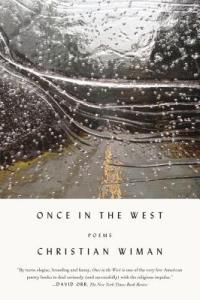
Once In The West, By Christian Wiman


Once in the WestI became intrigued by Christian Wiman, the immediate former editor of Poetry, after seeing the tail end of an interview he gave to Bill Moyers. He was actually speaking mostly about a book he wrote about his faith (and the cancer that almost killed him).

I don’t actually know if any of the poems in Once in the West were written after receiving the diagnosis, but as someone who has had his own experience with a life threatening medical condition and an arduous and uncertain recovery, I certainly wore that lens over my eyes when I read them.

These poems are often religious, but less… theological… than, say Fanny Howe. I don’t think Wiman is Catholic. I could probably just google the answer, but I’m going to guess he’s that Episcopalian. He’s also funny and a little crude in his ‘conversations’ with God.

A solid portion of Wiman’s poetry here are unrhymed couplets. He’s got a prose poem or two, some ones with longer or more unusual stanzas (or no stanzas at all), but the couplets appear in half or more, I would say. Even without rhyme, it gave them a nice, old fashioned feel, like some modern day Alexander Pope.

Below is one of the poems. Not necessarily typical in its quiet, but it does show how the faint, almost but not quite rhymes, assonance, and alliterations give it a feel rather like a Pope or a Thomas Gray.

Less


Silas,
say less

than silence.
In a dawn

lost to all,
but me,

be,
Sila, beyond

the hay bale
harboring

kittens
no one now

has the heart
to kill;

and touching
nothing

touch
my head

so we can be alive,
together,

Silas,
as together

we are dead.

Today Is The National Book Festival


nbf-event-icon.ios-2x.1438014483I’m working, so I’m not there, but if you’re not working and you live in the DMV, there is no good reason not to go that doesn’t involve funerals, weddings or dinosaurs (and, keep in mind, there will probably be books about dinosaurs available at the festival).

I would especially recommend checking out poets Marilyn Chin, Claudia Rankine and Kwame Alexander.

#LittleSalonDC


There’s a nice article on Little Salon in the WaPo today – and thankfully, no pictures of me (I don’t photograph well; my charms only appear after much time and gin).

It was a wonderful night, this time with free beer.

  And I bought this small painting (acrylic on paper) for my better half. The artist, Dana Ellyn, had a number of frankly disturbing pieces (not an insult, though the Madonn and Child-esque painting of Hillary with a naked baby Bill on his knee must be seen to believed), but I turned around and I saw this three small works featuring pigs and the first one I saw was just so… cute. That’s it, really. It was cute. And I’m not immune to cuteness.

But, with my better half having been out of town for a while (I keep on thinking that people secretly think that she left me and I just haven’t come to grips with it), after buying the piece, I felt myself becoming a little maudlin and not such good company, so I left a little early.

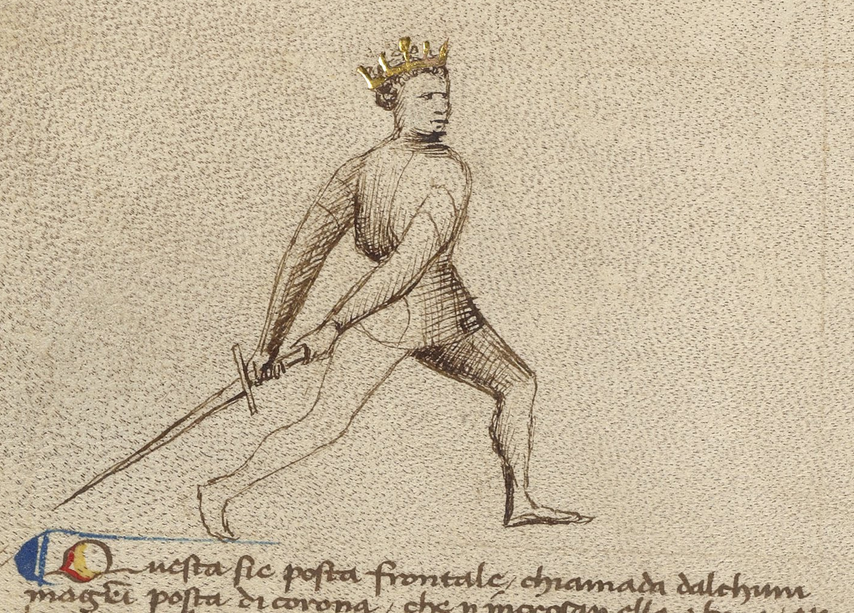
Midweek Staff Meeting – I Would Like A Sword, Please


Screenshot_2015-08-17_12.54.53.0If you live in Chicago and you are not taking these classes in medieval/renaissance longsword fighting and you are not prevented from taking these classes by some combination of crippling poverty and unforeseen amputations, then I have no respect for you.

How was it that Ralph Waldo Emerson, a champion of the unique power of poetry, failed to make his own, banal poetry soar half so well as his prose?

Heidegger, or else, the Heideggerians. But who are they?

The end of an era.

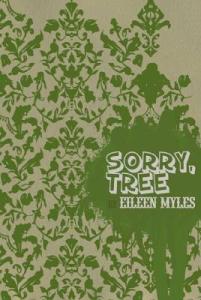
‘Sorry, Tree’ By Eileen Myles


Sorry, Tree

I’ve long admired Myles for her essays and poems in magazines and for her role as an poetry advocate/agitator and as a prominent (leading? I don’t know enough to say) figure in queer literature.

But, I’d never before read one of her books. Until now.

First of all, she’s very good. It reads quickly, but I actually read through the book a couple of times because it warrants it (and because it’s a quick read; let’s be honest, I’m not going to casually read War and Peace a second time without a lot thought about the investment I’m making in the project).

A wonderful melancholy thread runs throughout the short (though not broken) lines. A sense of loss of identity from trading New York for California. A fear of drifting from others or of not being able to connect with others like we feel we ought to… sometimes the ‘other’ seems to be a romantic partner (at least once, it’s explicit in that regard), but that also feels relatively unimportant. It is the dissociation that is important. She frequently writes in an almost ‘tough guy’ vernacular, but undercuts it at every turn.

So, very good.