The Court Of Broken Knives


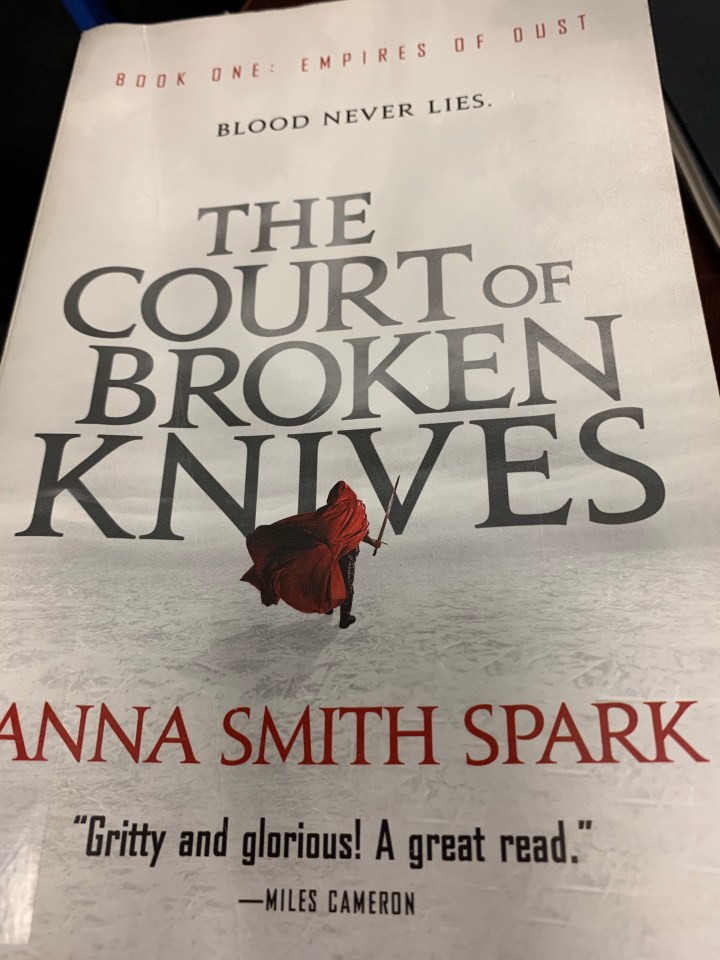
img_5217This was a difficult one to get into. A young, beautiful protagonist who is, at least initially, a member of a mercenary company that is only mostly shamelessly rips off Glen Cook’s Black Company (here, the unimaginatively named Free Company of the Sword), who happens to be a genetic sociopath. If there is a success here, it is in succeeding in duping the reader into thinking that – because he is good looking (yes, even when we can’t see the person, we are predisposed to think good looking people are better people) and is clearly set up as the protagonist – we are rooting for the good guy. Not that Spark doesn’t give us ample reason to mistrust that instinct (including pretty severe addiction problem – drugs and alcohol – that not infrequently has him puking all over himself).

About midway through, one character actually gives voice to that mistake, albeit inside her own head. Someone so beautiful must be good. And we are dragged along. It helps that the most mistrustful folks, the handful of members of the aforementioned Free Company who survive a bloodbath that takes place about one third of the way through, a portrayed as grimy, not very good looking, and very… human, in an icky and mortal way. So we don’t really trust them the way we do the good looking sociopath.

Admittedly, by around the final third, pretense has been dropped and the ‘hero’ is revealed as tramautized, sociopathic, man-child with never properly explained powers (he’s descended from some kind of god-like and also deranged hero of ancient legend).

I’m making this all sound more literary and successful than it is. Because it’s hard to feel super invested when you really don’t like anybody enough to care too much what happens to anybody and come to the conclusion that, with the exception of one (former) high priestess (who is too damsel-in-distress-y for my tastes), that the moral arc of the universe would be just fine if every significant character to whom the author introduced you were swallowed by a meth alligator.

Bloomsday Forgot


No, it’s not Bloomsday. I missed it.

I forgot about it. Which I do not normally do. In past years, I have been in strange rooms at midnight for marathon readings of Ulysses.

This year, it simply passed me by.

And yes, grappling with COVID and, perhaps more importantly, with racism (andyes, Black Lives Matter, and yes, All Lives Matter is racist in part because you never, ever used that phrase until people started saying Black Lives Matter), meant that I had other things on my mind. More important things, even.

But it passed. And that’s sad.

He is a member of the traditional, white, western canon, but he is also still one of the greatest English language authors in all history and we used to take one day a year to honor and. remember him and, as, if not more importantly, to make literature fun, vital, and experiential.

I won’t live forever, barring some kind of amazing medical advance and don’t know how many Bloomsdays I have ahead of me.

I hope that, at the very least, I remember the next one.


Nine-tenths of the people were created so you would want to be with the other tenth.

– Horace Walpole


Independent Bookshop Week

Ravelstein


You can, at least, say that reading Ravelstein makes you want to read more about and by Alan Bloom, who the title character is a not even really disguised version thereof.

I have read little Bloom. And only one other Bellow (Humboldt’s Gift; it liked me not, and while it inspired me to read some Delmore Schwartz, his poems discouraged me from reading more).

But my suspicion is that the only improvement this novel makes on reading Bloom himself (or a proper biography) is that Ravelstein is a much better name, with its towering, gothic overtones. Bloom is too comically joycean to be a really good name anymore, at least on a man.

I furthermore suspect that I would have better, in general, reading neither Bloom nor Bellow, but simply revisiting Isiah Berlin and Leo Strauss.

The book gets even weaker when it drifts from Ravelstein. The narrator, who is, as you might guess, a Chicago writer with too many marriages in a relationship with a much younger woman (intelligent, but not too intelligent; pretty, but not too beautiful; caring; understanding; indeed, the very perfect fantasy young wife of an old man), is not as interesting as he thinks. He is not uninteresting, but a long stretch where he goes to vacation to Puerto Rico, eats a toxic fish, has to be flown back to the United States, hallucinates in the hospital, and nearly dies, is completely unnecessary. Mortality is a theme that runs all through the novel, but this was, as I said, unnecessary. I didn’t read Ravelstein to spend so much time with someone improbably named ‘Chick’ (I kept thinking of Chick Corea).

I first started reading this book in 2004. I remember reading it a bar in St. Petersburg where my friend sometimes worked. I had left a position at an environmental nonprofit because the head of the Florida was a insufferable fool and a bit of a sadist. She wanted my job and pretending to ask permission. I was trying to read a paperback copy of Ravelstein. I don’t know where that copy went or why I decided I had to make another go at it.

‘The Middle Temple Murder’ By J.S. Fletcher


Despite myself, I enjoyed this Edwardian mystery. Despite myself, because it had many flaws. From the piling of coincidences to the protagonist’s name (Frank Spargo; it is just men, or does this sound more like a 1930s American noir anti-hero than an early 20th century London scribblers?), nothing should work. But, overall, it does.

While lacking the special genius of Doyle’s iconic detective stories, the forward movement was continuous and propulsive. So much so, that I felt tired reading about Spargo’s late nights followed by early mornings (but in true English fashion, he never seemed rushed). Like any good detective story, all the major persons on interest are introduced early, without giving the game away (or, at least not too much; why wasn’t our intrepid investigator more suspicious when two people claiming relative disinterest also said they really wanted to see the body?). Except for a small village, I never got a good feel for the setting (though there was a nice description that made the neighborhood around Middle Temple Bar seem, for just a moment, dangerous).

images

More Flower Fairies


My daughter and I loved reading Flower Fairies of Autumn, so I put the other three seasons on hold a the library. Then, you know, COVID stuff happened and we couldn’t go to the library.

Well, we still can’t go in, but we can stop by and pick up holds and these two were available. We read them at bedtime over a few nights and I want to say again, these are a fantastic way to introduce your children to poetry.


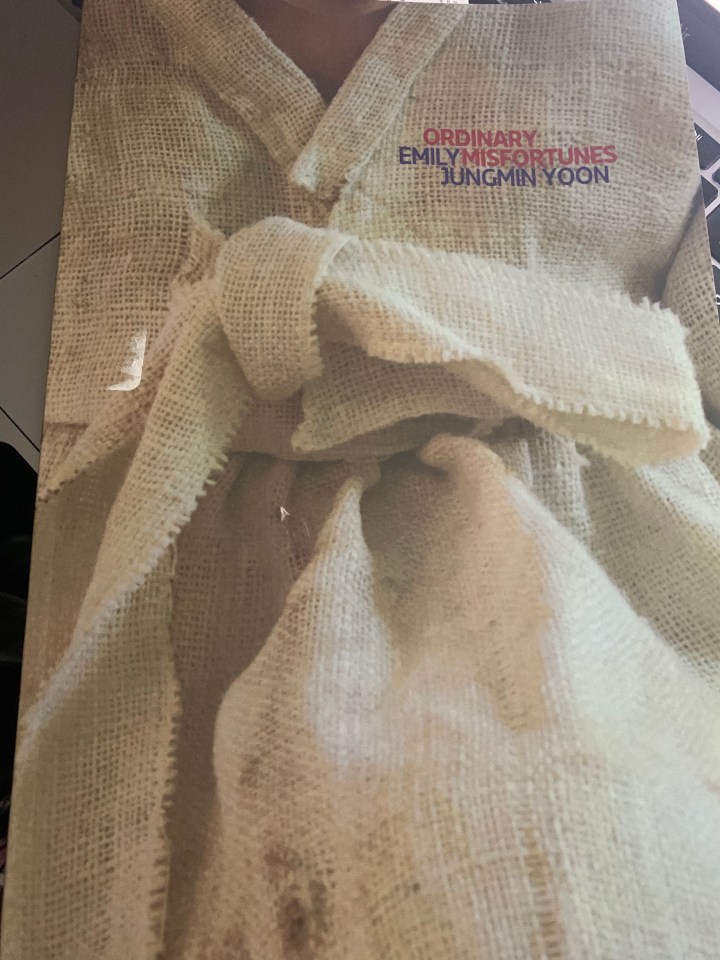
Ordinary Misfortunes


A wonderful, moving work of recreated memory. Emily Jungmin Yoon‘s poems (mostly; there’s a glaring exception at the end) cohere around two related themes: the so-called Korean comfort women, taken by Japanese soldiers; and a Korean-American woman navigating race and gender prejudices (and the predatory gaze of men, mirroring, perhaps, the Japanese soldiers).

She tells, in verse form, specific stories of specific women forced into sexual slavery by the Japanese army, mixed with prose poems (each one titled Ordinary Misfortunes) focusing on the second theme.

There are some variations thrown in and the final poem, The Transformation, though written as more traditional verse, follows the pattern of the prose poems in subject and theme. However, the opening epigram (In early 2016, thirteen sperm whales beached themselves on Germany’s North Coast, their stomachs full of plastic litter.), while timely important, so bluntly introduces ecopoetics into a book about something else, that it badly jarred me out of the melancholy reverie the rest of the book had settled me into.

‘The Beetle‘ By Richard Marsh


The Beetle is a work of horror by a man who seems not in control of his own sexual hang ups.

The characters are mostly too perfect or, in one case, too crippled by a twenty year old attack to be other than cryptic or hysterical at all times. In his defense, he was repeatedly sexually assaulted by a beautiful young woman who was also a divine and immortal beetle.

Only a fellow called Atherton is exempt. He’s excitable, vengeful, and generally relatable in a way everyone is not. He’s an ass, but a normal and understandable one. He is also shown working on a horrifying chemical weapon which… is never used to move the plot forward in any meaningful way. It’s as if Chekhov forgot to fire his gun.

The villain, besides being indicted based on their ethnic appearance, has, when not a beetle, the body a handsome woman with the face of aging and preternaturally ugly man.

Also, nudity is surprisingly frequent for a novel from 1897. A man runs through the streets wearing only a cloak and everyone he meets notes he is naked beneath. When a young woman is forced to wear a man’s rags, the speaker notes that she must first have been forced to undress. Atherton catches a glimpse of the villainous beetle’s alluring feminine body before they transform.

And did I mention the rapes and orgies that preceded the sacrifice of (formerly) virginal white women by burning?

Also: brandy can cure almost all ills (and literally brings a man back from the dead, even if only for a moment).

Something happened to Mr. Marsh and I don’t care to know what.

In the meantime, better folk than I can comment on what this all says about gender roles, masculinity, and the end of empire.

Tek Power


You’d think I’d be more embarrassed. I mean, I’m a little embarrassed, but not that much. This is my thing. Sci fi and fantasy pulps. And these particular ones are attributed to William Shatner, for whom I have a deep and abiding love.

The thread of these techno drug cartels (the titular ‘tek’) runs through all the novels and this one is no exception. While obviously science fiction, in a semi-near future way (more Neuromancer than Star Trek), I have settled into an appreciative groove by understanding these as decently crafted, fast moving detective novels. Jake Cardigan, the primary protagonist, is very much the archetype of a noir hero: middle aged, tough, haggard, former cop turned PI, formerly jailed for crime he didn’t commit, preternaturally good at his job, and not infrequently beaten up a little. Read more