Weekend Reading – Oddly Inadequate
‘Notebooks: 1935-1942’ By Albert Camus (New Year’s Resolution, Book Forty-Two)
My father bought me this for my birthday. It’s a pretty, hardbound that’s only slightly larger than a paperback. And it’s Camus.
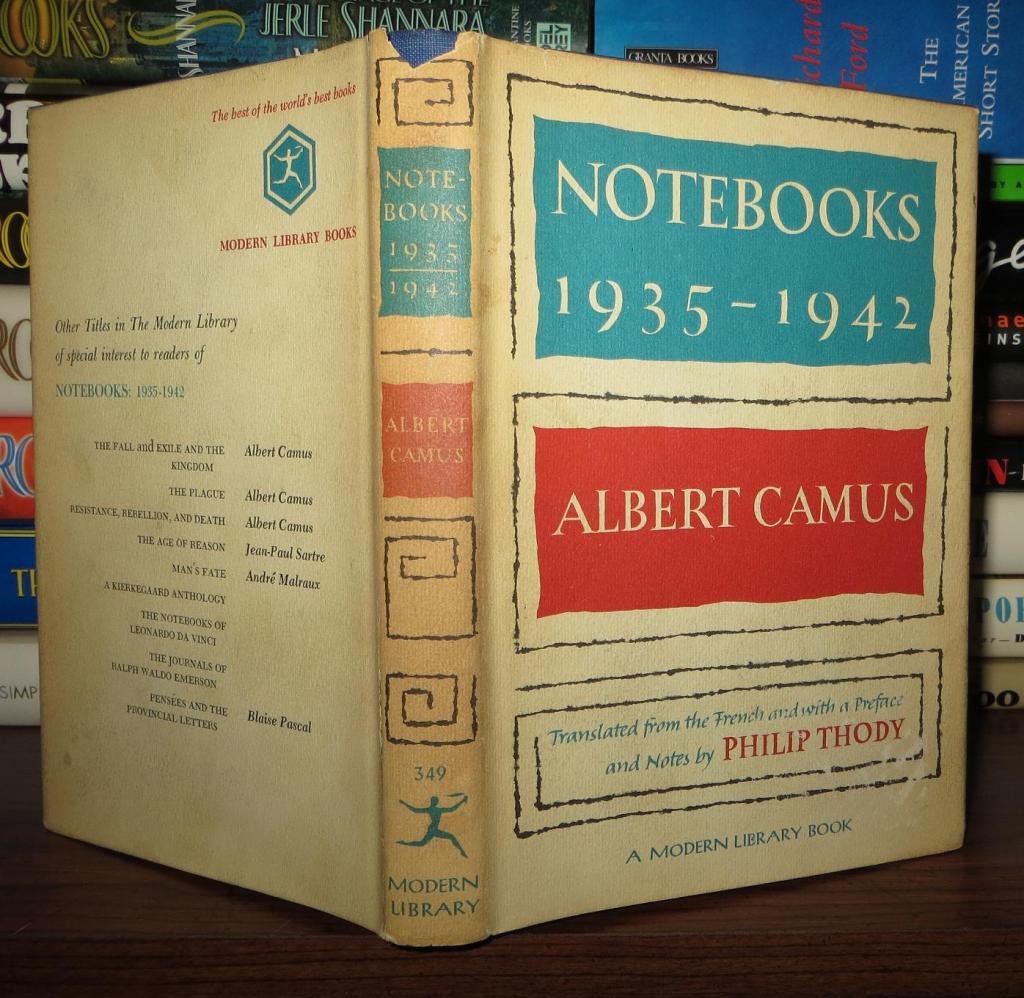 These are from his earliest published journals.
Many years ago, my stepmother gave me a cope of his journals from 1942-1951. It was a wonderful present and very thoughtful. Don’t mean to sound rude, but I was very surprised. She neither liked nor understood me at all (the feeling was more or less mutual and she was not a bad person, just not my type).
From May, 1938:
Nietzsche. Condemns the Reformation which saves Christianity from the principles of life and love that Cesarean Borgia was infusing into it. The Borgia Pope was finally justifying Christianity.
What an amazing statement! So forthrightly counterintuitive!
I don’t much that is true about the Borgia Pope (though I know a lot of scandalous fiction about him), but I remember that he was the first Pope to acknowledge his children. Previously, Popes with children tended to publicly identify them with the useful fiction of ‘nephews and nieces.’
Camus tried hard to eliminate personal history from these journals. They are intellectual documents, not autobiography. A reference here that hints at the quantity and quality of Camus’ envy-inducing sexual conquests. Some references to where Camus was standing when a thought occurred to him (in Greece, in Oran, in Paris, etc.). But little else personal.
Well, actually, a lot personal. The first two thirds take place while writing L’etranger and Le mythe de Sisyphe. The former appears in fragments, as Camus tests out passages and ideas, some of which would later make their way into that novel. The appearances of the latter take the form of numerous questions about suicide. Unlike that book of (admittedly, not very rigorous) philosophy, his journals suggest that committing suicide did cross mind. Not as an intellectual exercise, but an escape.
When the war appears, that becomes a constant, as you might imagine. But in a strange way. Camus the diarist seems shocked and surprised by the war. He makes some comments about Germany and German racism, but seems unable to really get his head around it. The failure that was the war, I felt, was, to Camus, a French failure. When he takes and fails to pass a physical (because of his tuberculosis), I was reminded that though he was unsuited for combat, he joined the resistance as the editor of Combat, an underground newspaper of the resistance.
Of course, when these journals end, France is occupied and Camus is living in Paris. From the journals, you would barely know the latter and the former not at all!
By the way, my father found this at Back in the Day Books in Dunedin, Florida. Haven’t been there personally, but seems like a quality place. Their facebook page always highlights good stuff in stock.

Monday Morning Staff Meeting

Weekend Reading – Naturally, Florida Gets Namechecked In Any Article About Terrible Trends
Gift Ideas

As you might expect, I’ve done a good deal of poetry gift giving, though maybe not this year (for reasons unrelated to poetry).
But let me give a couple of ideas for folks looking for something poesy-like that might make a good gift.
Brian Turner has two books of poetry, Here, Bullet and Phantom Limb. He is a veteran and writes a great deal about war and veterans and homecoming and PTSD and the like. Political without being partisan. Got that relevant-y thing going on. Good poet.
Charles Simic is fun and amusing, while also being a little dark and is far more formally interesting than Billy Collins. A better poet, too. Something for the person you know who, among all the poets s/he might have encountered in the x years since being forced to read poetry in school, has only read Collins and needs to be carefully introduced to something better. Sort of like introducing a fish in a bag of water in its new aquarium. The World Doesn’t End is might favorite, but a book of just prose poems might be a bridge too far. Virtually anything else he’s published would work.
Charles Baudelaire. For the angry, sexually frustrated person in your life. Get a copy of Fleurs de mal that includes the poems that were not published in the original version because they were too crazy for the time. One of those poems is a not-nearly-as-metaphorical-as-you-would-think piece about having syphilis and then cutting his lover with a knife and having sex in the wound he just made so that he can inject syphilis in the wound when he ejaculates. Yeah. He goes there. He’s French, what can I say?
Wordsworth. He’s just relaxing. People who think they don’t like contemporary because it lacks the magic of the great masters, like Byron and Shelley, probably haven’t actually read Byron and Shelley and would be very disappointed and confused if they did. Those people would be better off reading Wordsworth. His poetry is amazing, I love it, but it can also be like a warm, comforting bath that takes you away to Lake Country, only with central heating. And no syphilis sex with fresh, bleeding wounds. At least, none in my interpretation of his poems.
You want edgy? You want queer? But you also want someone with real poetic skill, someone who learning and experience who knows how to write and also knows classic and contemporary canons? You want Eileen Myles. A real throwback to a mythological ‘New York in the Seventies.’ She writes poetry and also prose that is really poetry (Lyn Hejinian would be an apt comparison). Trust me on this one. Just trust me.
For someone who hates to read, you can go to the Pacifica Radio Archives and for just $17.95, plus shipping, they will make a CD of a 1956 recording of Allen Ginsberg reading his poetry on the radio, including Howl. What a present, huh?
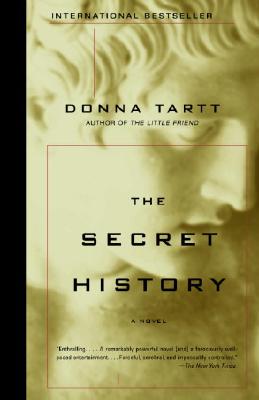
‘The Secret History’ By Donna Tartt (New Year’s Resolution, Book Forty-One)
 As I noted, I’m not going to make it to fifty-two, but at least we’re officially over forty.
I have used my resolution to try and read some of those books that have been on my ‘to read’ list and Tartt’s The Secret History is one of them.
Ultimately, it was a beautiful disappointment.
If I were to take out excerpts of the writing, it wouldn’t read very lushly (except in the sense that the characters consume great volumes of liquor), but in the memory, it always remembered as being very lush. Baroque.
The comparison I would make is to the Lawrence Durrell’s Justine. Not so rococo in its construction (I already used ‘baroque’ and ‘byzantine’ felt too bureaucratic, so we’re going with ‘rococo’) nor so erotically elegant (the eroticism in The Secret History feels a little forced, to be honest), but so what? Surpassing Durrell in rococo eroticism is just too a high bar to ask anyone to hurdle. I was reminded of Justine in part by how initial impressions of character and motive are, at the end, shown to be false (the reveal of the relationship between Henry and Camilla, the latter being the primary object of the narrator’s erotic longings, is very Justine-like).
Some of the late characterizations do feel forced and unearned. Julian, the classics professor who teaches the small, insular band, is described, near the end, as being a sort of father figure to the narrator. Benevolent. All well and good, except, after his initial, early appearances, he hardly appears at all for enormous stretches. This paternal impression simply wasn’t earned by the preceding pages.
The looming figure of Henry is done better. His death was inevitable, in terms of literary construction. Not many other options would have felt true (though, I could see something similar to the ending of Josephine Hart’s Damage, where the narrator’s daughter-in-law/mistress/obsession is seen at an airport, from a distance, and he realizes that she has become ordinary and the strange, secret thing in her that drove him mad with desire is entirely gone; but actually, isn’t that a variation of Humbert Humbert’s last encounter with the older, less nymphetish Lolita?). But the reason for his suicide, protecting Camilla… I don’t know. His death should have been more dionysian.
But the book is good. It’s worth reading. Apparently, it even has a little cult and I understand why. But I won’t be reading it again. I can’t see myself getting much from a second reading. I might even trade it in for credit at the used bookstore. But I’m glad that I read it. Just wish I’d read it when I was twenty years younger (it came out in 1992).
‘Guinevere In Baltimore’ By Shelley Puhak (New Year’s Resolution, Book Forty)
 Finally hit number forty. I don’t see myself making it all the way to number fifty-two, though. Nope. Don’t see it. Which is more than a little disappointing. Certainly, there’s no one to blame but myself. I can make some excuses about work and stress, but, really, it just illustrates the point of how we have let ourselves get away from the critical business of expanding our mind and world and improving ourselves and making a better place by reading.
Anyway…
Puhak won the Anthony Hecht Award, which was judged this year by my beloved Charles Simic. Both poets read at the Folger earlier this month and it was very good. Simic is always great and I very much liked Guinevere in Baltimore – though I liked it better in print than I did in her readings from it. Her readings sounded more repetitive than they come across on the page; this is a book that is meant to be read, rather than listened to.
The conceit is re-imagining the story of Lancelot’s affair with Guinevere, queen of the Britons and wife of his best friend, King Arthur, as something modern, with Arthur as a bumbling CEO, Lancelot as an aging playboy, and Guinevere as a woman of forty – old enough to be very conscious of age and loss and the terrible, silly sadness of her love affair.
As the title suggests, this is Guinevere’s story, with Lancelot a close second and Arthur barely appearing, at least as a speaker.
I’m writing this without the book by my side, so I can’t properly do any excerpts for you, but I do want to credit Puhak for her amazing use of enjambment.
The whole mixing the mythic and mundane is pretty, well, mundane these days. It’s been done. Been there, done that. So making it new (tip of the hat to Pound) isn’t easy, but is critical.
She does a great job of creating these mid sentence enjambments, where the line above resonates with the old mythology and language of myth and ancient times, but then when it continues in the next line, after the enjambment, the sentence suddenly becomes something quite contemporary and sadly sordid. You’ll have to trust me. It’s really good.
 the coffee philosopher