Make yourself feel bad with personality tests.
Fredric Jameson has really gotten into the philosophy of SF lately.
The Michael Derrick Hudson debacle has been embarrassing. I love poetry and advocate for it to my friends and co-workers, but when this sort of garbage is what gets it into the news… well, it ain’t good.
I’ve been reading Jenny Zhang’s poetry collection, Dear Jenny, We Are All Find, so I perked up when I saw she’d responded to the poetry s–tstorm on BuzzFeed in an essay entitled, They Pretend To Be Us While Pretending We Don’t Exist.
Nicely puts to bed the lie of some kind of supposed advantage that poets of color have in getting published and respected. Shouldn’t need to be said, because it doesn’t take much looking to figure out that published poets in America are largely white and male.
At Stanford, a white girl (well-meaning, of course) wrote a story about a Chinese American woman living in modern-day San Francisco (this was the early 2000s) who wanted to marry a white guy but was forced into an arranged marriage with a Chinese man and it was called The Dim Sum of All Things. (Laugh now, cry later!) I don’t think I’m being unreasonable when I say the reality of that story was fucked and so was the fantasy. She got into a highly coveted advanced fiction writing class taught by a famous writer and I didn’t. The story I submitted was also about Chinese Americans living in modern-day America, but it didn’t involve arranged marriage or dim sum or sensuous descriptions of chopsticks. This didn’t mean the teacher made a wrong choice. He made a subjective choice.
If, when you walk into Politics & Prose, you take the stairs down and then take a left and walk along the wall of the stairs, you will find shelves of various things, including drama and, most importantly, poetry.
Lots of poetry. Good poetry. Inexepensively priced poetry. Hardback copies for $7.99. Paperbacks for $6.99, $5.99, $4.99, $3.99.
I’ve bought books by Christian Wiman, Rita Dove, Franz Wright, Anne Carson, and Liu Xiaobo. I’ve passed by, because my arms were already full and my small budget already busted, books by John Ashberry, Frederick Seidel, and Augsut Kleinzahler.
Check it out. It never disappoints.
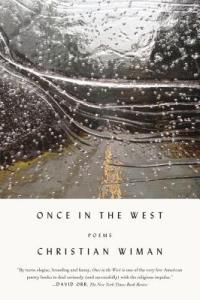 I became intrigued by Christian Wiman, the immediate former editor of Poetry, after seeing the tail end of an interview he gave to Bill Moyers. He was actually speaking mostly about a book he wrote about his faith (and the cancer that almost killed him).
I don’t actually know if any of the poems in Once in the West were written after receiving the diagnosis, but as someone who has had his own experience with a life threatening medical condition and an arduous and uncertain recovery, I certainly wore that lens over my eyes when I read them.
These poems are often religious, but less… theological… than, say Fanny Howe. I don’t think Wiman is Catholic. I could probably just google the answer, but I’m going to guess he’s that Episcopalian. He’s also funny and a little crude in his ‘conversations’ with God.
A solid portion of Wiman’s poetry here are unrhymed couplets. He’s got a prose poem or two, some ones with longer or more unusual stanzas (or no stanzas at all), but the couplets appear in half or more, I would say. Even without rhyme, it gave them a nice, old fashioned feel, like some modern day Alexander Pope.
Below is one of the poems. Not necessarily typical in its quiet, but it does show how the faint, almost but not quite rhymes, assonance, and alliterations give it a feel rather like a Pope or a Thomas Gray.
Less
Silas,
say lessthan silence.
In a dawnlost to all,
but me,be,
Sila, beyondthe hay bale
harboringkittens
no one nowhas the heart
to kill;and touching
nothingtouch
my headso we can be alive,
together,Silas,
as togetherwe are dead.
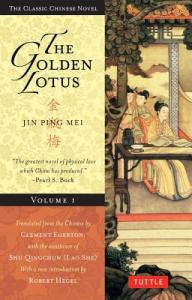 The Golden Lotus, aka, The Plum in the Golden Vase, aka Jin Ping Mei.
I can’t remember where I read about this book, but the minute that I did, I knew that I had to read it. And it hasn’t disappointed, though it’s charms are difficult to explain or put into words.
The book is infamous for descriptions of “physical love” (sex? can we say sex?), but if you’re looking for a titallating read, ninety percent of the internet will do the job much better.
Written in the early seventeenth or late sixteenth century, it takes place centuries earlier, during the notable corrupt Song Dynasty. The main characters are also notably corrupt, led by the wealthy, dissolute, cowardly and not notably bright Ximen Qing.
At the end of volume one, Qing has five wives, one regular mistress (married to one of his employees, who is more or less willing to trade cuckolding for gainful employment), and two servants (one of each sex) with him he sometimes cavorts. And he likes to visit brothels a lot.
At least one of his wives (the deliciously evil and lascivious Jinglian) killed her husband so she could marry Qing and another let not one, but two husbands be falsely accused so that she might be free to marry him.
So we’re not talking sympathetic characters, but it’s still wonderfully compelling and I’m not sure I understand why. Certainly, this vast and different world is endlessly fascinating. The structure is naturalistic and episodic. There’s no traditional plot: time passes and people have sex, waste money, bribe officials, and generally behave like trust fund babies. The part of me raised on the nineteenth century novel is invariably waiting for the author’s moral hand to press down on the scales and give everyone their comeuppance, but would that be for the best? Certainly, I’m not correct to be viewing things through the wrong lens (though it could still happen).
In any case, as soon as I finish Guermantes Way (next up in my Proust re-read), I’ll dive into volume 2.
 I’m working, so I’m not there, but if you’re not working and you live in the DMV, there is no good reason not to go that doesn’t involve funerals, weddings or dinosaurs (and, keep in mind, there will probably be books about dinosaurs available at the festival).
I would especially recommend checking out poets Marilyn Chin, Claudia Rankine and Kwame Alexander.
There’s a nice article on Little Salon in the WaPo today – and thankfully, no pictures of me (I don’t photograph well; my charms only appear after much time and gin).
It was a wonderful night, this time with free beer.
 And I bought this small painting (acrylic on paper) for my better half. The artist, Dana Ellyn, had a number of frankly disturbing pieces (not an insult, though the Madonn and Child-esque painting of Hillary with a naked baby Bill on his knee must be seen to believed), but I turned around and I saw this three small works featuring pigs and the first one I saw was just so… cute. That’s it, really. It was cute. And I’m not immune to cuteness.
But, with my better half having been out of town for a while (I keep on thinking that people secretly think that she left me and I just haven’t come to grips with it), after buying the piece, I felt myself becoming a little maudlin and not such good company, so I left a little early.

A while back, I dived into a big collection of his work, re-reading At the Mountains of Madness and The Shadow Out of Time.
Mountains is great, exciting yarn or explorers going further and further into the ruins of pre-human (and, as it turns out, of non-earthly origin) civilization, but Shadow is one of Lovecraft’s best. Comparatively long, it feels like it drags, but not in a bad way. In a piling on sort of way, where the accumulation of slow building unease and paranoia becomes nearly unbearable.
But what are to think of him? I can’t say. Should I stop reading him because of his not just slight racism, like the doddering grandfather who makes uncomfortable remarks about the Japanese and World War II every time there’s a kung fu movie on TV (he really can’t tell the difference between Chinese and Japanese), but thought the Asian girl you brought home was adorable, but rather full on Mississippi Burning-style racism? Maybe, but I won’t. Does that make me a bad person? A hypocritical person? I don’t know.
No, I didn’t just read The Arm of the Starfish, by Madeleine L’Engle (of Wrinkle in Time fame).
Not too long, I was trying to remember the name of this book I read as kid. I remembered that it had something to do with starfish research (and the ability of the starfish to regrow titular arms). Mostly, I (half) remembered this beautiful description of a somewhat villainous character, who was fat, with thin limbs and the effect was of a spider. I can’t remember the exact phrasing, but it stuck with me.
So then I read that essay and realized that the book was The Arm of the Starfish. Don’t be surprised if I get it from the library and re-read it.
Apparently, in a weird way, it’s a sequel to the Wrinkle in Time trilogy, with two secondary, but important characters being the same as two vital characters in that trilogy. I don’t recall their spiritual/metaphysical adventures being referenced, so I’m guessing it was more of a reference point for the author than anything a reader really needs to know. Or maybe it is. If I re-read it, I’ll let you know.
 the coffee philosopher