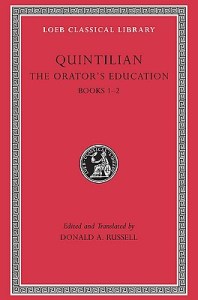
‘The Orator’s Education, Books 1-2’ By Quintilian


Orator's EducationI have mostly loved The Orator’s Education, as much for its insights into the Roman culture of its time as anything else – off handed remarks about gladiatorial styles, discussions that introduced me to how much constant interchange there was between Latin and Greek (with Latin even stealing letters from the Greek – I had had no idea what a state of perpetual transition Latin was in; such a difference from its current status as a ‘dead language’), remarks that showed how little formalized spelling and grammar could be, and more.

When Quintilian talks of ‘orators,’ he is, in the greater part, speaking of what we would call lawyers. Apparently, the pleading of cases was less a legalistic endeavor than it was a dramatic and rhetorical one. While legal procedurals on television make it seem like that’s still the case, believe me when I tell you that modern trials are almost always boring to watch and the average lawyer is not particularly eloquent.

At one point, Quintilian defends oratory against the claim that it cannot be an art because no art seeks to demolish itself (presumably, referring to how opposing orators will seek to demolish each other’s arguments). Leaving aside his actual refutation, what a different view of art! Now, we accept fairly readily the idea that an art is usually something in a state of constant oedipal rebellion.

He talks about three kinds of art: theoretical, practical, and poetic.

Theoretical arts include ancient astronomy, according to the author, and are what we might think of as scientific research, where the end is not a ‘thing,’ but understanding of the of the subject of study.

Practical arts are not things like carpentry, but rather actions. The example he gives is dance, where the end result is not a thing, but a properly completed action (oratory is this kind of art, he says)

Poetical arts are those which end with a work that can be seen, like a painting. I think this is awesome, because he uses the word ‘poetical’ to describe the most practical (in modern terms) of arts – that which ends in something. Gave me a smile.

Found The Perfect Book For My Trip


So I’ve been trying to figure out what reading material to bring with me to Thailand, besides the voluminous pulps downloaded to my nook.

I had been thinking about this Dover edition of Thus Spake Zarathustra that I bought in 2001 at Bridgestreet Books. And lo and behold, while unpacking, I found it!

Also while unpacking, I found this lovely hardback edition of Emerson. Positively perfect, except it is just too darn heavy. Nietzsche it is! Cicero is an outside contender, but Nietzsche holds most of the cards.

But now I need some poetry. In the past, I brought Wordsworth and he’s still my go to poet for this, but I’m hoping someone else inspires me. Tennyson would be great but I don’t actually own any Tennyson and I’ll be gone too long to use the library.

‘Elfstones Of Shannara’ By Terry Brooks


 It may be that, horror of horrors, I decided to read a Shannara novel because I read that MTV was making a television series based on the second book: The Elfstones of Shannara.

Many years ago, during a misspent youth, I read this first of the novels, The Sword of Shannara. Even as a callow youth, I could see that it was so shamelessly stolen from the Lord of the Rings that it seemed nearly unbelievable that no legal action had been taken.

The Elfstones is better, if not exactly original (‘Bloodfire’ beneath an ancient mountain in an evil land sounds remarkably like the fires of Mount Doom). I found a reasonable amount of enjoyment from the story. Like LOTR, there is a main quest and then a more military story. Here, the main quest feels surprisingly tension free and unstressful. On the other hand, the battles and the work if preparing for war and defense is pretty thrilling and tense.

Reading At Work


 I don’t read (except, infrequently, at lunch) at my regular job as minister of propaganda. However, I have a second job working for my better half, usually as a cashier/salesperson. On many such occasions, I read very nearly whatever I want and have recently been reading Remembrance of Things Past at Eastern Market. But lately, I have been at the Downtown DC Holiday Market and it is markedly more busy. It’s not impossible to read, but it is not conducive to the languorous hypnotism of Proust.

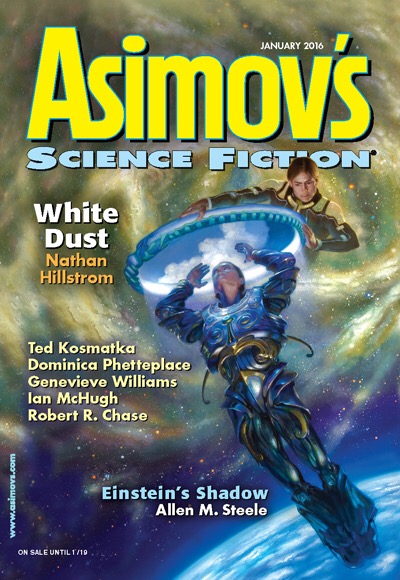
What turned out to be nearly perfect was the January 2016 edition of Asimov’s Science Fiction.

The big three of scifi are all owned by the same parent company: Analog Science Fiction and Fact, Asimov’s Science Fiction, and Magazine of Fantasy and Science Fiction. The last is thicker, but also a little more expensive, whereas the middle is so affordable as to be practically a negligible expense and is also named after the greatest science fiction writer of the last century (yes, I know we wasn’t actually a good writer, but he was so influential, especially in using hard science, that we have to give him his due), so the choice is easy. There are other magazines, like Lightspeed and Interzone, but they are but so easily found at my local bookstore.

So this edition was very, very good. Good writing, good ideas, good stories. One weak story near the end and there was a historicalish novella about Einstein that simply didn’t capture me and which I didn’t finish, overall, this boded well for the future of the genre.

Can’t Wait


Going back to Thailand I cannot wait. Absolutely ready. One hundred percent. Too much going on: buying a house, jam packed holiday season for my better half (she objects when I say that I ‘work’ for her; she prefers something like ‘help’ or ‘volunteer,’ but let’s be realistic, I’m an unpaid employee [so maybe the correct term of art should be that I ‘intern’ with her]), work stuff, work stuff, work stuff, family stuff.

Ready for a vacation. Ready to get away. Especially, knowing that it will probably be a while before I get away again. Logistics, and all.

Perhaps this is what adulthood is like, the constant, ceaseless nervous tension (I stole that turn of phrase about tension; I think from William Gibson; google it, I’m not your babysitter). Or perhaps it’s middle age. Did I skip adulthood and go directly to midlife?

Part of it is struggling, as always, with depression, which feels like a perpetual weight on your internal organs. Something is constantly pressing down on your heart and lungs and so they don’t work properly and you can always feel them about to fail and that knowledge of their being on that precipice takes your mind away from everything else and keeps you psychically crippled, after a fashion.

Let’s hope it’s the break I want it to be. I’ve downloaded several books to my Nook and are keeping them unread for the journey (mostly fantasy novels) and I’ll take some pleasure soon in picking out one or two physical books for the journey. At least one book of poetry, something worth re-reading. In the past, I’ve taken Wordsworth, for example. Perhaps this time I’ll bring Eliot or Shelley or Clare. And something else, something in prose. Could be a novel, but I’m inclined towards something non-fictional. While unpacking, I saw my cope of Elaine Scarry’s On Beauty and maybe I’ll bring that. It’s a little bulky, but perhaps if I put it away and don’t read anymore of it, Quintillian’s writings on the education of an orator. But probably not. Cicero might be better. Plato would be perfect, but I don’t have a compact copy of any of his books.

We shall see. Here’s a picture from Thailand, in the meantime.

Monday Morning Staff Meeting – Somebody’s Got A Crush


Art loves poetry. Or manipulates the idea of poetry. Or appropriates. Poets still get no respect.

Better business through literature.

Mean writers.

Weekend Reading – Potluck


The only reason for putting ‘potluck’ in the title is that today is the annual office holiday potluck party. You’re not invited. Probably. Unless you work with me. Which you probably don’t. Statistically, it’s very unlikely.

The pro-capitalist, anti-communist origins of MFA programs in creative writing.

It’s time for those end of year, ‘best of’ lists. And some of them are about poetry! Not lists by me, though. Not that I haven’t read a lot of poetry this year, because I have, at least compared to the average person, who probably reads none in a year, but more that I’m still catching up on the greatest hits of the nineteenth century (it might have been last year that I read him, but you should totally check out the mostly crazy, but sweet English pastoral poet, John Clare). Fortunately, The Guardian, over in merry old England, actually pays attention to poetry. So they did a top ten list that is probably worth looking over.

The poet on art.

Frost In The Poetry Aisle


Caveat emptor: I am not a huge Robert Frost fan. I don’t dislike him. I’ve got a nice volume of his collected poems at home. But that’s more because he is someone you want to have in your library (by the way, check out this article – it talks about how having a physical library is very important for children; a library of one hundred books will give your child a 1.5 year head start in reading comprehension over her/his peers and a five hundred volume library a 2.2 year advantage), not because he’s someone I turn to in certain moments of melancholy or confusion or whatever (that would be Anne Carson, William Wordsworth, Paul Eluard, Shakespeare, and Kenneth Rexroth, among others).

So when I first heard a middle aged couple talking a little too loudly next me near the poetry shelves of the soon to be closing downtown DC Barnes and Noble, trying to decide between editions of Frost, I felt some never to be spoken, but nonetheless curt (if they had ever been spoken) words rise up.

But, it didn’t take more than a moment of thought to realize my mistake. Eavesdropping, some poem by Frost had struck the man forcefully and now he had to have a book of his poetry. Surely this is the goal? What poetry lovers and promoters want to see happen?

I hope you found some more poems in whichever edition you chose, sir.

Monday Morning Staff Meeting – How Liberal Is Your ‘Hood?


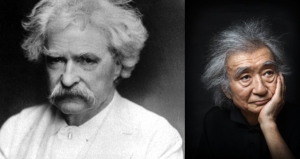
Ozawa and Twain... weirdly similar hair
Ozawa and Twain… weirdly similar hair

My neighborhood (H Street, or the Atlas District), is conservative by DC standards and slightly less liberal than my old haunt of Capitol Hill/Eastern Market. But this is DC, folks. Doesn’t really get that conservative.

A little creepy, Mark.

The Kennedy Center is honoring Seiji Ozawa (who I saw conduct a mostly Dvorak program in Minneapolis).

Duels


 While (re)reading Remembrance of Things Past, I’ve noted that the narrator (who has not yet been named but who will eventually be named Marcel) has mentioned having fought several duels over the Dreyfus Case. If you don’t know what the Dreyfus Case, I can’t help you except to say read a book and also to say that this isn’t a small part of history and you can see a historical precedent for the virulent, genocidal anti-semitism of the Holocaust and its enablers.

But what struck me is how the duels themselves are glossed over. Until I remembered that, at this time, a duel was typically a fairly harmless affair. Usually, two gentlemen the would show up at the appointed place and time and fire their pistols harmlessly into the air, having proved their courage by appearing. Only rarely would the parties aim at each other or use swords (which would necessitate an exchange or two until first blood was drawn, at least).

So, the duels were not described because the real danger would have been catching a cold in the early morning air.