Parades & Upshur Street Books


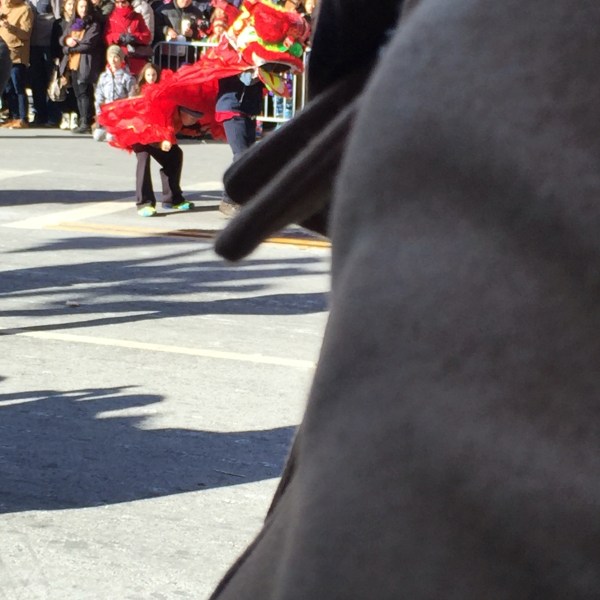
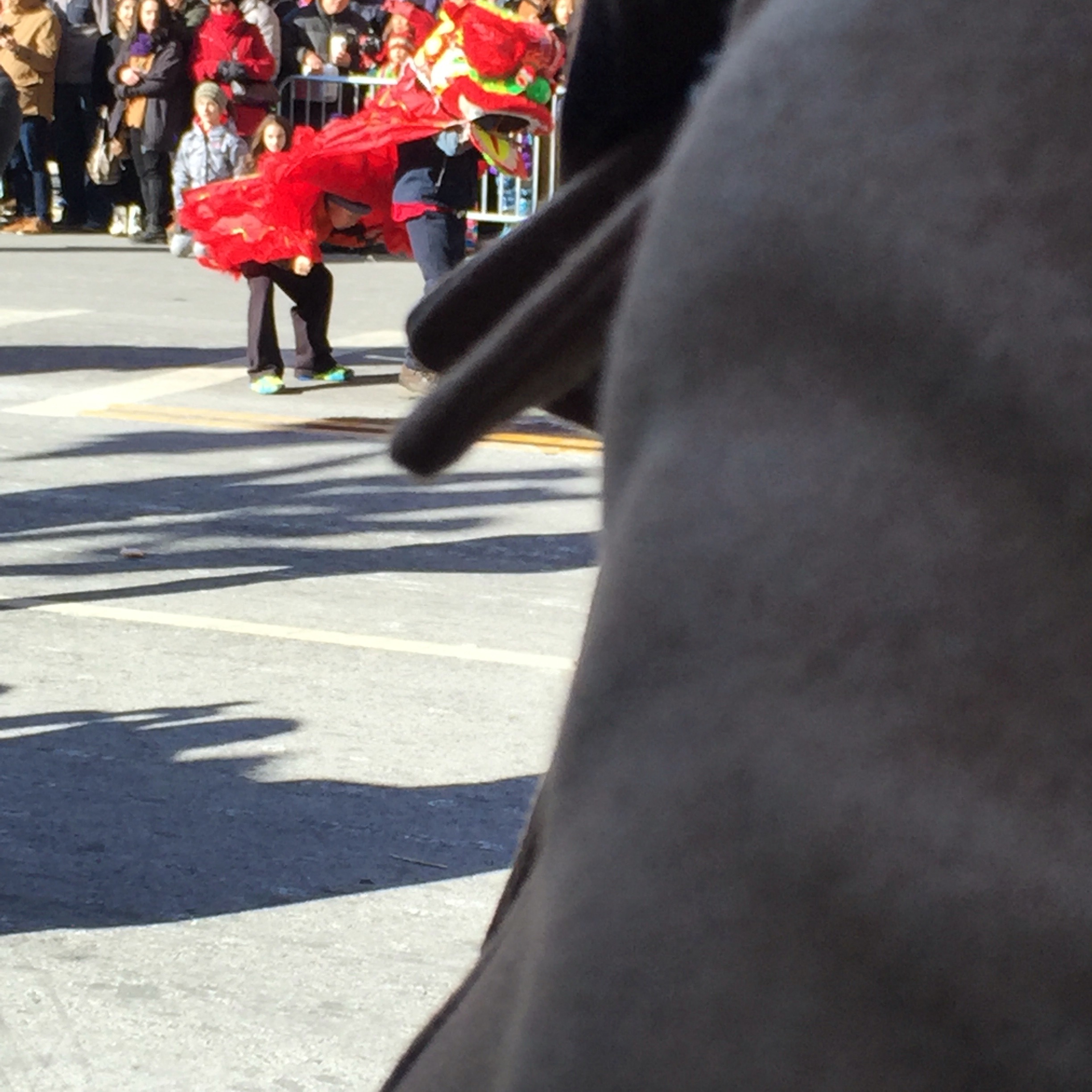
 Much of Valentine’s Day was spent in some solitary wanderings on crowded streets. My better half was away (the third year in a row we have spent February 14th apart, which, in a way, is not so bad, because, like New Year’s Eve, Valentine’s Day tends to pile on such overwhelming expectations of joy, romanticism, and impossibly good sex that it tends to crush the possibility of all three; that said, I’d rather she were with me, if I had my druthers), so I took a bus to Chinatown and carelessly browsed the Smithsonian Museum of American Art until it seemed a good time to find a spot on the street to watch the Chinese New Year (or Lunar New Year) Parade. Last year, I was on my own, I walked randomly about town and found my way to Chinatown and, unexpectedly, the parade. So I thought maybe I’d start to make it a tradition. Or not.

The parade itself contains a surprising number of white people and while I’m never exactly sure when these things cross the line from solidarity to appropriation, I suspect that that said line was, indeed, crossed. Whatever. I just watch it to see the little kids trying to manipulate dancing dragon costumes and props.

When the parade was over the subsequent parade of pols marching to the podium to speak was too much, even for me (in case you’re interested, Jack Evans was the straw that broke this camel’s back), I took a metro up to Petworth to make my first visit to Upshur Street Books.

It’s a nice little bookstore, but the selection is not very large, particularly the poetry shelves, which were few. Unusually for me, I did not buy anything. Something will, no doubt, bring me back, but it’s not going to be a regular thing.

I walked back (taking about an hour) and met a friend for a movie and then another friend and his wife for noodles.
Pound In Translation


That’s a bit misleading. I’ve noted a couple of times recently, when writing about translations of classical Chinese poetry, that the greatest influence on those translators might be Ezra Pound’s translations.

Well, in this trashing of Pound (not undeserved), is a quote from Simon Leys:

Pound had a mistaken idea of the Chinese language, but his mistake was remarkably stimulating and fecund as it was based on one important and accurate intuition. Pound correctly observed that a Chinese poem is not articulated upon a continuous, discursive thread, but that it flashes discontinuous series of images (not unlike the successive frames of a film).

Poems Of The Late T’ang


9781590172575

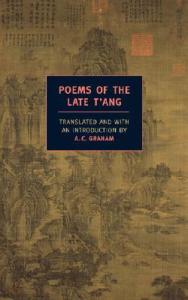
I probably should not have read this so soon after (re)reading a collection of Li Po, because (except for a few poems, including by Li Po) the vast majority of the poems in here are simply not as good and of less interest to the non-specialized, general poetry reader (of course, these days, a reader of poetry is not a generalist, but a specialist, because poetry is tragically underread). Many, frankly, appear as filler. Rather, they are there to fill in gaps, so provide a historical purpose, perhaps, but less so an aesthetic one.

As a side note, the edition I read was not the one pictured, but an older (I bought it used), Penguin edition. Even if I wasn’t a huge fan, for reasons partly unrelated to the work, I’m glad the NYRB imprint has republished this work.

Platonism In Boethius


Actually, it’s more Plato, than Platonism, which is arguably something different than the the ideas of Plato. Arguably.

I have a strange attachment to Boethius’ Consolations of Philosophy. Over a decade ago, my Aunt Petey was in a coma and she was taken off, to use the sterile, clinical phrasing, nutrition and hydration and then brought to her eldest son’s home, where the family gathered and waited.

At one point, I stood beside her bed and started reading aloud from Consolations. Maybe because I was reading it anyway or maybe because it was written by a man waiting to die. Maybe I just thought my family would think me extra super smart if I did it. Maybe I was just killing time, even as my aunt was killing time in a far more literal sense. I honestly don’t remember why.

But whatever my motivations, certainly, something like that burns a particular work onto the brain.

When I read Gorgias, I was unexpectedly hit by some parallels. There are some obvious between the Beothius of Consolations (the only Boethius that I know) and the Plato I know from his broader corpus (though I haven’t read all of Plato): their lack of respect for poetry (which, granted, was more like theater or even pagan ritual at the time) and the fact that the Socrates of Plato’s dialogues, including Gorgias, is always in a state of waiting to be taken away to die, much as my Boethius is in a cell, waiting for eventual punishment (which turned out to be execution, as he suspected).

Gorgias had an unexpected metaphysical aspect, as Socrates argued for the scales of justice righting themselves in the world hereafter as a way for the correct path – the best life, as it were – to be finally rewarded, even if lots of bad things happened to good people in this one, along with some pretty awful people seemingly to live pretty fun loving and enjoyable existences. In the Consolations, the figure of Philosophy (a woman, by the way) seems to take Socrates’ role and lead Boethius to the realization that his unjust accusers are, for this metaphysical reason, ultimately less happy than a just and good man, even if he is about to be tortured and killed.

Selected Poems Of Li Po


One of the advantages (and distractions of moving) is unpacking your books and seeing tomes you had forgotten about, reappear, as if by magic.

9780811213233I remember very clearly buying this book. I also remember that I didn’t really like it at the time. But, it came with me on a walk recently. It was the proper size and I had just unpacked it, so it went into my satchel and onto the road with me (or, rather, onto the sidewalk with me; actually, roads, too, because the recent Snowzilla had left many of the sidewalks unwalkable, so us pedestrians took to the streets, drivers be damned!).

Now, I’m wondering why I didn’t realize before how awesome it is.

And credit must go to the translator. While I don’t read classical Chinese, from what I know, a direct translation would be almost meaningless and certainly poetry-less. Of course, let’s be totally honest and acknowledge that classical Chinese poetry (and even contemporary Chinese poetry) translations are, in their style, vastly influenced by Ezra Pound’s translations and his interpretation of baroque spareness.

Avoiding Farewell in a Chin-Ling Wineshop

Breezes filling the inn with willow-blossom scents,
elegant girls serve wine, enticing us to try it.

Chin-ling friends come to see me off, I try to leave
but cannot, so we linger out another cup together.

I can’t tell anymore. Which is long and which short,
the river flowing east or thoughts farewell brings on?

‘A Midsummer Night’s Dream’ At The Folger


MSNDWide

Loved it.

Went on a whim. Found some cheap tickets online, bought that day for the show that evening.

When I was a child, my mother took me to see this play, making it my first encounter with live Shakespeare. If I’m honest, I don’t really have any firm memories of it. Nor had I read the play since then, so, rather unusually, I was able to go into the performance with only the barest knowledge of the plot (star-crossed lovers, Puck, fairies, and a donkey).

The production was befittingly playful, with some fun, extra-textual touches (a lovelorn Helena introduced singing a sad song by Adele). Puck was played by Erin Weaver as less a trickster, than a pan-sexual cupid (actually, all three fairy characters were pretty hypersexed). Lovers Lysander and Hermia were twenty-something, backpacking travelers; Helena as a stylish young woman (except that when first seen, she’s wearing the sweats of a depressed and jilted lover); but Demetrius was merely… I don’t know… millennial? He didn’t really get the kind of identifying costuming that the others did.

And it ended with an onstage dance party by the cast.

There’s still time. Absolutely worth seeing. Arguably, the second best production I’ve seen at the Folger (number one has to be their amazing Richard III).

Also, because of all the extremely valuable primary documents in the exhibit hall, they opened up the library itself for wine, water, and snacks (not wanting to risk a priceless letter to Shakespeare being wine-stained). Unless you’re a legitimate scholar, you don’t get much chance to wander back there, so that was exciting.

Poetry Is A Necessity When You Travel


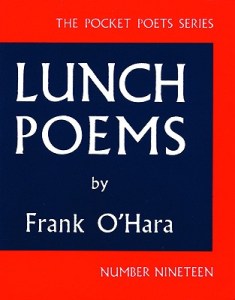
Reading Frank O’Hara’s Lunch Poems was a lucky coincidence. The book was a gift. I had been looking for a proper book of poetry to bring with me. Poetry is a necessity when you travel. You can pick it up, open it a random point, at the beginning, at a point, not random, but chosen because it has relevant meaning to what you have encountered.

My original thought had been to bring Whitman, but most editions are too big to be easily carried about.

But there was something of Whitman in Leaves of Grass. The pleasure in humanity as a mass. The aspects of the flaneur. Yes, the homoeroticism. Nothing in Lunch Poems resembles Whitman’s aching Civil War songs and laments, but, then again, what does? A reminder of Whitman’s power and influence over even the best poetry that followed. Or, perhaps, especially over the best poetry that followed.

Frank O'Hara: 'Lunch Poems'

‘The Charnel Prince’


9780345440716Against my better judgment, I liked this book much more than it deserved to be liked. In its (and my defense), it is better than the first book in the series, The Briar King. Among other things, it is shorter. It’s not short, but contemporary fantasy authors seem determined to publish nothing with less than five hundred pages anymore. And it’s developing a nicely creepy conspiracy. There’s almost an element of horror creeping. Not really, but you can see… not so much the influence of Lovecraft, but the influence of writers who were themselves influenced by Lovecraft. So, indirectly and a couple steps removed. But it’s still there.

Evernew Bookstore (Singapore)


  Towards the end of our visit to Singapore, we had a little time to kill before we had to board the metro for the airport. So what to do? The National Gallery had a twenty (Singapore) dollar admission and we don’t have that much time, so it seemed a poor investment.

Me being me, I dragged us, our luggage in tow, to the possible location of a bookstore with a possible English language section.

Finally, after rounding the corner from the post office (we wanted to send off some postcards), I found Evernew Bookstore, a used bookstore in a little shopping center.

I didn’t get very far beyond a stretch of shelves (with only a very narrow space for human beings) that was filled with the orange spines of Penguin classics. And what did I find but a book that I’ve been wanting to read that is not in the DC Public Library system and which is never available at your local bookstore: Goethe’s Elective Affinities.

If you’ve ever seen the great Truffaut film, Jules et Jim, you might remember there is a reference to it. When Jim visits Jules and Catherine in their wooded Austrian retreat, he asks to borrow the book, which is a signal that he intends to do a little wife swapping (not really swapping, though; Jim isn’t married; so not so much swapping as just sleeping with his friend’s wife; it’s complicated).

Midweek Staff Meeting – I Saw That!


6-F1903.309-768x411So, I finally got around to seeing this amazing Sotatsu exhibit at the Sackler. It’s around until Sunday, so go see it!

This is super awesome: century old audio recordings of Guillaume Appolinaire!

Whatever he chooses to write about, David Brooks is always hilariously wrong.